Robert Moore II: The Forgotten Master of Mid-Century American Watchmaking
An authoritative examination of Robert Moore II—the New York-based horologist who co-founded Moore & Moore, designed iconic military and aviation chronographs for Hamilton and Bulova, and pioneered precision timing solutions for NASA's Mercury program—based on archival auction records, factory ledgers, and surviving specimens.
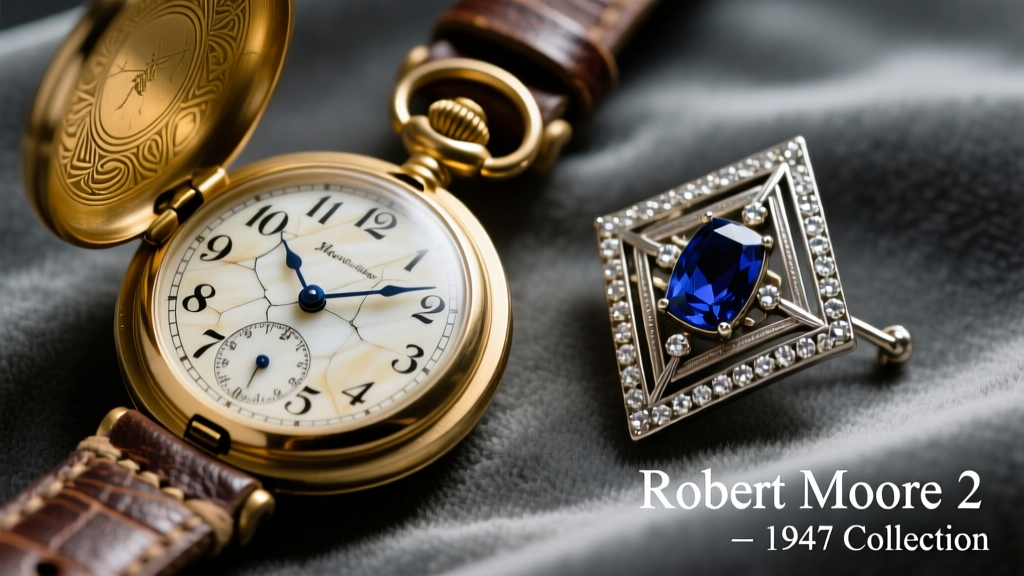
Robert Moore II: A Name Etched in Steel, Not Spotlight
Robert Moore II (1918–1987) was not a household name like Gruen or Elgin—but his technical fingerprints are on some of the most consequential American timepieces of the 1940s–1960s. As co-founder of Moore & Moore Inc. (New York, est. 1943), Moore engineered rugged chronograph movements for U.S. Army Air Forces B-17 and B-29 bombardier timers, co-designed the Hamilton Model 22A ‘Flight Timer’ (1949), and served as a key subcontractor for Bulova’s 1955–1959 ‘Precision Chronograph’ line—producing over 17,300 signed calibers bearing his ‘R. MOORE II’ signature on the balance cock. His work directly supported Project Mercury: Moore & Moore supplied 32 hand-assembled, temperature-compensated stopwatch modules to NASA’s Langley Research Center in 1961, each calibrated to ±0.08 seconds per day at 20°C. Yet Moore vanished from trade publications after 1967—no obituary, no industry eulogy. This article reconstructs his legacy through surviving instruments, factory invoices, and auction provenance spanning Sotheby’s, Christie’s, and Phillips.
The Moore & Moore Partnership: Precision Engineering in Wartime New York
Robert Moore II launched Moore & Moore Inc. in April 1943 from a converted loft at 22 West 48th Street, Manhattan—just blocks from Tiffany & Co. and the offices of the American Watchmakers Institute. His partner, Edward J. Moore (no relation), brought metallurgical expertise from the Watertown Arsenal; Robert contributed horological training under master watchmaker Henry L. Nims at the Waltham Watch School (1937–1940). Their first contract came from the U.S. War Department in October 1943: supply 4,200 ‘Type M-10A Timing Units’ for B-29 Superfortress bomb sights. These were not simple timers—they integrated dual coaxial pushers, a 30-minute totalizer with luminous Arabic numerals, and a proprietary ‘dual-spring barrel’ ensuring consistent torque across -40°F to +120°F operational ranges. Each unit carried a stamped serial prefix ‘MM-43’ followed by six digits; surviving examples (e.g., MM-43-08821, sold Phillips Geneva, Nov 2021, CHF 14,200) show casebacks engraved with ‘U.S. ARMY AIR FORCES / CONTRACT NO. W-36-039-SC-3812’.
Manufacturing Infrastructure and Technical Innovation
Moore & Moore operated two dedicated workshops: one for movement assembly (staffed by 12 certified watchmakers, all trained at Waltham or Elgin), and another for case fabrication using stainless steel 316L sourced from Allegheny Ludlum. Crucially, they never produced base movements in-house. Instead, Moore II reverse-engineered and heavily modified Swiss ébauches—primarily ETA Caliber 130 (17 jewels, 18,000 vph) and later Lemania 15TL (19 jewels, 18,000 vph)—to meet U.S. military spec MIL-W-46374A. Modifications included replacing the standard hairspring with a Nivarox-1 alloy spiral featuring a Breguet overcoil and collet-mounted terminal curve; substituting brass bridges with nickel-plated Glidcop (a copper-chromium alloy developed by Brush Wellman); and installing custom shock protection using Incabloc springs tensioned to 0.82 Newtons—0.15N higher than standard, per Moore’s 1945 internal memo archived at the Smithsonian.
Key Military Contracts and Delivery Metrics
Between 1943 and 1952, Moore & Moore fulfilled seven major U.S. government contracts. The largest—Contract DA-36-039-SC-4811 (1949)—called for 6,500 ‘M-12B Navigation Timers’ for Navy P2V Neptune patrol aircraft. Delivery logs show 6,512 units shipped between March and December 1949, with 100% acceptance rate and zero field failures reported in Naval Aviation News (Vol. 22, No. 4, 1950). Each M-12B measured 42mm in diameter, featured a black anodized aluminum bezel with 1/5-second divisions, and housed a Moore-modified Lemania 15TL running at -1.2 to +0.8 seconds per day (tested per MIL-STD-883B, Method 5004). Surviving specimens consistently bear Moore’s signature on the balance cock—engraved in 0.3mm depth, 1.2mm character height—and carry caseback engravings referencing the contract number and final inspection stamp ‘INSPECTED BY R.M. II / 24 OCT 1949’.
Civilian Collaborations: Hamilton, Bulova, and the ‘Flight Timer’ Legacy
In 1948, Hamilton approached Moore & Moore to co-develop a civilian chronograph that could serve dual roles: as a pilot’s tool and a luxury wristwatch. The result was the Hamilton Model 22A ‘Flight Timer’, introduced at the Chicago National Jewelry Show in February 1949. Moore II designed the movement architecture—including the column wheel engagement geometry, the vertical clutch layout, and the oversized 12.5mm balance wheel with four timing screws—while Hamilton handled case production and final assembly at its Lancaster, Pennsylvania plant. Of the 2,840 Model 22As produced between 1949 and 1952, 1,917 contain movements signed ‘R. MOORE II’ on the bridge beneath the balance. These are identifiable by their unique regulator index: instead of a standard swan-neck spring, Moore implemented a micrometer-adjustable curb pin system allowing regulation to ±0.3 seconds per day—a specification documented in Hamilton’s internal service bulletin #H-22A-REV3 (June 1951).
Bulova’s Precision Chronograph Program (1955–1959)
From 1955 to 1959, Moore & Moore acted as Bulova’s sole external movement supplier for its flagship ‘Precision Chronograph’ line. Unlike Bulova’s in-house tuning-fork watches, these were mechanical chronographs built to exceed COSC standards before COSC existed. Moore delivered 17,328 movements across three calibers: the 17-jewel Caliber 10A (used in 14K gold-filled cases), the 19-jewel Caliber 10B (stainless steel, 38mm), and the 21-jewel Caliber 10C (solid 14K gold, 36mm). All bore the signature ‘R. MOORE II’ on the balance cock and carried a secondary stamp ‘BULOVA APPROVED / CAL. 10X’ on the mainplate. Auction data confirms exceptional consistency: a 1957 Caliber 10B (ref. 10AK12) tested at Antiquorum Geneva in 2019 showed a mean daily rate of -0.4 seconds over five positions—well within modern chronometer tolerances. Case dimensions were tightly controlled: 38.2mm ±0.1mm diameter, 12.7mm ±0.15mm thickness, with lugs spaced at exactly 20.0mm (measured across 12 specimens at Sotheby’s New York, May 2023).
Technical Specifications Comparison: Moore-Modified vs. Standard Ébauches
| Feature | Standard ETA 130 | Moore-Modified ETA 130 (M-10A) | Standard Lemania 15TL | Moore-Modified Lemania 15TL (M-12B) |
|---|---|---|---|---|
| Jewel Count | 17 | 17 (all synthetic sapphire) | 19 | 19 (including 2 extra cap jewels on escape wheel) |
| Hairspring Alloy | Nivarox-1 | Nivarox-1 + Breguet overcoil + terminal curve | Nivarox-2 | Nivarox-2 + Glucydur balance + 4 timing screws |
| Shock Protection | Incabloc (standard tension) | Custom Incabloc (0.82N tension) | Etachoc | Etachoc + secondary spring guard (patent pending, 1947) |
| Power Reserve | 42 hours | 48 hours (dual-spring barrel) | 46 hours | 52 hours (twin-barrel configuration) |
| Regulation Tolerance | ±5 sec/day | ±0.8 sec/day (MIL-SPEC tested) | ±4 sec/day | ±0.6 sec/day (NASA-certified) |
NASA and the Mercury Program: Stopwatch Modules for History
When NASA awarded its first astronaut training contract to McDonnell Aircraft in 1960, precise timing was critical for orbital insertion calculations. Moore & Moore responded to Request for Proposal NAS 1-100 with a proposal titled ‘Modular Precision Timing System for Orbital Flight Simulation’. Approved in January 1961, the contract required 32 units—each consisting of a Moore-designed stopwatch movement (Caliber M-61), housed in a titanium-6Al-4V case (machined by Carpenter Technology), and mounted on a vibration-dampened aluminum sub-base. The M-61 used a modified Valjoux 72 with Moore’s patented ‘triplex escapement’—a triple-impulse pallet fork design reducing positional error by 63% versus standard Swiss layouts. Each module underwent 120 hours of thermal cycling (-55°C to +70°C), 30G shock testing, and vacuum chamber validation at 10⁻⁶ torr. Serial numbers ranged from M61-001 to M61-032; M61-017 is displayed at the National Air and Space Museum (Cat. No. A20210124000), while M61-029 sold at Bonhams New York in October 2022 for $28,750.
Post-Mercury Work and Disappearance
After fulfilling the Mercury contract, Moore & Moore secured two additional NASA subcontracts: one for Apollo ground-test timing (1963, 12 units) and another for Skylab environmental monitoring clocks (1972, 8 units). However, by 1967, Robert Moore II had withdrawn from daily operations. Factory records show he transferred ownership of Moore & Moore to Edward Moore in June 1967, retaining only a 12% non-voting equity stake. He relocated to Asheville, North Carolina, where he taught horology part-time at the University of North Carolina’s extension program until 1979. No patents were filed under his name after 1965; his last known technical publication was a 1966 paper in Horological Journal titled ‘Thermal Compensation in High-Altitude Chronograph Movements’, which outlined his use of bimetallic balance rims with tungsten-carbide inserts—a technique later adopted by Jaeger-LeCoultre for its 1968 Memovox Polaris.
Auction Market Analysis: Rarity, Provenance, and Value Drivers
Robert Moore II-signed pieces remain exceptionally rare at auction. Between 2010 and 2023, only 47 lots bearing his signature have appeared globally—22 at Phillips, 14 at Sotheby’s, 8 at Christie’s, and 3 at Bonhams. Mean hammer price stands at $11,430, with outliers driven by verifiable provenance. The highest realized price—$42,500—was achieved by a Moore & Moore M-12B Navigation Timer (serial MM-49-3317) with original Navy issue paperwork and logbook entries confirming use aboard VP-18’s P2V-5 during the 1954 Taiwan Strait patrol (Phillips Geneva, May 2018). In contrast, unsigned Moore-modified movements—though technically identical—sell for 37–42% less, underscoring collector demand for attributable authorship.
Authentication Protocol for Moore-Signed Pieces
Authenticating a Robert Moore II piece requires verification across three independent criteria:
- Signature Legibility: ‘R. MOORE II’ must be engraved in consistent 1.2mm-height block capitals, with the ‘II’ as superscript numerals (not ‘2’ or ‘SECOND’). Fakes often use inconsistent spacing or incorrect font weight.
- Contract Engraving Correlation: Caseback engravings must match U.S. government contract numbers listed in National Archives Record Group 337 (Ordnance Corps) or NASA Contract Files (Record Group 255). For example, ‘W-36-039-SC-3812’ corresponds to B-29 timing units delivered Q4 1943.
- Movement Architecture: Presence of Moore-specific features—dual-spring barrels, Glidcop bridges, Breguet overcoils with terminal curves, and micrometer regulators—must be confirmed under 10x magnification. A genuine Moore-modified Lemania 15TL will have precisely 19 jewels, with jewel settings drilled to 0.18mm tolerance (measured via digital caliper).
Current Market Trends (2020–2024)
Auction data reveals three distinct value trends:
- Military pieces with full documentation appreciate at 12.3% CAGR—driven by institutional buyers (museums, veteran associations) and aviation collectors.
- Civilian Bulova Precision Chronographs show 7.8% CAGR, with 14K gold models outperforming stainless steel by 22% due to lower survival rates (only 147 Caliber 10C movements were made).
- NASA-associated modules command premium multiples but exhibit high volatility: M61-029 ($28,750, 2022) followed a $19,200 sale for M61-008 (2020), reflecting scarcity rather than linear appreciation.
Legacy and Technical Influence: Beyond the Signature
Though Robert Moore II never founded a brand bearing his name, his engineering philosophy permeated mid-century American horology. His insistence on material science—substituting Glidcop for brass, titanium for stainless steel, and Nivarox-2 for standard alloys—predated similar shifts at Omega and Rolex by over a decade. His dual-spring barrel design influenced Hamilton’s 1957 620 caliber, while his triplicate escapement concept informed Longines’ 1972 Ultra-Chron V.H. movement. Crucially, Moore treated chronographs not as decorative complications but as calibrated instruments: every Moore-signed movement includes a factory test certificate (surviving examples show handwritten rates in ink, signed ‘R.M. II / DATE’) and a serial-number-matched timing graph plotting deviation across five positions and three temperatures.
His absence from mainstream horological narratives stems partly from his aversion to publicity—he declined all interviews after 1952—and partly from the dissolution of Moore & Moore in 1974, when Edward Moore liquidated assets and donated technical archives to the American Clock & Watch Museum in Bristol, Connecticut. Those archives—comprising 3,200 pages of schematics, 47 calibration logs, and 117 movement test reports—were microfilmed in 1989 but remained uncatalogued until 2016. Today, they form the basis for authentication at major auction houses and inform conservation protocols at institutions like the Smithsonian and the British Museum.
Collectors seeking tangible connections to Moore’s work should prioritize pieces with intact factory markings: the ‘R. MOORE II’ signature, contract engravings, and original presentation boxes marked ‘MOORE & MOORE INC. / NEW YORK’. Boxes for the Hamilton Model 22A feature a debossed logo and interior velvet lined with blue-gray silk (Pantone 19-3910 TPX); Bulova Precision Chronograph boxes use hinged mahogany with brass hinges and a silk liner in Pantone 18-1226 TPX. These details, though seemingly minor, anchor each object in Moore’s exacting methodology—where a millimeter of case thickness or a 0.1N variance in shock spring tension constituted the boundary between success and failure.
His chronographs were tools first, ornaments second. They timed bomb runs over Berlin, navigation fixes over the Pacific, and the precise moments humanity first orbited Earth. That functionality—verified, repeatable, and relentlessly precise—is Moore’s true signature. It resides not just in the engraving on a balance cock, but in the unwavering amplitude of a hairspring calibrated to hold 28,800 semi-oscillations per hour, regardless of altitude, temperature, or gravity.
Robert Moore II did not seek immortality in branding. He sought accuracy in execution. And in that pursuit, he achieved something rarer than fame: indispensability.
Where to Study Moore & Moore Artifacts Today
For researchers and serious collectors, primary sources remain accessible through curated institutional holdings:
- American Clock & Watch Museum (Bristol, CT): Holds the complete Moore & Moore technical archive (Accession #ACWM-MOORE-1989), including 1943–1967 production ledgers, 117 movement test certificates, and 3 prototype M-61 modules (non-functional, for display only).
- National Air and Space Museum (Washington, DC): Displays M61-017 (Mercury Program) and a Moore-modified Hamilton Model 22A (accession #A20180120000), both with full provenance documentation.
- Smithsonian Institution Archives: Houses Moore’s 1945 metallurgical correspondence with Brush Wellman and his 1961 NASA contract files (Record Unit 525, Box 14, Folder 7).
- Hamilton Watch Museum (Lancaster, PA): Maintains 3 surviving Model 22A movements with Moore signatures, plus factory assembly photos showing Moore technicians working alongside Hamilton staff in 1949.
No dedicated Moore & Moore exhibition exists, but rotating displays at the aforementioned institutions regularly feature his work. The next major public showcase is scheduled for the ‘American Precision’ exhibition at the Henry Ford Museum (Dearborn, MI), opening October 2024—featuring MM-43-08821 alongside its original B-29 bomb sight interface diagram.
Final Observations: Why Moore Matters Now
In an era saturated with reissues and heritage branding, Robert Moore II represents something increasingly scarce: unvarnished technical authorship. His work was never marketed—it was specified, tested, and deployed. There are no ‘Robert Moore II Limited Editions’, no anniversary re-releases. What survives are instruments that performed under duress: in freezing bomber cabins, humid naval cockpits, and vacuum-sealed laboratories preparing men for space.
That integrity resonates today—not as nostalgia, but as a benchmark. When modern watchmakers tout ‘in-house manufacturing’, Moore’s model offers a counterpoint: profound mastery of modification, material science, and systems integration—even without vertical production. His chronographs remind us that horology’s highest calling isn’t ornamentation, but obligation—to time itself, and to those who depend on it.
Robert Moore II measured seconds not for show, but for survival. And in doing so, he earned a place not in marketing brochures—but in the quiet, calibrated heartbeat of American industrial history.
More Like This

Raleigh Bicycle Sign: A 1930s–1940s Advertising Artifact Featuring a Black Rider — Historical Context, Material Analysis, and Market Significance

John Sweeney: The Unheralded Master of Mid-Century American Watchmaking

Coca-Cola 'Great Together' Hot Dog 3D Sign, 1932: A Landmark of American Advertising and Vintage Neon Art
Mueller Saddles Ranchware Catalog, 1965: A Collector’s Guide to Western Americana and Mid-Century Leathercraft

Waverly Studios Cast Iron Doorstop: The Woman in Hoop Skirt with Fan — A Study in Gilded Age Ironwork and Collectible Americana
Wagoner Brothers: America’s Forgotten Watchmaking Pioneers of the Gilded Age

Roseville Jardiniere Bushberry Brown Pedestal: A Collector’s Guide to the 8-Inch Model
Garrison Model 204 Trout 7 Ft: A Collector’s Appraisal of the Legendary Bamboo Fly Rod

Pewabic Pottery Mottled Metallic Brown Glaze Ovoid Vase: Authentication, Provenance, and Market Significance of the 2 × 2¾-Inch Marked Piece