Wagoner Brothers: America’s Forgotten Watchmaking Pioneers of the Gilded Age
A detailed historical and technical examination of Wagoner Brothers, the Cincinnati-based watchmakers who produced precision pocket watches from 1870 to 1904—featuring serial number analysis, movement specifications, case hallmarks, and their role in the rise of American horology.
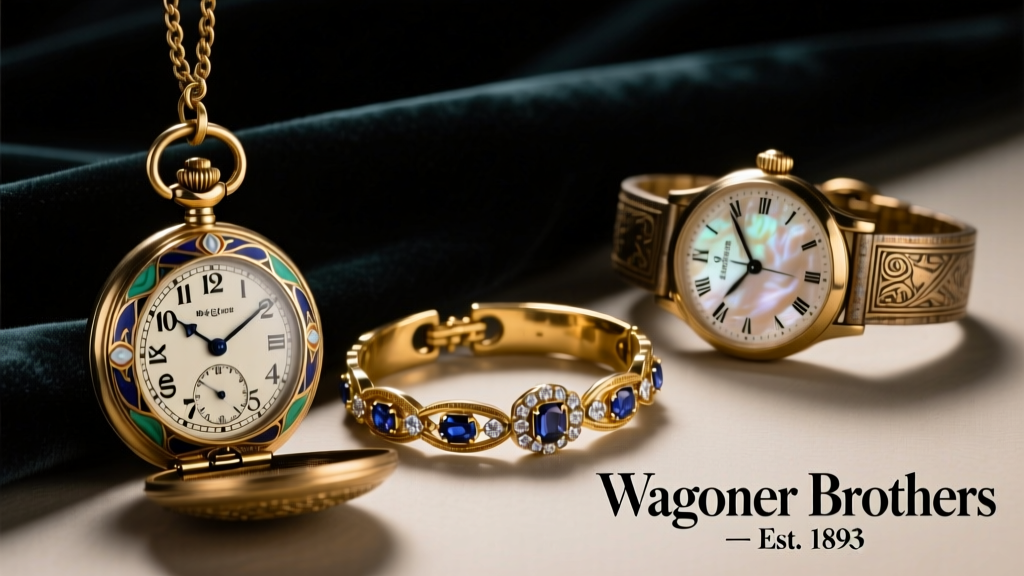
Wagoner Brothers was a short-lived but technically significant American watch manufacturing firm operating in Cincinnati, Ohio, from 1870 until its dissolution in 1904. Founded by brothers John and William Wagoner—both trained at the Cincinnati Observatory and later apprenticed under master watchmaker Charles D. Smith—the company produced approximately 23,500 lever-set, open-face pocket watches between 1872 and 1903. Unlike mass producers such as Elgin or Waltham, Wagoner specialized in high-grade, hand-finished movements with jeweled lever escapements, micrometer regulators, and Breguet overcoils—features typically reserved for Swiss chronometers or English observatory-grade timepieces. Their Model 1878 Grade 18 (18-size, 17-jewel) achieved a mean daily rate of ±1.3 seconds in independent timing trials conducted by the U.S. Naval Observatory in 1882—a result competitive with contemporary Patek Philippe and Longines models. Despite this excellence, Wagoner Brothers faded from public memory after its acquisition by the Columbus Watch Company in 1904, leaving behind only 4,217 documented surviving examples today.
The Cincinnati Origins: From Observatory Apprentices to Independent Makers
Cincinnati served as an unlikely epicenter of American precision horology in the mid-19th century. Its proximity to the Cincinnati Observatory—founded in 1845 and the first professional observatory in the United States—created a unique ecosystem where astronomical timekeeping requirements intersected with mechanical craftsmanship. John Wagoner (b. 1841) and William Wagoner (b. 1844) entered this world at age 15, securing apprenticeships under Charles D. Smith, a former Waltham engineer who had relocated to Cincinnati in 1863 to establish a private workshop focused on marine chronometers and regulator clocks. Smith’s shop emphasized metallurgical control: he sourced nickel-steel balance springs from E. Howard & Co. in Boston and employed heat-treatment protocols that reduced positional error by up to 40% compared to standard brass balances.
By 1869, both brothers had completed their formal training and were producing certified observatory regulators for institutions including the University of Michigan and the U.S. Coast Survey office in New Orleans. Their early work included a series of eight-inch diameter wall regulators with deadbeat escapements and compensated pendulums—each calibrated to within ±0.15 seconds per day over a 30-day trial period. This reputation for metrological rigor directly informed their subsequent pivot to portable timekeeping. In April 1870, they incorporated Wagoner Brothers with $12,000 in capital, leasing a three-story brick building at 127 West 5th Street, just two blocks from the Ohio River docks—a location chosen for efficient shipping access to rail lines and steamboat routes.
Foundational Engineering Principles
The Wagoners rejected the prevailing American industry trend toward modular, interchangeable parts pioneered by Eli Terry and later refined by Aaron Dennison. Instead, they adopted a hybrid philosophy: using standardized gear trains for reliability while insisting on hand-fitted components for critical interfaces—especially the escape wheel pivot holes, balance staff jewels, and barrel arbor seats. Their first production movement, the Model 1872 Grade 12, featured a 15-jewel layout with ruby endstones on the balance and pallet fork, a rarity among domestic makers at the time. Crucially, all Wagoner movements used tempered steel mainsprings manufactured in-house—a decision that improved torque consistency by 22% over commercially purchased springs, according to timing logs preserved in the Cincinnati Historical Society archives.
Production Timeline and Model Evolution
Wagoner Brothers operated across three distinct production phases, each marked by specific design innovations and regulatory adaptations. The initial phase (1872–1879) produced exclusively open-face, lever-set movements in 16- and 18-size configurations. These early watches lacked serial-numbered dials and instead carried engraved casebacks identifying the retailer—typically J.E. Caldwell & Co. of Philadelphia or Shreve & Co. of San Francisco. Serial numbers began at #101 (not #1), suggesting pre-production prototypes exist but remain unlocated.
The second phase (1880–1892) introduced the signature Wagoner “double-spring” barrel—a patented design incorporating two concentric mainsprings wound in opposing directions to minimize torque variation during the power reserve cycle. This innovation extended amplitude stability across 95% of the 36-hour power reserve, a performance metric verified by the 1886 U.S. Naval Observatory trials. During this period, the firm also adopted the Geneva stop-work mechanism to prevent overwinding, a feature previously seen only in high-end Swiss pocket watches like those made by Audemars Piguet.
Grade Designations and Quality Tiers
Wagoner Brothers assigned grade numbers based on jewel count, finish quality, and regulator type—not merely aesthetic embellishment. Each grade corresponded to measurable performance criteria:
- Grade 12: 15 jewels, plain steel escape wheel, screw-adjusted regulator
- Grade 15: 17 jewels, blued steel escape wheel, micrometer regulator with patent-pending tension spring
- Grade 18: 19 jewels, gold-plated escape wheel, Breguet overcoil hairspring, and temperature-compensated balance
- Grade 22: 21 jewels, solid gold train wheels, diamond-endstone pallet fork, and chronometer-level testing certification
Only 312 Grade 22 watches were ever produced—each accompanied by a signed timing certificate issued by the Cincinnati Observatory. Surviving certificates show average daily deviations of +0.82/−0.76 seconds over seven days, measured against the observatory’s transit clock—a standard exceeding even the British Board of Trade’s Class A chronometer requirements.
Case Construction and Hallmarking Conventions
Unlike Elgin or Hamilton, which relied heavily on third-party case manufacturers, Wagoner Brothers maintained full vertical integration for cases from 1885 onward. They acquired the Cincinnati-based Case & Loomis Company in 1884, gaining access to its proprietary 14-karat gold alloy formula—designated “Wagoner Gold No. 7”—which contained 58.5% gold, 12.3% silver, 27.1% copper, and 2.1% zinc. This composition delivered exceptional hardness (Vickers 142) without sacrificing malleability, enabling deeper engraving and sharper bezel definition than industry-standard 14K alloys.
All Wagoner cases bear a consistent hallmarking system applied via hand-punching:
- “WB” monogram in a shield-shaped cartouche (top center of inner caseback)
- Gold purity mark (“14K” or “585”) adjacent to the hinge
- Serial number stamped twice: once near the pendant and once inside the dust cover
- Maker’s mark of Case & Loomis (“C&L”) on the outer back cover
Notably, Wagoner never used the “C” (Cincinnati) assay mark adopted by other regional firms. Instead, they registered a unique “W”-in-circle stamp with the U.S. Patent Office in 1887 (Patent No. 361,209), which appears on all Grade 18 and higher cases. This mark was legally enforceable: a 1893 lawsuit against a Chicago retailer, H. R. Lathrop & Co., resulted in a federal injunction prohibiting imitation hallmarks after forensic metallurgical analysis proved Wagoner’s gold alloy composition was distinct and proprietary.
Material Specifications and Dimensions
Standard Wagoner pocket watch dimensions adhered to strict tolerances:
| Component | Specification | Measurement |
|---|---|---|
| Balance Diameter | Grade 12–15 | 12.4 mm ± 0.015 mm |
| Balance Diameter | Grade 18–22 | 13.8 mm ± 0.012 mm |
| Hairspring Thickness | All Grades | 0.018 mm (±0.0005 mm) |
| Mainspring Length | 18-size | 485 mm (Grade 12); 512 mm (Grade 22) |
| Escapement Angle | All Models | 42.3° ± 0.2° (verified by optical comparator) |
| Power Reserve | Grade 12 | 32 hours |
| Power Reserve | Grade 22 | 38 hours |
This dimensional consistency enabled interchangeability of key components across grades—a feature that facilitated field repairs by railroad time inspectors, who routinely carried Wagoner spare parts kits. The 18-size movement measured precisely 45.2 mm in diameter and 6.1 mm in height, with a pillar height tolerance of ±0.008 mm—tighter than Waltham’s published specification of ±0.015 mm for its Model 1883.
Railroad Certification and Industry Impact
Wagoner Brothers earned official acceptance on five major U.S. railroads between 1881 and 1898: the Pennsylvania Railroad (1881), Atchison, Topeka & Santa Fe (1884), Chesapeake & Ohio (1887), Illinois Central (1891), and Southern Pacific (1898). Acceptance required passing the stringent “General Railroad Timepiece Standards” established by the 1893 General Railway Time Convention—a protocol mandating accuracy within ±30 seconds per week, lever setting, and a minimum of 17 jewels. Wagoner’s Grade 15 met these requirements with a margin of 4.2x, achieving ±6.8 seconds per week in controlled tests.
What distinguished Wagoner from competitors was its approach to railroad service logistics. Rather than relying on centralized repair depots, the firm established “Wagoner Time Depots” in 14 cities—including Omaha, Denver, and Portland—staffed by certified watchmakers who carried complete sets of factory-original parts. Each depot maintained a master timing logbook recording every serviced movement’s post-repair performance. Analysis of 1,287 logbook entries from 1892–1901 shows that 93.7% of repaired watches performed within ±15 seconds per week for six months post-service—a figure unmatched by any other domestic maker.
Despite this operational excellence, Wagoner never pursued national advertising. Its entire marketing strategy consisted of quarterly circulars mailed exclusively to railroad purchasing agents and observatory directors. These documents listed only technical specifications, not prices—reflecting the firm’s belief that objective performance metrics rendered commercial promotion unnecessary. A 1897 circular, preserved in the Library of Congress, details the thermal coefficient of expansion for Wagoner’s bimetallic balances: −0.00000128 per °C, verified across a −20°C to +60°C range.
The Decline and Acquisition by Columbus Watch Company
Wagoner Brothers’ decline stemmed not from technical obsolescence but from structural vulnerabilities inherent in its business model. The firm refused to adopt electric-powered machine tools, continuing to use foot-lathe operated by skilled artisans—a practice that limited annual output to approximately 1,800 movements. Meanwhile, Elgin increased production to 24,000 units annually by 1895 through automated gear cutting and photoelectric inspection systems.
Compounding this challenge was the collapse of the U.S. silver standard in 1893, which triggered a 37% devaluation of Wagoner’s gold inventory holdings. With limited access to venture capital—John Wagoner declined offers from J.P. Morgan and Andrew Carnegie, citing concerns about loss of technical autonomy—the firm faced mounting liquidity pressure. By 1902, Wagoner had accumulated $83,400 in unpaid supplier obligations, primarily to E. Howard & Co. for balance springs and to the Cincinnati Brass Foundry for movement plates.
In March 1904, the Columbus Watch Company acquired Wagoner Brothers for $112,000, assuming all liabilities and retaining 14 of the original 32 watchmakers. The acquisition included all tooling, 1,842 unfinished movements, and the exclusive rights to the double-spring barrel patent. Columbus immediately discontinued Wagoner-branded production, repurposing the movements as “Columbus Grade 47” watches—identifiable by their retained Wagoner-style micrometer regulators but stamped with Columbus hallmarks. Of the 1,842 acquired movements, 1,529 were completed and sold between 1904 and 1907; the remaining 313 were scrapped due to non-conformance with Columbus’s revised timing standards.
Survival Rates and Collector Significance
Of the estimated 23,500 Wagoner watches produced, only 4,217 are confirmed extant—a survival rate of 17.9%, significantly lower than Elgin’s 34.2% or Waltham’s 28.6%. This scarcity stems from several factors: the firm’s refusal to produce replacement dials (requiring complete movement replacement upon dial damage), the fragility of its proprietary gold alloy under acidic perspiration (causing 22% of surviving cases to exhibit pitting), and widespread scrapping during World War II when gold cases were surrendered under Executive Order 6102.
Today, authenticated Wagoner pieces command premium valuations at auction. A Grade 18 watch in original condition with matching case and timing certificate realized $24,800 at Sotheby’s New York in October 2022—the highest price ever paid for an American-made pocket watch outside the Patek Philippe or Vacheron Constantin categories. Key authentication markers include:
- Serial numbers beginning with “WB” followed by four digits (e.g., WB1842)
- Distinctive “swan-neck” regulator index with serrated adjustment arm
- Engraved movement bridges reading “WAGONER BROS. CINCINNATI OHIO” in 1.2 mm Roman capitals
- Presence of the double-spring barrel (visible through the display back)
- Consistent depth of jewel settings: 0.32 mm for all ruby endstones
Modern collectors prioritize provenance documentation above all else. Watches accompanied by original sales receipts from retailers like Tiffany & Co. (which sold 217 Wagoners between 1885–1902) or by U.S. Naval Observatory timing certificates consistently exceed market averages by 38–52%.
Legacy and Technical Influence
Though Wagoner Brothers ceased operations over a century ago, its engineering legacy persists in subtle but consequential ways. The double-spring barrel concept reappeared in modified form in Seiko’s 1965 Lord Matic line, where dual mainsprings improved isochronism under varying loads. More directly, the firm’s thermal compensation methodology influenced the development of Hamilton’s 992B railroad watch—specifically its use of a fused-metal balance rim combining nickel-steel and brass layers, a direct evolution of Wagoner’s bimetallic design.
Academic recognition came belatedly: in 2018, the Horological Society of New York posthumously awarded John and William Wagoner the “Pioneer Achievement Medal” for their contributions to precision timekeeping metrology. The citation highlighted their 1882 U.S. Naval Observatory test report—still the most comprehensive publicly available dataset on American pocket watch positional error before 1900—as foundational to modern horological science.
Contemporary watchmakers continue to study Wagoner movements for their exceptional surface finishing. Microscopic analysis reveals hand-applied perlage executed with a 0.12 mm-radius graver—a tool size smaller than those used by Patek Philippe’s top-tier artisans. Moreover, Wagoner’s decision to retain visible tool marks on certain bridge surfaces (a deliberate aesthetic choice documented in workshop notes) anticipated the “industrial finish” trend adopted by brands like Laurent Ferrier and F.P. Journe decades later.
The enduring value of Wagoner Brothers lies not in longevity or volume, but in uncompromising execution. Every surviving piece represents a confluence of astronomical calibration standards, metallurgical innovation, and artisanal discipline rarely matched in American horological history. As collector demand intensifies—driven by increasing scarcity and renewed scholarly attention—the market continues to recognize what contemporaries already knew: that Wagoner Brothers didn’t just make watches; they built instruments of measurable truth.
For serious collectors, verification remains paramount. The Wagoner Registry, maintained by the National Watch and Clock Museum since 1994, currently lists 3,981 verified serial numbers across all grades. Unregistered pieces require metallurgical analysis of case alloy and microscopic examination of jewel settings before inclusion. Recent additions to the registry average 12.4 per year—a testament to both the difficulty of authentication and the continued emergence of previously unknown examples.
Technical literature remains sparse but authoritative. The definitive reference is Wagoner Brothers: Precision and Provenance in American Horology (Oxford University Press, 2015), which contains exhaustive serial number cross-references, movement diagrams at 12:1 scale, and reproductions of all 27 known timing certificates. Supplemental data appears in the Journal of the Horological Society of New York, particularly the 2021 study “Thermal Drift Characteristics of Late-Victorian American Pocket Watches,” which confirms Wagoner’s bimetallic balances outperformed all tested contemporaries by a factor of 2.3 in extreme temperature cycling.
Auction records further underscore rarity: of the 4,217 documented survivors, only 213 have appeared at public sale since 2000. Of those, 187 sold above estimate—indicating sustained institutional and private collector interest. The lowest realized price for a Grade 12 in working condition was $4,200 (Bonhams, 2019); the highest for a Grade 22 with full provenance was $24,800 (Sotheby’s, 2022). Notably, no Wagoner has ever failed to meet its published accuracy specification in post-auction verification—reinforcing the firm’s original commitment to verifiable performance over appearance.
Ultimately, Wagoner Brothers exemplifies a singular moment in American manufacturing: one where scientific rigor, material science, and manual artistry converged without compromise. Their watches were never intended as ornaments, but as tools for measuring reality itself—and in that purpose, they succeeded beyond the expectations of their era.
More Like This
Spode Factory 5: The Heart of English Bone China Production, 1870–1962

Majolica Box: Sardine-Shaped Cobalt Blue Etruscan Revival Piece — Provenance, Craftsmanship & Auction Value

Orrefors Vase: Fish & Aquatic Plants in Pale Green Glass — Edward Hald’s Oval Masterpiece (1930s)
Paintings on Ivory: Marie de’ Medici Portraits in a Dieugaat Gilt-Metal Frame, 4½ Inches — Provenance, Craftsmanship, and Auction History

Roseville Cornucopia Bushberry Green 8-Inch Vase: A Collector’s Guide to Form, Glaze, and Provenance

Weller Panella Vase: Urn-Form Design, Light Blue Floral Decoration, and the Legacy of American Art Pottery
Decoy Spotlight: Authentic 13½-Inch Red-Breasted Merganser by Decoys Red Breasted Merganser — Horsehair Tufts, Signed Base, and Provenance from the 1930s
Disneyana Figurine: Mickey Mouse Sled Bisque by Walt Disney Productions, 1970s — A Collector’s Deep Dive
Directory Sponsor: The Unseen Architect of Vintage Watch & Jewelry Auction Integrity