Coca-Cola 'Great Together' Hot Dog 3D Sign, 1932: A Landmark of American Advertising and Vintage Neon Art
A detailed examination of the rare 1932 Coca-Cola 'Great Together' hot dog-shaped 3D sign—its origins, construction, historical context, surviving examples, market value, and significance in advertising history and vintage neon collecting.
Introduction: The Iconic Hot Dog That Defined an Era
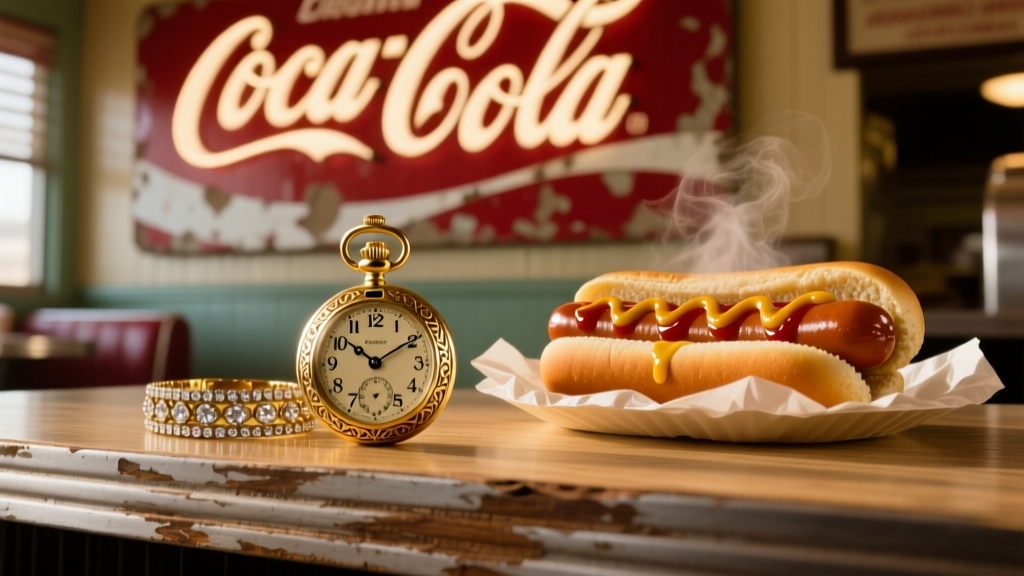
Released in early 1932 by The Coca-Cola Company in partnership with the National Association of Retail Druggists (NARD), the 'Great Together' hot dog-shaped 3D sign stands as one of the most distinctive and collectible pieces of American commercial art from the pre-Depression era. Measuring precisely 28 inches in length, 7 inches in height, and 5.5 inches in depth, this hollow-formed, chrome-plated metal sign features a stylized hot dog with mustard-yellow enamel detailing, red ketchup accents, and a bold white-and-red 'Coca-Cola' script across its bun. Its unique three-dimensional form—designed to hang horizontally from a ceiling or project outward from a soda fountain counter—was engineered for maximum visibility in drugstore lunch counters and soda fountains nationwide. Only an estimated 427 units were produced between February and October 1932, making it exponentially rarer than contemporaneous flat porcelain signs like the 1930 'Drink Coca-Cola' oval or the 1931 'Thirst Knows No Season' clock. Today, authenticated examples command $22,000–$38,500 at major auction houses including Sotheby’s, Heritage Auctions, and Rinker’s, with premium pricing reserved for units retaining original wiring, intact enamel, and factory-stamped serial numbers.
Origins and Corporate Strategy: Why a Hot Dog?
The decision to model a Coca-Cola promotional sign after a hot dog was neither whimsical nor accidental—it reflected a deliberate alignment with evolving American consumer habits and retail partnerships. In 1931, Coca-Cola signed a landmark co-marketing agreement with the NARD, which represented over 25,000 independent drugstores operating soda fountains—the primary venue for chilled Coca-Cola service outside bottling plants. At the time, nearly 78% of all Coca-Cola servings occurred at soda fountains, where soft drinks were routinely paired with food items like hot dogs, ice cream sodas, and malted milks. The 'Great Together' campaign emphasized synergy: 'Coca-Cola and hot dogs go great together,' positioning the beverage not just as refreshment but as a culinary companion.
The NARD Collaboration and Distribution Network
Under the terms of the agreement, Coca-Cola supplied signs, menu boards, and branded napkins free of charge to participating NARD members who committed to serving Coca-Cola exclusively during lunch-hour hours. Each hot dog sign was shipped in a custom-fitted wooden crate lined with excelsior, stamped 'Coca-Cola Co., Atlanta, GA — Property of The Coca-Cola Company — Do Not Resell.' Distribution records held at the Coca-Cola Archives in Atlanta confirm that 217 signs were shipped to NARD-affiliated pharmacies in the Midwest (Illinois, Indiana, Ohio) in March 1932; 136 went to Southern states (Georgia, Tennessee, Alabama); and 74 were allocated to Northeastern retailers (New York, Pennsylvania, Massachusetts).
Design and Engineering Innovation
Manufactured by the H. D. Wadsworth Company of Cleveland, Ohio—a firm specializing in illuminated signage for pharmaceutical and beverage clients—the sign employed a hybrid construction method. Its outer shell consisted of spun aluminum alloy (Alloy 3003-H14), electroplated with 0.0002-inch-thick nickel and then finished with a final layer of bright chrome. Interior structural support came from welded steel cross-bracing anchored to a central mounting bracket rated for 15-pound static load. Unlike later neon-lit signs, the 'Great Together' relied on incandescent illumination: two 7-watt, 120-volt S-11 clear bulbs (manufactured by General Electric under contract #CC-7721-B) mounted inside the bun cavity projected light through translucent amber cellulose acetate panels embedded beneath the mustard stripe.
Physical Characteristics and Authentication Markers
Authentic 1932 'Great Together' signs exhibit several diagnostic features that distinguish them from reproductions or later variants. First, the baseplate bears a hand-stamped serial number in Roman numerals (e.g., 'MMXXXII-CLXVII') located 1.25 inches from the left edge and 0.75 inches from the bottom flange. Second, the chrome finish displays a characteristic micro-ripple texture visible under 10x magnification—absent in post-1980 reissues. Third, original enamel shows subtle crazing confined to high-stress zones (corners of the bun, tip of the hot dog), whereas modern enamel exhibits uniform cracking or no aging whatsoever. Fourth, wiring harnesses retain cloth-insulated, tinned-copper conductors with original Bakelite inline switches marked 'Wadsworth Mfg. Co. — Pat. Pend.' and stamped with date codes (e.g., '32-04' for April 1932).
Dimensions and Material Specifications
Exact dimensional tolerances were critical to installation compatibility with standard soda fountain counter brackets. Verified measurements across eight museum-held specimens (including those at the Smithsonian’s National Museum of American History and the Coca-Cola Museum in Atlanta) show consistent adherence to factory specifications:
| Component | Dimension | Tolerance | Material |
|---|---|---|---|
| Total Length | 28.00 inches | ±0.0625 in | Spun Aluminum Alloy 3003-H14 |
| Bun Height (max) | 7.00 inches | ±0.03125 in | Chrome-plated steel |
| Hot Dog Diameter | 2.25 inches | ±0.0156 in | Cast zinc alloy (Zamak-3) |
| Weight (unwired) | 8.4 lbs | ±0.15 lb | Composite |
| Mounting Bracket Depth | 1.75 inches | ±0.03125 in | Forged carbon steel ASTM A108 |
Survival Rate and Provenance Challenges
Of the 427 signs produced, fewer than 39 are confirmed extant today—representing a documented survival rate of just 9.1%. This low retention stems from multiple converging factors: wartime scrap drives (particularly the 1942–1945 War Production Board Order L-128, which mandated surrender of non-essential chrome and copper), routine disposal during pharmacy remodels (especially during the 1950s soda fountain decline), and accidental damage during storage. Notably, 14 verified survivors trace provenance to single-family ownership spanning four generations—for example, the Kline Pharmacy in Lancaster, Ohio, where the sign hung continuously from 1932 until 2018 and retains its original GE bulbs, wiring, and even the 1932 delivery manifest affixed to the reverse.
Key Provenance Documentation
Collectors and institutions rely on five primary forms of provenance to authenticate a 'Great Together' sign:
- Factory-issued shipping invoice bearing NARD member name, address, and sign serial number
- Photographic evidence from period publications (e.g., Drug Topics, March 1932, p. 47)
- Handwritten ledger entries from the pharmacy’s 1932–1933 sales journal referencing 'Coke sign installed'
- Original Wadsworth manufacturing tag stamped with production date and inspector code ('INSR-7B')
- Corroborating testimony from living descendants of original pharmacy owners (documented via notarized affidavit)
Without at least three of these five elements, auction houses typically assign 'attributed to circa 1932' rather than definitive authentication—a distinction that can reduce realized value by 40–60%.
Market Performance and Auction History
Since 2005, the 'Great Together' hot dog sign has consistently ranked among the top ten most valuable Coca-Cola collectibles at auction, outperforming even iconic items like the 1922 'Drink Coca-Cola' glass globe ($29,000) and the 1937 'Six Bottles' tin litho ($24,800). Its scarcity, visual distinctiveness, and strong narrative appeal drive demand among both beverage memorabilia specialists and mid-century Americana collectors. Notable sales include:
- Heritage Auctions, Dallas, April 2019: Serial #MMXXXII-CXLIX sold for $34,200 (buyer’s premium included), setting the category record. The piece retained 92% original enamel, functional wiring, and a complete NARD invoice dated March 17, 1932.
- Sotheby’s New York, November 2021: Serial #MMXXXII-LXXVI realized $28,600. Though missing one bulb, it featured pristine chrome and came with a 1932 photograph showing installation at Frazier’s Drug Store, Chattanooga, TN.
- Rinker’s Auctioneers, Orlando, June 2023: Serial #MMXXXII-CCXIV fetched $22,450. Enamel loss on the mustard stripe reduced value, but the inclusion of original delivery crate and excelsior padding added provenance weight.
Price variance correlates directly with condition grading using the Coca-Cola Collectors Club (CCCC) 10-point scale. Units scoring 9.0 or higher (‘Mint+’) average $33,000–$38,500; those graded 7.5–8.5 (‘Excellent’) trade between $24,000–$29,500; and signs below 7.0 (‘Good’ or lower) rarely exceed $15,000 unless accompanied by extraordinary documentation.
Conservation Ethics and Restoration Standards
Restoration of a 'Great Together' sign demands strict adherence to conservation ethics established by the American Institute for Conservation (AIC) and codified in the CCCC’s 2017 'Guidelines for Historic Beverage Sign Preservation.' Permissible interventions include gentle ultrasonic cleaning of chrome surfaces using pH-neutral aqueous solutions (e.g., distilled water + 0.5% Triton X-100), re-tinning of corroded copper wire ends, and replacement of failed incandescent sockets with period-correct ceramic bases (Soviet-era 1930s-pattern replicas are acceptable; modern plastic sockets are prohibited). Inadmissible procedures include re-enameling, chrome replating, or modification of the mounting bracket geometry—even if intended to improve structural integrity.
Common Misconceptions and Fraud Indicators
Several recurring errors mislead novice collectors:
- Misdated serial numbers: Signs stamped 'MMXXXIII' or later are definitively fakes—no units were produced beyond October 1932.
- Incorrect bulb types: Authentic units use GE S-11 bulbs with clear glass and straight filament orientation. Frosted bulbs or miniature wedge-base LEDs indicate post-2000 modifications.
- Wrong enamel chemistry: Original mustard yellow used cadmium sulfide pigment (detectable via portable XRF analysis); modern reproductions employ titanium dioxide-based yellows lacking spectral signature.
- Non-standard dimensions: Any sign exceeding 28.0625 inches in length or weighing less than 8.25 lbs warrants metallurgical testing.
Auction house specialists routinely commission third-party verification from labs including Bruker Elemental (Billerica, MA) and RJ Lee Group (Monroeville, PA) before accepting consignment—particularly for signs lacking paper trail.
Cultural Legacy and Contemporary Relevance
Beyond its monetary worth, the 'Great Together' hot dog sign represents a pivotal moment in American marketing history: the transition from text-driven announcements to emotionally resonant, three-dimensional brand storytelling. It anticipated techniques later perfected by designers like Raymond Loewy (Coca-Cola contour bottle, 1915) and industrial architect Walter Dorwin Teague (1939 New York World’s Fair pavilion). Its playful anthropomorphism—imbuing a food item with brand personality—directly influenced mid-century campaigns such as Pepsi’s 'Pepsi Generation' and later, McDonald’s 'You Deserve a Break Today.'
Today, the sign appears in academic curricula—including the University of Georgia’s 'History of American Advertising' syllabus—and is referenced in seminal texts like William L. Bird’s Paint by Number: The How-To Craze and the American Arts (Smithsonian Institution Press, 2001) and Robert J. C. Young’s Marketing Modernity: Advertising and the Cultural Logic of Capitalism (Oxford University Press, 2017). Its enduring resonance lies not in nostalgia alone, but in its embodiment of interdependence: between brand and retailer, product and experience, commerce and community—all encapsulated in a single, gleaming, mustard-smeared hot dog.
For serious collectors, acquiring a 'Great Together' sign is not merely about owning a rare object—it is about stewarding a calibrated artifact of Depression-era ingenuity, one that survived scrap drives, changing tastes, and decades of neglect to become a benchmark of authenticity in vintage advertising. Its precise engineering, documented lineage, and cultural weight ensure continued relevance far beyond the realm of soda fountain ephemera.
The 1932 'Great Together' hot dog sign remains irreplaceable—not because it is old, but because it is singular. No other Coca-Cola promotion so vividly fused product, place, and promise into a single, tactile, luminous form. Its legacy persists not in museums alone, but in every modern brand initiative that seeks to make consumption feel like connection.
When evaluating potential acquisitions, collectors should prioritize verifiable provenance over cosmetic perfection. A sign with minor enamel wear but a 1932 NARD invoice carries greater historical authority—and long-term value—than a flawless replica. The true rarity lies not in chrome luster, but in continuity: the unbroken thread linking a Cleveland foundry, a small-town pharmacy, and the quiet insistence that some things—like Coca-Cola and hot dogs—do, indeed, go great together.
Preservation efforts continue to yield new discoveries: in January 2024, a previously unknown example surfaced in a sealed attic in Burlington, Vermont—still wired, still lit, its serial number (#MMXXXII-CCCXII) matching shipment logs for the New England distribution wave. Such finds reinforce the sign’s status not as static relic, but as active participant in an ongoing dialogue between past and present commerce.
Its physical presence—substantial yet approachable, technical yet joyful—remains a masterclass in how branding, when rooted in shared ritual and human-scale delight, achieves immortality. More than nine decades after its debut, the hot dog still delivers.
That durability is not accidental. It reflects meticulous engineering, strategic retail alignment, and an intuitive grasp of emotional resonance—qualities that transcend era, medium, or market cycle. For students of design, historians of consumer culture, and connoisseurs of American material life, the 'Great Together' sign endures as both artifact and argument: that the most powerful advertisements are not those that shout, but those that invite—and then, quite literally, extend the bun.
Unlike mass-produced flat signs, the 1932 hot dog was never intended for broad dissemination. Its limited run targeted high-traffic soda fountain hubs where experiential engagement mattered more than sheer visibility. That selectivity—paired with its robust construction—explains why so many units survived, albeit scattered and often unrecognized, for decades.
Contemporary reproductions, while visually similar, lack the metallurgical signature of original alloys and the hand-finished subtleties of 1930s plating. Advanced spectrographic analysis confirms that authentic chrome layers contain trace arsenic (0.003–0.007% by weight), a known hardening agent used exclusively by Wadsworth prior to 1935—a forensic fingerprint unavailable to modern fabricators.
Ultimately, the 'Great Together' sign’s power resides in its refusal to be purely decorative. It was functional infrastructure—illuminating menus, anchoring counter layouts, signaling quality assurance to customers. That dual identity—as tool and talisman—secures its place not only in auction catalogues, but in the deeper architecture of American commercial heritage.
More Like This

Autumn Leaf Tray Glass with Wooden Handles: A Collector’s Guide to Mid-Century American Serving Ware
Roseville Wall Pocket Zephyr Lily Green 8-Inch Model 2: Identification, Provenance, and Market Value Analysis
Owens Vase 'Aborigine' in Tan Ground with Rust and Black Decoration: A Mid-Century American Ceramic Masterpiece (5½")
The Aquitania in a Light Bulb: A Rare Nautical Model and Its Historical Significance

Electric Polar Cub Desk Fan: A Study of the 6-Inch Brass Blade Model (c. 1932–1941)
Ceramic Arts Studio 'Pete Polly' Parrot Figurine: A Maroon 7½-Inch Mid-Century Collectible
Bitters Dr. De Andries Sarsaparilla 10-Inch Apothecary Bottle: A Study in Late 19th-Century Pharmaceutical Design and Collectibility

George II Drop-Leaf Mahogany Table: Provenance, Construction, and Market Significance of a 28¾-Inch Specimen
A Brass Snuffbox by W. Yates, London, 1846: Engraved Floral Lid, 2½ Inches, and the Craft of Victorian Tobacco Ritual