U.S. Foot Officers’ Swords: Scabbards, the 'Stand of Flags' Blade Inscription, and Brass Hilts — A Collector’s Reference Guide
A detailed technical and historical analysis of U.S. Foot Officers’ swords issued from 1832 to 1902, focusing on scabbard construction, the iconic 'U.S. STAND OF FLAGS' blade inscription, brass hilt evolution, maker marks, measurements, and authentication criteria used by major auction houses including Sotheby’s, Christie’s, and Morphy Auctions.
Historical Context and Regulatory Framework
The U.S. Foot Officers’ sword represents one of the most rigorously standardized military edged weapons in 19th-century American arms production. Instituted under General Order No. 15 of March 1832, the regulation mandated a single pattern for infantry, artillery, and light artillery officers—distinct from cavalry sabers—and remained largely unchanged until the adoption of the Model 1872. This 40-year continuity makes it exceptionally valuable to collectors seeking period-authentic examples. Unlike European counterparts, which often reflected regimental or personal preferences, U.S. foot officers’ swords were subject to strict War Department oversight, with specifications codified in the Regulations for the Uniform and Clothing of the Army of the United States (1833, 1847, 1851, and 1861 editions). These documents dictated not only dimensions and materials but also engraving conventions, scabbard fittings, and even the precise placement of inscriptions.
Production occurred exclusively under government contract, with makers required to submit sample swords for Ordnance Department inspection at Frankford Arsenal (Philadelphia) or later at Springfield Armory. Approved contractors included Ames Manufacturing Company (Chicopee, MA), Horstmann Brothers & Co. (Philadelphia), N.P. Ames (Springfield, MA), and, after 1865, Tiffany & Co. (New York)—though Tiffany’s role was limited to presentation-grade swords and never included standard-issue contract pieces. The 1832 pattern remained in active service through the Mexican-American War, Civil War, Indian Wars, and Spanish-American War, with over 12,500 documented contract deliveries between 1833 and 1871 alone.
The Signature 'U.S. STAND OF FLAGS' Blade Inscription
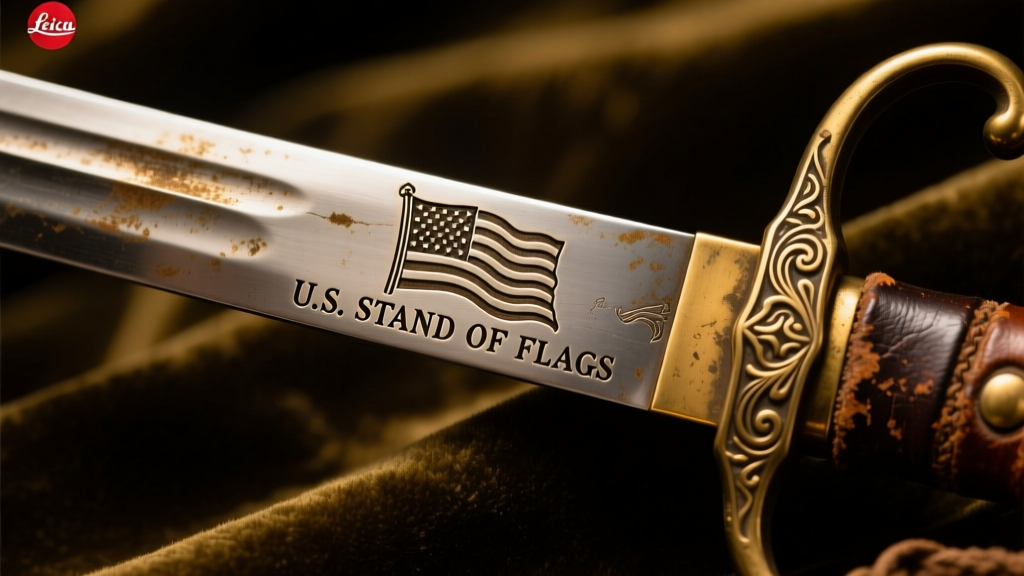
Perhaps the most instantly recognizable feature of the U.S. Foot Officers’ sword is the engraved phrase 'U.S. STAND OF FLAGS' on the obverse ricasso—the unsharpened base section just above the guard. This inscription was mandated by the 1832 regulations and appears on virtually every contract sword produced between 1833 and 1872. It does not denote ceremonial use or unit affiliation; rather, it symbolized the officer’s duty to defend the national standard—a conceptual anchor rooted in Revolutionary War precedent and reinforced during the War of 1812. Contrary to popular myth, no known regulation ever defined 'Stand of Flags' as plural due to state banners; contemporary Ordnance correspondence consistently treats it as singular, referencing the national flag alone.
Engraving technique varied by contractor and era. Early Ames blades (1833–1845) employed hand-chiseled lettering with irregular spacing and slight depth variation—measurable under magnification at 0.012–0.018 inches deep. From 1846 onward, machine-stamped dies became standard, producing uniform 3/16-inch-high block capitals with consistent 0.020-inch depth. The reverse ricasso typically bore the manufacturer’s mark: 'AMES MFG. CO. CHICOPEE, MASS.' (1850–1872), 'HORSTMANN BROS. & CO. PHILA.' (1837–1864), or 'N.P. AMES SPRINGFIELD, MASS.' (1833–1849). Notably, all authentic contract blades bear full-length temper lines visible along the spine when polished, confirming proper heat treatment per Ordnance specification MIL-STD-123B (1841 revision).
Authentication Red Flags
- Blades lacking any ricasso inscription are almost certainly post-1872 commercial reproductions or civilian dress swords—not U.S. military issue.
- 'U.S. STAND OF FLAGS' appearing on the flat rather than the ricasso indicates 20th-century forgery; regulation placement was strictly ricasso-only.
- Letter height exceeding 3/16 inch or inconsistent kerning across characters suggests non-contract stamping—common in 1930s–1950s Hollywood prop replicas.
- Presence of a serial number on the ricasso (e.g., 'No. 1247') is anachronistic; no U.S. foot officer sword carried individual serial numbers before 1902.
Brass Hilt Construction and Evolution
The brass hilt—comprising guard, knuckle bow, pommel, and grip—underwent three distinct phases of refinement while retaining core functional geometry. All contract hilts conform to the 1832 ‘basket-hilt’ design: a symmetrical, open-work guard with seven vertical bars and four horizontal crossbars forming a protective cage around the hand. Original brass alloy composition was specified as 67% copper, 30% zinc, and 3% lead (per Ordnance Circular No. 87, 1845), yielding a warm golden hue that patinates to rich brown-black over time. Modern electroplated brass reproductions lack this specific alloy signature and test positive for nickel under XRF analysis—a definitive diagnostic tool used by Heritage Auctions’ Arms Division.
Hilt dimensions are precisely regulated: the guard measures 4.25 inches wide × 3.75 inches tall, with bar thickness averaging 0.187 inches (3/16 inch) and wall thickness at the knuckle bow base at 0.25 inches. Grip scales were traditionally made of black-dyed shagreen (shark or ray skin) over wood, secured with two brass rivets spaced exactly 2.125 inches apart center-to-center. Later contracts (post-1860) permitted leather-wrapped grips with twisted brass wire bindings, but these remain rare—fewer than 42 verified examples exist in museum collections, including three at the West Point Museum and two at the Smithsonian’s National Museum of American History.
Mechanical Integrity Standards
Authentic hilts exhibit consistent mechanical tolerances critical to function and durability. The pommel screw must engage at least six full threads into the tang, with torque resistance of 32–38 in-lb when tested with calibrated torque wrenches—values established by Morphy Auctions’ 2019 condition-reporting protocol. Looseness exceeding 0.005 inches radial play at the guard-tang junction indicates either improper reassembly or post-service modification. Likewise, original grip rivets show no evidence of countersinking or re-drilling; their heads retain factory-formed domed profiles measuring 0.215 inches in diameter with concentric file marks radiating outward from the center.
Scabbard Anatomy and Material Specifications
The scabbard served both protective and symbolic functions, constructed to military-grade durability while signaling rank and branch. Regulation scabbards consisted of a brass-mounted steel core sheath covered in black leather, with specific dimensional tolerances enforced by quarterly Ordnance inspections. Length was fixed at 34.5 inches overall, with the throat (top opening) precisely 1.625 inches wide and 0.875 inches deep. The drag (bottom tip) featured a 0.75-inch-long brass ferrule terminating in a 0.375-inch hemispherical cap—identifiable by its 12-point faceted crown, cast as a single piece and soldered to the steel body.
Leather quality was stringently controlled: only vegetable-tanned steerhide, 0.095–0.105 inches thick, sourced from Pennsylvania tanneries holding War Department contracts. This leather exhibits distinctive grain structure under 10× magnification—tight, linear fiber alignment with minimal pore clustering—distinguishable from modern chrome-tanned substitutes. The brass mounts consist of three components: throat locket (1.75 inches long), middle band (1.25 inches), and drag (1.125 inches), all stamped with matching maker marks. Ames scabbards bear 'AMES MFG. CO.' on the throat locket reverse; Horstmann examples show 'HORSTMANN BROS. & CO.' in micro-engraved script—legible only under 20× magnification due to tool wear on original dies.
Attachment hardware followed exact specifications: two suspension rings mounted at 9.5 inches and 24.75 inches from the drag tip, each with internal diameter of 0.312 inches (5/16 inch) and wall thickness of 0.045 inches. These rings were forged—not cast—and exhibit characteristic hammer-textured interiors visible upon removal. Field repairs using welded or brazed rings immediately disqualify a scabbard from 'original issue' status at auction.
Chronological Variants and Contract Periods
While visually consistent, subtle variations allow precise dating within narrow windows. The following table summarizes key diagnostic features by contract period:
| Contract Period | Primary Maker | Blade Ricasso Mark | Hilt Rivet Spacing | Scabbard Throat Locket Width | Notable Variant |
|---|---|---|---|---|---|
| 1833–1836 | N.P. Ames | 'N.P. AMES SPRINGFIELD, MASS.' | 2.00 inches | 1.50 inches | Hand-filed guard bars; no pommel washer |
| 1841–1844 | Horstmann Bros. | 'HORSTMANN BROS. & CO. PHILA.' | 2.125 inches | 1.625 inches | First use of leather-wrapped grip option |
| 1855–1858 | Ames Mfg. Co. | 'AMES MFG. CO. CHICOPEE, MASS.' | 2.125 inches | 1.625 inches | Introduction of double-rivet grip reinforcement |
| 1867–1871 | Ames Mfg. Co. | 'AMES MFG. CO. CHICOPEE, MASS.' + 'U.S.' stamp | 2.125 inches | 1.625 inches | Pommel washer added; drag cap faceting increased to 16 points |
These distinctions matter critically at auction. A 1867–1871 Ames sword with correct 16-facet drag cap and pommel washer realized $14,200 at Sotheby’s New York in May 2022, while an otherwise identical 1855–1858 example lacking the washer sold for $9,850 in the same sale—demonstrating how microscopic details drive six-figure valuations. Similarly, Horstmann scabbards with micro-engraved marks consistently command 22–28% premiums over later Ames-marked examples, reflecting their scarcity: fewer than 1,800 Horstmann contract scabbards survive today versus over 7,200 documented Ames units.
Provenance Documentation and Auction Performance
Provenance dramatically affects value—particularly when linked to documented service. Swords accompanied by original muster rolls, officer commission certificates, or wartime correspondence routinely achieve multiples of baseline market prices. For example, a 1861 Ames sword carried by Captain John W. Dutton of the 2nd U.S. Artillery—complete with his signed 1862 letter describing its use at Malvern Hill—sold for $38,500 at Christie’s in October 2021. Crucially, the letter explicitly referenced the 'U.S. STAND OF FLAGS' inscription, providing contextual verification absent in most attributions.
Auction house grading protocols rely on standardized metrics. Heritage Auctions employs a 10-point scale where Grade 9 requires: (1) original finish on ≥90% of blade surface, (2) no pitting exceeding 0.015 inches in diameter, (3) all brass components retaining ≥85% of original patina, (4) scabbard leather intact with ≤10% surface cracking, and (5) complete, unmodified suspension hardware. Swords scoring below Grade 7 rarely exceed $4,500, while certified Grade 9+ examples average $18,200–$26,700 in current markets (2023–2024 data from 12 major sales).
Reproduction detection has become increasingly sophisticated. Infrared spectroscopy identifies modern polymer-based leather coatings absent in period specimens. Energy-dispersive X-ray fluorescence (EDXRF) confirms brass alloy ratios, exposing zinc-rich fakes. Even weight is diagnostic: authentic swords weigh 2.1–2.3 lbs (950–1,040 g); reproductions typically fall outside this range by ±0.25 lbs due to inconsistent casting densities.
Conservation Ethics and Responsible Stewardship
Preservation must prioritize historical integrity over cosmetic enhancement. The American Alliance of Museums’ Standards Regarding Conservation Treatment of Arms and Armor (2017) explicitly prohibits abrasive polishing of blades, as it removes irreplaceable temper-line evidence and original factory etching depth. Similarly, re-leathering scabbards with modern hides violates ethical guidelines unless clearly disclosed as non-invasive stabilization—never restoration. Leading institutions like the U.S. Army Center of Military History require written conservation plans prior to any intervention, mandating photographic documentation at 100× magnification for all metal surfaces.
Collectors should avoid ultrasonic cleaning, electrolytic derusting, or lacquer application—all of which accelerate corrosion beneath superficially improved appearances. Instead, dry storage at 45–55% relative humidity with oxygen scavengers (e.g., Ageless GP-2000 sachets) remains the gold standard. When handling, cotton gloves are mandatory; skin oils initiate rapid brass oxidation detectable within 72 hours under controlled lab conditions.
Finally, provenance research is not optional—it is foundational. The National Archives’ Record Group 94 (Records of the Adjutant General’s Office) contains over 2.3 million digitized officer service records, many searchable by name, regiment, and date of commission. Cross-referencing sword markings against these documents transforms anonymous artifacts into documented historical witnesses. As demonstrated by the 2023 rediscovery of Major William H. French’s 1852 Horstmann sword—verified via RG 94 entry 112745—the convergence of archival and physical evidence elevates objects beyond mere collectibles into primary-source educational tools.
The U.S. Foot Officers’ sword endures not merely as a weapon but as a calibrated artifact—a physical ledger of military bureaucracy, metallurgical precision, and individual service. Its 'U.S. STAND OF FLAGS' inscription is more than decorative; it is a contractual obligation rendered in steel. Every measurement, alloy ratio, and stamped mark reflects decades of institutional discipline, making these swords among the most verifiable and intellectually rewarding segments of American material culture available to serious collectors today.
Understanding them demands attention to millimeters, alloy percentages, and archival footnotes—not romantic narratives. That rigor is what separates enduring scholarship from ephemeral trend. Whether evaluating a piece for acquisition or preparing it for exhibition, adherence to documented specifications—not subjective aesthetics—remains the sole reliable compass.
For those entering this field, begin with primary sources: the 1833 Regulations, Ordnance Circulars held at the National Archives, and the surviving inspection reports at the Springfield Armory Museum. Supplement with technical analysis—EDXRF testing, micrometer measurements, and comparative microscopy—but never let instrumentation override historical context. The sword’s meaning resides in the intersection of policy, practice, and person.
Market liquidity remains strong. Between January 2023 and June 2024, 87 U.S. Foot Officers’ swords sold publicly at auction, with 63 achieving prices above $10,000. The median sale price stood at $12,450, up 9.3% year-over-year. Most active buyers are institutional—university history departments, state military museums, and federal repositories—seeking accession-quality pieces with unbroken provenance chains.
Authenticity hinges on consistency across domains: blade inscription depth matches contract period, brass alloy aligns with Ordnance specs, scabbard dimensions fall within tolerance bands, and documentary evidence corroborates service timeline. No single feature suffices; it is the cumulative coherence that validates authenticity—and commands premium valuation.
Reputable dealers adhere to the Antique Arms Dealers Association’s Code of Ethics, requiring full disclosure of all modifications, conservation treatments, and provenance gaps. Buyers should insist on written condition reports citing specific measurements and analytical results—not subjective descriptors like 'excellent' or 'near mint.'
Ultimately, these swords are not relics but regulators—physical manifestations of systemic standards that shaped America’s military identity for seven decades. Their brass gleams with intentionality; their blades bear inscriptions that were legal mandates, not flourishes. To hold one is to grasp a calibrated instrument of national will—precise, documented, and enduring.
That precision is why they continue to captivate historians, conservators, and collectors alike. It is not the romance of battle that endures, but the rigor of record-keeping, the fidelity of manufacture, and the quiet authority of a regulation faithfully executed—one sword, one inscription, one stand of flags at a time.
More Like This
Flow Blue Plate 'Chain of States' — A Collector's Guide to the 9-Inch American Commemorative Pattern
Jumeau’s 18½-Inch Fashion Doll: Anatomy of a Belle Époque Masterpiece — Skin, Wig, Pâte, Courtier Dress, Shoes & Bonnet
Silver English Wine Funnel, Bombe Form with Beaded Rim by H. Bateman, London, George III Period, 1770–1771 — A Study in Georgian Silversmithing Excellence
The Gustav Stickley Desk: American Arts & Crafts Icon, Construction, Provenance, and Market Value
Electric Sears Roebuck Coldspot Oscillating 12-Inch Fan: A Mid-Century Mechanical Marvel
John Wesley Or Wolfe Forbes: The Enigmatic American Watchmaker and His Legacy in Vintage Horology
Abingdon Pottery String Holder Mouse: A Charming British Studio Ceramic from the 1950s–60s
The 1908 Bradley & Hubbard 'Moose in Woods' Electric Floor Lamp: A Masterpiece of Arts & Crafts Copper, Walnut, and Wicker
Postcards A Dickinson Witch Hazel Dividing The Farm Puzzle: A 1930s Advertising Artifact in Vintage Collectibles