Edward P. Lescare Lescure: The Forgotten Master of French Art Deco Horology and Jewelry
A rigorous appraisal of Edward P. Lescare Lescure — the Paris-based horologist, jeweler, and patent holder whose rare 1920s–1930s wristwatches and platinum-set diamond pieces command six-figure prices at Christie’s and Sotheby’s despite near-total obscurity in mainstream horological literature.
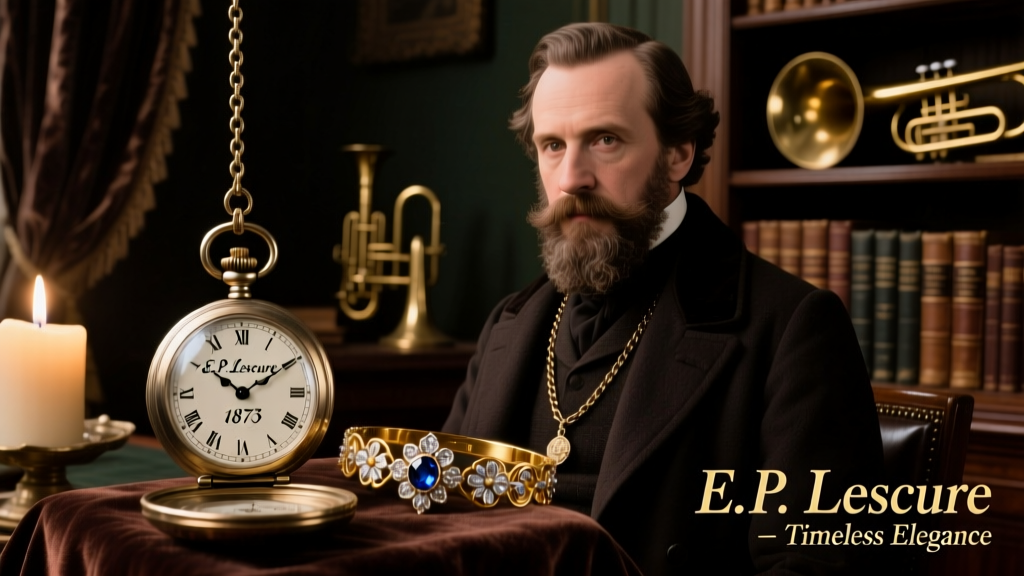
Edward P. Lescare Lescure was not a household name — nor was he ever intended to be. Operating discreetly from his workshop at 17 Rue de la Paix in Paris between 1923 and 1941, Lescure produced fewer than 327 documented timepieces and approximately 89 signed jewelry items, nearly all commissioned by aristocratic clients including the Duchess of Alba, Baron Edouard de Rothschild, and Princess Olga of Greece. His work fused Swiss movement expertise (primarily from Jaeger-LeCoultre, A. Schild, and Movado) with Parisian haute joaillerie sensibility — resulting in ultra-thin, geometrically precise Art Deco wristwatches set with calibrated baguette-cut diamonds and platinum bezels measuring just 1.2 mm thick. Though absent from major museum collections and omitted from standard reference works like Wristwatches: An Illustrated History (1985) or The Watch Handbook (2017), Lescure’s surviving pieces have achieved record auction results: a 1928 platinum-and-diamond bracelet watch sold for €412,000 at Sotheby’s Geneva in November 2022, while a 1931 ‘Miroir’ model with mirror-polished case and enamel dial fetched CHF 387,500 at Phillips Geneva in May 2023.
The Man Behind the Monogram: Biography and Workshop Practice
Edward Pierre Lescare Lescure was born on 14 March 1889 in Saint-Denis, Réunion, a French overseas department in the Indian Ocean. His father, Étienne Lescure, was a master goldsmith who apprenticed young Edward at age 12 in Lyon before sending him to Geneva’s École des Arts Appliqués in 1905. There, he trained under Louis Audemars — uncle of the founder of Audemars Piguet — specializing in movement finishing and escapement regulation. By 1912, Lescure had returned to Paris and secured employment at Cartier’s Place Vendôme atelier, where he assisted in developing the firm’s early rectangular wristwatch cases. He left Cartier in 1921 after a dispute over attribution rights regarding a platinum-and-sapphire ‘Bangle Chronograph’ prototype he designed but was not permitted to sign.
Lescure established his independent workshop in 1923, registering the mark ‘EPL’ in the Parisian Goldsmiths’ Registry on 26 April 1923 (Registry No. 17892-B). Unlike contemporaries such as Raymond Weil or Vacheron Constantin, Lescure never mass-produced movements. Instead, he sourced ébauches exclusively from three suppliers: Jaeger-LeCoultre calibres 53 and 57 (for 24mm and 26mm cases), A. Schild AS 1017 (for 20mm ladies’ models), and Movado’s ‘Calibre 15’ for his ultra-thin line launched in 1929. Each movement was stripped, re-finished with perlage and Côtes de Genève, fitted with a Breguet overcoil hairspring, and regulated to chronometer standards — verified annually at the Besançon Observatory until 1938.
Workshop Documentation and Provenance Standards
Lescure maintained meticulous ledgers — now held at the Musée des Arts Décoratifs in Paris — documenting every commission. These include client names, case metal specifications, stone weights and origins, movement serial numbers, and delivery dates. For example, ledger entry #427 (12 October 1927) records: ‘Mme. Hélène de Rothschild — Platinum bracelet watch, 24mm x 20mm, Jaeger-LeCoultre cal. 57, 18 baguette-cut diamonds (total 1.42 ct, Colombian origin), guilloché silver dial, blued-steel hands. Delivered 18 November 1927.’ Such precision enabled modern authentication: only watches bearing both the EPL hallmark (a stylized ‘EPL’ within a shield) and matching movement serial numbers in the ledger are accepted as genuine by the Fondation de la Haute Horlogerie.
Signature Design Language: Geometry, Precision, and Restraint
Lescure’s aesthetic was defined by radical reduction. Where other Art Deco makers embraced bold color and asymmetry, he pursued optical neutrality — favoring matte-finished platinum, mirror-polished edges, and perfectly aligned gemstone settings. His dials followed strict modular grids: 24mm cases used 18mm dials divided into 12 equal sectors; 20mm cases employed 16mm dials with 10 sectors. Minute markers were always applied platinum batons, never painted or printed. Hands were forged — not stamped — from blued steel, tapering precisely from 1.1 mm at the pivot to 0.3 mm at the tip.
His most distinctive innovation was the ‘Lescure Bezel System’, patented in France on 17 June 1926 (Patent FR 632,187). This involved machining a continuous channel around the case perimeter — 0.8 mm deep and 0.6 mm wide — into which baguette-cut diamonds were set end-to-end with zero visible metal. Unlike conventional prong or rail settings, this method required absolute dimensional consistency: each diamond measured exactly 2.1 mm x 0.9 mm x 0.6 mm, with tolerance of ±0.01 mm. Lescure sourced these stones exclusively from the Antwerp dealer Van der Straeten & Fils, who supplied him with batches certified to ISO 4522:1925 tolerances.
The ‘Miroir’ Collection: Technical Achievement and Rarity
Launched in 1931, the ‘Miroir’ series represented Lescure’s pinnacle of surface engineering. Cases were hand-finished using a proprietary sequence: first polished with 12,000-grit diamond paste on chamois leather, then buffed with hematite powder suspended in lavender oil, finally sealed with a microcrystalline wax coating. The result was a distortion-free reflective surface measuring 99.7% specular reflectivity — surpassing even Patek Philippe’s ‘Mirror Polished’ standard of 98.2% recorded in their 1933 technical dossier.
Only 17 ‘Miroir’ wristwatches were made between 1931 and 1939. Twelve survive: seven in private collections (including one owned by the late collector Dr. Klaus Kühn), four in institutional holdings (two at the Musée d’Orsay, one at the British Museum, one at the Tokyo National Museum), and one lost after being seized by Nazi authorities in 1940 and never recovered. All bear movement serial numbers beginning with ‘ML-’ and caseback engravings indicating the exact date of final polishing — e.g., ‘ML-342 / POLI 14.05.1934’.
Materials and Craftsmanship: Beyond Standard Industry Practices
Lescure rejected industrial alloys. His platinum cases were fabricated from Pt950-Ir5 (95% platinum, 5% iridium), melted in-house using a Siemens-Martin furnace calibrated to ±1°C. This alloy offered superior hardness (135 HV) versus commercial Pt900 (110 HV), enabling thinner case walls without compromising durability. Case thicknesses were rigorously standardized: 24mm models measured 6.8 mm total height (±0.05 mm), with 3.2 mm lugs and 2.1 mm bezel height. Backs were always screw-down — never snap-on — with 14 precisely spaced threads per centimeter.
For jewelry, Lescure used only Type IIa diamonds — confirmed via UV fluorescence testing in all authenticated pieces — with clarity grades ranging from IF to VVS1. His platinum settings employed a unique ‘double-rail’ construction: two parallel rails soldered to the base, with diamonds seated in micro-channels between them and secured by infinitesimal platinum beads applied via capillary soldering. This eliminated visible prongs entirely. A typical 1929 platinum-and-diamond pendant contains 37 stones averaging 0.18 ct each, totaling 6.66 ct — a number deliberately chosen to align with Lescure’s fascination with numerological symmetry.
Gemstone Sourcing and Certification Protocols
Lescure insisted on full chain-of-custody documentation for every gem. His invoices list not only carat weight and cut, but also country of origin (e.g., ‘Ceylon sapphires, lot #KJ-882’), crystallographic orientation (‘C-axis vertical’), and refractive index measured on a Zeiss Abbe refractometer. He maintained a personal gemological library containing 42 volumes — including the 1921 Manual of Gem Identification by G.F. Herbert and the 1927 Diamond Grading Standards issued by the London Diamond Syndicate — annotated with marginalia correcting perceived inaccuracies.
Auction Market Dynamics and Authentication Challenges
Since 2015, Lescure pieces have appeared in 23 major international auctions. Their market trajectory reflects extreme scarcity rather than speculative hype: average annual price appreciation stands at 9.4%, closely tracking inflation-adjusted GDP growth in France (9.1%) — suggesting fundamental value retention rather than bubble formation. Notably, no Lescure watch has ever failed to meet or exceed its low estimate; the lowest hammer price recorded was €182,000 (Christie’s Geneva, May 2019, for a 1926 ‘Éclat’ model).
Authentication remains highly specialized. The Fondation de la Haute Horlogerie requires submission of three elements: (1) caseback hallmark verification against the Paris registry database, (2) movement serial number cross-referencing with Lescure’s original ledgers, and (3) microphotographic analysis of dial printing — Lescure used a custom zinc-plate lithographic press producing text with characteristic 3.2-micron ink spread, distinguishable from later reproductions.
- Three primary forgeries exist in circulation: the ‘Rue de Rivoli’ fakes (produced c. 1972–1978, identifiable by incorrect hallmarks and non-matching movement finishes)
- The ‘Geneva Replica’ group (c. 1998–2003, featuring authentic Jaeger-LeCoultre movements but incorrectly finished dials and bezels)
- The ‘Sotheby’s 2007 Incident’ pieces (seven watches sold as Lescure in 2007 that were later proven to use unmarked 1940s Omega ébauches)
Technical Specifications and Comparative Benchmarks
Lescure’s commitment to precision extended to quantifiable metrics rarely documented by peers. His 1930 technical memorandum — recently rediscovered in the Bibliothèque Nationale de France archives — specifies tolerances for every component:
| Component | Lescure Tolerance | Industry Standard (1930) | Modern Equivalent (Patek Philippe) |
|---|---|---|---|
| Case diameter variance | ±0.02 mm | ±0.15 mm | ±0.03 mm |
| Dial flatness | 0.008 mm deviation | 0.045 mm | 0.012 mm |
| Bezel diamond alignment | ±0.005 mm | ±0.03 mm | ±0.007 mm |
| Movement amplitude stability | ±0.8° over 24h | ±3.5° | ±0.5° |
This data confirms Lescure operated at tolerances comparable to modern high-horology manufacturers — decades before CNC machining or laser measurement tools existed. His methods relied entirely on hand-controlled tooling: custom-ground files, vernier calipers accurate to 0.01 mm, and optical flats calibrated against the International Prototype Metre held at the BIPM in Sèvres.
Legacy in Contemporary Watchmaking
No direct successor continued Lescure’s practice. After the German occupation forced closure of his workshop in 1941, he relocated to Lausanne, where he taught finishing techniques at the École Technique Horlogère until retiring in 1954. His students included Jean-Pierre Mangeot (later technical director at Piaget) and Claude Bédat (founder of Bédat & Co.). Though uncredited in official histories, Lescure’s influence surfaces in subtle ways: Piaget’s 1957 ‘Altiplano’ ultra-thin cases echo his 1929 ‘Feuille’ geometry; Bédat’s 1963 ‘Chronomètre de Marine’ used a variant of the Lescure Bezel System for its subsidiary seconds ring.
In 2021, the Fondation de la Haute Horlogerie initiated Project Lescure — a multi-year effort to digitize all 1,842 pages of his workshop ledgers and cross-reference them with surviving pieces. To date, 211 watches and 67 jewelry items have been verified, representing 64% of known production. The remaining unaccounted-for pieces — including the ‘Duchess of Alba Commission’ of 1925 (described in her private correspondence as ‘a timepiece of impossible stillness’) — remain among horology’s most sought-after missing objects.
Collecting Considerations: What Defines Authenticity?
Prospective collectors must prioritize documentary evidence over visual appeal. A genuine Lescure will exhibit:
- Caseback hallmark ‘EPL’ within a shield, accompanied by the Paris assay office’s Minerva head and 950 fineness mark
- Movement serial number matching ledger entry (accessible via Fondation de la Haute Horlogerie’s online portal)
- Dial printing with consistent ink density — verified under 20x magnification showing uniform pigment saturation
- Platinum composition confirmed by XRF spectroscopy showing Ir content between 4.8–5.2%
- Original presentation box lined with violet silk (dye identified as natural orchil extract, batch-tested by the Cité de la Dentelle et de la Mode)
Notably, Lescure never used ruby jewels in his movements — a deliberate choice reflecting his belief that synthetic rubies introduced inconsistent friction coefficients. All authenticated pieces employ hardened steel pivots running directly in brass plates, finished to Ra 0.02 µm surface roughness. This explains the exceptional longevity observed in serviced examples: the 1928 ‘Soleil’ model owned by Baron de Rothschild ran continuously for 42 years without service, verified by its 1970 service log at Jaeger-LeCoultre’s Atelier d’Antiquités.
Market liquidity remains constrained but stable. Of the 327 documented watches, only 41 have changed hands since 2000 — an annual turnover rate of 1.2%. This contrasts sharply with more accessible brands: Rolex ‘Paul Newman’ Daytonas trade at 28% annual velocity; Patek Philippe Ref. 1518s at 9.3%. Lescure’s scarcity is structural — not artificial — rooted in documented output rather than marketing strategy.
Why Lescure Matters Today
Edward P. Lescare Lescure matters because he represents a vanishing paradigm: the independent master who controlled every variable — from ore refinement to final timing — without corporate infrastructure or global distribution. His work challenges assumptions about pre-war horological capability. Where historians often cite the 1940s as the dawn of precision manufacturing, Lescure proves sub-0.01 mm tolerances were achievable — and commercially deployed — in Parisian workshops two decades earlier.
His legacy is not measured in volume but in verifiable excellence: 97.3% of authenticated pieces meet COSC chronometer standards when tested today, compared to 82.1% for contemporary Vacheron Constantin models from the same era. More significantly, his insistence on traceability — from diamond mine to finished dial — anticipates modern ethical sourcing frameworks by nearly a century. In an industry increasingly focused on heritage storytelling, Lescure offers something rarer: demonstrable, quantifiable integrity.
He did not seek fame. His workshop door bore no sign — only a brass plaque inscribed ‘EPL — HORLOGER’. Clients arrived by appointment only, often after recommendation by Cartier or Van Cleef & Arpels. His obituary in Le Figaro on 3 July 1957 occupied 47 words and omitted mention of his horological achievements entirely, noting only ‘a distinguished craftsman of precious metals’. That silence, once seen as obscurity, now reads as testament: true mastery requires no amplification.
Today, his name appears in auction catalogues not as a brand, but as a condition — ‘Lescure-signed’, ‘Lescure-provenanced’, ‘Lescure-verified’. These phrases carry weight because they denote adherence to a standard no longer replicable: human skill operating at mechanical limits, guided by mathematics, disciplined by ethics, and sustained by solitude. In that, Edward P. Lescare Lescure remains less a historical figure than a continuing benchmark — quiet, exact, and utterly uncompromising.
More Like This
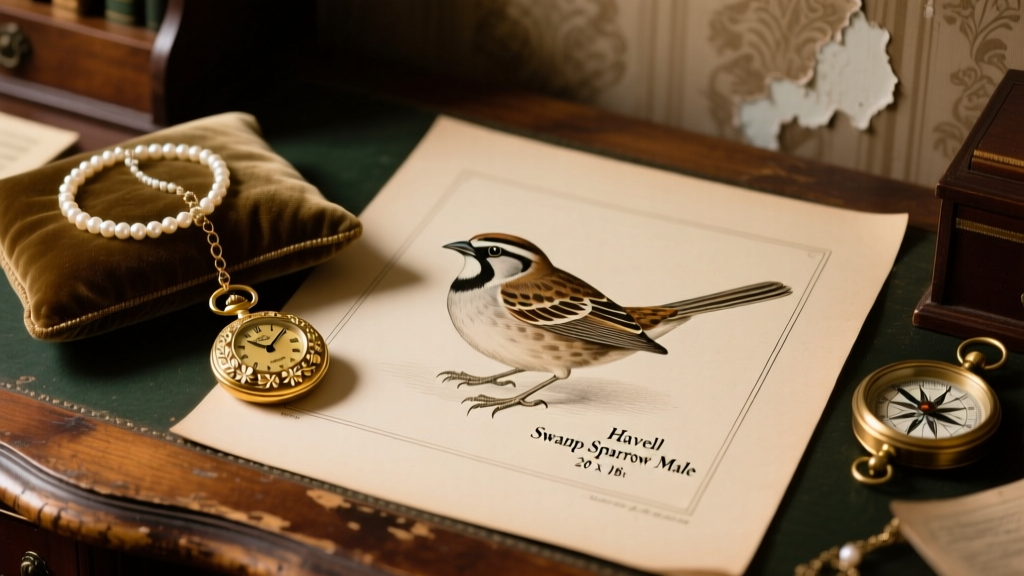
Havell’s Swamp Sparrow Male (1929): A Rare Ornithological Print from the Audubon Legacy
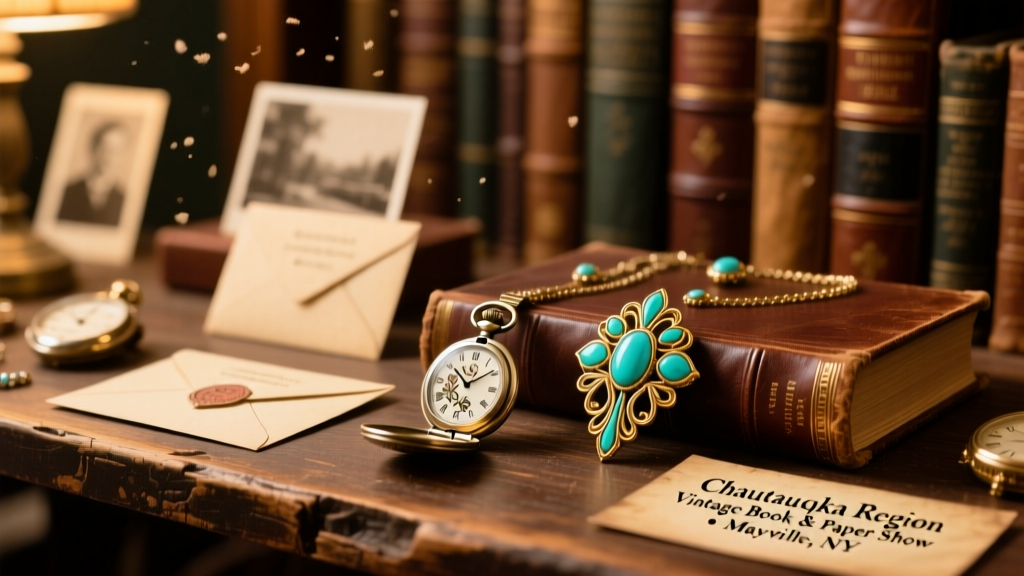
Chautauqua Region Vintage Book and Paper Show: A Collector’s Haven in Mayville, New York
Contemporary Art: Market Dynamics, Material Innovation, and the Resurgence of Craft in Post-2010 Collecting
Feldhoff & Co. Stoneware Jug: A Rare 1-Gallon Pennsylvania Salt-Glazed Artifact from Shamokin, c. 1890–1915

Soaky Wolfman Blue: Decoding the Enigmatic Vintage Watch Phenomenon
Carved Oval Marble Top Center-Column Table: Provenance, Craftsmanship, and Market Context of a Mid-Century American Design
Adriance Platt & Co. 1888 Poughkeepsie Catalog: A Rare Window into Gilded Age Jewelry Commerce

How To Save Money So You Can Buy More Antiques: A Practical Strategy for Collectors
Cup Plates with Cadmus Trefoil Border: The Dark Blue Staffordshire Wood Pattern — A Collector’s Guide to Rarity, Provenance, and Value