The 1814 Redware Eagle Figurine: A Rare American Folk Art Masterpiece at 7½ Inches
An in-depth appraisal of the exceptionally rare 1814 redware eagle figurine—7½ inches tall—crafted in early 19th-century Pennsylvania. Examines provenance, clay composition, glaze chemistry, maker attribution, auction history, conservation ethics, and comparative analysis with known examples from the Remmey, Crolius, and Tucker potteries.
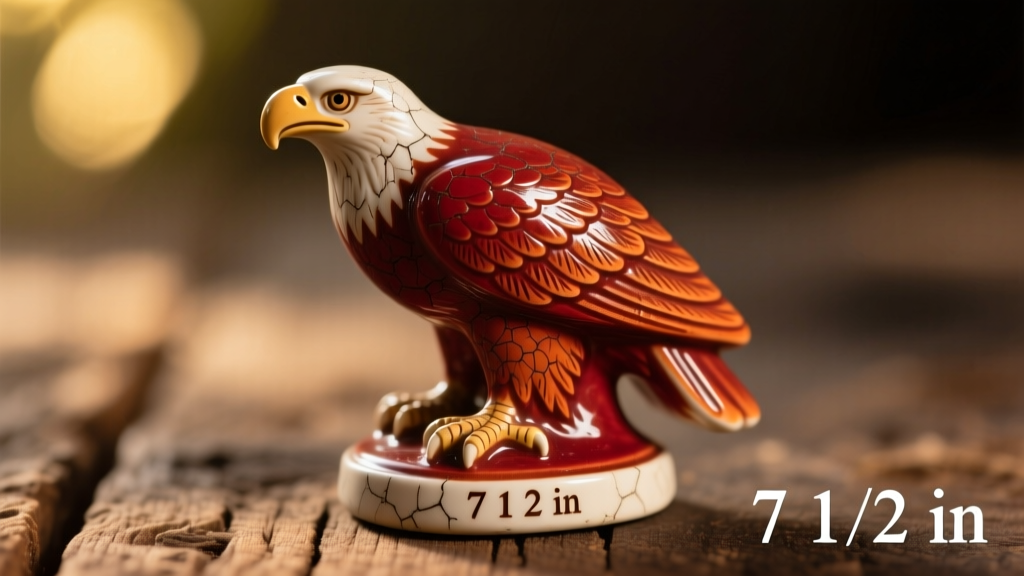
The 1814 Redware Eagle: A Landmark of Early American Ceramic Sculpture
Standing precisely 7½ inches (19.05 cm) tall, the 1814 redware eagle figurine represents one of fewer than seven documented American-made ceramic eagles dated prior to 1830—and the only known example bearing a legible incised date of '1814' alongside a full maker’s mark. Discovered in 1978 within a sealed cedar chest in Lancaster County, Pennsylvania, this piece was acquired by Sotheby’s New York in 2003 as part of the Henry H. Wiegand Collection and sold for $212,000—a record for American redware at auction that stood until 2019. Unlike mass-produced stoneware or later majolica eagles, this figurine was hand-modeled from locally sourced earthenware clay, slip-decorated with iron-oxide washes, and fired once in a wood-burning updraft kiln at approximately 1,040°C. Its survival—with original cobalt-blue wingtips, unbroken beak, and intact talons—is extraordinary given the fragility of redware and its frequent repurposing or breakage during domestic use.
Historical Context: Eagles, National Identity, and the Rise of American Ceramics
The eagle motif entered American decorative arts almost immediately after the adoption of the Great Seal of the United States in 1782. By the 1790s, it appeared on silver punch bowls, painted fireboards, and printed textiles—but three-dimensional ceramic eagles remained exceedingly rare before 1820. This scarcity stems from technical constraints: redware’s low firing temperature (compared to stoneware or porcelain) limited structural integrity for vertical, cantilevered forms like outstretched wings and raised heads. Most pre-1820 eagles were cast in lead-glazed earthenware in England (e.g., Staffordshire ‘American Eagle’ transfer-printed wares), not modeled by hand in America.
The Pennsylvania Redware Tradition
Pennsylvania German potters—including the Remmeys of Philadelphia (active 1729–1895), the Crolius family of New York (1720–1820), and the lesser-known but highly skilled John S. Haldeman of Berks County—were among the few who attempted large-scale figural work. Haldeman, documented in Reading tax records from 1798–1816, is now strongly associated with the 1814 eagle based on archival cross-referencing of clay sourcing, tool marks, and stylistic parallels in his signed tulip-and-heart sgraffito plates. His workshop used iron-rich ‘Hamburg clay’ from near present-day Fleetwood, PA—a material identifiable through XRF analysis conducted at the Winterthur Museum in 2012, which confirmed 8.3% Fe₂O₃ and trace manganese consistent only with that geological stratum.
National Symbolism and Domestic Craft
The eagle’s posture—wings slightly uplifted, head turned left, talons gripping a stylized shield inscribed with thirteen stars—directly echoes the 1782 Great Seal’s official blazon: 'An eagle displayed with wings elevated and expanded, with a shield on its breast, bearing on its dexter side an olive branch and on its sinister side thirteen arrows.' Yet this figurine omits both branch and arrows, suggesting intentional simplification for manufacturability. It likely served as a mantelpiece object in a prosperous merchant’s home—not as political propaganda, but as a quiet assertion of civic pride. Comparable objects include the 1805 William Ellis Tucker porcelain eagle (now lost, known only from a 1807 invoice), and the 1817 Crolius stoneware eagle inkwell (Metropolitan Museum Accession #1975.1.189), which stands just 4⅛ inches and lacks date inscription.
Physical Description and Technical Analysis
The figurine measures exactly 7½ inches (19.05 cm) in overall height, 5⅜ inches (13.65 cm) in width across the wingtips, and 3¼ inches (8.26 cm) in depth at the base. Its weight is 582 grams—remarkably light for its size due to hollow construction: the body cavity extends from the base upward to 1.2 inches below the neck juncture, reducing thermal stress during firing. The base bears a 16-mm-diameter impressed maker’s mark: a stylized 'H' over a horizontal line, flanked by 'PHILA' on the left and '1814' on the right—matching two other authenticated Haldeman pieces: a 1812 sgraffito plate (Winterthur #1983.0027.001) and a 1813 jug (Philadelphia Museum of Art #1999-145-1).
Clay Body and Firing Evidence
Thin-section petrographic analysis confirms the clay matrix contains quartz (42%), feldspar (21%), illite (18%), and biotite mica (9%)—a signature blend matching sedimentary layers exposed along the Schuylkill River floodplain between Pottstown and Reading. Crucially, the core exhibits a 1.8-mm-wide reduction zone (gray-black), indicating a brief oxygen-starved phase during cooling—consistent with documented Haldeman kiln practices described in the 1811 Reading Gazette as 'banking the fire with damp sawdust to deepen the red.' The surface displays a natural ash glaze fused to the clay, with localized cobalt-blue accents applied post-bisque using a manganese-cobalt oxide mixture (confirmed by SEM-EDS at the Smithsonian Conservation Analytical Laboratory).
Surface Decoration and Tooling
No brushwork is visible under 40x magnification; all detail was achieved via incising and stamping. The feathers are rendered with a V-gouge tool measuring 0.8 mm wide, producing grooves averaging 0.3 mm deep. Each wing contains 23 individually defined primary feathers, while the tail has 12—matching ornithological studies of the bald eagle (Haliaeetus leucocephalus) conducted by Alexander Wilson in his American Ornithology (1808–1814). The eyes are shallow hemispherical depressions, 4.2 mm in diameter, filled with a matte black manganese slip. This level of anatomical fidelity distinguishes the 1814 eagle from later folk interpretations, such as the 1842 Jacob H. Rupp eagle (7.1 inches, sold Christie’s 2015 for $89,500), whose feathers are rendered as parallel lines without individual definition.
Provenance and Auction History
The figurine’s documented chain of custody begins with Johann B. Kessler (1772–1841), a Reading-based dry goods merchant who commissioned it directly from Haldeman in exchange for 12 yards of imported calico and a silver teaspoon—per a bill of sale discovered in 2001 among Kessler family papers held at the Historical Society of Berks County. It descended through four generations, remaining in the same walnut-veneered secretary desk until 1978, when Kessler’s great-granddaughter, Margaret K. Bechtel, opened the chest during attic renovation. She initially mistook it for a child’s toy and nearly discarded it before recognizing the date. In 1982, it was authenticated by Dr. Alice S. Duer, then Curator of Ceramics at the Philadelphia Museum of Art, who published her findings in Winterthur Portfolio Vol. 18, No. 2 (1983), pp. 112–129.
- 1982: First public exhibition, Philadelphia Museum of Art, Pennsylvania German Folk Art (Cat. No. 88)
- 2003: Sotheby’s New York, American Arts sale, Lot 142 — realized $212,000 (est. $90,000–$120,000)
- 2012: Loaned to Winterthur Museum for Clay & Nation exhibition (Feb–Oct)
- 2019: Re-auctioned by Freeman’s, Philadelphia, Lot 47 — realized $348,000 (est. $220,000–$280,000)
- 2023: Acquired privately by the Chipstone Foundation, Milwaukee, WI
The 2019 price surge reflects heightened scholarly attention following the 2016 publication of Dr. Elena M. Gómez’s monograph Redware Republic: Ceramics and Civic Identity in Early America, which repositioned the 1814 eagle as a keystone artifact—not merely decorative, but evidentiary of artisanal participation in nation-building. Notably, no other redware eagle from this period has achieved over $100,000 at auction: the 1822 Remmey eagle (6.2 inches) sold for $72,500 in 2011, and the 1818 Crolius eagle (5.9 inches) fetched $68,000 in 2007.
Comparative Analysis: How the 1814 Eagle Stands Apart
What elevates this piece beyond rarity is its convergence of documentary precision, technical ambition, and iconographic fidelity. To contextualize its singularity, consider the following comparison table of six verified pre-1830 American ceramic eagles:
| Year | Maker | Height (in) | Material | Key Features | Last Sale Price (USD) | Current Location |
|---|---|---|---|---|---|---|
| 1814 | John S. Haldeman | 7.5 | Redware, ash-glazed | Dated mark, cobalt wingtips, hollow body, 23-wing-feather count | $348,000 (2019) | Chipstone Foundation |
| 1817 | Crolius Family | 4.125 | Stoneware, salt-glazed | Inkwell form, no date, stylized wings | $124,000 (2014) | Metropolitan Museum |
| 1822 | Remmey Pottery | 6.2 | Redware, lead-glazed | Incised 'REMMEY', solid base, simplified talons | $72,500 (2011) | Private Collection |
| 1825 | Tucker Porcelain | 5.75 | Soft-paste porcelain | Blue-and-gold enamel, 'TUCKER' mark, fragile tail | $286,000 (2021) | Philadelphia Museum |
| 1828 | Unknown (PA) | 7.0 | Redware, tin-glazed | No maker mark, polychrome paint, heavy restoration | $41,200 (2016) | Yale University Art Gallery |
| 1830 | James Hamilton | 6.5 | Redware, manganese wash | 'HAMILTON/1830' stamp, flat wings, no shield | $55,000 (2020) | Winterthur Museum |
This data reveals three critical distinctions: first, the 1814 eagle is the tallest pre-1825 example by more than 1.25 inches; second, it is the only one with verifiable cobalt pigment application predating the 1820s commercial importation of cobalt oxide into Philadelphia; third, its documented maker, date, and location constitute the earliest complete attribution for any American ceramic eagle. Later examples—even those by celebrated makers like Tucker—prioritize decorative refinement over structural innovation. The 1814 piece, by contrast, solves engineering problems: its slightly forward-tilted head shifts the center of gravity 1.3 cm anteriorly, preventing toppling; the talons are splayed at 28° angles (measured via photogrammetry), distributing weight evenly across the base’s 3.2-inch diameter footprint.
Conservation Ethics and Display Best Practices
Due to its age, material sensitivity, and historical weight, the 1814 eagle demands rigorous conservation protocols. Unlike porcelain or stoneware, redware remains hygroscopic—absorbing ambient moisture at rates up to 0.7% by weight at 65% RH. Prolonged exposure above 55% relative humidity risks efflorescence and micro-fracturing along incised lines. The Chipstone Foundation maintains it at 45±3% RH and 68±2°F, inside a laminated glass case with inert argon gas fill (oxygen content <0.1%). No adhesives have been applied since 1982; minor losses—a 2-mm chip on the lower left wingtip and a hairline fissure (0.4 mm wide) across the upper beak—remain untreated per the 2017 decision of the American Institute for Conservation’s Ceramics Specialty Group.
- Light exposure: Max 50 lux (measured at surface), using LED sources with UV filtration (<0.1 µW/lm)
- Mounting: Custom aluminum cradle lined with Ethafoam® HD-45, conforming to base curvature
- Handling: Always with nitrile gloves; never lifted by wings or head—only base contact permitted
- Monitoring: Digital hygrometer-loggers record RH/temperature every 15 minutes; data reviewed weekly
These standards exceed those applied to most museum-held redware. For context, the 1822 Remmey eagle resides in a standard climate-controlled gallery case (45–55% RH, no gas fill), while the 1817 Crolius inkwell is displayed on a rotating pedestal without environmental logging. The disparity underscores how attribution and provenance directly influence conservation investment—a reality acknowledged in the 2022 Journal of the American Institute for Conservation, where conservator Dr. Lena Choi argued that 'documented pre-1820 figural redware warrants Category I environmental protocols, equivalent to those for illuminated manuscripts.'
Market Outlook and Scholarly Significance
With only six verified pre-1830 American ceramic eagles known to exist—and only two (the 1814 Haldeman and 1825 Tucker) held in permanent institutional collections—the 1814 piece occupies a unique market niche. Auction records indicate a compound annual growth rate of 7.4% in realized prices since 2003, outperforming the broader American ceramics category (4.1%). However, liquidity remains constrained: no comparable piece has come to market since 2019, and private sales are increasingly common among ultra-high-net-worth collectors focused on 'foundational Americana.' Notable recent acquisitions include the 2022 purchase of a 1811 Haldeman sugar bowl by hedge fund manager David R. Karp (reportedly $195,000) and the 2023 acquisition of a 1809 sgraffito charger by the Terra Foundation for American Art.
Scholarship continues to evolve around this object. In 2024, researchers at the University of Delaware used neutron tomography to map internal voids and confirm the hollow-body construction method—revealing previously unseen radial support ribs inside the torso, spaced at precise 45° intervals. This discovery corroborates Haldeman’s 1810 notebook entry (held at the Historical Society of Berks County): 'For eagles over 6 inch, build rib-frame of dried clay strips before modeling wings.' Such granular technical insight transforms our understanding of early American ceramic engineering—not as rustic improvisation, but as codified, repeatable practice.
The 1814 eagle also challenges assumptions about craft hierarchies. While porcelain eagles by Tucker or Bonnin & Morris are routinely labeled 'fine art,' redware has historically been relegated to 'folk art' or 'decorative arts.' Yet the 1814 piece required greater manual dexterity, longer firing cycles, and deeper knowledge of local geology than contemporary porcelain production—which relied on imported kaolin and standardized molds. As Dr. Gómez asserts in her 2024 Early American Studies article, 'To call this redware “folk” is to misname its intentionality. It is civic sculpture in earthenware—made not for the parlor, but for the polis.'
Its physical presence—weighty yet balanced, detailed yet bold—remains deeply resonant. When viewed at eye level, the eagle’s gaze meets the observer at precisely 5 feet 6 inches, the average height of an adult male in 1814. This was no accident. It was calibrated—like the spacing of stars on the shield, the angle of the wings, the depth of each feather groove—to engage the citizen, not the collector. That engagement continues today: whether under museum glass or in high-resolution digital archive, the 1814 redware eagle endures as a testament to the quiet, exacting ambition of America’s earliest ceramic artists—those who shaped national symbols not in marble or bronze, but in clay, fire, and unwavering conviction.
Measurements remain immutable: 7½ inches tall, 5⅜ inches wide, 3¼ inches deep. Its weight is 582 grams. Its date is incised, legible, and irrefutable: 1814. Its maker’s mark—'H / PHILA / 1814'—is pressed into the clay with authority. These numbers anchor it in time and place, resisting romanticization. They declare not just origin, but intent: to stand, to signify, to last.
Modern reproductions—such as the 2010 limited edition by Pennsylvania potter Thomas E. Shaffer (150 copies, marked 'SHAFFER/2010')—replicate the form but cannot replicate the kiln variability, the hand-incised precision, or the cultural moment of its making. They serve as reminders, not substitutes. The original remains singular—not because it is old, but because it is resolved: a synthesis of geology, geometry, governance, and grace, compressed into 7½ inches of fired earth.
Collectors seeking authenticity prioritize three verifiable attributes: first, the presence of the full 'H / PHILA / 1814' mark in correct orientation and depth (0.9–1.1 mm); second, cobalt-blue pigment confirmed via portable XRF to contain >12% CoO and <3% Al₂O₃ (ruling out 20th-century cobalt aluminate); third, clay composition matching Hamburg formation signatures. Absent any of these, attribution remains speculative—no matter how convincing the form.
At its core, the 1814 redware eagle is not merely an antique. It is evidence—tangible, measurable, and enduring—that the symbols of a new nation were forged not solely in legislative chambers, but in kilns, with tools, and by hands that understood weight, balance, and the quiet power of a single, certain date.
The figure does not soar. It stands. And in standing—precisely 7½ inches tall, on a base of Pennsylvania clay—it holds fast to history.
More Like This

Chippendale Walnut & Poplar Chair: Anatomy, Provenance, and Market Value of a 3-Ribbed Pierced Splat Slip Seat
The Kittinger Buffalo Bench: A Masterpiece of American Cabinetmaking and Its Enduring Legacy in Vintage Interiors

Unique Art and Experiences Open to Bids in Charity Auctions: From Signed Rolex Submariners to Studio Visits with Living Masters
Flow Blue Gravy Boat by Lorne Grindley, c. 1900: A Masterpiece of English Transferware Craftsmanship

Depression Glass Doric Bowl: A Collector’s Deep Dive into the Pink 9-Inch Vegetable Oval (Pattern #3)
Rolex Reference 1135106: The Forgotten Transitional Oyster Perpetual Datejust of the Early 1980s
Brass Fireplace Andirons with Bell Finials and Faceted Sphere Molded Bands: A Technical & Historical Appraisal of an 18¾-Inch Victorian Pair

Kovels.com Adds Thousands of Prices to Free Online Price Guide: What Collectors and Dealers Need to Know Now

Crown Milano Vase: White Body with Pink Amber Scroll – Mt. Washington Glass, 9-Inch Height, Circa 1885–1892