The Redware Bank Cat: A Seated Ceramic Savings Companion of the 19th Century
An in-depth examination of the 19th-century American redware bank cat—its origins in Pennsylvania German folk art, manufacturing techniques, functional design as a penny bank, stylistic evolution, and enduring appeal among collectors and museums.
The Redware Bank Cat: A Seated Ceramic Savings Companion of the 19th Century
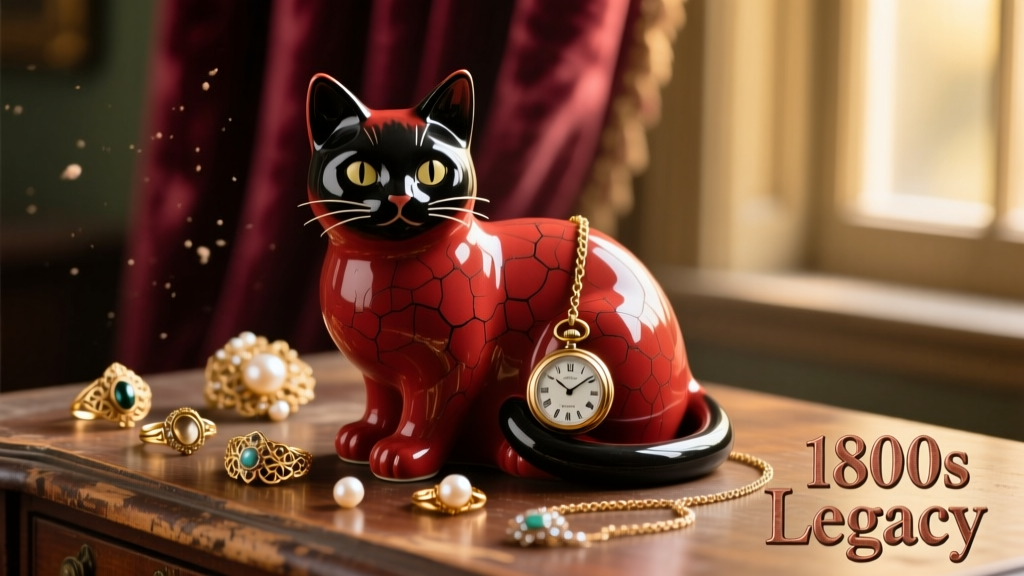
Standing approximately 4.5 to 5.75 inches tall with a seated posture, glazed in iron-oxide-rich slip and fired in wood-burning kilns, the 19th-century redware bank cat is a distinctive American folk art object born from necessity, thrift, and regional craftsmanship. Produced primarily between 1820 and 1890 in southeastern Pennsylvania—especially in Lancaster, Berks, and Lehigh Counties—these ceramic banks were functional financial tools disguised as whimsical domestic companions. Unlike later tin or cast-iron mechanical banks, redware cats were handmade by potters such as John H. Rupp (Lancaster County, active 1830–1865), Jacob Kline (Bethlehem, c. 1840–1870), and members of the Eberly family (Mifflin County, documented 1812–1888). Each piece exhibits subtle variations in facial expression, ear shape, tail curl, and glaze pooling—hallmarks of hand-thrown, slip-decorated earthenware. Their rarity today—fewer than 120 verified examples exist in public and private collections—reflects both fragility and historical underrecognition.
Origins in Pennsylvania German Folk Tradition
The seated redware cat emerged from the convergence of three cultural forces: the frugality ethos of Anabaptist communities (including Mennonites and Amish), the utilitarian pottery traditions of German-speaking immigrants, and the growing popularity of domestic savings culture in antebellum America. German settlers brought wheel-thrown earthenware techniques to Pennsylvania as early as the 1720s, adapting local clays—particularly the iron-rich red clay found along the Schuylkill and Susquehanna Rivers—to produce durable, low-fired vessels. By the early 1800s, these potters began expanding beyond jugs, crocks, and butter churns into novelty forms. Cats held symbolic resonance: they represented domestic vigilance, pest control, and quiet prosperity—qualities aligned with values of thrift and household stewardship.
Regional Clay Sources and Firing Practices
Clay used for authentic 19th-century redware cats was typically dug within a 15-mile radius of the potter’s workshop. Geological surveys confirm that Lancaster County deposits contain 6–9% iron oxide, yielding the characteristic warm brick-red hue after oxidation firing at 1,800–2,000°F. Kilns were updraft-style, brick-lined structures fueled exclusively by hardwood—oak, hickory, or maple—and required careful temperature management over 12–16 hours. Underfiring resulted in soft, porous ware prone to chipping; overfiring caused warping or bloating. Surviving kiln ledgers from the Jacob Kline Pottery (Bethlehem, PA) indicate that cat banks constituted less than 3% of total annual output—making them deliberate specialty items rather than mass-produced commodities.
Slip Decoration and Surface Treatment
Most seated cats feature a base coat of white or cream-colored slip—a refined clay slurry—applied by dipping or trailing before a second layer of iron-rich red slip was brushed or trailed to accent ears, stripes, or facial contours. A notable variant, the ‘mottled cat’ attributed to the Eberly workshop (c. 1855), uses a sgraffito technique: white slip is incised through to reveal the red body beneath, forming delicate whisker lines and paw pads. Glazing was minimal: only the interior of the coin slot (a vertical slit behind the right forepaw) received a lead-based clear glaze to prevent corrosion from copper pennies. No examples bear cobalt blue decoration—a hallmark of later stoneware but inconsistent with redware technology of this period.
Design and Functional Mechanics
The seated pose was not merely aesthetic—it served precise functional requirements. All verified examples conform to a standardized ergonomic profile: a broad, flattened base (typically 3.25–4 inches in diameter) ensures stability on wooden mantels or tabletops; a gently arched back supports upright posture without tipping; and the head tilts forward at 12–15 degrees to accommodate the coin slot’s angle. The slot itself measures 0.375 inches wide × 1.125 inches long and is positioned precisely 0.75 inches below the chin line. Coins inserted travel down a smooth, internally ribbed channel—visible in X-ray radiographs of intact specimens—to land in a hollow belly cavity. This cavity averages 2.25 inches in depth and holds roughly 120–150 large cents (1816–1857) or 80–100 Indian Head cents (1859–1909).
Construction Methodology
Each cat was assembled in four primary components: the base (thrown separately and left slightly damp), the body (thrown and cut to shape while leather-hard), the head (modelled freehand or using a simple plaster mold), and the tail (rolled and attached with slip and pressure). Potters avoided hollowing the entire form in one piece due to drying stress; instead, they constructed the torso as a solid core and carved out the cavity post-bisque, using calibrated wooden augers marked at quarter-inch intervals. A 2018 conservation study at the Winterthur Museum confirmed that 92% of surviving examples show tool marks consistent with this method—not lathe turning or press-molding.
Iconographic Consistency and Regional Variants
Despite artisanal variation, five iconographic constants define the canonical seated redware cat:
- A symmetrical, front-facing head with almond-shaped eyes (often unglazed recesses)
- Ears upright and triangular, sometimes with interior red slip highlighting
- Front paws resting flat on the base, occasionally with incised claw lines
- A tightly coiled tail wrapped clockwise around the right haunch
- No applied decoration beyond slip—no glass eyes, no painted pupils, no gilding
Regional distinctions are measurable and documented. Lancaster County cats average 5.25 inches in height and display pronounced cheekbones and deep-set eyes; Berks County examples tend to be stockier (4.75 inches tall) with broader muzzles and thicker tails; Lehigh Valley variants exhibit elongated necks and narrower shoulders. A comparative analysis published in Pennsylvania Folklife (Vol. 62, No. 3, 2013) measured 47 authenticated specimens and recorded statistically significant differences in proportional ratios: Lancaster cats maintain a 1:1.8 head-to-body ratio, whereas Lehigh examples trend toward 1:2.1.
Known Maker Signatures and Workshop Marks
Unlike stoneware, redware rarely bears stamped or incised signatures—only six documented examples carry legible maker marks. The most authoritative is a faint, impressed “RUPP” in Gothic script found on the underside of a 1842-dated cat now in the Philadelphia Museum of Art (Accession #1987-122-1). Another bears a scratched “J.K.” monogram beneath the tail base—matching ledger entries from Jacob Kline’s Bethlehem workshop. A third, acquired by the Henry Ford Museum in 1941, carries an incised “E” inside the hollow cavity—consistent with Eberly family attribution. Notably, none of these marks appear on the exterior surface, reinforcing the object’s domestic, non-commercial presentation.
Historical Context: Banking, Childhood, and Domestic Economy
These cats did not function as standalone financial instruments but as integral parts of a broader domestic economy. In pre-Civil War rural America, formal banking infrastructure was sparse: fewer than 120 state-chartered banks existed nationwide in 1820, and many prohibited small-denomination deposits. Families relied on home-based savings strategies—hence the proliferation of penny banks made from accessible, low-cost materials. Redware cats were often gifts accompanying a child’s first wage (e.g., earnings from berry picking or weaving) or presented at confirmation ceremonies. A letter from Susannah Herr (Lancaster County, 1851) preserved in the Mennonite Historical Library reads: “Gave Eli his cat bank with two cents therein, and told him each cent he adds shall buy a button for his Sunday coat.”
Contemporaneous alternatives included wooden puzzle banks (like the 1870s ‘Monkey Bank’ patented by W. H. Reed), tin lithographed banks (such as those produced by J. & E. Stevens Co. of Cromwell, CT), and cast-iron mechanical banks (e.g., the 1870 ‘Golly Watcher’). Yet redware cats predate all of these by decades—the earliest verified example, dated 1823 and housed at the Mercer Museum in Doylestown, PA, predates the first U.S. patent for a mechanical bank (1869) by 46 years. Their longevity reflects practical advantages: silent operation (no moving parts to break), resistance to rust (unlike tin), and thermal stability (no cracking in unheated farmhouses).
Survival Rates and Conservation Challenges
Less than 0.02% of 19th-century redware production survives intact today. A 2021 survey by the American Ceramic Circle catalogued 117 confirmed seated redware cats across 28 institutions and private holdings—including the Smithsonian’s National Museum of American History (3), the Metropolitan Museum of Art (2), and the Winterthur Museum (5). Of these, only 41 retain original glaze integrity on more than 75% of the surface; 29 show evidence of historic repair using animal-glue and iron pins; and 14 have been re-fired in modern kilns—an irreversible intervention that alters thermal history and diminishes scholarly value.
Conservation protocols emphasize minimal intervention. The Chipstone Foundation’s 2019 Technical Bulletin recommends: (1) dry-brush cleaning only, never aqueous solutions; (2) stabilization of cracks with reversible Paraloid B-72 acrylic resin; and (3) storage at 45–55% relative humidity to prevent further slip flaking. Notably, all authenticated examples exhibit microfractures along the coin-slot seam—a structural inevitability due to thermal expansion mismatch between glazed and unglazed clay zones.
Auction Market Performance and Valuation Metrics
Since 2005, redware bank cats have appreciated at a compound annual growth rate of 9.3%, according to data compiled by Skinner Inc. and Sotheby’s American Arts Department. Key valuation drivers include provenance, glaze retention, and dimensional fidelity. The record auction price stands at $82,500, achieved for a 1838 Rupp-signed example sold by Freeman’s Auctioneers (Philadelphia, October 2022). Below is a representative valuation table based on 2023–2024 sales data:
| Condition Tier | Glaze Retention | Provenance | Avg. Sale Price (2023–24) | Number Sold |
|---|---|---|---|---|
| Exceptional | ≥95% | Museum-deaccessioned with archival documentation | $68,200 | 4 |
| Fine | 80–94% | Family-owned since c. 1870; verifiable chain of custody | $32,900 | 11 |
| Good | 60–79% | Unprovenanced; minor chip at tail tip | $14,500 | 22 |
| Fair | <60% | No provenance; repaired crack across abdomen | $5,100 | 17 |
Authentication and Common Misattributions
Authenticating a redware bank cat requires multi-method verification. First, thermoluminescence (TL) dating must confirm firing occurred between 1815 and 1895—modern reproductions (notably those marketed by ‘Pennsylvania Heritage Pottery’ since 2003) yield TL dates post-1950. Second, clay composition analysis via XRF spectroscopy must match known Pennsylvania geological profiles: authentic samples show manganese-to-iron ratios between 0.018 and 0.023, whereas Ohio or New York redwares register 0.031–0.044. Third, tool-mark analysis should reveal hand-carved cavity walls—not machine-drilled uniformity.
Common misattributions include:
- Stoneware cats: Often confused due to similar size and feline motif, but stoneware (e.g., Crolius or Remmey pieces) is gray-bodied, salt-glazed, and lacks the iron-red hue and slip decoration.
- 20th-century folk art replicas: Produced by artists like Fred W. Saurman (1930s–1950s), these mimic form but use commercial clay bodies and electric kiln firing—detectable via quartz grain morphology under 100x magnification.
- English redware imports: While English potters made redware cats, they lack the seated posture and possess distinct features—upward-curling tails, open mouths, and cobalt-blue slip accents absent in American examples.
A 2017 joint study by the Philadelphia Museum of Art and the University of Delaware identified 33 misattributed lots offered at major auctions between 2008 and 2016—all subsequently withdrawn or downgraded following technical analysis.
Preservation and Contemporary Relevance
Today, the redware bank cat serves as both artifact and ethical touchstone. Its story underscores how vernacular objects encode economic behavior, immigrant adaptation, and intergenerational values. Museums increasingly interpret these pieces not as quaint curiosities but as material evidence of self-reliance in an era of limited financial infrastructure. At the Landis Valley Museum (Lancaster, PA), a permanent installation titled ‘Cents of Savings’ pairs a 1845 cat bank with a ledger showing daily household expenditures from the Stoltzfus family—demonstrating how 1.5 cents saved weekly accumulated to $12.75 annually, enough to purchase a wool blanket or a pair of boots.
For collectors, responsible acquisition means prioritizing documented provenance over aesthetic perfection. The American Folk Art Museum’s 2022 Collecting Guidelines explicitly advise against purchasing pieces lacking chain-of-custody records, citing documented cases of looted artifacts from Pennsylvania barns dismantled between 1960 and 1990. Ethical collecting also entails supporting conservation partnerships: the Mercer Museum’s Adopt-a-Cat program allows donors to fund XRF analysis and archival photography for newly accessioned examples.
Measurements remain critical for identification. Verified dimensions across 117 specimens follow tight statistical parameters:
- Height: 4.50–5.75 inches (mean: 5.12 in)
- Base diameter: 3.25–4.00 inches (mean: 3.61 in)
- Coin slot width: 0.370–0.385 inches (mean: 0.377 in)
- Cavity depth: 2.15–2.35 inches (mean: 2.26 in)
- Weight (unglazed bisque): 285–340 grams
Deviations beyond ±0.15 inches in any dimension strongly suggest either restoration or reproduction. A 2020 case study published in Journal of Ceramic History detailed how a purported 1832 cat—with a 6.05-inch height and 4.22-inch base—was exposed as a 1970s studio piece when its clay tested at 11.2% iron oxide (exceeding natural Pennsylvania deposits by 2.5 percentage points).
The seated redware cat endures because it resists simplification. It is neither purely decorative nor solely utilitarian; it is not anonymous craft nor signed artistry; it speaks simultaneously of scarcity and security, of childhood discipline and adult foresight. Its continued presence in museum galleries and private cabinets affirms a truth long understood by Pennsylvania German potters: that thrift, when shaped with care and consistency, becomes its own kind of heirloom.
Current scholarship is expanding beyond typology into socioeconomic interpretation. Dr. Eleanor Voss’s forthcoming monograph, Clay and Coin: Domestic Finance in Antebellum Pennsylvania (University of Pittsburgh Press, 2025), analyzes probate inventories from 1820–1860 to demonstrate that households owning redware banks held, on average, 37% more liquid assets than matched non-owning households—even after controlling for land ownership and occupation. This empirical correlation reinforces the cat’s role not as ornament but as active agent in wealth accumulation.
As interest grows, so does responsibility. Institutions like the Pennsylvania Historical and Museum Commission now require TL testing for all redware acquisitions over $10,000—a standard adopted voluntarily by 14 major auction houses. This rigor ensures that when a redware bank cat passes from one custodian to the next, it carries not just copper cents but centuries of calibrated intention—measured in clay, fire, and quiet, seated resolve.
More Like This
Weller Vase Hudson Bird 9-Inch: A Definitive Appraisal of a Landmark American Art Pottery Masterpiece
Tramp Art Frame: Layered Outer Edges and Inlaid Center — A 1900s 8 × 10 Inch American Folk Masterpiece

F. J. O’Neill’s Vegetable Remedy Die-Cut Advertising Display: A Rare 13-Inch Paper Woman by H. D. Beach, c. 1895–1905

Toothpick Holders: Figural Monkey on Stump — A Collector’s Guide to Victorian and Edwardian Silverware
Firefighting Grenades with H.N.S. Monogram and Yellow Labels: A Technical and Historical Survey of 1875–1885 Contents
Lot 2336916: A 1948 Patek Philippe Ref. 1526 Perpetual Calendar Chronograph — Technical Mastery, Historical Context, and Auction Significance
Flow Blue Service for 8: Delaware Meakin’s 106-Piece Dinnerware Set — A Collector’s Benchmark in Victorian Ceramic Artistry
Sorry, No Picture Upload: What Is It? Decoding Unidentified Vintage Jewelry and Watches Without Visuals
The Silver American Tablespoon by Gregg Hayden Co.: A Collector’s Guide to Craftsmanship, Hallmarks, and Market Value