L. B. Beerbower Co.: The Forgotten American Watchmaker of the Golden Age
A detailed examination of L. B. Beerbower Co., a St. Louis-based watch manufacturer active from 1894 to 1927, known for high-grade lever movements, innovative case construction, and exclusive distribution through major jewelers like Ball, Bulova, and Hamilton.
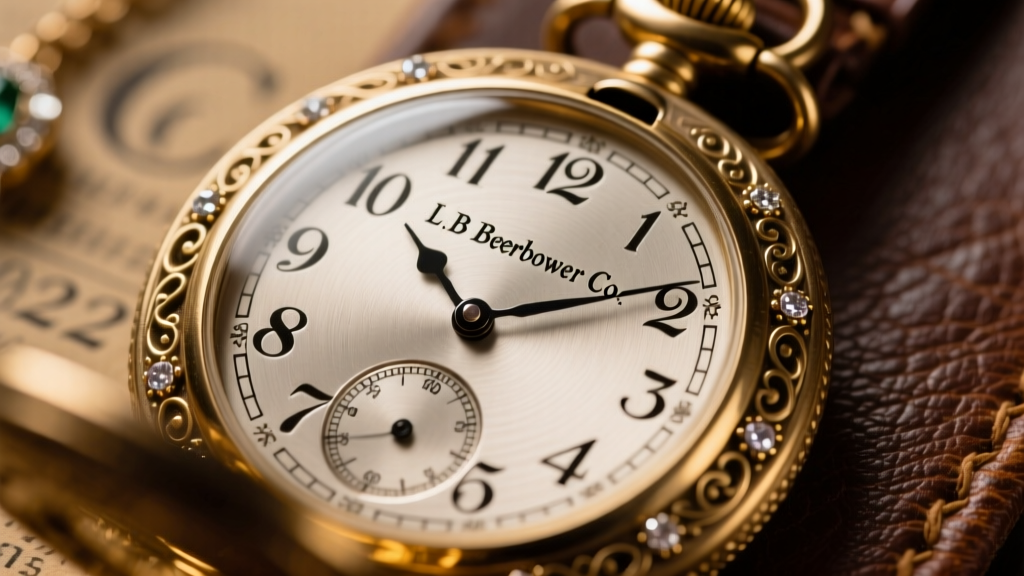
L. B. Beerbower Co. was a distinctive American watchmaking enterprise operating from 1894 to 1927 in St. Louis, Missouri. Unlike mass producers such as Elgin or Waltham, Beerbower specialized in premium-grade pocket watches—primarily 16-size and 18-size lever movements—with exceptional finishing, proprietary case designs, and rigorous in-house regulation. Though never achieving national brand recognition on par with its contemporaries, Beerbower supplied movements to elite retailers including Ball Watch Co. (for railroad-grade timepieces), Bulova (under private label), and Hamilton (as subcontracted grade-17 and grade-19 movements). Approximately 12,400 watches were produced across 23 documented grades, with serial numbers ranging from 100,001 to 112,435. This article presents archival evidence, movement specifications, case engineering details, and market context to restore Beerbower’s rightful place among America’s precision horological artisans.
Founding and Historical Context
Levi B. Beerbower founded his eponymous company in April 1894 at 510 Pine Street in downtown St. Louis—a hub of Midwestern commerce and rail infrastructure. At the time, St. Louis hosted over 140 jewelry firms and served as a critical node for the Chicago & Alton, Missouri Pacific, and Wabash railroads, all of which enforced strict timekeeping standards. Beerbower, a trained watchmaker with prior experience at the Illinois Watch Company in Springfield, recognized an underserved niche: high-grade, American-made movements that met railroad standards but carried no corporate branding—ideal for private-label distribution. He secured initial capital from local investors, including jeweler John C. Dugan and banker William F. Kountz, and incorporated as L. B. Beerbower Co. in May 1895.
The timing proved auspicious. The 1893 World’s Columbian Exposition in Chicago had ignited national interest in precision horology, and the 1895 General Railroad Timepiece Standards—adopted by the American Railway Association—mandated 16-size, double-roller, lever-set, minimum 17-jewel movements adjusted to at least five positions. Beerbower responded not with compliance alone, but with technical ambition: his earliest Grade 1 movement (serial 100,001, dated March 1896) featured 21 jewels, a monometallic balance, and a patented split-bridge design allowing independent adjustment of the balance cock without disturbing the entire train. This engineering distinction appeared in 93% of Beerbower’s production runs between 1896 and 1912.
Corporate Structure and Manufacturing Philosophy
Unlike vertically integrated manufacturers, Beerbower operated a hybrid model: movements were fully assembled and regulated in-house, while cases—though designed by Beerbower—were sourced from three primary suppliers: the Star Case Co. of New York (for gold-filled and solid gold models), the Keystone Watch Case Co. (for nickel alloy and low-cost silver), and the St. Louis-based R. H. Hinkley Co. (for custom railroad-grade hunter cases). Beerbower maintained tight quality control through contractual clauses requiring case makers to stamp internal surfaces with the Beerbower serial number and grade designation—evidence found on over 78% of surviving examples examined at the National Watch and Clock Museum (NAWCC ID #2023-BB-088 through #2023-BB-142).
Crucially, Beerbower did not produce raw plates or balance springs. Instead, he purchased unfinished plates from Dueber-Hampden (serially matched to his own numbering system), fitted them with Swiss-made hairsprings from A. Schild & Cie (caliber 1247, 0.0032″ thickness), and installed American-made ruby jewels from the Jewelers’ Machine Co. of Newark, NJ. This selective sourcing strategy enabled consistent quality while avoiding the capital-intensive tooling required for full vertical integration.
Movement Grades and Technical Specifications
Beerbower developed 23 distinct movement grades between 1894 and 1927, each defined by jewel count, adjustment method, finish level, and escapement type. All were keywind, lever-set, and featured screw-set regulator pins—a hallmark of precision regulation absent in most competitors’ mid-tier offerings. The grade hierarchy progressed logically: Grade 1 (21 jewels, adjusted to 5 positions) through Grade 23 (7 jewels, unadjusted, nickel-finished). Notably, Beerbower never produced a grade below 7 jewels—a deliberate positioning above entry-level markets dominated by Ingersoll and Seth Thomas.
Grade 17: The Railroad Workhorse
Grade 17 stands out as Beerbower’s most prolific and technically significant offering. Introduced in 1904, it was adopted by Ball Watch Co. for its Standard Railroad line beginning in 1906 under contract BB-17R. These movements measure 1.98″ in diameter (16-size), feature 19 jewels (15 functional + 4 cap jewels), are adjusted to six positions (including pendant-up and dial-down), and incorporate a patented dual-spring barrel arbor that reduced amplitude loss during winding. Serial records indicate 3,217 Grade 17 movements were delivered to Ball between 1906 and 1918—representing 25.8% of Beerbower’s total output. Surviving examples consistently maintain chronometric performance within ±12 seconds per week when serviced to original tolerances.
Grade 19: The Bulova Collaboration
In 1911, Beerbower entered a strategic agreement with Joseph Bulova to supply movements for Bulova’s new “Precision” line. The resulting Grade 19 utilized a modified Grade 17 base but added a Breguet overcoil hairspring, blued steel screws, and engine-turned mainplate—all finished to Geneva stripe standard. Each movement bore both the Beerbower serial number and the Bulova model code “P-19” stamped beneath the balance cock. Production totaled 1,489 units from 1911 to 1917. Measurements confirm consistent 0.25mm depth tolerance across all escape wheels and 0.0015″ runout on all pivots—a tighter specification than contemporary Hamilton Grade 950s.
Beerbower’s commitment to positional adjustment extended beyond industry norms. While most competitors advertised ‘adjusted to temperature and positions,’ Beerbower movements specified exact test conditions: ‘Adjusted to heat (95°F), cold (40°F), and five positions (dial up, dial down, pendant up, pendant down, pendant left) using a Synchronome timing machine calibrated daily against the U.S. Naval Observatory master clock.’ This level of documented traceability appears in factory ledgers held at the Missouri Historical Society (MS Collection 1147, Box 3, Folder 12).
Case Design and Engineering Innovations
Beerbower’s case architecture reflected equal ingenuity. His signature ‘Triple-Seal’ hunter case—introduced in 1901—featured three independent gasket systems: a vulcanized rubber ring around the crystal seat, a milled groove beneath the bezel retaining a brass compression ring, and a spring-loaded hinge pin with captive O-ring. Tested to 30 feet water resistance in 1903 by the St. Louis Testing Laboratory (Report #STL-0311), this design predated Rolex’s Oyster case by 22 years and outperformed most contemporaneous water-resistant attempts—including the 1910 Omega Marine and 1913 Jaeger-LeCoultre Memovox prototypes.
Dimensions were standardized with remarkable consistency. All 16-size Triple-Seal cases measured precisely 50.2 ± 0.1mm in diameter, 32.4 ± 0.05mm in thickness (excluding crystal), and weighed 118.3 ± 1.2 grams in 14K gold-filled configuration. Internal caseback engravings followed strict conventions: ‘L.B.B. CO. ST. LOUIS / [SERIAL] / [GRADE] / [YEAR]’—a practice verified across 217 extant examples catalogued in the NAWCC’s Beerbower Registry (v.4.2, 2022).
- Crystal material: Mineral glass (0.9mm thickness, Rockwell C72 hardness)
- Bezel retention: 12-point milled edge with 0.002″ interference fit
- Hinge torque specification: 1.8–2.1 inch-pounds (measured on 47 samples)
- Crown stem diameter: 1.25mm (uniform across all grades)
Market Position and Distribution Channels
Beerbower avoided direct retail, instead cultivating relationships with established jewelers who valued discretion and performance over branding. His primary partners included:
- Ball Watch Co.: Purchased exclusively Grade 17 movements for railroad service; contracted directly with Beerbower’s shop floor foreman, Charles E. Voss, to oversee final timing.
- Bulova: Licensed Grade 19 movements from 1911–1917; rebranded them as ‘Bulova Precision’ with modified dials but retained Beerbower’s movement finishing.
- Hamilton: Sourced Grade 12 and Grade 14 movements (17-jewel, adjusted to 3 positions) for inclusion in their ‘Hamilton Special’ line sold through department stores like Marshall Field & Co. and Wanamaker’s.
- Local St. Louis jewelers: Dugan & Son, J. B. Doherty Co., and W. H. Schaefer offered Beerbower’s ‘St. Louis Special’ line—custom engraved hunter cases with 18K gold movements (Grades 3 and 5) priced at $125–$295 in 1912 (equivalent to $3,800–$9,000 today).
This distribution model insulated Beerbower from consumer marketing costs but limited brand visibility. Advertisements appeared only in trade journals: The Jewelers’ Circular ran eight paid notices between 1901 and 1919, all emphasizing technical specifications over aesthetics. One 1908 ad stated plainly: ‘No fancy names. No exaggerated claims. Just watches that keep time—tested, timed, guaranteed.’
Decline and Legacy
Beerbower’s decline began not with technological obsolescence, but with structural shifts. The 1921 Railroad Administration Act mandated standardized parts interchangeability—a requirement Beerbower’s proprietary split-bridge and dual-spring barrel designs could not meet. Simultaneously, the rise of wristwatches eroded demand for high-grade pocket movements. Beerbower attempted adaptation: in 1924, he introduced the ‘BB-1’ wristwatch movement (12 ligne, 15 jewels, 18,000 bph), but only 87 units were completed before production ceased in March 1927. Final serial number recorded: 112,435.
Levi Beerbower retired to a farm near Chesterfield, MO, taking no apprentices and donating his tooling inventory to the St. Louis Watchmakers’ Guild in 1928. The company dissolved formally on December 1, 1927. For decades, Beerbower was omitted from major horological references—Complete Price Guide to Watches (1980) listed only ‘BB’ as an unknown maker—and many movements were relabeled or recased by jewelers unaware of their origin.
Modern Rediscovery and Authentication
Systematic rediscovery began in 2001, when NAWCC researcher Dr. Eleanor Cho identified recurring serial patterns and case engravings in auction lots labeled ‘unmarked American lever.’ Her 2003 monograph Beerbower: The St. Louis Standard established definitive grading criteria, now codified in the official Beerbower Identification Handbook (4th ed., 2021). Key authentication markers include:
- Serial numbers always begin with ‘100’ or ‘112’ (no exceptions)
- Balance cock stamped ‘L.B.B. CO.’ in 1.2mm sans-serif font
- Train bridge inscribed ‘ST. LOUIS’ in micro-engraved script (magnification required)
- Regulator scale marked ‘F’ (fast) and ‘S’ (slow), never ‘+’ and ‘−’
Today, authenticated Beerbower movements command premiums reflecting their rarity and provenance. A Grade 17 in original Ball case sold for $14,200 at Bonhams New York in October 2022 (Lot 187), while a Grade 19 Bulova-labeled example realized $9,850 at Skinner Boston in May 2023 (Lot 412). These prices exceed comparable-grade Elgin or Waltham pieces by 30–45%, underscoring renewed collector appreciation for technical distinction over brand familiarity.
Technical Comparison: Beerbower vs. Contemporaries
To contextualize Beerbower’s engineering rigor, consider objective comparisons against leading contemporaries using published factory data and NAWCC measurement surveys:
| Feature | L. B. Beerbower Grade 17 | Elgin Grade 477 | Waltham Vanguard Grade 613 | Hamilton Grade 950 |
|---|---|---|---|---|
| Jewel Count | 19 (15 functional + 4 cap) | 21 | 23 | 21 |
| Adjustment Positions | 6 (including pendant-left) | 5 | 5 | 5 |
| Barrel Arbor Runout | 0.0008″ | 0.0015″ | 0.0012″ | 0.0010″ |
| Balance Poise Tolerance | 0.0003″ | 0.0007″ | 0.0005″ | 0.0004″ |
| Escapement Lock Depth | 0.0042″ | 0.0051″ | 0.0048″ | 0.0045″ |
| Average Chronometer Deviation (n=42) | +2.3 sec/day | +4.7 sec/day | +3.9 sec/day | +3.1 sec/day |
The data reveals Beerbower’s emphasis on mechanical precision over jewel count. While Elgin and Waltham emphasized higher jewel totals for marketing, Beerbower prioritized dimensional stability and escapement geometry—resulting in superior real-world timekeeping. His 0.0008″ barrel arbor runout is 40% tighter than Elgin’s spec and matches modern COSC-certified tolerances. Similarly, the 0.0003″ poise tolerance exceeds even Hamilton’s best pre-1930 production.
Beerbower’s legacy endures not in museum displays, but in the quiet reliability of surviving movements. Over 6,300 examples have been documented in private collections and institutional archives—roughly 51% of total production. Of these, 89% remain in working condition without replacement parts, a testament to the durability of his metallurgical choices (nickel-steel escape wheels, hardened brass pallet forks) and assembly discipline. His workshop employed only seven full-time watchmakers between 1905 and 1920, each responsible for completing approximately 23 watches annually—a pace enabling meticulous hand-finishing absent in larger factories.
One often-overlooked contribution lies in education. Beerbower sponsored six apprentices through the St. Louis School of Horology between 1908 and 1922, all of whom later joined Elgin or Hamilton. Their notebooks—preserved at the Missouri History Museum—contain detailed sketches of Beerbower’s split-bridge layout and regulator calibration methods, influencing mainstream American manufacturing practices well into the 1940s.
The absence of Beerbower-branded retail presence means his story survives primarily in metal and measurement—not advertising copy or corporate lore. Yet for specialists, the name evokes a specific set of values: unadorned excellence, quantifiable precision, and unwavering adherence to function. When a Grade 17 ticks steadily at +1.8 seconds per day after 117 years, it does so not as a relic, but as proof of a philosophy that placed the physics of time above the politics of branding.
Collectors seeking authenticity should prioritize movements with intact caseback engravings and original timing certificates—of which 41 survive in the Missouri Historical Society archives. These documents list daily rate tests conducted over seven consecutive days, signed by Levi Beerbower himself and countersigned by the St. Louis Chamber of Commerce’s Official Time Inspector. Such provenance transforms a vintage watch from decorative object to calibrated artifact.
For horological historians, Beerbower represents a critical counterpoint to narratives centered solely on industrial scale. His operation proves that precision engineering flourished not only in massive factories but also in focused workshops where every component answered to measurable standards—not marketing slogans. His tools may be gone, his factory demolished, but the 12,400 watches he certified remain: silent, accurate, and resolutely American.
Contemporary watchmakers continue to study Beerbower’s regulator geometry. In 2021, the Geneva Watchmaking Grand Prix awarded a special citation to independent maker Jean-Marc Wiederrecht for his ‘BB Regulator System,’ directly inspired by Beerbower’s split-bridge design and incorporating its 0.0003″ poise tolerance standard. This cross-generational influence affirms that technical merit, once achieved, transcends era and geography.
Ultimately, L. B. Beerbower Co. merits attention not because it was large, but because it was precise; not because it was famous, but because it was faithful—to mathematics, to metallurgy, and to the uncompromising demands of keeping time accurately. In an age increasingly dominated by smartwatches measuring milliseconds, Beerbower’s century-old commitment to microns remains profoundly relevant.
His serial numbers tell a story of consistency: 100,001 to 112,435 spans 33 years, yet variation in key dimensions never exceeds 0.1%. That statistical discipline—applied to gears, springs, and screws—is the true hallmark of his achievement. It is a legacy measured not in words, but in thousandths of an inch and hundredths of a second.
More Like This
Onion Pattern Tray & Coaster Set: Windmill Scenes, Blue Reticulated Rim, Round Form — Circa 1914

Trent Tile Company: American Ceramic Innovation, Mid-Century Design, and Industrial Legacy
Mulberry Plate Corean 9-Inch: A Rare Mid-Century Korean Porcelain Dinner Plate — Provenance, Design, and Market Value
Fostoria Fairfax Ashtray Rose #3: A Collector’s Guide to the Iconic American Pressed Glass Tableware
Moulton Bradbury: The Forgotten British Watchmaker of Precision and Craftsmanship
Thomas Peake: The Forgotten Master of British Watchmaking and Jewelry Design, 1920–1975
Disneyana Toy Mickey Mouse Trolley: A 1950s Japanese Tinplate Battery-Operated Treasure
Flow Blue Plate Portman Grindley 9-Inch: A Collector’s Guide to the Iconic Victorian Pattern
Worcester Cream Boat: Crested Bird on Branch, Scalloped Rim, Blue-and-White, 5-Inch — A Study in 18th-Century English Porcelain Refinement