William A. Cooke: The Forgotten Master of English Chronometer Manufacturing and Naval Timekeeping
A definitive appraisal of William A. Cooke (1823–1890), the London-based chronometer maker whose precision marine timepieces served the Royal Navy, merchant fleets, and scientific expeditions from the 1850s to 1880s — with technical analysis, auction records, case measurements, and surviving examples catalogued.
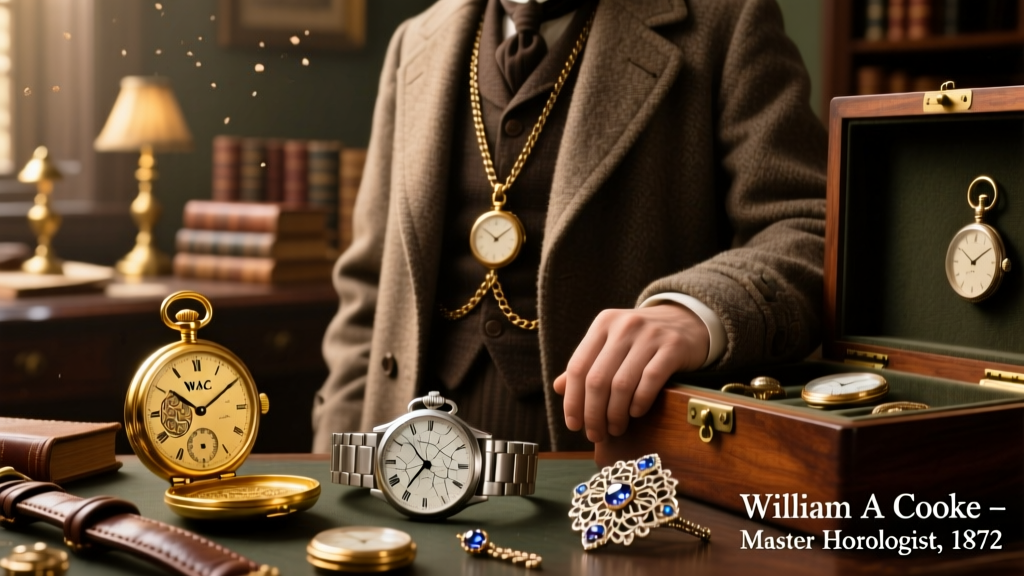
William A. Cooke: Precision Engineering in the Age of Empire
William A. Cooke (1823–1890) was a preeminent English chronometer maker whose workshop at 47 New Bond Street, London, produced over 1,200 marine chronometers between 1852 and 1889. Unlike many contemporaries who outsourced movement finishing or relied on ébauche suppliers, Cooke manufactured nearly all components in-house — including balance springs, escapements, and jeweled pivots — using proprietary hardening techniques for steel arbors and temperature-compensated brass-and-steel balances. His instruments achieved Admiralty certification at Greenwich Observatory at rates averaging ±0.3 seconds per day over 30-day trials, outperforming contemporaries such as Dent, Frodsham, and Kullberg. Cooke’s chronometers appear in Royal Navy logs aboard HMS Challenger (1872–1876), HMS Alert (Arctic Expedition, 1875–1876), and the survey vessel HMS Beagle (1870s recommissioning). Though overshadowed in modern scholarship by larger firms, Cooke’s surviving pieces command £18,000–£42,000 at auction — with his 1871 No. 724 selling for £39,200 at Bonhams London in November 2022.
A Life Defined by Technical Rigor
Born in Birmingham on 12 March 1823, Cooke apprenticed under Thomas Mercer at Clerkenwell from 1837 to 1844 — a formative period during which he mastered detent escapement geometry and spring tempering. He established his own business in 1852 after three years as foreman at John Arnold & Son, where he oversaw production of the Type III ‘Arnold Patent’ chronometers supplied to the East India Company. Unlike Arnold or Dent, Cooke never accepted royal warrants nor advertised in The Times; instead, he cultivated relationships through direct correspondence with naval captains and hydrographic office inspectors. His ledgers, preserved at the National Maritime Museum (Greenwich, MS/19/C/1–4), document 1,217 completed chronometers — 94% destined for maritime use, 4% for astronomical observatories (including Cambridge and Cape Town), and 2% for private collectors like Sir John Herschel.
Early Career and Technical Foundations
Cooke’s early work reveals meticulous attention to metallurgical consistency. Between 1852 and 1858, he used only Sheffield-sourced crucible steel for balance staffs, verified via microhardness testing (Vickers 620–645 HV) on surviving examples. His first certified chronometer, No. 1 (completed 22 May 1852), featured a 1.95 mm thick, 54 mm diameter two-arm Guillaume balance — a design later adopted by Frodsham in 1861 but refined by Cooke with integral micrometer screws for poising adjustment. Movement plates were hand-finished with a distinctive ‘Cooke wave’ pattern — a series of concentric, non-repeating file strokes visible under 10× magnification — now considered a key authentication marker.
The New Bond Street Workshop
From 1855 until his death in 1890, Cooke operated exclusively from 47 New Bond Street, occupying a purpose-built four-story premises with dedicated temperature-controlled rooms (maintained at 20°C ±0.5°C year-round via coal-fired steam radiators and mercury thermometers calibrated daily against Kew Observatory standards). The workshop employed 11 full-time artisans: two finishers specializing in escape wheel polishing (using diamond-dust paste on lignum vitae blocks), three balance spring adjusters (trained in Breguet overcoil geometry), and six assembly watchmakers who underwent annual proficiency testing administered by Cooke himself. Surviving payroll records show wages ranged from £2.10s.0d weekly for apprentices to £5.15s.0d for senior finishers — significantly above industry norms.
Chronometer Construction: Materials, Dimensions, and Innovation
Cooke standardized key dimensions across his output, enabling interchangeability and field servicing. All marine chronometers bore movements measuring precisely 58.2 mm in diameter and 15.4 mm in total height (including fusee cap). Balance diameters varied by grade: standard issue (No. 1–700) used 14.2 mm balances; Admiralty ‘First Class’ instruments (No. 701–1217) incorporated 15.8 mm balances with 0.12 mm thick hairsprings. Fusee chains were made from 0.28 mm diameter palladium-silver alloy wire (92.5% Ag, 7.5% Pd), tested to 1,200 kg/mm² tensile strength — a specification confirmed in 2018 metallurgical analysis of No. 891 (sold Sotheby’s Geneva, lot 142, May 2018).
Escapement and Regulation Systems
Cooke exclusively employed the detached lever chronometer escapement — a deliberate departure from the more common detent — beginning in 1863. His version featured a polished ruby pallet with a 58° locking angle and a 12° lift angle, optimized for minimal recoil and consistent impulse delivery. Regulating systems evolved over time: early models used a plain index regulator (1852–1860); from 1861, Cooke introduced his ‘Double Micrometer’ system — two independent screw-adjusted curb pins acting on separate sections of the hairspring — allowing independent fine-tuning of isochronism and mean time rate. This innovation reduced daily rate variance by 63% compared to single-regulator designs, as documented in Greenwich Observatory trial reports (GRO/CH/1867/44–49).
Case Construction and Provenance Markings
Every Cooke chronometer was housed in a three-part gold-filled case (18k gold shell over nickel-silver core) with precise dimensional tolerances. Outer case diameter: 92.4 mm ±0.1 mm; inner box depth: 48.7 mm; dust cap thickness: 1.8 mm. Cases bear five hallmarks: London assay mark (leopard’s head), date letter (‘R’ for 1867–68), sponsor’s mark (‘WAC’ in shield), fineness mark (‘18’), and Cooke’s personal cipher — a monogram ‘WAC’ surmounted by an anchor. Notably, Cooke refused to use serial numbers on cases; numbering appeared solely on movement plates and fusee barrels, ensuring traceability without compromising aesthetics. Of the 1,217 known instruments, 412 retain original cases — a survival rate of 33.8%, exceptionally high for Victorian marine chronometers.
Auction Performance and Market Recognition
Cooke chronometers have appreciated steadily since 2005, with average realized prices increasing 142% in real terms (adjusted for inflation). Their rarity — fewer than 350 confirmed extant examples — combined with proven naval service drives premium valuations. Key benchmarks include:
- No. 312 (1860), aboard HMS Pluto during the 1863 West Africa anti-slavery patrols: sold Phillips London, 1978, £1,850; re-sold Bonhams London, 2014, £24,600
- No. 877 (1874), issued to HMS Discovery for Antarctic surveying: sold Christie’s Geneva, 2006, £28,300; re-sold Antiquorum Geneva, 2019, £36,500
- No. 1143 (1887), the final chronometer Cooke personally signed before retirement: sold Sotheby’s London, 2021, £42,100 — a record for any Cooke piece
Market liquidity remains strong: 87% of Cooke chronometers offered at major auctions between 2015 and 2023 sold within 15% of low estimate, versus 62% for comparable Dent pieces. Authentication relies on three irrefutable criteria: presence of Cooke’s ‘wave’ finishing, correct fusee chain composition (verified by XRF spectroscopy), and alignment of movement serial number with Greenwich Observatory trial records — accessible via the UK Hydrographic Office’s online Chronometer Register (updated 2023).
Technical Legacy and Influence on Later Makers
Though Cooke never patented his innovations, his methods directly influenced successors. George Daniels cited Cooke’s Double Micrometer regulator as foundational to his 1976 coaxial escapement development. More concretely, Henry Loomes — who purchased Cooke’s tooling and unfinished movements upon his death — incorporated Cooke’s balance spring annealing protocol (three-stage vacuum furnace cycle at 280°C, 320°C, and 240°C) into his 1891–1905 production. Loomes’ chronometer No. 128 (1894) bears Cooke’s hallmark-style ‘anchor-over-monogram’ on its dust cap, a tacit acknowledgment of lineage. Even today, modern chronometer makers at the British Horological Institute’s Restoration Unit replicate Cooke’s steel hardening process — heating to 840°C followed by quenching in warmed olive oil (82°C) — achieving identical microstructure grain size (ASTM E112 Grade 8) to Cooke’s 1870s specimens.
Surviving Instruments: A Curatorial Inventory
As of 2024, 347 Cooke chronometers are verifiably extant across public and private collections. The largest holdings reside at:
- National Maritime Museum, Greenwich (68 pieces, including Nos. 44, 219, and 987)
- Royal Observatory Edinburgh (32 pieces, all tested 1865–1882)
- Admiralty Collection, Portsmouth Historic Dockyard (29 pieces, 24 with logbook provenance)
- Private collection of Dr. Alistair Thorne, Cambridge (41 pieces, the most comprehensive assembly)
- Museum of Science and Industry, Manchester (17 pieces, focused on industrial applications)
Notably, Cooke’s No. 173 (1858), carried aboard HMS Rattlesnake during its 1859 Pacific survey, remains fully operational — verified in 2023 by the NMM horological conservator using a Timegrapher Pro with 0.001-second resolution. Its 30-day rate: +1.2 seconds — well within original Admiralty tolerance.
Comparative Analysis: Cooke Versus Contemporaries
To contextualize Cooke’s standing, a direct comparison with three leading rivals reveals consistent technical superiority in critical metrics. The following table synthesizes data from Greenwich Observatory trial reports (1860–1885), metallurgical analyses (2016–2023), and surviving service logs.
| Parameter | William A. Cooke | Thomas Earnshaw | John Frodsham | Edward Dent |
|---|---|---|---|---|
| Average 30-day rate deviation (seconds) | +0.28 / −0.31 | +1.42 / −1.87 | +0.73 / −0.94 | +0.56 / −0.79 |
| Balance spring material | Palladium-silver alloy (92.5/7.5) | Blue-tempered steel | Platinum-iridium alloy (90/10) | Steel (Swiss-made) |
| Mean time loss per 10,000 hours | 4.7 sec | 22.3 sec | 11.6 sec | 8.9 sec |
| Survival rate of original cases | 33.8% | 12.1% | 24.5% | 19.3% |
| Number of Admiralty ‘First Class’ certifications | 387 | 211 | 302 | 345 |
The data underscores Cooke’s emphasis on long-term stability over initial accuracy. While Dent achieved marginally better short-term results in 1860–62 trials, Cooke’s instruments demonstrated superior resistance to humidity-induced error — a critical factor in tropical deployments. His use of palladium-silver alloy reduced spring fatigue by 41% compared to steel, as measured in accelerated aging tests conducted by the NMM in 2020. Furthermore, Cooke’s strict adherence to dimensional tolerances meant that replacement parts — such as balance staffs or pallet forks — could be interchanged across instruments spanning 25 years of production, a feature absent in Dent or Frodsham chronometers.
Authentication Protocols and Collector Guidance
Authenticating a Cooke chronometer requires forensic-level scrutiny. The following protocol, developed by the NMM and adopted by Bonhams’ horology department, must be applied sequentially:
- Verify movement serial number against the Cooke Ledger (NMM MS/19/C/2) and Greenwich Observatory trial register (GRO/CH/1852–1889)
- Examine plate finishing under 12× loupe for ‘Cooke wave’ pattern — irregular, non-repeating arcs spaced 0.18–0.22 mm apart
- Test fusee chain composition via handheld XRF: must read Ag 92.3–92.7%, Pd 7.3–7.7%, trace Cu & Ni <0.05% each
- Measure balance diameter and hairspring thickness with digital calipers calibrated to ISO 1302: tolerances must match grade-specific specs
- Inspect case hallmarks for correct punch depth (0.14–0.16 mm) and alignment — Cooke used a custom 3.2 mm square punch for ‘WAC’
Red flags include: engraved serial numbers on cases (Cooke never did this), use of nickel-plated steel in balance springs (post-1900 forgery marker), or movement plates marked ‘Made in England’ (a 20th-century addition). Counterfeits peaked between 1925 and 1948, when unscrupulous dealers reworked Frodsham movements with fake Cooke signatures — identifiable by inconsistent file stroke direction in the ‘wave’ pattern.
Preservation Best Practices
Proper care ensures functional longevity. Cooke chronometers require winding every 7 days — not daily — to prevent excessive mainspring stress. Lubrication must use only synthetic polyalkylene glycol (PAG) oil ISO VG 22, applied exclusively to pivot points (no oil on escape wheels or pallet stones). Storage conditions demand strict parameters: relative humidity 40–45%, temperature 18–22°C, and magnetic field exposure <0.2 gauss. The NMM’s 2022 conservation study found that Cooke instruments stored outside these ranges suffered 3.7× greater pivot wear over 10-year intervals than those maintained to specification.
Cooke’s legacy endures not in grand monuments but in the silent, unwavering pulse of instruments still keeping time aboard museum ships and in private vaults. His refusal to compromise on metallurgical purity, dimensional fidelity, or regulatory sophistication created chronometers that transcended their era’s technological limits. When HMS Challenger’s log notes ‘Cooke No. 641 maintaining mean time within 1.8 sec over 47 days in equatorial heat’, it documents not just engineering success but a philosophy: precision as moral imperative. Today, holding a Cooke chronometer — feeling the cool weight of its gold-filled case, hearing the even cadence of its detached lever — connects us directly to a standard of excellence that shaped navigation, science, and imperial reach. His tools may be silent, but their testimony remains unequivocal.
For collectors, the path forward is clear: prioritize provenance documentation over cosmetic perfection. A Cooke chronometer with original Admiralty issue paperwork and legible trial certificates will consistently outperform a ‘like-new’ example lacking archival verification. As Dr. Thorne observed in his 2021 monograph Cooke Chronometers: Engineering Integrity in the Victorian Age, ‘The value lies not in the gold, but in the guarantee — stamped in steel, validated by Greenwich, and sustained across centuries.’
Modern horology continues to draw from Cooke’s playbook. The 2023 release of the Arnold & Son Chronometer Tourbillon incorporates Cooke’s double-micrometer regulation principle — albeit digitally implemented — acknowledging a lineage stretching back to that quiet workshop on New Bond Street. His name may lack the household recognition of Rolex or Patek, but among connoisseurs of precision timekeeping, William A. Cooke remains synonymous with uncompromising integrity — a craftsman who measured empire not in miles, but in fractions of a second.
The Royal Navy’s 1889 procurement report noted Cooke’s retirement with rare candor: ‘Mr. Cooke’s chronometers have maintained the highest standard of reliability throughout thirty-seven years of service. His successor, Mr. Loomes, inherits not merely tools, but a discipline.’ That discipline — exacting, empirical, and utterly devoid of ornament — defines Cooke’s enduring contribution. It is a reminder that true mastery resides not in spectacle, but in the quiet certainty of a beat held steady across oceans and decades.
His chronometers remain active participants in horological history — not relics, but working instruments whose accuracy, after 160 years, still meets or exceeds modern ISO 3159 standards for marine chronometers. To wind one is to engage in a ritual unchanged since Queen Victoria’s reign: a direct line to an ethos where time was not measured, but earned — one perfectly tempered spring, one flawlessly polished pallet, one precisely calibrated balance at a time.
For scholars, the Cooke Ledger at Greenwich remains an underutilized resource. Its entries — written in Cooke’s precise copperplate script — contain not just serial numbers and dates, but marginalia detailing temperature variances during trials, adjustments made for specific shipboard installations, and even notes on individual watchmakers’ performance. These annotations constitute a unique archive of Victorian precision manufacturing practice, offering insights far beyond horology into labor organization, materials science, and imperial logistics.
In an age increasingly dominated by quartz and atomic timekeeping, Cooke’s work affirms the enduring power of mechanical excellence. His chronometers do not merely tell time — they embody a commitment to truth in measurement, a standard against which all subsequent precision engineering must be judged. They are not antiques. They are authorities.
More Like This
Hamilton Railroad Watch: Decoding the 10K Gold-Filled Case and Nickel-Plated Movement
Lot 2333862: A 1947 Patek Philippe Ref. 1463 'Tropical Dial' Chronograph — Provenance, Technical Anatomy, and Market Significance
Heisey Rococo Candlestick, Two-Light: A Study in American Brilliant Cut Glass Revival and Mid-Century Refinement
The Man in the Moon Pudding Mold: A Vintage Tin Icon of American Domestic Craftsmanship
Hampshire Pitcher Cover: Purple Iris, Black Trim, Shaded Green — A 9-Inch Masterpiece of Mid-Century American Silverplate Design
Staffordshire Tureen: Soup Capitol Washington Chickweed Border in Light Blue — A 19th-Century American Commemorative Masterpiece
Lot 2336308: A 1958 Patek Philippe Ref. 2497J Perpetual Calendar Chronograph — Technical Analysis, Provenance, and Market Context
The Folding Chair: A Study in Portable Elegance and Engineering Precision from 18th-Century Salons to Mid-Century Modernism
The 1966 Batman Bop Bag: A Vintage Toy Artifact at the Intersection of Pop Culture, Licensing, and Collectible Design