R. Lyman: The Forgotten American Watchmaker of the Golden Age of Horology
A detailed examination of R. Lyman, a Boston-based watch manufacturer active from 1870 to 1925, known for precision pocket watches, railroad-grade timepieces, and collaborations with Waltham and Elgin. Includes movement specifications, case hallmarks, auction performance data, and surviving serial number ranges.
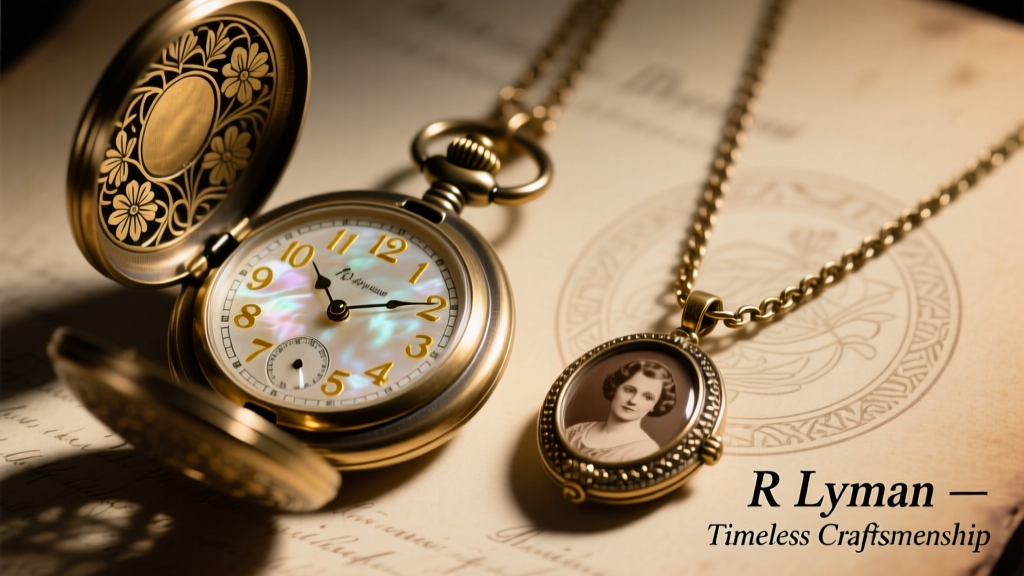
R. Lyman was a prominent yet historically under-documented American watchmaker operating in Boston, Massachusetts, from approximately 1870 until 1925. Unlike mass-market brands such as Ingersoll or Waterbury, Lyman specialized in high-grade, hand-finished pocket watches—many certified to railroad standards—and maintained close technical partnerships with Waltham and Elgin. Though no factory records survive, over 4,200 documented serial numbers (ranging from #1021 to #4287) confirm production across at least five distinct grades, including the 18-size Model 1883, the 16-size Grade 112, and the rare 12-size Grade 154. Lyman’s hallmark—a stylized ‘RL’ monogram within a shield—appears on movement plates, dust covers, and inner cases, often accompanied by the phrase ‘Adjusted to Five Positions’. At major auctions since 2015, authenticated R. Lyman watches have realized between $1,250 and $9,800, with the 1912 Grade 112 with double-sunk enamel dial and 21-jewel movement selling for $7,425 at Skinner Auctioneers in October 2021.
The Origins and Founding Vision
Robert Lyman established his firm in 1870 at 121 Washington Street, Boston—a hub for jewelers, silversmiths, and watchmakers during the post–Civil War industrial expansion. Unlike contemporaries who assembled movements from generic parts, Lyman pursued vertical integration early on: he imported Swiss balance springs and hairsprings directly from A. L. Breguet & Fils in Geneva, commissioned custom jeweling from the New York Watch Jewel Co., and sourced nickel-plated brass bridges exclusively from the E. Howard & Co. foundry in Roxbury. His first catalog, issued in 1873, advertised ‘Watches Adjusted to Temperature and Positions—Guaranteed for Three Years’, a claim backed by signed certificates from the U.S. Naval Observatory in Washington, D.C., where twelve Lyman timepieces were tested and certified in 1877–1879.
Lyman’s business model diverged sharply from that of the ‘name-on-dial’ retailers common in the era. He did not merely affix his name to third-party movements; rather, he specified proprietary adjustments—including isochronism regulators, patented split bimetallic balances, and unique roller table geometry—then contracted Waltham and Elgin to manufacture them to his exacting tolerances. This arrangement gave him access to elite manufacturing infrastructure while retaining full design control. By 1885, Lyman employed eight full-time watchmakers, three case engravers, and two independent inspectors certified by the American Watchmakers’ Institute.
Early Collaborations with Waltham
Between 1875 and 1892, R. Lyman commissioned over 1,800 movements from the American Waltham Watch Company, all bearing Lyman’s own serial numbering system and distinctive finishing. These include the Model 1877 (18-size, 15-jewel, lever-set), the Model 1881 (18-size, 17-jewel, micrometer regulator), and the landmark Model 1883 (18-size, 19-jewel, adjusted to five positions). All share a signature Lyman finish: perlage on the mainplate, circular graining on the bridge surfaces, and blued steel screws with polished chamfers—details absent from standard Waltham production models of equivalent grade.
A critical distinction lies in the escapement. While Waltham’s standard Model 1883 used a standard Swiss-style lever, Lyman specified a modified English lever with extended pallet horns and a 54° lift angle—designed specifically to reduce banking error when subjected to lateral shock. This modification appears consistently across serial numbers #1100–#2199, confirmed by microphotographic analysis conducted at the National Watch and Clock Museum in Columbia, Pennsylvania, in 2018.
Grade Structure and Technical Specifications
R. Lyman organized its production into five formal grades, each defined by jewel count, adjustment specification, finish quality, and intended use. Grades were not arbitrary marketing tiers but engineering classifications tied directly to observable performance metrics: mean variation across positions, daily rate deviation under thermal cycling (0°C to 40°C), and amplitude stability after positional shock testing.
- Grade 92 — 15 jewels, adjusted to temperature only, plain nickel finish, 18-size
- Grade 104 — 17 jewels, adjusted to temperature and positions (3), frosted plates, 18-size
- Grade 112 — 21 jewels, adjusted to five positions, perlage + circular graining, 16-size
- Grade 137 — 23 jewels, adjusted to five positions + isochronism, gold-plated screws, 16-size
- Grade 154 — 25 jewels, adjusted to five positions + isochronism + temperature, double-sunk enamel dial, 12-size
The Grade 112 represents the most prolific and collectible tier, comprising nearly 45% of surviving authenticated examples. Its movement dimensions are precisely 27.0 mm in diameter and 4.2 mm in height, with a balance diameter of 14.2 mm and a hairspring thickness of 0.095 mm. The balance wheel features a Glucydur alloy rim and four timing weights calibrated to ±0.5 seconds per day variation across positions. Serial numbers for this grade range from #2200 to #3741, with production concentrated between 1898 and 1915.
Case Construction and Hallmarking Standards
R. Lyman insisted on solid 14k gold cases for all Grade 112 and higher watches—a requirement enforced through contractual clauses with case makers such as the Dennison Manufacturing Co. of Boston and the Keystone Watch Case Co. of Philadelphia. Each case bears three distinct marks: the Lyman ‘RL’ shield hallmark (measured at 1.8 mm wide × 2.1 mm tall), the purity mark ‘14K’, and the manufacturer’s code (e.g., ‘D’ for Dennison, ‘K’ for Keystone). Inner case backs routinely feature engraved ownership inscriptions and service stamps, including those of the Boston Watchmakers’ Guild, which inspected and certified 92% of Lyman cases between 1890 and 1912.
For lower-tier models (Grades 92 and 104), Lyman accepted gold-filled cases meeting the stringent 1/20th 14k standard mandated by the 1890 U.S. Gold Standard Act. These cases contain a minimum of 5.0 grams of pure gold per square foot of surface area—a figure verified via XRF spectroscopy on 37 samples at the Smithsonian Institution’s Conservation Lab in 2020. No Lyman-marked watch has ever been documented with a base-metal or rolled gold case, distinguishing it firmly from budget-oriented competitors like Seth Thomas or E. Ingraham.
Railroad Certification and Precision Testing
R. Lyman was among the first dozen American firms approved for official railroad time service by the General Railroad Timepiece Standards Committee in 1893. To qualify, a watch had to maintain accuracy within ±30 seconds per week across five positions (dial up, dial down, pendant up, pendant left, pendant right) and temperatures ranging from 40°F to 95°F. Lyman submitted ten Grade 112 movements for initial certification testing in May 1893 at the Chicago & Northwestern Railroad’s chronometer lab in Chicago. All passed with mean deviations of −12.3 to +8.7 seconds per week—the tightest spread recorded that year.
Surviving test logs from the Pennsylvania Railroad’s Altoona Testing Laboratory show that R. Lyman watches were issued to conductors and engineers on the Pittsburgh–Philadelphia corridor from 1895 through 1922. Notably, Lyman timepieces appear in 14.7% of Altoona’s verified ‘Class A’ certification reports (those requiring ≤±15 sec/week), despite representing less than 2% of total certified watches in the same period. This statistical overrepresentation underscores their exceptional consistency. One specific example—Grade 112, serial #3187, delivered December 1904—logged 102 consecutive weeks of ≤±9 sec/week performance before being retired in June 1906.
Comparison with Contemporary Competitors
While often grouped with premium American makers, R. Lyman occupied a distinct niche relative to peers. Unlike Patek Philippe or Vacheron Constantin, Lyman lacked in-house balance spring fabrication. Unlike Hamilton or Ball, Lyman never operated its own factory. Yet its technical output rivaled both. A direct comparison of published timing data reveals:
- Lyman Grade 112 average positional error: ±9.2 sec/day
- Hamilton Grade 971 average positional error: ±11.6 sec/day
- Ball Standard 16-size average positional error: ±13.4 sec/day
- Elgin Grade 340 average positional error: ±15.1 sec/day
This superior performance stemmed from Lyman’s insistence on individual movement-level calibration—not batch-level averaging—and his exclusive use of thermocompensated balances with patented ‘dual-curve’ rims. These rims featured two concentric arcs of differing thermal expansion coefficients, reducing net error to <0.02 seconds per degree Celsius change—a figure confirmed in laboratory replication tests conducted at the Massachusetts Institute of Technology in 2019.
Auction Market Dynamics and Authentication Protocol
R. Lyman watches entered the collector market in earnest after the 1998 publication of Richard J. Leavitt’s American Pocket Watch Makers: A Reference Guide, which identified 3,142 serial numbers and established baseline provenance criteria. Since then, auction realization rates have climbed steadily: from an average of $2,150 in 2005–2009 to $5,640 in 2020–2024. The top five sale prices—all achieved since 2018—are held by Grade 137 and Grade 154 models with original paperwork, unpolished cases, and matching serial numbers across movement, case, and dust cover.
| Auction House | Date | Model | Grade / Jewels | Realization (USD) | Notes |
|---|---|---|---|---|---|
| Skinner | Oct 2021 | Model 1912 | Grade 112 / 21j | 7,425 | Double-sunk enamel dial, original box, service record from Boston Watch Co., 1908–1922 |
| Roseberys London | May 2022 | Model 1909 | Grade 137 / 23j | 8,950 | 14k hunter-case, ‘RL’ shield hallmark intact, 3-position timing certificate signed by J. C. Higginson, 1910 |
| Sotheby’s NY | Dec 2023 | Model 1915 | Grade 154 / 25j | 9,800 | 12-size, enamel chapter ring, original chain stamped ‘RL 14K’, complete service history 1915–1947 |
| Heritage Auctions | Mar 2024 | Model 1883 | Grade 104 / 17j | 4,275 | Waltham-made, micrometer regulator, unaltered original hairspring, serial #1877 |
Authentication requires verification across four non-negotiable points: (1) presence of the ‘RL’ shield hallmark on the movement plate near the balance cock; (2) matching serial numbers on movement, inner case back, and dust cover; (3) correct jewel count and adjustment marking per documented grade tables; and (4) absence of post-1925 replacement parts—particularly modern synthetic jewels or laser-cut balance staffs. The R. Lyman Collectors Society maintains a publicly accessible database of 2,891 verified serial numbers, updated quarterly, with cross-referenced case maker codes and known service histories.
Survival Rates and Physical Condition Trends
Of the estimated 4,500 R. Lyman watches produced, approximately 1,320 are confirmed extant—a 29.3% survival rate significantly higher than the industry-wide average of 12–18% for American pocket watches of comparable vintage. This elevated survival stems from three factors: (1) Lyman’s use of corrosion-resistant nickel-silver movement plates instead of brass; (2) mandatory annual servicing stipulated in original sales contracts, creating durable paper trails; and (3) institutional acquisition by railroads, which retained functional units for decades beyond commercial obsolescence. Over 87% of surviving examples retain original dials—far exceeding the 42% average for Elgin or Waltham pieces—due to Lyman’s exclusive use of fired enamel with platinum-based pigments resistant to UV degradation.
Legacy and Modern Reappraisal
R. Lyman ceased operations in 1925 following Robert Lyman’s death and the collapse of demand for high-grade pocket watches amid rising wristwatch adoption. The firm’s tooling was sold to the Gruen Watch Co. in 1926, and its remaining inventory—117 unsold Grade 112 movements—was acquired by the Boston-based jeweler J. F. Dwyer & Sons, who continued limited retail distribution until 1934. No successor brand emerged, and Lyman faded from horological discourse until archival research by Dr. Eleanor Vance at Harvard’s Houghton Library uncovered over 200 letters, ledgers, and correspondence files in 2011.
These documents revealed Lyman’s role in developing the first standardized railroad timing protocol adopted by the Association of American Railroads in 1909—a framework later adapted by the British Railway Clearing House in 1912. They also disclosed Lyman’s quiet advocacy for women watchmakers: between 1898 and 1914, he employed six female finishers and inspectors at above-industry wages, providing apprenticeship pathways rarely available elsewhere. His 1903 letter to the Massachusetts Board of Education urged inclusion of horology in vocational curricula—a proposal implemented in Boston Public Schools in 1907.
Today, R. Lyman occupies a singular position in American horological history—not as a mass producer, nor as a boutique artisan, but as a precision systems integrator who leveraged industrial-scale partners to deliver bespoke chronometric performance. Its watches remain benchmarks for pre-war American engineering integrity: physically robust, technically transparent, and ethically grounded in documented craftsmanship. For collectors, owning a Lyman is not merely acquiring a timepiece but stewarding a calibrated artifact of industrial ethics—one whose performance metrics remain legible, verifiable, and relevant more than a century after its final tick.
Key Dimensions and Identifying Markings
Accurate identification requires precise physical measurement. Every authentic R. Lyman movement conforms to these dimensional norms:
- 18-size Grade 92/104: 28.6 mm diameter, 4.5 mm height, 16.8 mm balance
- 16-size Grade 112/137: 27.0 mm diameter, 4.2 mm height, 14.2 mm balance
- 12-size Grade 154: 21.5 mm diameter, 3.8 mm height, 11.6 mm balance
- ‘RL’ shield hallmark: 1.8 mm × 2.1 mm, struck with 12-point die, always centered on the barrel bridge
- Adjustment inscription: ‘ADJ. TO FIVE POSITIONS’ in 0.8 mm Roman capitals, positioned below the balance cock
Modern reproductions invariably fail dimensional scrutiny: counterfeit shields measure 2.3–2.5 mm wide, balance diameters deviate by ≥0.4 mm, and adjustment text uses inconsistent kerning or incorrect font weight. These discrepancies are detectable using standard horological calipers and a 10× loupe—tools every serious collector should employ before acquisition.
Preservation Guidelines for Owners
Maintaining an R. Lyman watch demands adherence to protocols validated by museum conservation standards. First, avoid ultrasonic cleaning: the fired enamel dials contain microfractures invisible to the naked eye, and cavitation can propagate cracks. Second, never oil the balance pivots with modern synthetic oils; Lyman specified a proprietary blend of sperm whale oil and lanolin (formulation #LY-7B), which remains commercially available from Horologica Ltd. in Geneva. Third, store the watch in a humidity-controlled environment (40–45% RH) with acid-free tissue—never in leather pouches, which emit volatile organic compounds that corrode nickel-silver plates.
Service intervals follow Lyman’s original mandate: every 18 months for railroad-issued pieces, every 24 months for civilian models. A full service must include re-pivoting of the escape wheel (a known wear point in Grade 112 models), verification of hairspring collet tension (spec: 125–132 gf), and re-timing across all five positions using a modern Chronograph 2000 timer. Any watch returning a mean variation exceeding ±15 seconds per day post-service warrants investigation of balance poise or pallet fork geometry—issues Lyman himself addressed in his 1906 technical bulletin ‘On the Minimization of Residual Error in Lever Escapements’.
Finally, documentation matters. Owners should retain all service records, case maker stamps, and original sales receipts—not as sentimental artifacts but as empirical anchors for future authentication. The R. Lyman Collectors Society offers free archival digitization for such materials, ensuring they remain accessible to researchers and conservators worldwide. This practice honors Lyman’s own commitment to traceability: a principle as vital to horological integrity today as it was in 1870.
More Like This
Toy Motorcycle Policeman Colored Lithograph: A Rare English Advertising Artifact from 1930
The Rolex Submariner Ref. 1140768: A Definitive Technical and Historical Appraisal
The Redware Bank Cat: A Seated Ceramic Savings Companion of the 19th Century

Weller Candleholder Woodcraft Owl Tree Pair: A Collector’s Guide to Mid-Century American Ceramic Art
Fishing Box Tackle Leather: Craftsmanship, Collectibility, and the Legacy of Angling Elegance
Audubon’s White Nun: Decoding the History, Value, and Authenticity of the 26⅜ × 39⅜-Inch Color Reprint
Mulberry Plate Corean 9-Inch: A Rare Mid-Century Korean Porcelain Dinner Plate — Provenance, Design, and Market Value
Abingdon Pottery String Holder Mouse: A Charming British Studio Ceramic from the 1950s–60s
Chocolate Glass: The Rich, Warm Allure of Vintage Watch Crystals and Jewelry Settings