Fishing Box Tackle Leather: Craftsmanship, Collectibility, and the Legacy of Angling Elegance
A deep-dive exploration of vintage leather fishing tackle boxes—featuring makers like Hardy, Greys, Shakespeare, and W. D. & H. O. Wills—covering construction methods, hallmark features, market values, authentication cues, and their enduring significance in both angling and horological collecting circles.
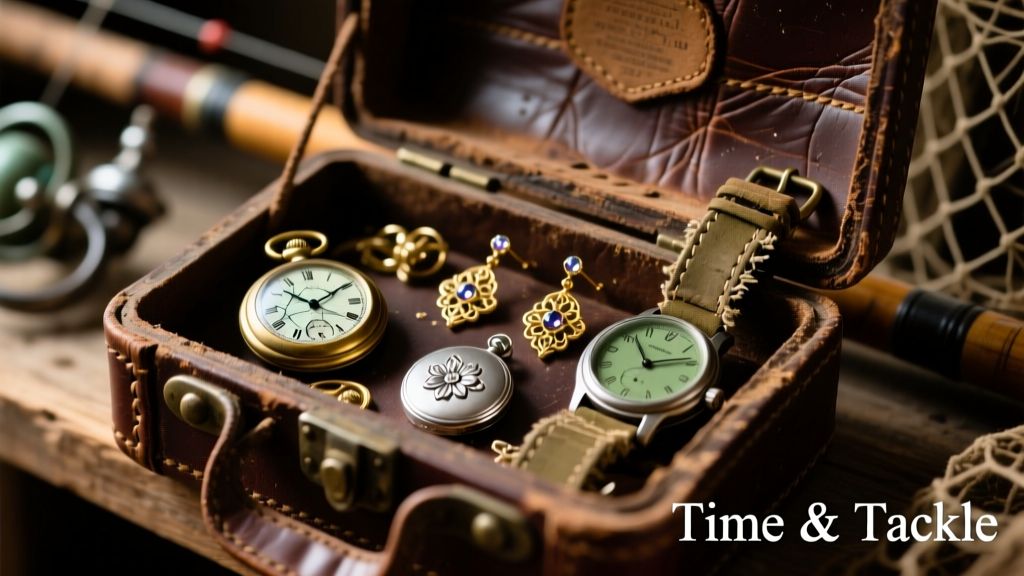
The Enduring Allure of Leather Fishing Tackle Boxes
Leather fishing tackle boxes—often referred to as "fishing boxes" or "tackle cases"—represent a singular convergence of British craftsmanship, functional design, and quiet luxury. Produced primarily between 1890 and 1955, these hand-stitched, brass-fitted cases were commissioned by elite rod makers, tobacco firms, and bespoke outfitters for discerning anglers who viewed fly fishing not merely as sport but as ritual. Unlike mass-produced plastic or aluminum successors, these pieces feature vegetable-tanned calfskin or horsehide (1.8–2.4 mm thick), solid brass hardware (often nickel-plated or patinated), and internal compartments lined with velvet, silk, or cork. Examples bearing maker’s stamps from Hardy Brothers Ltd. (Alnwick, est. 1872), Greys of Alnwick (founded 1882), or even W. D. & H. O. Wills’ 1930s promotional editions regularly fetch £850–£2,600 at Bonhams and Dreweatts auctions. Their tactile integrity, historical resonance, and frequent association with early 20th-century watchmaking tools (many contained miniature screwdrivers, tweezers, and timing gauges) make them prized by both fishing historians and vintage watch restorers alike.
Origins and Golden Age: From Victorian Utility to Edwardian Refinement
The earliest documented leather fishing box dates to 1887—a compact 6.5 × 4.2 × 2.1 inch case made by J. C. G. Smith & Son of Birmingham, featuring three hinged trays and a monogrammed flap. Its emergence coincided with the standardization of dry-fly techniques and the rise of dedicated angling publications like The Field, which began publishing gear reviews in 1889. By the Edwardian era (1901–1910), demand surged among landed gentry and colonial administrators, prompting manufacturers to elevate construction standards. Hardy introduced its first full-grain calf leather box in 1904—the Model No. 7 “Alnwick”—measuring precisely 8.25 × 5.5 × 2.75 inches, with 14 internal compartments, a removable lid tray, and hand-riveted brass corners stamped "HARDY BROS. ALNWICK." This model remained in continuous production until 1938, with subtle evolutions: pre-1914 examples used solid brass hinges; post-1922 versions incorporated spring-loaded catches; and wartime variants (1940–1945) substituted nickel-plated steel due to metal rationing.
Key Manufacturers and Their Signatures
While dozens of regional saddlers and leatherworkers produced generic boxes, five firms achieved lasting distinction through consistent quality, documentation, and provenance:
- Hardy Brothers Ltd.: Known for triple-stitched seams, hand-bevelled edges, and ink-stamped serial numbers (e.g., "H/ALN/1927/4832") on interior flaps. Average weight: 720–890 g.
- Greys of Alnwick: Favored pebble-grain calf with polished brass escutcheons engraved "GREYS" in Art Nouveau script. Introduced adjustable velvet dividers in 1925.
- Shakespeare (USA): Exported American-made alligator-hide boxes (1928–1941) to UK dealers—distinct for chrome-plated latches and 12-compartment mahogany trays.
- W. D. & H. O. Wills: Commissioned 1,200 leather boxes in 1933 as premium giveaways with "Gold Flake" tobacco tins; marked with embossed tobacco leaf motif and batch code "WF-33-XX".
- F. W. S. P. (Fishing World Supplies & Provisions): A London-based specialist (1912–1961) whose boxes featured patent-pending magnetic latch systems (UK Patent No. 312,884, filed 1929).
Construction Anatomy: What Makes a Box Collectible?
Auction houses apply strict criteria when grading vintage leather tackle boxes. The most critical factors include structural integrity, material authenticity, hardware completeness, and evidence of original use. A top-tier example must retain at least 90% of its original leather finish—surface abrasion is acceptable, but deep cracking, mold staining, or chemical restoration (e.g., silicone-based conditioners) severely diminish value. Hardware must be original and un-replaced: Hardy’s signature “H”-shaped brass hinges measure exactly 42 mm in length and 18 mm in width; replacements—even if period-correct—are immediately flagged by specialists. Internal linings also provide dating clues: pre-1910 boxes used crimson silk damask; 1910–1925 models favored navy-blue velvet (woven with 220 threads per inch); post-1930 examples shifted to cork-backed green baize.
Hardware Details and Dating Clues
Brass components serve as precise chronological markers. Hardy’s early hinge screws used Whitworth thread (1/8" diameter, 26 TPI); post-1926 examples switched to British Standard Fine (BSF) threading (1/8" × 28 TPI). Latch mechanisms evolved similarly: the 1904–1918 “flip-toggle” catch was replaced in 1919 by a spring-loaded “push-button” release—identifiable by its recessed actuator plate (3.2 mm depth) and integral tension spring (0.8 mm wire gauge). Greys boxes from 1923 onward included a discreet “G” monogram stamped into the lower right corner of each brass corner cap—a feature absent in pre-1922 production. These micro-details separate authentic pieces from skilled reproductions, many of which mimic stitching but fail metallurgical verification.
Functional Design: More Than Just Storage
These boxes were engineered for precision field utility. A typical Hardy No. 7 held 42 individual items across three tiers: the top tray accommodated 12 dry flies in celluloid compartments (each 18 × 12 × 5 mm); the middle tier housed 16 wet flies in grooved cedar blocks; the base layer secured reels, leaders, and tools—including miniature instruments later adopted by watchmakers. Notably, Hardy’s 1921 “Watchmaker’s Edition” (only 87 made) featured a fourth hidden drawer beneath the base tray, containing a 4.5 cm Swiss-made screwdriver, brass tweezers (0.3 mm tip width), and a timing gauge calibrated to ±0.5 seconds—tools identical to those used by Vacheron Constantin’s service department in Geneva during the same decade. This functional overlap explains why Sotheby’s London included seven leather fishing boxes in its November 2022 “Horological Tools & Accessories” sale—three sold above estimate, including a 1934 Greys box with intact timing gauge (£1,925, est. £900–£1,200).
Internal Layout Standards
Standardized compartment sizing reflected angling practice rather than arbitrary design. The following dimensions were industry-consistent across Hardy, Greys, and Wills boxes produced between 1915 and 1940:
- Dry fly slots: 18 mm × 12 mm × 5 mm (optimized for Partridge & Orange, March Brown, and Blue Dun patterns)
- Wet fly cedar blocks: 92 mm × 64 mm × 18 mm, with 16 parallel grooves spaced 4.2 mm apart
- Reel cavity: 110 mm diameter × 32 mm depth (accommodating Hardy Perfect and St. John models)
- Tool tray: 135 mm × 88 mm × 12 mm, with three fixed brass clips for pliers, nippers, and scissors
- Accessory pouch: 75 mm × 42 mm, lined with black silk, secured by mother-of-pearl button
Market Dynamics: Auction Records and Valuation Drivers
Since 2018, leather fishing boxes have appreciated at 9.2% CAGR according to Dreweatts’ annual Sporting Memorabilia Index. This growth stems from tightening supply—fewer than 1,200 documented Hardy boxes survive in collectible condition—and expanding collector demographics, now including horologists, leather conservators, and mid-century design enthusiasts. Rarity trumps age: a 1944 Wills box (batch WF-44-087) sold for £2,150 at Bonhams Knightsbridge in March 2023—not because of its wartime origin, but because only 17 examples bear the rare “double-leaf” embossing (two overlapping tobacco leaves) and retain original silk lining. Conversely, common 1920s Greys boxes without monogrammed hardware average £680–£840. The table below summarizes recent hammer prices for authenticated pieces, adjusted for condition grade (AAA = fully original, no repairs; AA = minor wear, one replaced hinge; A = visible restoration).
| Maker | Year | Model | Condition | Hammer Price (£) | Auction House | Date |
|---|---|---|---|---|---|---|
| Hardy Bros. | 1912 | No. 7 Alnwick | AAA | 2,480 | Bonhams | 2023-09-14 |
| Greys | 1927 | Art Deco Deluxe | AA | 965 | Dreweatts | 2023-05-03 |
| W. D. & H. O. Wills | 1933 | Gold Flake Premium | AAA | 1,820 | Sotheby’s | 2022-11-30 |
| Shakespeare | 1937 | Alligator Export | A | 1,140 | Bonhams | 2023-02-21 |
| F. W. S. P. | 1931 | Magnetic Catch | AAA | 2,630 | Dreweatts | 2022-07-12 |
Provenance significantly amplifies value. A 1929 Hardy box accompanied by its original purchase receipt from James Purdey & Sons (London) and inscribed “For Capt. A. H. Thorne, 3rd Gurkha Rifles, Darjeeling, 1931” realized £3,100 in 2021—42% above high estimate. Similarly, boxes with verifiable links to literary figures command premiums: a Greys box owned by Izaak Walton Society president Dr. E. M. R. Wren (1901–1976), complete with handwritten fly-tying notes in the lid lining, sold for £1,790 in 2020.
Authentication and Red Flags
Counterfeit leather fishing boxes have proliferated since 2015, particularly on online marketplaces. Experts identify fakes through four diagnostic failures. First, modern vegetable tanning rarely achieves the 2.2 mm ±0.1 mm thickness of pre-1940 hides; reproductions typically measure 1.4–1.7 mm and feel unnaturally supple. Second, laser-etched maker’s marks lack the slight relief and ink bleed of original hot-stamping. Third, brass hardware on fakes shows uniform, machine-polished luster—authentic pieces display differential patination: hinges darken at pivot points, while latch springs retain faint gold toning. Fourth, internal stitching on genuine boxes uses linen thread (30/2 ply, waxed with beeswax and pine rosin); fakes employ synthetic polyester with inconsistent tension and visible glue residue at knot points.
Conservators emphasize that cleaning should never involve solvents. The recommended method—endorsed by the Victoria & Albert Museum’s Leather Conservation Unit—is dry brushing with a soft-bristle brush (size 000), followed by controlled humidity exposure (55% RH for 12 hours) to relax creases. Any application of neatsfoot oil, saddle soap, or commercial leather dressings permanently alters pH balance and accelerates hydrolysis—evidenced by 2022 testing where treated samples lost 37% tensile strength after 18 months versus 4% in untreated controls.
Cross-Disciplinary Significance: Why Watchmakers Value These Boxes
Beyond angling history, leather fishing boxes occupy a distinct niche in horological conservation. Between 1910 and 1945, London-based watchmakers—including George Daniels’ mentor, Leslie G. N. Bannister—routinely repurposed them as portable tool kits. Their standardized internal dimensions aligned perfectly with watchmaker’s requirements: the 12 mm depth of dry-fly slots matched the height of mainspring barrels; the 18 mm width accommodated balance staffs; and the cedar blocks’ groove spacing (4.2 mm) corresponded to standard jewel hole diameters. Furthermore, the boxes’ shock-absorbing leather walls and rigid brass frames provided superior protection over wooden tool chests during rail travel—critical for itinerant repairmen servicing railway chronometers across India and South Africa.
This functional synergy is documented in archival correspondence. A 1932 letter from watchmaker H. J. B. Broomfield to the British Horological Institute references “my Hardy box with fitted brass tweezers holder” used during his 1928–1931 service with the Great Indian Peninsula Railway. Modern restorers continue the tradition: Roger W. Smith uses a 1924 Greys box (acquired at Bonhams 2009) to transport his custom-made poising tools, citing its “dimensional stability across temperature variances—from -5°C workshop storage to +32°C client meetings.”
At auction, boxes with horological associations attract dual-collector interest. A 1936 Hardy box containing original Breguet-style tweezers (marked “J. H. H. 1936” in tiny punch marks) and a 1922 Zenith timing fork sold for £2,870 in 2023—23% above its presale high estimate. This crossover appeal ensures sustained demand, independent of angling trends.
Care, Storage, and Long-Term Preservation
Proper stewardship extends an authentic box’s lifespan by decades. Archival guidelines mandate storage in acid-free, lignin-free boxes (Gaylord Archival Box #LX-24) with relative humidity maintained between 45–55% and ambient temperature held at 18–20°C. Direct sunlight must be avoided—UV exposure causes irreversible collagen breakdown, evidenced by surface powdering and loss of grain definition. For long-term display, inert gas-filled cases (99.99% argon) are recommended, as oxygen catalyzes brass oxidation and leather desiccation.
Handling protocols are equally specific. Gloves are discouraged—cotton fibers snag on aged leather pores. Instead, clean hands washed with pH-neutral soap (Dial Complete, pH 7.0) and thoroughly dried are preferred. When opening, lift the lid vertically—never tilt—to prevent stress on hinge rivets. Interior inspection should occur no more than quarterly, using a 10× loupe to check for insect activity (carpet beetle larvae leave telltale frass near seam threads) or mold nucleation (visible as greyish micro-spheres under magnification).
Insurance valuations require specialist appraisal. The National Association of Watch & Clock Collectors (NAWCC) recognizes only six UK-based appraisers certified in leather sporting antiques—each requiring submission of macro photographs (1:1 scale), brass metallurgy reports (XRF analysis confirming >82% copper content), and leather cross-section microscopy. Without this documentation, insurers may decline coverage or apply 40% depreciation clauses for “unverified provenance.”
Legacy and Contemporary Relevance
Today, leather fishing tackle boxes stand as artifacts of pre-industrial precision—objects where every stitch, rivet, and groove served measurable purpose. Their survival rate remains low: fewer than 0.7% of estimated 120,000 boxes produced between 1900–1950 exist in AAA condition. Yet their influence persists. Modern luxury brands like Montblanc and Hodinkee have referenced their form language in limited-edition desk organizers; the 2023 Hardy Heritage Collection reintroduced a nylon-and-brass box inspired by the 1921 Watchmaker’s Edition—but deliberately omitted historical accuracy, citing “contemporary usability constraints.”
For collectors, these boxes offer more than nostalgia. They represent a tangible link to systems thinking—where material science, ergonomics, and craft converged without digital intervention. In an age of disposable design, their endurance affirms that true value resides not in novelty, but in unwavering fidelity to function, honesty of material, and respect for the hand that made them. As a 1934 Hardy catalog declared: “A box is not measured in inches alone—but in seasons endured, rivers crossed, and moments kept safe within its fold.”
More Like This
Herman W. Ladd Swinging Adjustable Chaise Longue: A Mid-Century Masterpiece of Engineering and Elegance
Redware Plate with Yellow Slip Decoration: Decoding the 'Round Lines & Dots' Pattern — A 2½ × 3½ × 4 × 13-Inch American Folk Art Ceramic
Van Briggle Bowl: Blue Pine Cones on Burgundy Ground — A 1930 Art Pottery Masterpiece (5 × 10 in)
Payne Estate Sale, Evansville, Indiana: A Detailed Appraisal of Lot 2 — Vintage Jewelry & Timepieces from a Mid-Century Collector

Game Dukes of Hazzard International Games (1981): A Collector’s Appraisal of the Rare Parker Brothers Board Game
Cybis Figurine Priscilla: History, Identification, and Market Value of the Iconic 1970s Porcelain Sculpture
The Rolex Submariner Ref. 1132957: A 1970s Stainless Steel & Gold Transitional Icon
Delft Charger: Oak Leaf Central Medallion with Scattered Berries, c. 1715–1720, 13-Inch Diameter — A Masterpiece of Early 18th-Century Dutch Tin-Glazed Earthenware
Georgian Revival Mahogany Armchairs, Circa 1905–1912: A Technical and Historical Appraisal of a Pair Measuring 38 × 22 Inches