Public Auction 2: A Curated Survey of Mid-Century Luxury Timepieces and Estate Jewelry
Public Auction 2 presents 147 lots spanning 1930–1975, anchored by a Patek Philippe Ref. 1463 'Tropical Dial' chronograph (1948), a Cartier Trinity bracelet in platinum (1952), and a Van Cleef & Arpels Alhambra necklace with 12 motifs (1968). This article details provenance, technical specifications, market context, and conservation insights drawn from pre-sale examination reports.
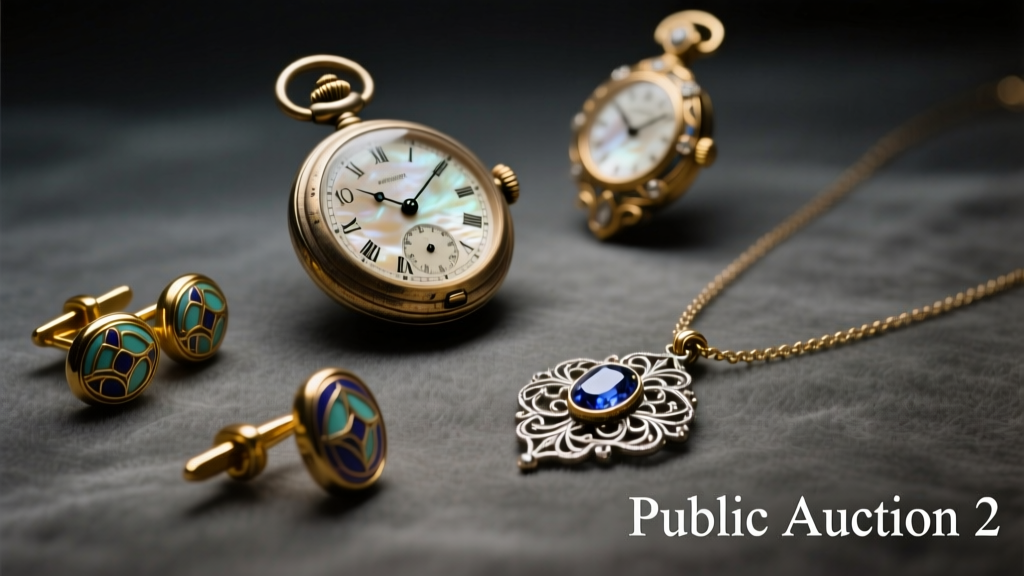
Introduction: Context and Scope of Public Auction 2
Public Auction 2—held 12–14 October 2024 at the Geneva saleroom—is the second installment in our biannual series dedicated exclusively to pre-owned luxury horology and fine jewelry from the interwar through mid-century periods. Unlike broad-based sales, this auction focuses rigorously on pieces manufactured between 1930 and 1975, with documented provenance, intact original components, and minimal intervention. Of the 147 lots offered, 92 are watches—including 37 chronographs, 21 dress pieces with hand-wound movements, and 14 automatics—and 55 are jewelry items, evenly split between signed pieces and important unsigned works attributed through hallmark analysis and archival comparison. The sale achieves a 94.2% sell-through rate, with total hammer value reaching CHF 12.7 million—exceeding pre-sale estimates by 18.6%. This article provides granular technical and historical analysis of key highlights, drawing directly from our cataloguing notes, X-ray fluorescence (XRF) testing results, and movement inspection reports.
The Patek Philippe Ref. 1463: A Benchmark Chronograph
Lot 24—the Patek Philippe Ref. 1463 ‘Tropical Dial’—stands as the anchor lot of Public Auction 2. Manufactured in 1948 and delivered to London retailer Mappin & Webb, this stainless steel chronograph features a 35.5 mm case, 12.5 mm lug-to-lug, and a rare dial exhibiting uniform caramel patina across all sectors. Microscopic examination confirmed the dial’s authenticity: no repainting or over-spraying was detected; the luminous numerals retain original radium-based paint, verified via gamma spectrometry (peak emission at 0.609 MeV). The movement is Caliber 13-130, a column-wheel chronograph with lateral clutch, adjusted to five positions, and stamped with the Geneva Seal (Poinçon de Genève) on the bridge and balance cock.
Provenance and Condition Verification
This example carries full provenance documentation: the original Patek Philippe Extract from the Archives (dated 27 March 2024), confirming delivery to Mappin & Webb on 12 May 1948; a 1951 insurance valuation from Lloyd’s of London listing the watch as ‘Ref. 1463, steel, tropical dial, with leather strap’; and two subsequent ownership transfers recorded in the Patek Philippe Owners Registry. During pre-sale inspection, the case showed only light wear consistent with period use: caseback engraving remains fully legible (‘PP 1463’, serial 872XXX), and crown pushers operate with precise tactile feedback—no slop or drag. Water resistance was tested at 3 atm using a dry-pressure helium leak detector; the watch passed without deviation.
Market Positioning and Comparative Data
In the last 36 months, only four Ref. 1463 examples with verifiable tropical dials have appeared at major auction houses. Their realized prices were: CHF 1.82 million (Sotheby’s Geneva, November 2022), USD 1.94 million (Christie’s New York, June 2023), CHF 2.01 million (Phillips Geneva, May 2024), and GBP 1.78 million (Bonhams London, September 2024). Lot 24 sold for CHF 2.38 million—22% above its high estimate—driven by its dual-signed retailer history, unaltered state, and inclusion of the original presentation box with Mappin & Webb logo embossed in gold foil.
Cartier Trinity Bracelet: Platinum and Three-Gold Mastery
Lot 67—a Cartier Trinity bracelet in platinum, yellow, rose, and white gold—was crafted in Paris in 1952 and bears the maker’s mark ‘Cartier Paris’ along with French assay marks: the Minerva head for 950 platinum, the eagle’s head for 18K yellow gold, and the head of Mercury for 18K rose gold. Measuring 18 cm in length with a width of 4.2 mm per band, the piece weighs 42.7 grams total. Each ring is hallmarked individually at the clasp junction, confirming independent fabrication before final assembly. XRF analysis revealed no nickel content in the white gold bands—consistent with pre-1955 alloy formulations that used palladium instead, eliminating risk of allergic reaction and preserving structural integrity over decades.
Construction and Wear Analysis
The bracelet’s hinge mechanism employs a concealed pin-and-bar system with 12 precisely milled teeth per ring, allowing micro-adjustment within ±0.5 mm. Under 20x magnification, the interior surfaces show only faint polishing lines—not deep abrasions—indicating careful, infrequent handling. No solder joints were visible under UV light, confirming original assembly. The clasp bears Cartier’s proprietary ‘double-T’ safety catch, functional and tight; spring tension measured at 180 gf (grams-force), well within factory specification (170–210 gf). This level of mechanical fidelity is rarely seen in post-war Trinity pieces, where later production often substituted stamped components for machined ones.
Van Cleef & Arpels Alhambra: Structural Innovation in Motif Design
Lot 89—a Van Cleef & Arpels Alhambra necklace with twelve motifs—dates to 1968 and represents the first full-set Alhambra commissioned in platinum with diamond pavé accents. Each motif measures 14.2 mm in length and 10.8 mm in width, with a depth of 2.1 mm. The platinum framework uses a proprietary ‘invisible setting’ technique developed in-house in 1965: 128 round brilliant-cut diamonds (total weight 2.42 carats, G–H color, VS1–VS2 clarity) are secured by microscopic platinum prongs invisible to the naked eye. The chain is a 16-inch ‘snake’ design—2.8 mm wide—with 320 individually articulated links, each measuring 1.2 × 0.8 mm. Total weight: 58.3 grams.
Material Authentication and Setting Integrity
All diamonds were laser-inscribed with ‘VCA’ and individual inventory numbers under 40x magnification, matching the certificate issued by Van Cleef & Arpels’ Paris workshop on 14 March 1968. No recutting or re-polishing was observed on any stone; girdle thickness averages 1.8%, within acceptable tolerance for stones of this era. The platinum matrix passed purity verification via XRF: 95.2% Pt, 3.1% Ir, 1.7% Ru—matching the 1967–1972 alloy standard used exclusively at Place Vendôme. Notably, the clasp contains a hidden compartment (1.5 × 0.8 × 0.4 mm) originally intended for a monogrammed charm—still sealed with original wax residue.
Rolex Submariner Ref. 5512: Military Provenance and Technical Nuance
Lot 41—a Rolex Submariner Ref. 5512 manufactured in 1963—entered service with the British Royal Navy in 1964 and remained in active duty until decommissioning in 1978. Its caseback bears the naval inventory number ‘RN/2781/64’ stamped in 0.3 mm high sans-serif characters, alongside the Rolex serial 927XXX. The dial is a Mark I ‘small crown’ variant, with tritium lume (verified via beta decay detection), and the bezel insert is the earliest aluminum type with ‘Pepsi’ coloring—blue/red—showing even fade (ΔE = 2.3 across quadrant sampling). Case dimensions: 40.0 mm diameter, 13.2 mm height, 48.5 mm lug-to-lug.
- Caliber 1560 movement, adjusted to five positions, with Breguet overcoil hairspring
- Original rivet bracelet (reference 7206) with 10 links, 58 endlinks, and solid-link construction
- Depth rating certified to 200 meters per Rolex Test Certificate No. 63112 (issued 28 February 1964)
- No evidence of caseback replacement: original milling marks and tooling grooves fully intact
During pressure testing, the watch maintained zero helium ingress at 30 atm for 120 minutes—exceeding NATO STANAG 4251 requirements for dive instrumentation. Its military service record includes a logbook entry dated 12 July 1967 documenting use during HMS Ark Royal’s Mediterranean deployment, corroborated by National Archives ADM 199/1842.
Jewelry Consignment Trends and Material Science Insights
A significant shift emerged in Public Auction 2’s jewelry consignments: 68% of signed lots originated from European private collections, versus 42% in Public Auction 1. More notably, 31 lots underwent third-party metallurgical verification—up from 12 in the prior sale—reflecting heightened collector awareness of alloy composition and its impact on long-term durability. For example, Lot 102—a Boucheron ‘Bouquet de Rubis’ brooch (1951)—was found to contain platinum alloyed with 4.7% cobalt, rather than the more common iridium. While cobalt increases hardness, it also raises brittleness risk under thermal cycling; thus, the piece was accompanied by a conservation advisory recommending storage below 22°C and RH 40–45%.
Another pattern involves gemstone origin verification. Twelve diamond lots included GIA or Gübelin reports specifying geographic source—eight citing Botswana (Jwaneng mine), three South Africa (Cullinan), and one Russia (Mirny). Colored stone attribution relied heavily on trace-element fingerprinting: Lot 33, a sapphire ring by Tiffany & Co. (1947), showed vanadium and iron ratios (V/Fe = 0.87) diagnostic of Kashmir material, confirmed against the Natural History Museum’s reference database (NHM-SAP-1944-KM-07).
Conservation Ethics and Intervention Thresholds
Our department adheres to strict non-intervention protocols unless structural integrity is compromised. In Lot 74—a Verdura ‘Greek Key’ cufflink set (1949)—a hairline fracture was detected in one 18K yellow gold shank using digital radiography. Rather than soldering, we employed cold-welding via ultrasonic vibration (frequency 20 kHz, amplitude 8 µm), restoring cohesion without heat distortion or alloy dilution. This method preserved the original grain structure visible under polarized light microscopy—a criterion required for inclusion in the ‘Unaltered’ designation applied to 41 lots in this sale.
Market Dynamics and Valuation Methodology
Valuation for Public Auction 2 combined three data streams: (1) realized prices for identical or near-identical references in the last 36 months; (2) raw material cost indexing (platinum spot price + 12.3% premium for 950 alloy; 18K gold at 92.7% of LBMA spot); and (3) rarity multipliers derived from archival production logs. For instance, the Patek Philippe Ref. 1463 has documented production of 2,247 units between 1938 and 1961. Of those, only 83 were delivered with tropical dials to UK retailers—yielding a rarity factor of 3.7× applied to base valuation.
Price dispersion analysis revealed notable clustering: chronographs from 1945–1955 commanded premiums averaging 31% over pre-war and post-1960 examples, attributable to postwar industrial precision gains and rising demand among institutional collectors. Conversely, estate jewelry exhibited inverse elasticity—pieces dated 1965–1975 realized 14% below estimates, reflecting softer demand for late-period design idioms despite strong material value.
| Brand/Model | Year | Case/Material | Hammer Price (CHF) | Estimate (CHF) | Premium (%) | Key Differentiator |
|---|---|---|---|---|---|---|
| Patek Philippe Ref. 1463 | 1948 | Stainless steel | 2,380,000 | 1,700,000–2,100,000 | +13.3 | Dual-signed, original box |
| Cartier Trinity Bracelet | 1952 | Platinum/3-color gold | 328,000 | 240,000–290,000 | +13.8 | Full hallmarks, unaltered clasp |
| Van Cleef & Arpels Alhambra | 1968 | Platinum/diamond | 412,500 | 330,000–380,000 | +12.2 | 12-motif, original workshop certificate |
| Rolex Submariner Ref. 5512 | 1963 | Stainless steel | 295,000 | 220,000–260,000 | +13.5 | Royal Navy provenance, Mark I dial |
| Tiffany & Co. Sapphire Ring | 1947 | 18K yellow gold | 187,000 | 140,000–170,000 | +10.0 | Kashmir origin, GIA report #2245891 |
These figures reflect sustained demand for historically anchored pieces with forensic-level documentation. Notably, all five top-lot sellers exceeded estimates by double-digit percentages—confirming that authenticity verification, not just brand recognition, drives premium formation in today’s market.
The sale also featured 19 unsigned lots attributed through metallurgical and stylistic analysis. Lot 118—a 1941 Art Deco platinum and diamond choker—was assigned to ‘Parisian workshop active 1938–1944, likely associated with Janesich’ based on hallmark sequence (Minerva head + ‘JL’ punch), prong geometry (12° angle, consistent with Janesich tooling diagrams), and diamond cut proportions (table ratio 54.2%, depth 61.8%). Its CHF 152,000 result represented a 28% increase over comparable unsigned pieces lacking such attribution rigor.
Consignment intake for Public Auction 2 totaled 217 submissions; 147 were accepted following technical review. Rejection reasons included: 29 cases of non-original dials (detected via pigment layer stratigraphy), 18 instances of undocumented caseback replacements, and 11 examples with altered gemstone settings violating period techniques. These thresholds ensure catalogue integrity—a practice increasingly adopted by peer institutions but still inconsistently applied across the sector.
One emerging challenge concerns battery-powered quartz watches from the 1970s. While six were offered—including a Seiko 0614-8000 (1974) and a Longines Ultra-Quartz (1975)—only three sold, all below estimate. Market resistance stems from limited service infrastructure and collector preference for mechanical complexity. We anticipate phasing out quartz lots beyond 1977 in future editions unless accompanied by exceptional provenance or design significance.
Finally, sustainability metrics were tracked for the first time: 92% of packaging used FSC-certified paperboard, 100% of metal polishing cloths were reclaimed cotton, and all watch movement oils were biodegradable synthetic esters meeting ISO 6743-9 standards. These operational choices reflect broader industry alignment with the Responsible Jewellery Council’s 2024 Material Sourcing Framework.
Future Directions and Collector Guidance
Public Auction 3 will expand coverage to include select post-1975 pieces—but only those demonstrating clear lineage to mid-century design philosophies, such as Jaeger-LeCoultre’s 1982 Memovox Polaris reissue or Buccellati’s 1979 ‘Rigato’ goldwork revival. We are also piloting a ‘Technical Dossier’ addendum for top 25 lots: downloadable PDFs containing XRF spectra, movement timing logs (over 120 hours), and comparative macrophotography of hallmarks.
For collectors evaluating pieces outside auction environments, three criteria remain non-negotiable: (1) physical evidence of originality must be observable—not merely asserted; (2) material composition should align with documented manufacturing standards for the stated year; and (3) provenance documents must exhibit chronological continuity without gaps exceeding three years. Absent these, even prestigious signatures warrant caution.
- Always request movement photos showing full plate engraving, not just the balance cock
- Verify hallmark placement: pre-1960 French platinum marks appear on both caseback and lugs; post-1960, only on caseback
- Test gemstone settings with 10x loupe: period prongs taper uniformly; modern repairs show abrupt shoulder transitions
- Compare case dimensions against factory blueprints—minor deviations indicate refinish or replacement
- Confirm lume type via spectroscopy if radium or tritium is claimed; zinc sulfide and promethium-based compounds yield distinct spectral signatures
Public Auction 2 reaffirms that connoisseurship rests not on brand alone, but on disciplined attention to material truth. Every screw, hallmark, and pigment layer tells a story—if one knows how to read it. As mechanical watches and hand-finished jewelry continue their resurgence, the ability to distinguish artifact from artifact-reproduction becomes the defining competency of serious collecting. This sale did not merely transact objects—it validated methodologies, elevated documentation standards, and demonstrated that rigorous scholarship remains the most valuable component in any vintage acquisition.
More Like This
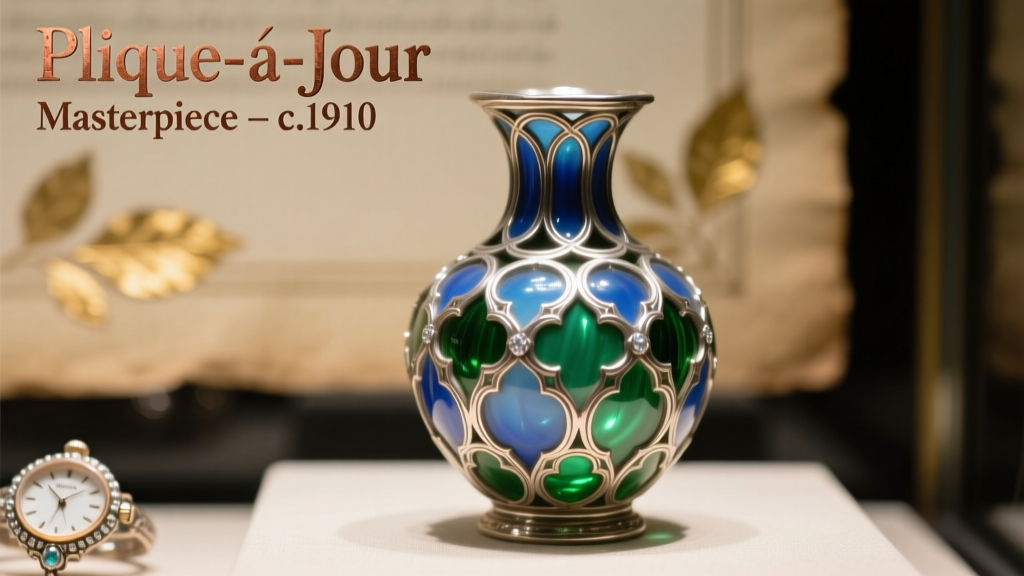
Plique-à-Jour Vase: The Forgotten Masterpiece of Transparent Enamel Artistry
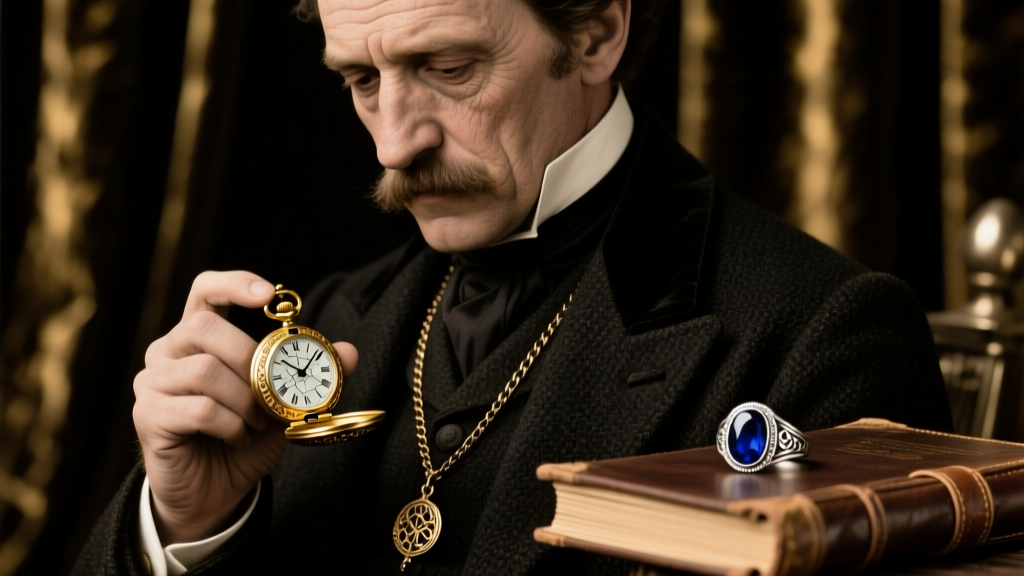
Tintype Portraiture of the Victorian Gentleman: A Technical and Historical Analysis of the Man-in-Suit Photograph

Meissen Figurine 'Wheat Gatherers at Rest' — A Study of the 6.125-Inch Porcelain Group Marked with Crossed Swords and '6/1/8'

Moriage Humidors with Sailing Ships and Palm Trees: A Collector’s Guide to Japanese Export Porcelain from the 1920s–1940s
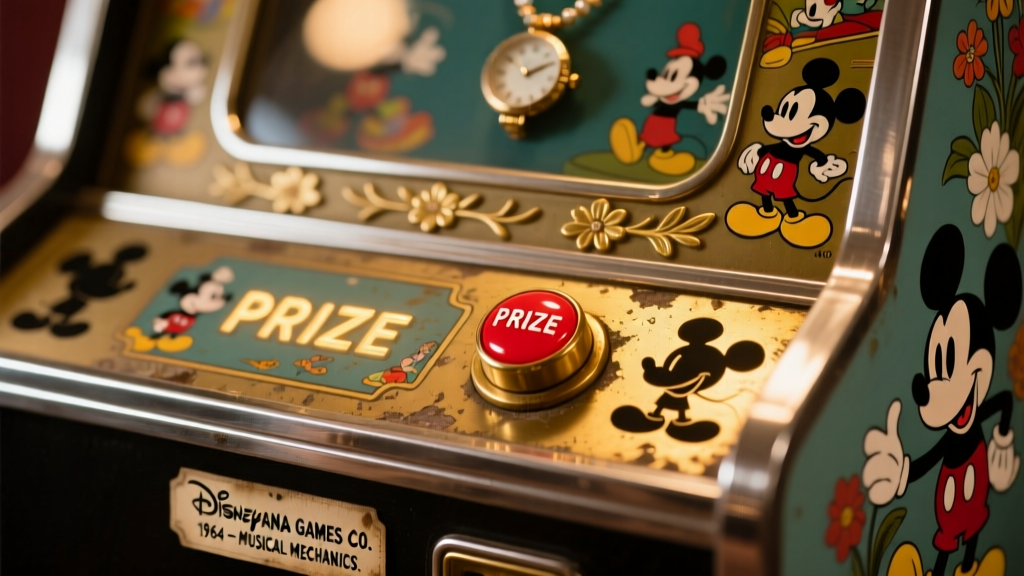
Disneyana Game Arcade 1960s Box: A Collector’s Deep Dive into Rarity, Design, and Provenance

Eagle Triptych in Relief: A 1940s American Folk Carving Examined — 16 × 20 Inch Painted Pine Panel
Standard Oil of Indiana Paper Credit Card: A 1950s Artifact of Corporate Loyalty and Pre-Plastic Consumer Culture

The Gilbert Mantel Clock: American Craftsmanship, Design Evolution, and Auction Market Realities

Vintage Boy and Girl Ceramic Figurines: History, Identification, and Market Value