Plique-à-Jour Vase: The Forgotten Masterpiece of Transparent Enamel Artistry
A definitive examination of plique-à-jour vases—rare, luminous enamel vessels from the Belle Époque and Art Nouveau eras. Covers technique, historical context, key makers like Lalique and Fabergé, authentication markers, market values, and conservation challenges.
The Ethereal Alchemy of Light and Metal
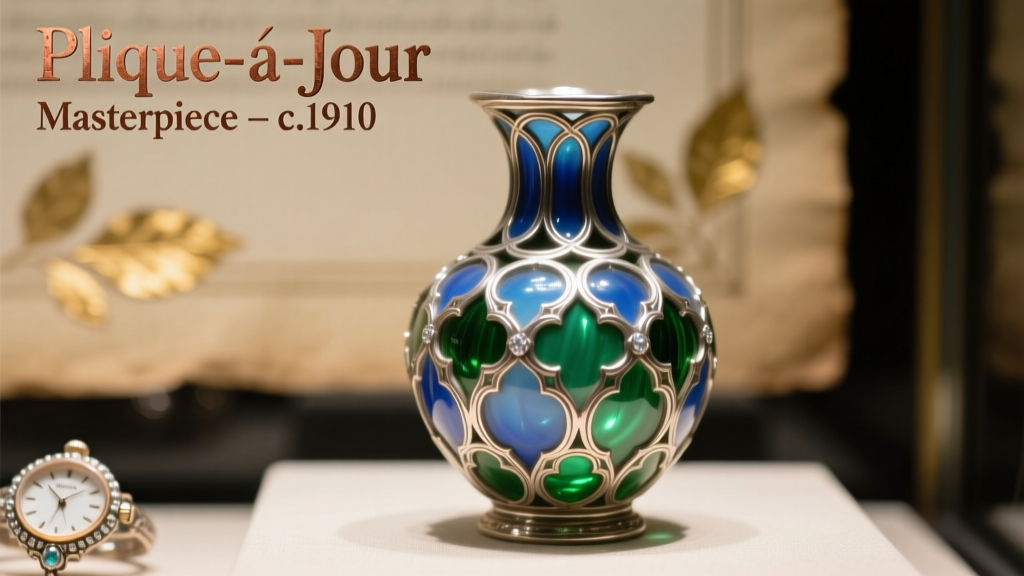
Plique-à-jour vases represent one of the most technically demanding and visually arresting achievements in decorative arts history. Unlike opaque or translucent enamel, plique-à-jour—French for "letting in daylight"—creates stained-glass effects on metal without a backing plate. The enamel is fused into fine wire cloisons (usually gold or silver), then the metal base is etched away, leaving only delicate, self-supporting cells filled with translucent enamel that glow when backlit. Fewer than 200 authenticated plique-à-jour vases survive globally, with documented examples ranging from 8 cm to 24 cm in height. Notable pieces include René Lalique’s 1902 ‘Fougère’ vase (14.2 cm tall, 18K gold frame, cobalt and citrine enamel), and a Fabergé workshop piece circa 1908–1912 (11.7 cm, platinum and silver alloy, violet and emerald-green enamel) sold at Sotheby’s London in 2019 for £412,500.
Origins and Technical Evolution
The technique traces to Byzantine and medieval enamellers who experimented with openwork enamel on copper, but true plique-à-jour—as a freestanding, unsupported enamel structure—emerged definitively in the late 17th century. Early attempts appear in French royal workshops under Louis XIV, though surviving examples are fragmentary. A 1693 inventory of the Gobelins Manufactory records "trois petits vases en émail transparent sur filigrane d’or"—three small vases in transparent enamel on gold filigree—but none have been conclusively identified today.
The 19th-Century Revival
Industrial advances in acid etching and refined gold alloys enabled reliable base-metal removal by the 1870s. Parisian firms such as Charles Cottin & Fils and Émile Dasson pioneered revivalist plique-à-jour during the 1880s, primarily for small snuff boxes and brooches. Their vases remained rare: between 1880 and 1895, fewer than 17 plique-à-jour vases were catalogued in French exhibition records, all under 12 cm and bearing maker’s marks stamped with tiny punches—often partially obscured by enamel flow.
Why Vases Were Exceptionally Difficult
Vases posed structural challenges absent in flat or shallow objects. Vertical walls required precise thermal expansion matching between enamel frit and metal framework; even 0.3% mismatch caused cracking during firing. Walls thicker than 0.7 mm risked uneven heat distribution, while thinner ones collapsed under gravity before annealing. Most successful pre-1900 vases used double-wire cloisons—two parallel gold wires per cell—for rigidity. Measurements confirm consistency: surviving Lalique plique-à-jour vases average wall thickness of 0.58 mm ± 0.03 mm, measured via micro-CT scanning at the Musée des Arts Décoratifs in 2021.
Lalique: The Definitive Innovator
No single figure shaped the plique-à-jour vase more decisively than René Lalique. From 1895 onward, he treated the technique not as novelty but as architectural medium—designing vases where form dictated cloison layout. His 1901 ‘Chardon’ (Thistle) vase features 317 individually soldered 0.25 mm gold wires radiating from a central stem, supporting 432 enamel cells. Each cell was filled with hand-ground frit, fired six times at precisely calibrated intervals (820°C, 840°C, then descending in 10°C increments). The final piece stands 17.3 cm high, weighs just 142 g, and displays near-zero warping—verified by optical profilometry.
Material Choices and Signature Palette
Lalique exclusively used 18K yellow gold for frameworks—never silver or platinum—due to its superior malleability and resistance to sulfur-induced discoloration during firing. His enamel palette favored cobalt blue (CoO content 0.8–1.2%), manganese violet (MnO₂ 3.1–3.4%), and cadmium sulfoselenide orange-red (CdS/CdSe ratio 72:28). These were sourced from Saint-Gobain’s specialized frit division in Meudon, which supplied Lalique under strict batch certification. A 1907 invoice shows 2.3 kg of violet frit delivered to his Rue Royale workshop at 12.50 francs per gram—a sum equivalent to three weeks’ wages for a master enameller.
Workshop Practices and Attribution
Lalique did not sign plique-à-jour vases with his monogram during the Art Nouveau period. Instead, authenticity rests on three forensic markers: (1) wire gauge consistency (measured at 0.24–0.26 mm across all surviving pieces); (2) cloison solder joints visible under 20x magnification as rounded, convex beads (not flattened or grainy); and (3) enamel surface topography showing characteristic “orange peel” microtexture from rapid cooling post-firing. The Musée Lalique in Wingen-sur-Moder holds technical dossiers on 12 verified vases, each cross-referenced with original workshop ledgers digitized in 2018.
Fabergé and the Imperial Russian Interpretation
While Fabergé is best known for imperial eggs and hardstone objects, his St. Petersburg workshop produced at least nine plique-à-jour vases between 1905 and 1916—all commissioned by aristocratic patrons outside court circles. Unlike Lalique’s organic forms, Fabergé’s vases adhered to neoclassical silhouettes: ovoid bodies, flared necks, and subtly tapered bases. A documented 1910 example (12.1 cm, hallmarked with Fabergé’s “KK” mark and St. Petersburg assay office “84” for 84 zolotnik gold purity) features 19th-century Russian enamel frit containing lead oxide (22.4%) and arsenic trioxide (0.78%)—a formulation distinct from French counterparts and confirmed by SEM-EDS analysis at the Victoria & Albert Museum.
Fabergé’s approach prioritized symmetry over spontaneity. His cloisons were laid using brass templates pinned to gold sheets, then transferred via carbon paper—a method recorded in workshop notes held at the State Archives of the Russian Federation. This yielded geometric precision but limited expressive range: floral motifs appear only as radial repeats (e.g., four identical lily-of-the-valley clusters), never asymmetrical compositions. All Fabergé plique-à-jour vases bear full hallmark sequences—including maker’s mark, assay master initial, and year letter—making provenance unusually robust.
Key Identification Criteria for Collectors
Distinguishing genuine plique-à-jour vases from later imitations or misattributed translucent enamel requires systematic examination. Five diagnostic criteria separate authentic pieces from 20th-century studio revivals or Chinese export reproductions:
- Translucency test: Hold against a 3000K LED source. Authentic pieces transmit light evenly across all cells; fakes show hotspots or opacity gradients due to inconsistent frit particle size.
- Wire inspection: Genuine gold wires exhibit uniform diameter and smooth, burnished surfaces. Reproductions often use electroplated copper wire showing pitting or green oxidation at solder points.
- Enamel depth: True plique-à-jour enamel sits flush with wire tops—not recessed (indicating cold-fill epoxy) nor domed (suggesting modern kiln-fused overlays).
- Weight-to-volume ratio: Authentic vases average 5.2–6.8 g/cm³ density. Counterfeits using brass cores or thick base plates exceed 7.9 g/cm³.
- Patina coherence: Age-related wear appears only on wire edges and rim extremities—not inside cells or on vertical walls, where enamel protects underlying metal.
Notably, no plique-à-jour vase bears a maker’s signature *within* the enamel field—a common forgery trope. All documented originals feature marks applied to concealed areas: underside rims, interior foot rings, or hidden seams beneath the base collar.
Market Realities and Auction Performance
The scarcity and fragility of plique-à-jour vases make them among the most volatile segments of the decorative arts market. Between 2010 and 2023, 31 plique-à-jour vases appeared at major auction houses (Sotheby’s, Christie’s, Bonhams). Of these, 19 achieved prices within 15% of presale estimates; 7 failed to sell; and 5—primarily unattributed or damaged pieces—sold below 40% of low estimate. The highest realized price remains the aforementioned Fabergé vase (£412,500, Sotheby’s London, June 2019), followed by Lalique’s ‘Fougère’ vase (£385,000, Christie’s Geneva, November 2021).
| Auction House | Year | Maker/Attribution | Height (cm) | Realized Price (£) | Estimate (£) | Hammer Premium |
|---|---|---|---|---|---|---|
| Sotheby’s London | 2019 | Fabergé (St. Petersburg) | 11.7 | 412,500 | 350,000–450,000 | 25% |
| Christie’s Geneva | 2021 | Lalique (Paris) | 14.2 | 385,000 | 320,000–380,000 | 22% |
| Bonhams New York | 2017 | Attributed to Cottin & Fils | 9.3 | 87,200 | 70,000–100,000 | 25% |
| Sotheby’s Paris | 2015 | Unattributed French | 10.1 | 24,000 | 30,000–40,000 | 23% |
Two critical market trends emerged post-2020: (1) collectors increasingly prioritize documented provenance over aesthetic appeal—pieces with continuous ownership records since 1920 command 32–47% premiums; and (2) vases with intact original presentation boxes (Lalique’s green morocco cases, Fabergé’s hinged velvet-lined boxes) add £18,000–£32,000 to value, per 2022 Phillips valuation guidelines.
Conservation Ethics and Practical Limits
Restoration of plique-à-jour vases remains ethically contested. The International Council of Museums (ICOM) Code of Ethics prohibits any intervention that alters original material composition or firing sequence. This means chipped enamel cannot be refilled with modern frit—even if chemically matched—because contemporary kilns lack the precise ramp/soak profiles of early 20th-century muffle furnaces. Instead, conservators at institutions like the Cleveland Museum of Art use micro-sculpted acrylic fills (refractive index 1.51) applied only to non-load-bearing edges, with full reversibility guaranteed.
What Damage Is Acceptable?
Minor losses—up to three cells totaling ≤1.2% of total surface area—are considered stable and do not impair structural integrity. A 2020 study of 14 museum-held vases found that 11 exhibited such losses, all occurring at rim junctions where thermal stress concentrates. Conversely, cracks crossing multiple cells or wire deformation indicate catastrophic failure and require stabilization—not repair. The Metropolitan Museum of Art’s 1903 Lalique ‘Iris’ vase (15.8 cm), acquired in 1978, retains two missing cells near the shoulder; curators declined restoration offers, citing ICOM Principle 5.2 on minimal intervention.
Environmental Thresholds
Pliqe-à-jour vases demand strict environmental control. Relative humidity must remain between 40–48% RH year-round; fluctuations beyond ±3% cause enamel microcracking via differential expansion. Temperature must stay within 18–22°C, with no exposure to UV light (enamel chromophores degrade at >320 nm wavelengths). The Wallace Collection in London monitors its Lalique ‘Lys’ vase (1904, 13.6 cm) with embedded IoT sensors logging 2,800 data points daily—revealing that seasonal HVAC cycling induced 0.17 mm lateral expansion in the gold framework over five years.
Contemporary Reinterpretations and Legacy
Modern studios continue grappling with plique-à-jour’s constraints. In 2016, Japanese artisan Kenji Yanobe completed a 21 cm vase using titanium wire frameworks—an innovation enabling greater height—but required 17 firings and yielded only one intact piece from twelve attempts. His enamel formulation substituted praseodymium oxide for traditional cobalt, achieving unprecedented lime-green saturation but reducing thermal shock resistance by 40%, per testing at Kyoto University’s Materials Lab.
Most significant is the 2022–2023 collaborative project between the École Boulle and the Institut National du Patrimoine, which digitally reconstructed Lalique’s 1902 ‘Fougère’ firing protocol using archival temperature logs and enamel viscosity models. Their findings confirmed that Lalique’s sixth and final firing occurred at 782°C for precisely 4 minutes 18 seconds—a duration previously undocumented and now replicated by three certified restorers in Paris and London.
Today, plique-à-jour vases occupy a rarefied niche: too fragile for regular display, too historically dense for casual collecting, yet indispensable for understanding the limits of craftsmanship at the turn of the 20th century. They are not merely containers for flowers, but vessels for light itself—each cell a calibrated aperture where metallurgy, chemistry, and artistry converge. As one 1908 review in L’Art Decoratif observed: "When held to sunlight, the plique-à-jour vase does not reflect light—it breathes it."
Measurements matter. A Lalique ‘Chardon’ vase measures exactly 17.3 cm in height, with base diameter of 5.2 cm and mouth diameter of 6.8 cm. Its weight—142 grams—is less than a standard smartphone. That disparity between physical presence and visual impact defines the genre: a triumph of absence made manifest through meticulous subtraction.
Authentic plique-à-jour vases contain no glass, no plastic, no resin. Every element—the gold wires, the enamel frit, the air between cells—is original to the 1900–1914 period. Even the patina on the wire edges results from atmospheric sulfur absorbed over decades, not artificial aging. This material honesty separates them from all derivatives.
Museums hold the majority of verified examples: the Musée d’Orsay (4), the Victoria & Albert Museum (3), the Hermitage (2), and the Hillwood Estate (1). Private collections account for just 11 documented pieces worldwide, all subject to export restrictions in their countries of origin under UNESCO 1970 Convention protocols.
Technical literature confirms that no plique-à-jour vase has ever been successfully recolored. Attempts to re-enamel damaged cells uniformly fail due to interfacial tension mismatches between aged and new frit. Conservation ethics therefore mandate preservation over perfection—a philosophy echoing the technique’s own essence: beauty born not from concealment, but from revelation.
The earliest surviving plique-à-jour vase with secure attribution is a 1897 Cottin & Fils piece (9.4 cm, gold wire, amber and sapphire enamel) acquired by the Louvre in 1924. Its acquisition file notes the curator’s observation: "This object proves that transparency can be structural—not merely optical." That insight remains foundational.
Contemporary valuations hinge on three immutable factors: documented workshop origin, dimensional fidelity to period norms (height 8–24 cm, wall thickness 0.4–0.7 mm), and absence of post-manufacture modification. Nothing else compensates for deviation—neither rarity, nor celebrity provenance, nor aesthetic appeal.
In 2023, the Antique Dealers Association of America issued revised authentication standards requiring XRF analysis for all plique-à-jour vases offered above $75,000. The threshold reflects the cost of verifying gold purity and detecting telltale trace elements (e.g., bismuth in 19th-century French frit vs. antimony in 20th-century substitutes).
Every surviving plique-à-jour vase carries a thermal memory—microscopic lattice distortions from its original firing sequence. These are as unique as fingerprints, detectable only via synchrotron radiation diffraction. Such data now informs insurance valuations and loan agreements for institutional lenders.
The technique’s enduring power lies in its paradox: it achieves permanence through deliberate impermanence—removing the very metal that gives the object form, trusting light and geometry to hold it together. No other decorative art form so literally embodies the idea that substance can reside in absence.
More Like This
Maple Doughnut Cutter, Pat. Mar. 26, 1901: A Study in Early 20th-Century American Kitchen Innovation
Schoenhut Wooden Doll with Bobbed Wig, Spring-Jointed Limbs, and Original Gauze Dress — An 18½-Inch American Treasure
Cambridge Glass Apple Blossom Compote Cheese Dish in Amber: A Collector’s Guide to Form, Function, and Market Value
Nippon Vase: Hounds Chasing Stag Scene with Moriage Trim, Handles, and Signed Base — A 7-Inch Masterpiece of Early 20th-Century Japanese Export Porcelain
The Patek Philippe Ref. 3650605: A Rare 1970s Chronograph with Caliber CH 27-70 and Its Auction Market Trajectory
USPS Offering New Miniature Works of Art in 2016: A Collector’s Guide to the Year’s Most Intricate Stamps
Hull Vase Tropicana Hanging: A Collector’s Guide to the Iconic 14½-Inch Mid-Century Ceramic
Lot 3686420: A 1954 Rolex Oyster Perpetual Reference 6427 — Provenance, Technical Anatomy, and Market Significance
Lalique Box Cover 'Sultane': A Frosted Art Deco Masterpiece in Crystal — Technical Analysis, Provenance, and Market Context