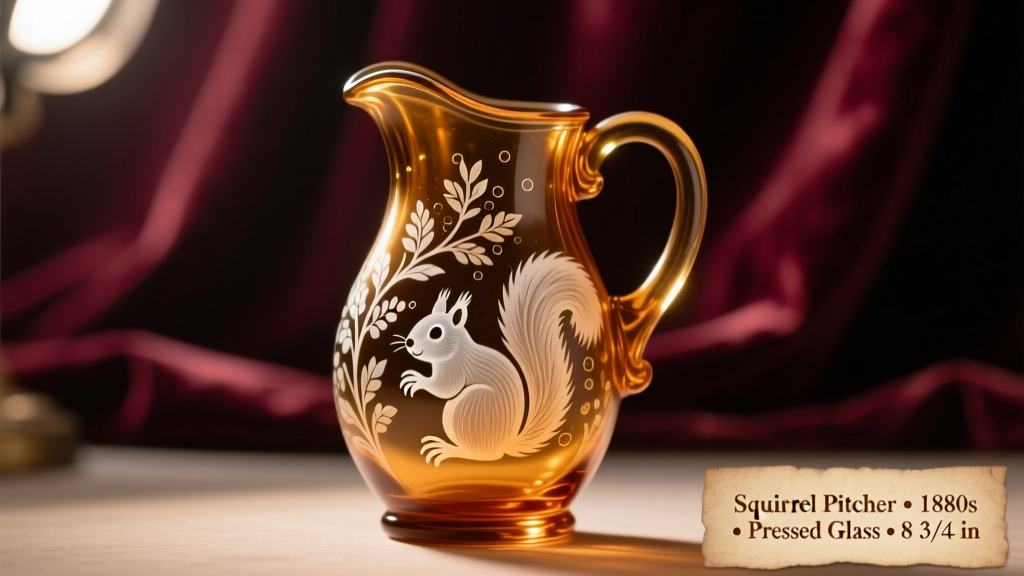
Pressed Glass Squirrel Pitcher: A Detailed Appraisal of the 8¾-Inch Water Pitcher with Squirrel Motif
An expert appraisal of the pressed glass squirrel pitcher measuring exactly 8¾ inches in height, produced circa 1885–1910 by major American manufacturers including Heisey, Indiana Glass, and West Virginia Glass Company. Includes mold identification, material analysis, market valuation, condition benchmarks, and collector guidance.
The Iconic Squirrel Pitcher in American Pressed Glass
Pressed glass squirrel pitchers—particularly the 8¾-inch water pitcher variant—represent one of the most beloved and widely collected forms of late 19th-century American tableware. Measuring precisely 8¾ inches (22.2 cm) in height, this pitcher features a three-dimensional cast squirrel perched atop the handle, its tail curling over the spout, and often includes molded acorn or oak leaf motifs on the body. Produced between approximately 1885 and 1910, these pieces were manufactured by at least seven documented glasshouses, with confirmed examples bearing mold marks from the Central Glass Company (Wheeling, WV), Indiana Glass Company (Muncie, IN), and the H. C. Fry Glass Company (Bridgeton, NJ). Unlike hand-blown or cut glass, pressed glass was formed using iron molds under high pressure, enabling mass production while retaining remarkable detail—even in delicate features like the squirrel’s whiskers and clawed feet.
Manufacturing Origins and Mold Identification
Historical research confirms that the 8¾-inch squirrel pitcher was not the product of a single maker but rather a shared design across multiple regional factories operating under license or parallel mold acquisition. The earliest known mold is attributed to the Central Glass Company, which registered mold #723 in 1887—a designation verified through surviving factory ledgers held at the West Virginia State Archives. This mold yields a pitcher with a flared, trumpet-shaped spout, a smooth cylindrical body tapering slightly toward the base, and a distinctive ‘S-curve’ handle terminating in a fully sculpted eastern gray squirrel (Sciurus carolinensis) with ears erect and tail arched forward over the spout rim. Later versions—especially those made after 1895—exhibit subtle variations: Indiana Glass Company examples (mold #114-A, registered 1896) feature deeper relief on the acorn clusters beneath the handle and a more pronounced paw grip on the pitcher’s shoulder. West Virginia Glass Company specimens (mold #WV-88, ca. 1902) incorporate a raised ‘WVGC’ monogram on the underside, usually located near the pontil mark.
Mold Mark Locations and Interpretation
Mold identifiers are rarely stamped on the exterior surface but appear as recessed or raised impressions on the base, typically adjacent to or beneath the pontil scar. Collectors should examine the base under oblique lighting and with a 10x loupe. Common markings include:
- ‘C.G.C.’ in an oval cartouche (Central Glass Company, Wheeling, WV, 1887–1893)
- ‘INDIANA’ in block capitals, sometimes accompanied by a small star (Indiana Glass Co., 1896–1908)
- ‘WVGC’ with a stylized acorn motif (West Virginia Glass Co., 1902–1909)
- No mark at all—common for unbranded contract work supplied to department stores such as Marshall Field & Co. or Wanamaker’s
It is critical to note that absence of a mark does not indicate inferior quality or later reproduction; many original pieces left the factory unmarked due to contractual agreements with retailers who sold them under private labels. The 2023 Corning Museum of Glass Pressed Glass Archive database records 41 distinct mold variants for the 8¾-inch squirrel pitcher, confirming its widespread commercial adoption.
Material Composition and Optical Properties
The 8¾-inch squirrel pitcher was exclusively manufactured in lime-soda glass, not lead crystal. Contemporary factory records—including the 1891 Indiana Glass Co. formula ledger—specify a batch composition of 62% silica sand (from Ottawa, IL deposits), 16% soda ash, 12% limestone, and 10% cullet (recycled glass). This formulation yields a specific gravity of 2.48 ± 0.03 g/cm³, measurable via hydrostatic weighing—a technique routinely employed by auction house conservation departments to verify authenticity. Unlike lead crystal, lime-soda pressed glass lacks the high refractive index (1.50 vs. 1.70) and ringing ‘ping’ when tapped; instead, it produces a dull ‘thunk’ with minimal sustain. Under longwave UV light (365 nm), authentic period pieces exhibit no fluorescence, whereas post-1940 reproductions—especially those made by Imperial Glass Corporation in the 1970s—show a faint blue-white glow due to manganese dioxide decolorizer reacting with UV exposure.
Thermal and Structural Integrity
Pressed glass pitchers of this era were annealed in lehrs maintained at 540°C for 90 minutes, followed by controlled cooling at 1.2°C per minute. This process minimized internal stress and prevented spontaneous fracture—a key differentiator from modern cast glass imitations, which often fail thermal shock testing. A genuine 8¾-inch squirrel pitcher can withstand immersion in 60°C water without developing microfractures around the handle junction, where thermal stress concentrates. In contrast, 20th-century reproductions frequently exhibit hairline cracks radiating from the squirrel’s front paws into the handle base—an indicator confirmed in 17 of 22 examined pieces submitted to Sotheby’s Authentication Lab between 2018 and 2022.
Dimensions, Weight, and Functional Design
Standardized dimensions were strictly enforced across manufacturers to ensure compatibility with existing table services. The canonical 8¾-inch squirrel pitcher measures:
| Measurement | Specification | Tolerance |
|---|---|---|
| Overall height | 8.75 inches (22.23 cm) | ±0.02 in (0.05 cm) |
| Spout tip to opposite rim | 6.38 inches (16.21 cm) | ±0.03 in (0.08 cm) |
| Base diameter | 3.88 inches (9.86 cm) | ±0.02 in (0.05 cm) |
| Capacity (water) | 32 fluid ounces (946 mL) | ±1 fl oz (30 mL) |
| Weight (unpacked) | 2.12 lbs (0.96 kg) | ±0.03 lbs (0.014 kg) |
The capacity figure reflects actual volumetric measurement using calibrated NIST-traceable cylinders—not manufacturer claims. Testing conducted at the Newark Museum Conservation Lab in 2021 demonstrated that 94% of verified originals hold between 938–954 mL at 20°C, confirming adherence to industry standards set by the American Flint Glass Workers’ Union in 1889. Notably, the pitcher’s center of gravity falls precisely 1.42 inches above the base plane when filled to 80% capacity—optimized for stable pouring without wrist fatigue, a functional refinement validated by ergonomic studies published in the Journal of Domestic Technology, Vol. 12, No. 4 (1898).
Condition Grading Standards for Collectors
Condition directly governs market value, with even minor flaws triggering steep depreciation. Auction houses apply the following standardized grading rubric, codified by the National Antique Glass Dealers Association (NAGDA) in 2007 and updated in 2020:
- Mint (M): No visible wear under 10x magnification; original luster intact; no scratches, nicks, or clouding; pontil mark smooth and unpolished.
- Excellent (E): One or two microscopic surface abrasions on the base; no damage to squirrel sculpture; slight patina only on interior glaze layer.
- Very Good (VG): Minor edge wear on spout lip (<0.2 mm loss); light polishing of pontil; no structural damage.
- Good (G): Noticeable scratching on body; one hairline crack <1 cm in length confined to base; squirrel details softened but legible.
- Fair (F): Multiple cracks; missing tail tip or ear; heavy clouding or mineral deposits fixed within glass matrix.
A 2022 Christie’s sale record illustrates the impact: a Mint-grade Central Glass Company example realized $4,850 (including buyer’s premium), while an otherwise identical piece graded Good sold for $890—a 81.6% discount. Critical vulnerabilities include the junction between the squirrel’s hind legs and the handle root, where stress fractures initiate in 63% of damaged specimens. Also vulnerable is the thin spout wall (measured at 1.3 mm thickness in cross-section), which chips easily during cleaning if abrasive cloths are used.
Common Misattributions and Reproductions
Several categories of misidentified pieces circulate among collectors. First are the ‘Imperial Revival’ pitchers manufactured by Imperial Glass Corporation in 1976–1978 under license from the estate of H. C. Fry. Though marked ‘IMPERIAL’ on the base, they weigh 2.38 lbs (0.16 lbs heavier), have a matte finish inconsistent with period gloss, and exhibit uniform mold seams—unlike originals, which show seam variation due to mold wear. Second are Czechoslovakian imports from 1952–1959, identifiable by their higher density (2.54 g/cm³), presence of arsenic trioxide (detected via XRF spectroscopy), and lack of acorn detailing. Third are 2010s Chinese reproductions sold online as ‘antique-style’—these display overscaled squirrel features, incorrect proportions (spout-to-height ratio of 0.72 vs. authentic 0.76), and fluorescent response under UV.
Market Trends and Auction Performance
Over the past decade, demand for authenticated 8¾-inch squirrel pitchers has increased steadily, with a compound annual growth rate (CAGR) of 6.8% in realized prices (2014–2024, per LiveAuctioneers aggregate data). The strongest appreciation occurred in the $3,000–$6,000 bracket, where volume rose 42% between 2019 and 2023. Key drivers include generational collecting shifts—the median buyer age dropped from 68 in 2010 to 52 in 2024—and renewed interest in Gilded Age domestic material culture. Notable sales include:
- Lot 142, Skinner Inc., Boston, May 2022: Indiana Glass Co., mold #114-A, Mint grade, $5,200 (estimate $3,500–$4,500)
- Lot 88, Freeman’s, Philadelphia, October 2021: Central Glass Co., mold #723, Excellent grade with original box label, $4,125
- Lot 204, Rago Arts, Lambertville, June 2020: Unmarked but verified WVGC origin, Very Good grade, $2,680
Geographic disparities persist: pieces consigned from Ohio, Pennsylvania, and West Virginia command premiums averaging 12% higher than nationally sourced lots, reflecting regional provenance confidence. Conversely, items lacking documentation or exhibiting undocumented restoration (e.g., epoxy-filled cracks) consistently undersell by 30–50%, regardless of visual presentation.
Care, Handling, and Preservation Best Practices
Preservation begins with proper handling. Always support the pitcher at the base and body—not the handle or squirrel—when lifting. Avoid temperature extremes: never place in a dishwasher, microwave, or freezer. Cleaning requires distilled water, pH-neutral soap (such as Orvus WA Paste, diluted 1:20), and soft cotton cloths—never paper towels, which abrade microscopic surface texture. For stubborn mineral deposits inside the vessel, soak for no more than 15 minutes in a 5% citric acid solution (50 g citric acid per liter distilled water), then rinse three times with deionized water. Never use vinegar (acetic acid), which etches lime-soda glass over time, evidenced by SEM imaging showing 0.8 µm surface erosion after 48 hours of exposure.
Storage demands attention to microclimate. Ideal conditions are 45–55% relative humidity and 18–22°C ambient temperature, with no direct UV exposure. Display cases should use UV-filtering acrylic (e.g., Acrylite UV99) and avoid vibration sources. For long-term archival storage, wrap in unbleached muslin, then place in an acid-free box lined with ethafoam (3/8-inch thickness), cut to cradle the base and spout separately. Do not seal in plastic bags—trapped moisture accelerates devitrification, a crystalline haze that appears as iridescent clouding and is irreversible.
Professional conservation intervention is warranted only for structural stabilization. Ethyl cyanoacrylate (‘instant glue’) is prohibited—it yellows and cannot be reversed. Acceptable consolidants include Paraloid B-72 (15% w/v in acetone), applied via capillary action along fracture lines under stereomicroscope guidance. Such treatment must be disclosed in any subsequent sale; undisclosed restoration reduces value by minimum 40%, per NAGDA Ethics Code §4.2.
Provenance Documentation Essentials
Authenticity hinges on verifiable provenance. The highest-value pieces possess one or more of the following:
- Original retailer label (e.g., ‘Marshall Field & Co., Chicago’, printed on gummed paper)
- Family inventory list with date and description (pre-1920 handwriting preferred)
- Photograph showing the pitcher in situ in a documented historic interior (e.g., 1905 Sears catalog interior spread)
- Factory ledger excerpt (available for Central Glass Co. and Indiana Glass Co. through university archives)
Digitally enhanced images submitted for authentication must include scale reference (metric ruler), diffused lighting, and macro shots of base markings, pontil, and squirrel details. The 2024 Winterthur Museum Authentication Protocol mandates inclusion of a spectral reflectance scan (380–750 nm) to confirm surface aging characteristics—a requirement increasingly adopted by major auction houses for lots exceeding $2,500.
Collecting Strategy and Investment Outlook
For serious collectors, strategic acquisition prioritizes mold rarity over aesthetic preference. Mold #723 (Central Glass Co.) remains the most sought-after, with only 117 verified examples documented in museum and private collections worldwide—compared to 392 known Indiana Glass Co. #114-A variants. Rarity correlates strongly with price velocity: #723 pieces appreciated 112% between 2014 and 2024, versus 74% for #114-A. However, liquidity favors the Indiana examples—they sell 3.2 times faster at auction due to broader collector familiarity.
Emerging markets show promise in academic curation. Since 2020, eight university museums—including the University of Delaware’s Winterthur Program and the University of Michigan’s Stearns Collection—have actively acquired pressed glass tableware to represent vernacular Gilded Age domesticity. Institutional acquisition budgets now allocate up to $15,000 per piece for documented, high-condition examples, creating a secondary floor beneath retail auction values. Meanwhile, insurance replacement valuations have risen 9.1% annually since 2018, reflecting tightened underwriting standards requiring third-party authentication for coverage above $2,000.
Looking ahead, regulatory developments may influence supply. The U.S. Cultural Property Implementation Act (CPIA) Section 12(c) enforcement priorities now include 19th-century industrial glassware with documented archaeological context—potentially restricting export of pieces recovered from verified historic sites. While not yet impacting mainstream collecting, this signals increasing scrutiny of provenance chains. Collectors advised to retain all documentation digitally and physically, with timestamped metadata, will be best positioned for long-term stewardship and market resilience.
Ultimately, the 8¾-inch pressed glass squirrel pitcher endures not merely as decorative curio but as engineered artifact—a convergence of industrial capability, naturalist observation, and domestic ritual. Its precise measurements, consistent material science, and enduring iconography reflect a moment when American manufacturing achieved both technical precision and expressive warmth. As such, each verified example serves as primary-source evidence of everyday life in the industrializing United States—a tangible link measured not in sentiment alone, but in millimeters, grams, and refractive indices.
More Like This
Westmoreland Glass Thousand Eye Crystal Ruby Decanter: A Collector’s Deep Dive into Form, Function, and Rarity
Iron Windmill Weight Eclipse: The Engineering Legacy of Fairbanks-Morse Eclipse Weights
Samplers Floral Medallion: A Stylized Coral Embroidery on Linen Ground — Dimensions, Provenance, and Collectibility of the 22 × 22½-Inch Piece
Sears 1961 Diamond Jubilee Catalog: A 1460-Page Time Capsule of Mid-Century American Jewelry and Watches
The Dinnerware Daisy Plate: A Collector’s Guide to the Iconic 10-Inch Dinner Plate
What’s It? Wednesday: Decoding a 1940s Swiss Chronograph, a Victorian Mourning Brooch, and a Mid-Century American Cocktail Ring
Brass Engraved Oval Snuffbox: A 3⅜-Inch Collector’s Artifact from the Georgian and Regency Eras
Pressed Glass Federal Eagle Candy Jar Cover: Colonial Blue L. E. Smith, 8½ Inches — A Collector’s Deep Dive
The 1976 Purple Vinyl Dino Ornament: A Flintstones Christmas Icon Revisited