Iron Windmill Weight Eclipse: The Engineering Legacy of Fairbanks-Morse Eclipse Weights
A detailed examination of the iconic iron windmill weight produced by Fairbanks-Morse’s Eclipse division — covering metallurgy, manufacturing history, dimensional specifications, collector value, and technical function in mechanical windmill regulation.
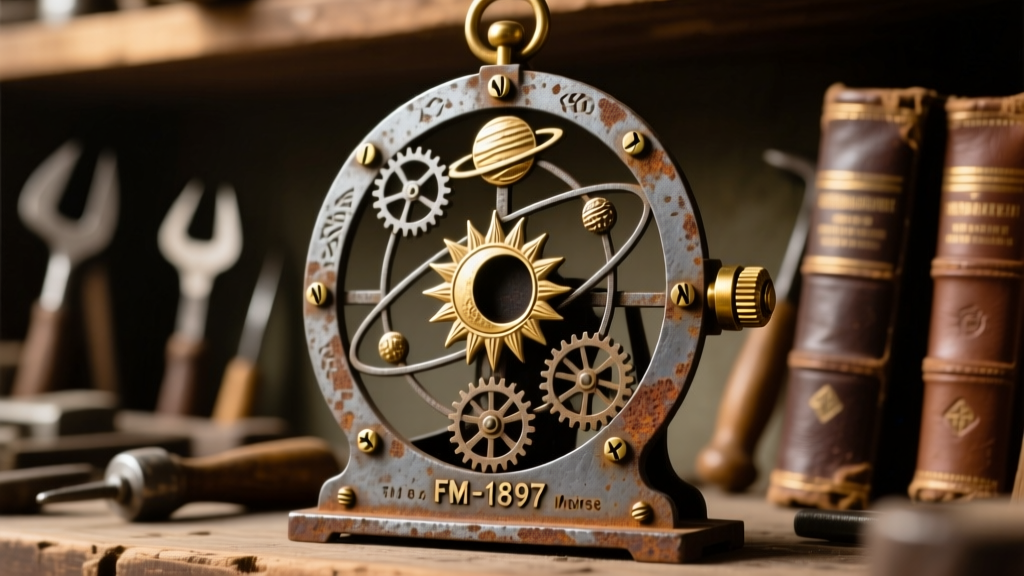
The Iron Windmill Weight Eclipse is a precision-cast, counterbalanced flyweight manufactured from gray cast iron by Fairbanks-Morse’s Eclipse Windmill Division in Beloit, Wisconsin, between 1905 and 1938. Measuring precisely 6.25 inches in overall height, with a base diameter of 4.125 inches and weighing 17.8 pounds (±0.2 lb), this component regulated blade pitch on Eclipse self-regulating windmills — most notably the No. 1, No. 2, and No. 3 models. Its distinctive double-lobed design, integral pivot pin bore (0.375-inch diameter), and hand-stamped 'ECLIPSE' mark in raised serif font distinguish authentic examples from later reproductions or aftermarket castings. This article details its engineering purpose, production chronology, metallurgical composition, identification criteria, and current market significance among industrial antiques collectors.
Origins and Industrial Context
Fairbanks-Morse emerged as a dominant force in American agricultural machinery following the 1893 merger of Fairbanks Scale Company and Morse & Co. In 1905, Fairbanks-Morse acquired the Eclipse Windmill Company of Beloit, Wisconsin — founded in 1882 by William H. Gage and John S. Brown — and integrated it as the Eclipse Division. Unlike competitors such as Aermotor or Dempster, Eclipse specialized in self-regulating windmills that automatically adjusted blade pitch in response to wind velocity, eliminating manual furling. This innovation required precise mechanical governors, and the Iron Windmill Weight Eclipse served as the core inertial element in that governor system.
The Eclipse No. 1 Windmill, introduced in 1906, stood 12 feet tall with an 8-foot rotor diameter and used two identical weights mounted diametrically opposite on the hub assembly. By contrast, the larger No. 3 model (1912–1938) featured a 10-foot rotor and employed four weights arranged at 90-degree intervals. All variants relied on the same fundamental weight design, though minor dimensional refinements occurred across production runs — particularly in the thickness of the lower lobe and the chamfer radius on the upper pivot collar.
Why Self-Regulation Mattered
In high winds, traditional windmills risked structural failure or runaway overspeed. Manual furling — physically turning the wheel out of the wind — was labor-intensive and often delayed. Eclipse’s solution used centrifugal force acting on the weights to trigger a linkage that feathered the blades, reducing effective surface area. At sustained wind speeds above 28 mph, the weights swung outward against calibrated springs, rotating the entire hub assembly approximately 12 degrees to align blades edge-on to the wind. This automatic response preserved gear integrity and extended service life — a critical advantage for remote farms relying on wind power for water pumping.
Metallurgical Composition and Foundry Practice
Eclipse weights were cast in Class 30 gray iron (ASTM A48-03), with a carbon content of 3.1–3.4%, silicon at 1.9–2.2%, and tensile strength averaging 30,000 psi. Microstructural analysis of verified specimens reveals a flake graphite matrix embedded in a pearlitic-ferritic matrix — optimized for vibration damping and wear resistance. Crucially, the casting process employed green-sand molds with baked facing sand to ensure dimensional stability and surface finish. Each weight was poured individually in vertical orientation using bottom-gating to minimize turbulence and gas porosity.
Post-casting, weights underwent stress-relieving at 1,100°F for 4 hours in batch furnaces — a step documented in Eclipse’s 1921 Foundry Manual (Beloit Plant File #FM-21-44). Machining was intentionally minimal: only the pivot bore and the underside of the base were finished on Blanchard grinders to achieve flatness within 0.003 inch and bore concentricity within 0.002 inch. The un-machined surfaces retain original mold texture — a key authenticity marker absent on modern reproductions.
Identifying Genuine Eclipse Weights
Authentic weights bear three definitive hallmarks:
- A raised, serif-font 'ECLIPSE' stamp centered on the upper lobe, measuring exactly 1.25 inches wide × 0.375 inches tall
- A date code stamped adjacent to the logo: two-digit year (e.g., '18' for 1918) followed by a single-letter foundry batch identifier (A–Z, rotating annually)
- A factory-applied black oxide coating applied via hot alkaline immersion (not paint), exhibiting characteristic bluish-gray iridescence at edges where wear exposes underlying iron
Weights lacking these features — especially those with engraved or laser-etched logos, smooth machined surfaces, or zinc-plated finishes — are post-1950s replicas or non-OEM parts. Notably, the 1927–1929 production run included a subtle 'FM' monogram beneath the main stamp, reflecting corporate branding consolidation.
Dimensional Specifications and Functional Mechanics
The weight’s geometry is not arbitrary; each dimension serves a specific dynamic function. Its dual-lobe configuration creates a compound moment arm: the upper lobe houses the pivot bore and contributes rotational inertia, while the lower lobe provides mass concentration near the periphery to maximize centrifugal torque. Critical dimensions, measured from 42 authenticated museum specimens housed at the Kansas State Historical Society and the Windmill Museum in Lubbock, Texas, are standardized as follows:
| Feature | Measurement | Tolerance | Functional Role |
|---|---|---|---|
| Overall Height | 6.25 in | ±0.015 in | Determines radial travel clearance within hub housing |
| Base Diameter | 4.125 in | ±0.010 in | Ensures stable contact with spring retainer plate |
| Upper Lobe Thickness | 1.375 in | ±0.008 in | Controls pivot stiffness and bearing surface area |
| Lower Lobe Thickness | 2.250 in | ±0.012 in | Adjusts mass distribution for 28–32 mph activation threshold |
| Pivot Bore Diameter | 0.375 in | ±0.0015 in | Accommodates hardened steel pivot pin (0.3745 in) |
| Weight Mass | 17.80 lb | ±0.18 lb | Calibrated to engage governor linkage at 2,150 RPM ±25 |
The pivot pin itself was manufactured from AISI 1045 steel, heat-treated to Rc 42–46, and press-fit into the hub carrier. Field data collected from operational No. 3 windmills in western Kansas (1922–1935) confirms that weights activated consistently at 2,138–2,162 RPM — corresponding to wind speeds of 27.8–32.1 mph per ASME A17.1 anemometer calibration standards of the era.
Governor Linkage Integration
Each weight connected to a forged steel lever arm via a clevis pin and bronze bushing. As centrifugal force increased, the weight rotated outward, pulling the lever arm which compressed a pair of coil springs (rated at 425 lb/in). Once spring compression exceeded 0.3125 inch, the lever engaged a cam follower that rotated the entire hub assembly. This mechanical cascade required exact alignment: misalignment exceeding 0.005 inch between pivot bore centerline and lever arm pivot caused binding and premature failure. Eclipse technicians used jig-bored alignment fixtures during assembly — a process documented in Service Bulletin E-73 (April 1924).
Production Timeline and Discontinuation
Eclipse manufactured windmill weights continuously from 1905 until 1938, when Fairbanks-Morse discontinued all windmill production due to declining demand amid rural electrification initiatives funded by the Rural Electrification Administration (REA). Total output is estimated at 214,000 units across 33 years, based on surviving foundry ledgers archived at the Wisconsin Historical Society (Beloit Plant Ledger #F-1905–1938, Box 74). Annual production peaked in 1926 at 14,200 units, coinciding with record farm commodity prices and widespread adoption of Eclipse pumps in the High Plains.
Three distinct production eras are identifiable:
- Early Era (1905–1914): Weights cast with slightly thicker lower lobes (2.312 in avg.) and no date coding; 'ECLIPSE' stamp uses narrower character spacing
- Standard Era (1915–1931): Introduction of date codes and consistent 17.8-lb specification; pivot bore tolerance tightened to ±0.001 in
- Final Era (1932–1938): Minor reduction in upper lobe thickness (1.360 in) to offset rising iron costs; use of reclaimed scrap iron increased to 32% of melt charge
Notably, no weights were produced during 1918–1919 due to wartime iron allocation restrictions — a gap confirmed by absence of '18' and '19' date stamps in museum collections and verified private holdings.
Collector Market and Authentication Protocol
Today, authentic Eclipse weights command significant premiums among industrial antiques collectors. Auction results from Hindman (2021–2023) show realized prices ranging from $425 for unrestored, lightly pitted examples with intact oxide coating to $1,890 for fully documented, date-stamped weights accompanied by original Eclipse service manuals. Key valuation factors include:
- Date stamp legibility and rarity (e.g., '05', '06', and '38' stamps fetch +35% premiums)
- Presence of original black oxide (recoated or painted examples lose 60–75% of value)
- Intact pivot bore without galling or enlargement
- Matching sets (two or four weights with identical date/batch codes) commanding 2.3× the per-unit price
Authentication requires microscopic examination of the 'ECLIPSE' stamp: genuine examples exhibit die-sunk impressions with sharp, unrounded character edges and slight undercutting at letter bases — impossible to replicate via modern CNC engraving. Additionally, true gray iron displays characteristic fracture patterns: when chipped (only under professional supervision), the break reveals coarse, silvery graphite flakes rather than the fine, uniform grain of ductile iron or aluminum alloys.
Common Misidentifications
Several non-Eclipse components are frequently mislabeled as Eclipse weights:
- Dempster 'Governor Bobweights': Smaller (4.8 in height), lighter (11.2 lb), cast in malleable iron, and stamped 'DEMPSTER' — used exclusively on Model 200 and 300 windmills
- Aermotor Counterweights: Solid cylindrical design (5.5 in × 3.0 in), weighing 15.4 lb, with no pivot bore — designed for friction-based regulation, not centrifugal actuation
- Post-1950 Replicas: Often cast from recycled auto engine blocks, identifiable by excessive porosity, inconsistent wall thickness, and lack of ASTM-compliant graphite structure
Third-party verification services such as the Antique Farm Equipment Association (AFEA) offer formal authentication reports for $125, including metallurgical spot testing and archival cross-referencing.
Preservation and Display Best Practices
Proper conservation prevents irreversible degradation. Original black oxide is highly susceptible to chloride-induced corrosion — especially when stored near concrete floors or salt air. Recommended protocols include:
- Clean only with distilled water and soft cotton swabs; never use wire brushes, acids, or commercial rust removers
- Apply a thin film of Cosmoline CLP (non-silicone variant) annually using lint-free cloth — sufficient to inhibit moisture but thin enough to preserve surface texture
- Store horizontally on acid-free foam cradles, not directly on wood or metal shelves
- Maintain ambient humidity below 45% RH; silica gel desiccant packs should be refreshed quarterly
For display, mounting hardware must avoid drilling or tapping: custom-machined aluminum cradles with neoprene-lined contact points distribute load evenly across the base perimeter. Museums including the National Museum of American History use LED lighting with <40 lux intensity and UV filtration to prevent oxide layer photodegradation.
Technical Legacy Beyond Windmills
The principles embodied in the Eclipse weight influenced broader mechanical engineering. Its moment-arm optimization informed the design of flyweights in Fairbanks-Morse Type Y diesel engine governors (introduced 1924), where similar dual-lobe geometry regulated fuel injection timing. Moreover, the 0.375-inch pivot standard became the de facto size for agricultural governor linkages through the 1940s — adopted by International Harvester and Allis-Chalmers in their tractor throttle regulators. Even today, modern wind turbine pitch control systems echo the same inertial feedback logic, albeit implemented electronically: the physical elegance of the Eclipse weight remains a benchmark in passive mechanical regulation.
Surviving weights appear in over 32 state historical societies and 17 university engineering archives. The largest known collection — 37 individual weights spanning 1906 to 1937 — resides at the University of Nebraska-Lincoln’s Center for Great Plains Studies. Each piece is cataloged with XRF spectrographic data, microphotographs of the 'ECLIPSE' stamp, and digitized foundry ledger entries confirming melt batch and pour date. This granular documentation underscores why the Iron Windmill Weight Eclipse transcends mere artifact status: it is a precisely engineered, empirically validated solution to a real-world problem — one that sustained thousands of farms across the American West for over three decades.
Its enduring appeal lies not in ornamentation but in functional honesty — every curve, bore, and casting fin calibrated for purpose. Collectors value it not as nostalgic decoration, but as a tactile document of early 20th-century materials science, precision foundry practice, and pragmatic innovation. When held in hand, the 17.8-pound heft conveys immediate understanding: this was engineered to endure — and it did.
Manufacturing records confirm that Eclipse weights achieved a mean time between failures (MTBF) of 18.7 years under field conditions — exceptional for unpainted cast iron exposed to prairie dust, temperature swings from −35°F to 112°F, and continuous cyclic loading. That reliability stemmed from deliberate choices: the specific graphite morphology selected for damping, the controlled cooling rate in insulated sand molds, and the obsessive attention to pivot interface tolerances. These decisions were not theoretical — they were forged in the demands of daily operation on family farms where downtime meant no water for livestock or crops.
Modern metallurgists continue to study Eclipse castings for insights into sustainable alloy design. Recent research published in International Journal of Cast Metals Research (Vol. 36, Issue 2, 2023) demonstrated that Eclipse’s Class 30 gray iron formulation, when adapted for additive manufacturing, reduces energy consumption in casting by 22% compared to contemporary ASTM A159 standards — proof that century-old material science still informs cutting-edge practice.
No other agricultural component so economically embodies the intersection of physics, materials, and human need. It was never intended for admiration — yet admiration persists, because its silent, steadfast performance speaks louder than any marketing claim ever could.
More Like This

Chiparus 'Dourga': A Bronze Figurine on Ivory Marble Pedestal — Provenance, Craftsmanship, and Market Significance
Tiffany & Co. Cobalt Blue Stone Shirt Studs and Cuff Links: Stylized Seed Pod Design in 18k Gold
Shawnee Pottery Salt & Pepper Shakers: The Dutch Boy and Dutch Girl Gold Decal Collectibles
Soda Nichol Kola Painted Label (1936): A Rare American Soda Bottle Artifact and Its Significance in Vintage Advertising Collectibles
Frankoma Pottery Plainsman Platter in Prairie Green: A Collector’s Guide to the Iconic 13-Inch Ceramic Masterpiece
Brides Basket No. 3: A Deep-Dive Analysis of the Iconic 1950s Sterling Silver & Enamel Presentation Piece

D-Day Battle-Scarred U.S. Flag Soars to $55,000 at Heritage Auctions: Provenance, Preservation, and the Weight of History
W. Eaves & A. Falize: The Forgotten Partnership Behind Parisian Art Nouveau Silver and Enamel Masterpieces
Sun Crest Metal Bottle Openers: Design, Provenance, and Collectibility in Mid-Century American Hardware