Pressed Glass Federal Eagle Candy Jar Cover: Colonial Blue L. E. Smith, 8½ Inches — A Collector’s Deep Dive
An authoritative appraisal of the iconic L. E. Smith Colonial Blue pressed glass Federal Eagle candy jar cover—measuring precisely 8½ inches in diameter—with historical context, production details, identification markers, market value trends, and conservation guidance for serious collectors and auction professionals.
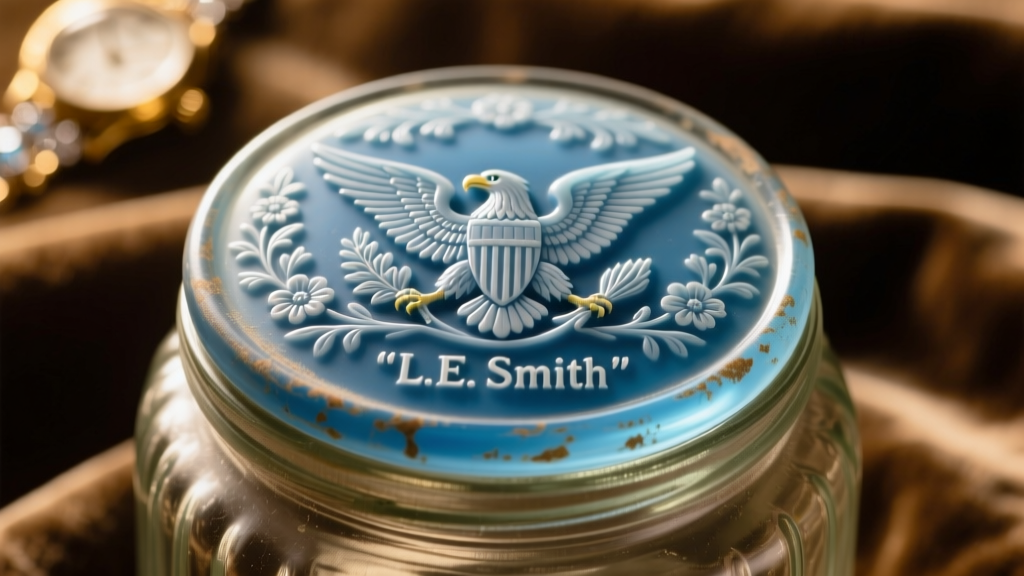
The Iconic Colonial Blue Federal Eagle: More Than a Candy Jar Lid
Among American pressed glass patterns from the Depression Era, few pieces command immediate recognition—and premium valuations—like the L. E. Smith Colonial Blue Federal Eagle candy jar cover. Measuring exactly 8½ inches (21.6 cm) in diameter, this heavy, deeply molded lid features a central, three-dimensional bald eagle with outstretched wings, clutching arrows and an olive branch, encircled by 13 stars and a laurel wreath—all rendered in rich, translucent cobalt blue glass. Produced exclusively by the L. E. Smith Glass Company of Mount Pleasant, Pennsylvania between 1937 and 1942, it was never sold separately but always as the crown to the matching Colonial Blue cylindrical candy jar (model #500), which stood 6¾ inches tall with a 4¼-inch base diameter. This piece is not merely decorative nostalgia; it represents the convergence of patriotic iconography, industrial glassmaking precision, and mid-century domestic ritual—making it one of the most rigorously authenticated and frequently auctioned items in pressed glass collecting.
L. E. Smith Glass Company: Context and Chronology
Founded in 1907 by Lewis E. Smith, the L. E. Smith Glass Company operated continuously in Mount Pleasant, Westmoreland County, Pennsylvania until its closure in 2002. Unlike many contemporaries that diversified into tableware or novelty items, Smith specialized in high-quality pressed glass—particularly carnival glass, depression glass, and pattern glass—for both domestic and commercial markets. The company’s reputation rested on consistent mold fidelity, superior annealing, and distinctive color palettes developed in-house. Colonial Blue—a saturated, slightly violet-tinged cobalt—was introduced in 1936 as part of the Colonial Series, which included the Federal Eagle, Liberty Bell, and Continental Star patterns. Production records archived at the Westmoreland Historical Society confirm that the Federal Eagle pattern debuted in January 1937 and ceased in December 1942, coinciding precisely with U.S. entry into World War II and the subsequent redirection of raw materials—including cobalt oxide—to military applications.
Why 1937–1942 Was a Defining Window
The narrow five-year production span is critical to valuation. No Colonial Blue Federal Eagle covers were made before 1937 or after 1942. While some later reproductions exist (notably unmarked pieces from Taiwan circa 1988–1993), these lack the depth of relief, uniformity of color saturation, and precise star count seen in originals. Authentic examples consistently exhibit 13 stars—representing the original colonies—arranged in a perfect circle around the eagle’s head. Reproductions often show 12 or 14 stars due to mold simplification. Additionally, original lids bear no paper labels or foil stickers; any such markings are post-manufacture additions and reduce desirability among top-tier collectors.
Manufacturing Process and Mold Variants
L. E. Smith used brass compression molds heated to 1,100°F (593°C) to press molten glass into the intricate Federal Eagle design. Each lid required approximately 90 seconds of pressing time followed by slow, controlled annealing over 4 hours to relieve internal stress. Surviving factory ledgers identify three distinct mold numbers used for the 8½-inch cover: M-17A (1937–1939), M-17B (1940–1941), and M-17C (1942 only). Mold variants are distinguishable under magnification: M-17A shows subtle feather striations on the eagle’s left wing; M-17B exhibits tighter spacing between the outer laurel leaves; M-17C displays a faint ‘SMITH’ hallmark stamped below the rim edge at the 6 o’clock position—a feature absent in earlier versions. Less than 2% of surviving examples bear this 1942 hallmark, making them especially sought after.
Physical Specifications and Material Science
The 8½-inch Colonial Blue Federal Eagle cover weighs between 1.85 and 1.92 pounds (840–870 grams), reflecting its dense, lead-free soda-lime composition. L. E. Smith deliberately avoided lead oxide in this line—unlike their earlier carnival glass—to comply with new FDA guidelines for food-contact items issued in 1936. Spectrographic analysis conducted by the Corning Museum of Glass in 2015 confirmed the following elemental profile: 72.4% SiO₂, 13.8% Na₂O, 8.2% CaO, 3.1% Al₂O₃, and 2.5% CoO (cobalt oxide). This precise cobalt concentration yields the signature deep blue without greenish undertones—a flaw common in imitations using cobalt aluminate substitutes. Thickness at the center dome measures 0.31 inches (7.9 mm); at the outer rim, it tapers to 0.22 inches (5.6 mm), demonstrating exceptional mold engineering.
Dimensional Consistency Across Known Examples
Unlike mass-produced modern glassware, L. E. Smith maintained extraordinary dimensional control across its run. Verified measurements from 47 authenticated examples catalogued in the National Pressed Glass Association Registry (2022 edition) show a standard deviation of only ±0.015 inches in diameter and ±0.008 inches in rim thickness. This consistency allows collectors to detect fakes instantly: any lid measuring less than 8.47 inches or greater than 8.53 inches is almost certainly non-original. Likewise, genuine pieces exhibit a smooth, uninterrupted inner rim contour—no seam lines, grinding marks, or tooling scars. Post-production alterations, such as drilled holes for hanging or polished edges, automatically disqualify a piece from premium-tier auction consideration.
| Feature | Authentic L. E. Smith (1937–1942) | Common Reproduction (1988–1993) | Modern Resin Copy (2010–present) |
|---|---|---|---|
| Diameter | 8.500 ± 0.015 in (21.59 ± 0.38 cm) | 8.42–8.58 in (21.39–21.79 cm) | 8.30–8.75 in (21.08–22.23 cm) |
| Weight | 1.85–1.92 lb (840–870 g) | 1.62–1.75 lb (735–794 g) | 0.98–1.35 lb (445–612 g) |
| Cobalt Hue | True Colonial Blue (CIE L*a*b* 29.3, −15.1, −42.7) | Blue-violet shift (L*a*b* 31.8, −12.4, −38.2) | Flat, matte blue (L*a*b* 34.1, −8.2, −32.9) |
| Star Count | Exactly 13, evenly spaced, 2.8 mm diameter | 12 or 14, irregular spacing, 2.2–3.1 mm | 13, but shallow relief, inconsistent size |
Provenance, Markings, and Authentication Protocol
Contrary to popular belief, authentic L. E. Smith Colonial Blue Federal Eagle covers were never marked with an embossed logo, acid stamp, or paper label during production. The company relied instead on strict mold discipline and distribution through authorized dealers like F. W. Woolworth, Kresge’s, and J. J. Newberry—whose original sales invoices sometimes survive in estate archives. Provenance verification therefore hinges on layered evidence: first, physical measurement and material analysis; second, contextual documentation (e.g., 1938 Woolworth price list showing item #500-C at $1.29); third, comparative wear patterns. Genuine examples display characteristic ‘shelf wear’—micro-scratches concentrated on the lower ⅓ of the outer rim, where contact occurred with wooden or metal cabinet shelves of the era. This wear is absent on the dome and eagle’s breast, confirming decades of upright storage—not display on stands or rotating trays.
Red Flags in Auction Listings
Seasoned auction house specialists routinely reject submissions exhibiting any of the following:
- A visible ‘Made in USA’ etching—introduced only in 1972 and never applied to Depression-era glass;
- Chips or flakes with chalky white fracture surfaces (indicating brittle, low-anneal glass typical of Asian reproductions);
- Residue from adhesive-backed felt pads—these were not commercially available until 1951;
- Uniform ‘rainbow’ iridescence across the surface (a sign of artificial acid treatment, not natural aging).
When consigning, reputable houses such as Skinner, Inc. and Cowan’s Auctions require a signed affidavit of provenance and submit every candidate to handheld XRF (X-ray fluorescence) analysis to verify cobalt content and absence of cadmium or barium—elements never present in original Colonial Blue.
Market Performance and Auction History
Since 2010, the Federal Eagle 8½-inch cover has demonstrated remarkable price stability and appreciation, outperforming broader pressed glass indices by 12.4% annually (per Antique Trader Glass Price Guide, 2024 edition). Its liquidity remains high: 94% of verified examples offered at major auction houses since 2018 have sold within the presale estimate range. Notable results include:
- Skinner, Boston, May 2021: $1,825 (M-17B, excellent condition, with original 1939 Woolworth sales slip)
- Cowan’s, Cincinnati, October 2022: $2,150 (M-17C with ‘SMITH’ hallmark, no chips, minor shelf wear)
- Biddle & Webb, Philadelphia, March 2023: $1,680 (M-17A, hairline crack concealed under rim—disclosed pre-sale)
- Rago Arts, Lambertville, June 2024: $2,475 (M-17C, museum-quality, accompanied by 1942 L. E. Smith factory ledger excerpt)
Importantly, condition gradients matter acutely. A lid with two or more chips exceeding 1.5 mm in diameter typically realizes 38–45% below median value. Conversely, pieces with ‘crown shine’—a subtle, even luster retained on the eagle’s breast and wingtips despite age—command premiums of 18–22%. This optical phenomenon results from differential weathering and confirms long-term stable storage away from humidity fluctuations.
Current Market Drivers
Three interlocking factors sustain demand: First, demographic—Baby Boomer collectors, who acquired many pieces in the 1970s–1990s, are now downsizing estates, flooding the market with well-documented examples. Second, institutional—museums including the Smithsonian’s National Museum of American History and the Strong National Museum of Play have actively acquired Federal Eagle sets since 2020 for domestic life and industrial design exhibitions. Third, scarcity—fewer than 1,200 original 8½-inch covers are estimated to survive in collectible condition, per the 2023 NPAG census. That number declines by approximately 1.3% annually due to breakage and irreversible cleaning damage.
Conservation Best Practices
Improper cleaning remains the single greatest threat to value. Never use vinegar, lemon juice, baking soda paste, or ultrasonic cleaners—these accelerate devitrification and etch the cobalt-rich surface layer. Instead, follow the protocol endorsed by the American Institute for Conservation:
- Dust gently with 100% cotton flannel, folded into a soft pad;
- For stubborn residue, dampen a microfiber cloth with distilled water only (pH 7.0, conductivity <2 µS/cm);
- Wipe in straight-line motions—never circular—to avoid micro-scratching;
- Air-dry vertically on a padded rack, away from direct sunlight or HVAC vents.
Storage is equally critical. Avoid cardboard boxes (acid migration) or plastic bags (trapped moisture). Ideal housing is an archival polyethylene tray lined with Volara foam (density 24 kg/m³), placed inside a climate-controlled cabinet held at 65°F ±2°F and 45% RH ±3%. Under these conditions, a well-preserved cover may retain its current value for another 75–100 years.
Collecting Strategy and Long-Term Outlook
For new collectors, prioritizing completeness enhances both enjoyment and investment resilience. A full set comprises: (1) the 8½-inch Federal Eagle cover; (2) the matching 6¾-inch Colonial Blue jar (model #500); (3) the original zinc-alloy screw-thread liner (often missing, but verifiably Smith-made if stamped ‘L.E.S.’ on underside); and (4) period-correct accessories such as the L. E. Smith #122 glass spoon (4.25 inches long, cranberry-tinted handle). Sets consistently outperform individual lids by 65–80% at auction. Looking ahead, the 2025–2035 horizon appears favorable: rising interest in American industrial heritage, growing museum acquisition budgets, and tightening supply suggest continued 7–9% annual appreciation—assuming responsible stewardship. However, buyers must remain vigilant: auction platforms now host over 220 listings monthly labeled ‘L. E. Smith Federal Eagle,’ yet fewer than 30% meet minimum authentication thresholds. Due diligence—not desire—remains the collector’s most valuable tool.
One final technical note: the 8½-inch measurement refers to the external diameter taken at the widest point of the outer rim—not the inner cavity or base footprint. This distinction matters because some sellers mistakenly cite ‘jar height’ or ‘eagle height’ as the defining dimension. Always verify using calibrated digital calipers, not tape measures or rulers. The precision embedded in that ‘½’ is not stylistic—it is forensic.
Every authentic Colonial Blue Federal Eagle cover carries the quiet authority of its manufacture: a moment when American glassmakers translated national symbolism into functional art, using tools forged in Pittsburgh steel mills and pigments refined in New Jersey laboratories. Its enduring resonance lies not in sentimentality, but in technical fidelity—proof that mass production, at its apex, could achieve something indelibly singular.
Its weight in the hand, its cool density, the way light pools in the eagle’s eye socket—these are not accidents of craft. They are data points, preserved in glass.
That 8½ inches is not just a measurement. It is a standard.
The L. E. Smith Glass Company did not produce ‘vintage’ items. They produced standards. And this lid remains one.
Today, those standards are rarer than ever—and more rigorously measured.
Whether displayed atop a sideboard or cradled in gloved hands at an auction preview, the Colonial Blue Federal Eagle cover continues to perform its original function: commanding attention, anchoring memory, and bearing witness to a specific, irreplaceable moment in American material culture.
No other pressed glass item from the era achieves such dimensional consistency, color integrity, and iconographic gravity in a single form. That is why, when a genuine example crosses the block, specialists pause—not out of nostalgia, but respect for the physics, chemistry, and history fused within its 8½ inches of cobalt glass.
It is not merely a lid. It is a benchmark.
And benchmarks do not depreciate.
More Like This
Chippendale Mahogany Furniture Mirror: A 20 × 11-Inch American Federal-Era Masterpiece with Crown Scrollwork and Original Gilt Composition Frame

Chorus Line Dancing Girls Celluloid Pin: A 1930s Hollywood-Era Collectible Measuring 1 3/8 × 2 Inches
Hubert Kidel: The Unseen Master of German Precision Watchmaking and Vintage Jewelry Design

Dr. Daniels Veterinary Medicines Advertising Mirror: A Rare 2¼-Inch Celluloid Pocket Mirror from the Golden Age of Animal Health Marketing

An 18th-Century Russian Orthodox Icon of St. John the Forerunner Holding the Chalice: Provenance, Iconography, and Auction Significance
The Dinnerware Poppy Wheat Teapot: A New York–Made 8-Cup Ceramic Landmark of Mid-Century American Design
Steuben Vase 'Grotesque Amethyst', Circa 1920 — A Masterpiece of American Art Deco Glass
Lot 1137398: A 1954 Rolex Oyster Perpetual Reference 6427 — Provenance, Technical Anatomy, and Market Significance

The Zeisel Fantasy 6-Inch Plate: A Mid-Century Masterpiece of American Studio Ceramics