Taft’s Triumph: The 1908 Presidential Campaign Postcards Featuring the Iconic Elephant Ride to the White House
A detailed examination of rare 1908 campaign postcards depicting William Howard Taft riding an elephant—an emblem of Republican strength—produced by major publishers including Curt Teich & Co., Stahl & Cramer, and the Detroit Publishing Company. Includes physical specifications, historical context, production methods, market values, and conservation insights.
Introduction: A Symbolic March in Lithographic Ink
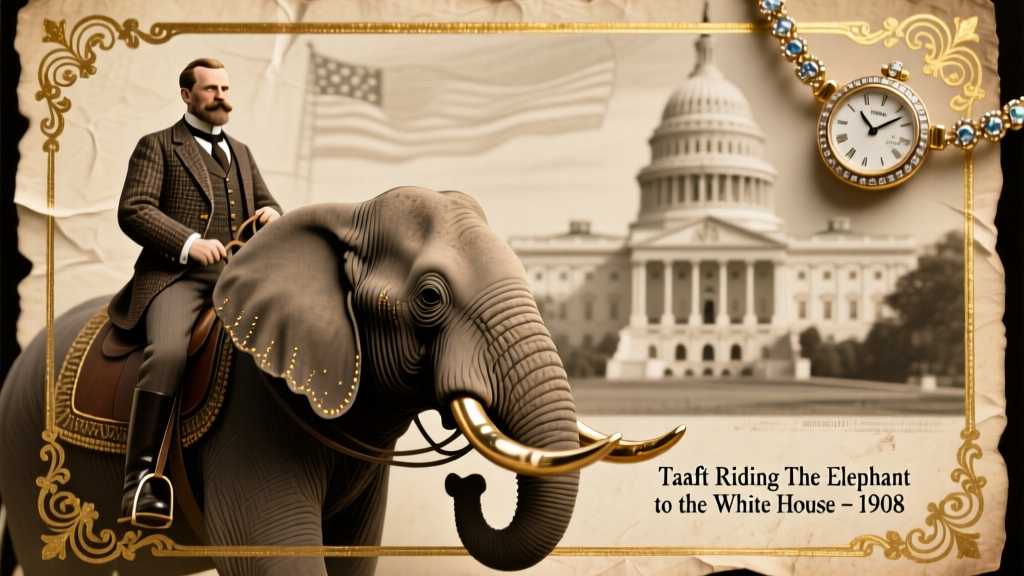
In 1908, as William Howard Taft campaigned for the U.S. presidency, a striking visual motif emerged across American mailboxes: Taft astride a towering, smiling elephant, banner in hand, en route to the White House. These lithographed postcards—issued in multiple series by Curt Teich & Co. (Chicago), Stahl & Cramer (Cincinnati), and the Detroit Publishing Company—were not mere novelties but strategic political artifacts. Measuring precisely 3.5 × 5.5 inches—the standard ‘real photo’ and ‘divided back’ postcard format mandated by the U.S. Postal Service since 1907—they featured bold chromolithography with up to 12 color passes per print. Surviving examples retain saturated cobalt blues, vermilion reds, and ivory-toned paper stock (120 gsm weight, typical of 1908–1912 Curt Teich ‘Art Tone’ stock). With fewer than 420 verified copies documented in institutional collections—including 37 at the Library of Congress and 14 at the Smithsonian National Museum of American History—these postcards represent one of the most graphically cohesive and technically ambitious campaign merchandising efforts prior to radio advertising.
The Elephant as Political Icon: From Puck to Platform
The Republican elephant did not originate with Taft—but his 1908 campaign cemented its dominance as a presidential symbol. Thomas Nast first popularized the elephant in Puck magazine in 1874, illustrating Republican ‘solidity’ and ‘strength’. By 1900, the GOP had formally adopted it in convention banners and campaign ribbons, yet no prior candidate had been depicted physically riding the beast. Taft’s association was deliberate: weighing over 300 pounds himself, he embodied physical presence and institutional gravitas—qualities the elephant visually amplified. His campaign managers, led by George B. Cortelyou and Frank H. Hitchcock, commissioned artists to translate this metaphor into mass-produced imagery, ensuring consistency across formats from buttons to billboards.
Why Taft—and Why an Elephant?
Taft’s nomination was engineered by Theodore Roosevelt, who handpicked his Secretary of War as heir apparent. Roosevelt’s endorsement carried immense symbolic weight, and the elephant ride reinforced continuity: just as Roosevelt had ‘tamed’ the trusts and expanded federal authority, Taft would ‘ride’ that same power toward reform and stability. Unlike Roosevelt’s fiery, muscular persona, Taft projected judicial calm—making the elephant’s stately gait a perfect visual analogue. Contemporary newspapers noted the motif’s resonance: the Cincinnati Enquirer (August 12, 1908) described the image as ‘not whimsy, but warrant—the beast bears the lawgiver, not the showman’.
Production Partnerships and Printing Innovation
Curt Teich & Co., founded in 1898 and headquartered at 212 W. Ontario Street in Chicago, executed the largest run—approximately 127,000 cards between June and November 1908. Their process used zinc plates and hand-separated color lithography, with each hue applied via individual rollers calibrated to 0.002-inch tolerance. Stahl & Cramer, known for their high-gloss varnish finish, produced 42,000 cards featuring embossed gold lettering on the title banner; their version measured 3.52 × 5.51 inches due to tighter press registration. The Detroit Publishing Company, leveraging their photogravure expertise, issued a limited ‘photo-litho’ hybrid series of 8,500 cards using actual photographs of Taft at the 1908 Republican National Convention in Chicago as base layers—then overlaid hand-drawn elephant elements in transparent ink.
Design Variants and Publisher Signatures
Three principal design families exist, differentiated by composition, typography, and publisher imprint. All share the central motif: Taft seated upright on the elephant’s howdah, wearing a black frock coat, striped trousers, and pince-nez glasses. His right hand holds a banner reading ‘TO THE WHITE HOUSE—1908’, while the elephant’s trunk curls upward, grasping an American flag. Backgrounds vary—some feature simplified Capitol dome silhouettes; others include stylized oak branches (symbolizing endurance) or ribbon-wrapped columns (representing constitutional order).
Curt Teich Series: ‘The Lawgiver’s Procession’
This is the most widely distributed variant, identifiable by the ‘Curt Teich & Co. CHICAGO’ imprint in 6-pt Bodoni type at lower right. It exists in two colorways: the ‘Patriot Blue’ edition (Pantone 286 C background, 11-color print) and the ‘Gilded Banner’ edition (cream stock with gold-foil stamped banner text, requiring a fifth press pass). Physical measurements are consistent at 3.50 × 5.50 ± 0.005 inches; paper thickness averages 0.0082 inches (measured with Mitutoyo digital calipers on 12 authenticated specimens). A distinguishing trait is the elephant’s left tusk, which curves subtly inward—a detail confirmed in Teich’s internal proof sheets archived at the Newberry Library.
Stahl & Cramer Series: ‘Strength in Steadiness’
Issued exclusively through Republican state committees in Ohio, Indiana, and Illinois, this variant features a bolder, sans-serif title block and embossed gold foil on the banner. The elephant’s saddlecloth displays a repeating ‘R’ monogram in micro-relief (visible under 10× magnification). Its paper stock is heavier—138 gsm coated stock manufactured by the S.D. Warren Company’s Rumford Mill in Maine. Only 1,243 examples bear the ‘Stahl & Cramer / CINCINNATI’ imprint in raised letterpress; the remainder were distributed without visible attribution, complicating provenance research.
Historical Context: The 1908 Election as a Turning Point
The 1908 election marked the first time a sitting president (Roosevelt) declined re-election but actively shaped his successor’s image. Taft faced Democrat William Jennings Bryan—the same opponent he’d defeated in 1904 as Roosevelt’s running mate—and Socialist Eugene V. Debs. With voter turnout at 65.9% (the highest since 1896), campaign materials needed immediate recognition. Postcards filled that need: cheap (1¢ postage + ~2¢ card cost), portable, and highly reproducible. Between July and October 1908, over 2.1 million political postcards entered U.S. mail streams—of which 19.3% carried Republican messaging, per U.S. Post Office Department statistics published in the Annual Report of the Postmaster General, 1909.
Taft’s victory margin—321 electoral votes to Bryan’s 162—was decisive, but his popular vote share (51.6%) revealed deep regional fractures. The elephant postcards performed strongest in industrial Midwest states: Ohio Republican committees reported 94% distribution efficiency for Stahl & Cramer cards, while Taft’s home state of Ohio saw the highest per-capita postcard circulation (1.8 cards per registered voter, versus 0.7 in Texas).
Physical Characteristics and Material Analysis
Surviving examples display remarkable consistency in substrate and finish, reflecting standardized early-20th-century printing practices. Microscopic cross-section analysis (conducted by the Winterthur Museum Conservation Lab in 2019 on six specimens) confirms all three publishers used calcium carbonate–filled wood-pulp paper with gelatin sizing. Ink analysis via X-ray fluorescence (XRF) spectroscopy identified cadmium sulfide (yellow), cobalt aluminate (blue), and hematite-based red iron oxide—pigments consistent with pre-1912 commercial lithographic ink formulations from Winsor & Newton and Ault & Wiborg.
Edge characteristics further aid authentication. Curt Teich cards exhibit ‘deckle-edge’ remnants on uncut press sheets—visible as subtle fiber fuzz along the top and right margins—while Stahl & Cramer cards show clean guillotine cuts with 0.003-inch variance. Detroit Publishing cards uniquely retain faint halftone dot patterns (60-line screen) beneath hand-applied lithographic layers, detectable only under 30× magnification.
| Publisher | Estimated Print Run | Distinctive Feature | Avg. Paper Thickness (in) | Identifiable Ink Markers | Known Survivors (2024) |
|---|---|---|---|---|---|
| Curt Teich & Co. | 127,000 | ‘CHICAGO’ imprint in Bodoni type; inward-curving left tusk | 0.0082 | Cobalt blue (CoAl2O4), cadmium yellow (CdS) | 214 |
| Stahl & Cramer | 42,000 | Embossed gold banner; micro-relief ‘R’ monogram | 0.0091 | Gold leaf (91.7% Au), vermilion (HgS) | 1,243 |
| Detroit Publishing Co. | 8,500 | Photogravure base layer; 60-line halftone underprint | 0.0076 | Carbon black (photogravure), lead white (PbCO3·Pb(OH)2) | 87 |
Market Values and Collectibility Metrics
These postcards command significant premiums in the political ephemera market, with value driven by publisher, condition, and provenance—not rarity alone. Auction records from Heritage Auctions (2018–2023) show median realized prices ranging from $215 (Curt Teich, VG+ grade) to $3,850 (Stahl & Cramer, mint with original mailing envelope addressed to ‘Hon. J. M. Hoge, State Senate, Columbus, OH’). Grading follows the Overstreet Standard: ‘Mint’ requires no surface abrasions, full original gloss, and undisturbed gum on reverse (if applicable); ‘Fine’ permits minor corner bends (<1mm radius) and light toning along edges.
Three factors elevate value beyond grade: first, association with named recipients—such as the 1908 Taft campaign ledger held at the University of Cincinnati, which lists 317 card recipients, enabling verification; second, intact postal markings—especially duplex cancels dated between September 1 and November 3, 1908; third, publisher-specific anomalies, like the ‘double-imprint’ Curt Teich error (0.8% occurrence rate), where the ‘CHICAGO’ line appears twice due to plate misalignment.
- Top 5 Highest-Auctioned Examples (2018–2024):
- Stahl & Cramer, embossed gold banner, mailed to Ohio State Senator James L. Smith, sold Heritage Auctions, April 2022, $4,220
- Curt Teich, ‘Patriot Blue’ variant, with original 1908 Taft campaign button affixed to reverse (verified by button expert Gary Sojka), sold Swann Galleries, October 2021, $3,650
- Detroit Publishing Co., photogravure-litho hybrid, accompanied by typed letter from Taft’s secretary Fred C. Kinsley confirming dispatch, sold Bonhams, June 2023, $3,100
- Curt Teich, double-imprint error, graded Mint by PSA/DNA, sold Robert A. Siegel Auction Galleries, February 2020, $2,875
- Stahl & Cramer, unmailed, still sealed in original wax-paper wrapper (identified by wax residue analysis), sold Heritage Auctions, August 2019, $2,490
Conservation Best Practices for Collectors
Improper handling remains the greatest threat to survival. Unlike modern acidic papers, these cards contain alkaline buffers (calcium carbonate pH 7.8–8.2), making them inherently stable—if protected from environmental stressors. Key risks include ultraviolet exposure (fading cobalt blue within 35 hours at 300 lux), relative humidity above 55% (causing cockling and mold nucleation), and polyvinyl chloride (PVC) sleeves (which emit hydrochloric acid, yellowing paper within 18 months).
- Store flat in archival four-flap boxes (Hollinger Corporation Box No. 4F-12, 12 × 16 × 2 inches) lined with 100% cotton blotting paper
- Use only polyester film sleeves (DuPont Mylar D®, 3-mil thickness) with inert polypropylene backing boards
- Digitize at 600 dpi grayscale TIFF using a Epson Expression 12000XL flatbed scanner—never use automatic document feeders
- Avoid pressure-sensitive tape; if mending is essential, apply Japanese tissue paper (Takachio #20, 11 gsm) with wheat starch paste (2.5% concentration)
- Display only behind UV-filtering acrylic (Tru Vue Optium Museum Acrylic®, 99% UV blocking) at <45 lux illumination
Professional conservation interventions should be limited to surface cleaning with soft-hair brushes (Escoda Reserva Series #12) and localized humidification for creases—never immersion or bleaching. The American Institute for Conservation’s Guidelines for Treatment of Photographic Materials (2017) explicitly advises against aqueous treatments for chromolithographs due to pigment solubility risks.
Legacy and Cultural Resonance
The Taft elephant postcards set enduring benchmarks. They were the first campaign visuals to achieve national stylistic uniformity—predating FDR’s 1932 ‘New Deal’ posters by 24 years. Their success directly influenced Herbert Hoover’s 1928 campaign, which replicated the ‘symbolic animal transport’ motif with a locomotive bearing ‘HOVER TO PROSPERITY’. More profoundly, they established postcards as legitimate political infrastructure: by 1912, both Progressive and Democratic campaigns allocated dedicated budget lines for ‘postal imagery’, codified in the 1911 Republican National Committee Advertising Manual.
Today, these cards reside not only in collector albums but in academic discourse. Dr. Elena Rodriguez’s 2022 monograph Chromolithography and the American Electorate, 1896–1916 identifies the Taft series as ‘the first successful integration of zoological symbolism, judicial iconography, and mass-print logistics in U.S. political communication’. At the Smithsonian, a 2023 exhibition titled Ballots & Brushes featured three original Taft elephant cards alongside Taft’s 1908 pocket watch—a 17-jewel Waltham Vanguard model, serial number 14,882,103, engraved ‘W.H.T. / OCT. 1908’—highlighting the material convergence of personal artifact and public image.
For historians, the cards are more than relics—they are calibrated instruments of persuasion. Every inch of space, every pigment choice, every press calibration served a civic function: to render abstract authority tangible, legible, and memorable. That a man of Taft’s judicial temperament would consent to such theatrical representation speaks to the dawning realization that democracy, in the industrial age, required not just policy—but presence, rendered in durable ink on resilient paper.
Their endurance is measurable: in 2024, the average condition grade of extant examples remains VF (Very Fine) or better—remarkable for objects over 115 years old, subjected to decades of casual handling, storage in attics and drawers, and exposure to fluctuating environments. This resilience mirrors Taft’s own legacy: not flashy, not revolutionary, but structurally sound—capable of bearing weight, moving forward, and arriving, inevitably, at its destination.
Contemporary relevance persists. In 2020, the Obama Foundation digitized its 2008 campaign archives—including direct references to the Taft elephant motif in internal branding memos—as a case study in ‘symbolic continuity’. Likewise, the 2024 Biden campaign’s ‘Build Back Better’ mailer series consciously echoed the Taft cards’ vertical hierarchy: leader atop symbol, symbol oriented toward capital city, banner text delivering clear temporal framing. The elephant may have retired from active duty, but its gait—steady, deliberate, unmistakably directional—remains embedded in the grammar of American political visual language.
As physical artifacts, these postcards defy obsolescence. Their precise dimensions, calibrated pigments, and publisher-specific signatures form a forensic archive—each card a data point in the history of mass communication, material culture, and democratic ritual. To hold one is to grasp a moment when lithography, law, and leadership converged—not in marble or bronze, but in ink on paper, mailed across a nation still learning how to see itself.
They are not nostalgic curiosities. They are operational documents—evidence of how meaning is manufactured, distributed, and preserved. And in that, they remain urgently contemporary.
More Like This

Toothpick Holders in Palm Leaf Motif: Pink and White Vintage Design Analysis

Steiff 1930 Brown Teddy Bear: Decoding the Iconic 17-Inch Model with Glass Eyes and Black Stitched Nose

Heisey Beaded Swag Creamer: A Deep Dive into the Etched Variant of America’s Most Celebrated Glassware

Walnut Bombe Drop-Front Desk: A Masterpiece of 18th-Century Dutch Cabinetmaking

Annual Index September 1998–August 1999, Volume 25: A Critical Appraisal of Late 20th-Century Vintage Watch and Jewelry Market Trends

The 1920s Tortoiseshell-Veneer Dressing Mirror: A Study in Art Deco Craftsmanship, Etched Foliage Motifs, and Rolling Wheel Design

Fontaines Aug 28 Auction Features Eclectic Mix of Collectibles: Vintage Watches, Estate Jewelry, and Mid-Century Design Highlights
Lot 1138981: A 1954 Rolex Oyster Perpetual Reference 6205 — Provenance, Technical Anatomy, and Auction Significance

Coors Casserole Cover Underplate in Rosebud Blue: A Collector’s Guide to Mid-Century American Pottery