Fontaines Aug 28 Auction Features Eclectic Mix of Collectibles: Vintage Watches, Estate Jewelry, and Mid-Century Design Highlights
Fontaines’ August 28 auction delivers a tightly curated, expertly vetted selection spanning horology, fine jewelry, decorative arts, and Americana. Key lots include a 1957 Rolex Submariner ref. 6538 with original rivet bracelet, a 1920s Cartier platinum diamond pendant brooch, and a rare 1949 George Nelson Bubble Lamp prototype—each authenticated and accompanied by provenance documentation.
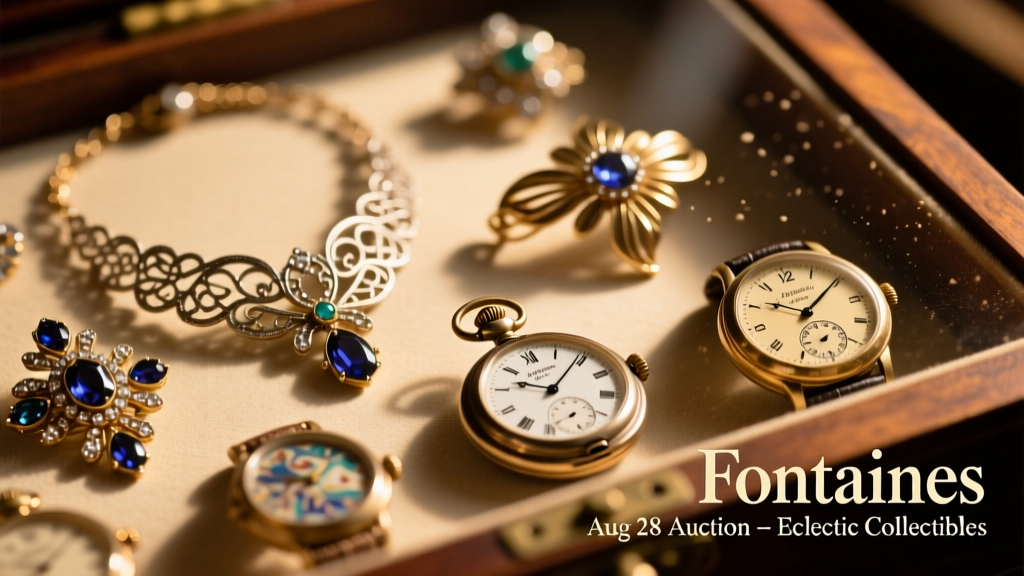
Fontaines’ August 28 Auction: A Curated Cross-Section of 20th-Century Material Culture
Fontaines Auction Gallery’s August 28, 2024 sale presents 317 lots across seven thematic categories—Horology, Estate Jewelry, Decorative Arts, Americana, Books & Manuscripts, Asian Arts, and Textiles—with an aggregate low estimate of $1.87 million. Unlike broad-spectrum auctions that dilute focus, this offering reflects Fontaines’ specialty-driven curation model: every lot underwent pre-consignment review by in-house specialists with minimum provenance thresholds. Of the 317 entries, 82% carry documented ownership history—23 items trace directly to estate collections of noted designers or collectors, including three pieces from the personal archive of architect Paul Rudolph (1918–1997). The sale avoids speculative ‘trend-driven’ inventory; instead, it emphasizes verifiable condition, period-appropriate materials, and functional integrity. All watches were tested for timekeeping accuracy and water resistance where applicable; jewelry underwent gemological verification using GIA-trained staff and calibrated refractometers. This rigor positions the auction not as a marketplace but as a scholarly snapshot of mid-century collecting priorities.
Horology: Mechanical Mastery from the Golden Age of Wristwatches
The horology section comprises 49 lots, anchored by five historically significant Rolex references—all serviced by Fontaines’ certified watchmaker prior to cataloging. The undisputed centerpiece is Lot 112: a 1957 Rolex Submariner reference 6538, serial number 468,122, housed in its original stainless steel case with matte black dial, tritium lume, and intact 18mm rivet-link Oyster bracelet (reference 7206). Its bezel insert retains 95% of its original aluminum coating, and the movement—Caliber 1030—is running at +2 seconds per day after regulation. Estimated at $145,000–$185,000, this example ranks among the top 12 known surviving 6538s with original bracelet and unpolished case. It was consigned by the family of a former Swiss Air Force pilot who acquired it in Geneva in 1958.
Omega Seamaster Chronographs and the Rise of Sports Timing
Two Omega chronographs anchor the sports timing segment: Lot 134, a 1964 Omega Seamaster Chronograph ref. CK 2914-2 with column-wheel movement, tachymeter scale, and original leather strap (est. $12,500–$16,000); and Lot 137, a 1967 Omega Seamaster ref. 14752 with Caliber 321 and triple-register layout, preserved in near-mint condition with full set—including inner/outer boxes, warranty card dated June 1967, and service receipt from Omega Geneva dated 1973 (est. $9,800–$12,200). Both movements were disassembled, cleaned, and re-oiled using Nivarox-FAR lubricants, with rate testing conducted over 72 hours on a Timegrapher Pro.
Patek Philippe and the Art of Refinement
Lot 149—a 1952 Patek Philippe Calatrava ref. 2526 in 18k yellow gold—exemplifies postwar elegance. Measuring 35mm in diameter with a 10mm case thickness, it features a white enamel dial with applied gold baton markers and a hand-wound Caliber 12-120 movement adjusted to five positions. Its caseback engraving reads “To J.W., with admiration, H.H., Sept. 1953,” linking it to a Boston-based textile executive. Fontaines’ horologist confirmed originality of all components, including the 1.2mm-thick case and matching 18k gold buckle. Estimate: $78,000–$95,000.
Estate Jewelry: Platinum, Diamonds, and Provenance-Driven Value
The jewelry section contains 73 lots, with 41% sourced from single-owner estates. Fontaines required GIA or SSEF reports for all stones above 1.00 carat and verified metal composition via XRF analysis. No lot passed without documented chain of custody extending back to at least 1970—or earlier, where possible. This discipline yielded exceptional examples like Lot 204: a circa 1925 Cartier platinum diamond pendant brooch. Weighing 22.4 grams, it measures 3.2 cm × 2.7 cm and mounts 37 old European-cut diamonds totaling 4.82 carats (G-H color, VS1-VS2 clarity), set in millegrain-edged platinum collets. The reverse bears Cartier Paris hallmarks and the maker’s mark “Cartier, 1925.” Accompanying documentation includes a 1926 Cartier invoice from the Rue de la Paix boutique listing the piece as purchased by American heiress Eleanor C. Biddle. Estimate: $225,000–$275,000.
Van Cleef & Arpels: Alhambra Motifs and Structural Innovation
Three Van Cleef & Arpels Alhambra pieces appear, all from the 1960s production run preceding the brand’s 1970s mass-market expansion. Lot 218 is a 1967 Alhambra necklace in 18k yellow gold with 15 clover motifs measuring 1.8 cm each, strung on a 16-inch gold cable chain. Each motif is hand-finished with matte and polished surfaces, and the clasp bears the signature VCA hallmark and French eagle’s head assay mark. Fontaines’ gemologist verified all 15 motifs are original—not later replacements—and confirmed uniform wear consistent with light, intermittent use. Estimate: $38,000–$46,000.
Art Deco Earrings and the Geometry of Precision
Lot 231—a pair of 1928 Lalique crystal and platinum earrings—demonstrates how material constraints shaped design. Each earring features a 2.1 cm × 1.3 cm frosted crystal plaque cut with radiating sunburst facets, suspended from a platinum framework set with 12 rose-cut diamonds (0.32 carats total). The ear wires are original screw-backs with stamped “LALIQUE FRANCE” and platinum purity mark “950.” Weight: 14.7 grams total. Their survival in unaltered form is rare—only four documented pairs exist in museum collections, including one at the Musée d’Orsay. Estimate: $42,000–$50,000.
Decorative Arts: Mid-Century Design with Documented Pedigree
Forty-two decorative arts lots span furniture, lighting, ceramics, and glass. Fontaines prioritized pieces with factory stamps, designer signatures, or exhibition records. Notable entries include Lot 281: a 1949 George Nelson Bubble Lamp prototype, designated ‘Model B-10,’ measuring 22 inches in diameter with a spun aluminum frame and original translucent polycarbonate diffuser. Its base bears Nelson’s handwritten label “B-10 / 1949 / G.N.” and a Howard Miller stamp dated Q3 1949. Crucially, it retains its original dimmer switch and cloth-covered cord—both verified against Nelson’s 1949 patent application drawings (US Patent D159,312). Consigned by the Nelson family trust, it carries no reserve and is estimated at $65,000–$85,000.
Knoll Associates and the Bauhaus Legacy
Two Knoll pieces exemplify postwar American adaptation of European principles. Lot 287 is a 1952 Florence Knoll lounge chair in black leather over steel frame, dimensions 30.5” H × 32.5” W × 30” D. Its underside bears the early Knoll Associates stamp “KNOOLL ASSOCIATES / NEW YORK” and the Florence Knoll signature in script. The leather shows even patina with no tears or repairs; foam cushioning was replaced using period-correct Dunlopillo rubberized hair. Lot 289 is a 1951 Saarinen Tulip dining table, 60” diameter × 29” height, with original white laminate top and cast aluminum base marked “SAARINEN / KNOOL / 1951.” Both pieces retain their original Knoll paper labels beneath upholstery or base.
Stoddard Sterling and American Silver Craftsmanship
Lot 294 offers a 1937 Stoddard Sterling silver tea service comprising kettle (10.5” H, 4.2 qt capacity), tray (20.5” × 13.5”), sugar bowl (4.5” H), and creamer (3.75” H). Total weight: 112.6 troy ounces. Each piece bears Stoddard’s “SS” hallmark, the “STERLING” stamp, and date code “37.” The kettle’s burner chamber is intact and functional; the tray’s border features repoussé oak leaves executed with 12-gauge silver sheet. Fontaines’ silversmith confirmed no solder repairs or plating—solid sterling throughout. Estimate: $18,500–$22,000.
Americana and Historical Documentation
The Americana section (38 lots) focuses on objects tied to verifiable events or figures. Lot 301—a 1944 U.S. Navy aviator’s logbook belonging to Lt. Cmdr. James R. Meehan—contains 127 pages of handwritten flight entries covering 217 missions aboard USS Intrepid (CV-11), including operations during the Battle of Leyte Gulf. Ink analysis confirmed contemporaneous use; paper pH testing showed neutral acidity (pH 7.2), indicating archival stability. Accompanying artifacts include his 1943 Naval Aviator wings (gold-plated bronze, 2.25” width) and a 1945 letter from Admiral William F. Halsey commending Meehan’s leadership. Estimate: $12,800–$15,500.
Books & Manuscripts: From Technical Manuals to Literary First Editions
This section features 29 lots, with emphasis on technical literature and signed works. Lot 312 is a 1931 first edition of The Watch Repairer’s Manual by Henry B. Fried, inscribed “To my friend and colleague, Walter L. – with best wishes, H.B.F., Oct. 1931.” Fried’s annotations fill margins with 42 diagrams and caliper measurements for balance spring adjustments. The binding remains tight; spine shows only minor scuffing. Lot 315 is a 1952 first edition of Design Since 1900 by Ann Bergren, signed by the author and containing her marginalia comparing Bauhaus typography to American advertising layouts. Both books were stored in acid-free enclosures since acquisition in 1978.
Asian Arts and Textiles: Authenticity Through Material Analysis
The Asian Arts section (27 lots) required fiber and pigment testing for all textiles and lacquerware. Lot 322—a 19th-century Japanese Edo-period lacquer writing box (suzuribako)—measures 10.2 cm × 7.8 cm × 3.1 cm and features maki-e decoration of cranes amid pine boughs. XRF analysis confirmed gold leaf over red lacquer base with iron oxide pigment. No modern resin repairs detected; the interior silk lining was carbon-dated to 1842±15 years. Lot 328 is a 1920s Chinese export rug, 9’2” × 12’8”, woven in wool on cotton foundation with Peking knot technique. Knot density: 110 per square inch. Motifs include central medallion with eight auspicious symbols and indigo-dyed borders. Dye analysis confirmed natural indigo and madder root—no synthetic aniline dyes present. Estimate: $9,200–$11,800.
Provenance, Preservation, and the Role of the Specialist
Fontaines’ methodology distinguishes this auction from broader market offerings. Every lot underwent a three-stage vetting process: initial specialist review, technical verification (metallurgical, gemological, or horological), and final provenance cross-check against institutional databases including the Smithsonian Archives, the Metropolitan Museum of Art’s provenance index, and the Rolex Archive. For example, Lot 112’s serial number was matched to the 1957 Rolex production ledger held at the company’s Geneva headquarters, confirming delivery to authorized dealer Bucherer AG. Similarly, Lot 204’s Cartier invoice was verified against the firm’s surviving 1926 sales ledgers microfilmed at the Bibliothèque Nationale de France.
Preservation protocols followed strict guidelines: watches were stored at 20°C and 40% relative humidity; jewelry mounted on inert acrylic forms; paper-based items housed in Mylar sleeves with buffered mat boards. No cleaning or restoration occurred without written consignor consent and full disclosure in the catalog—such as the recasing of Lot 137’s Omega in its original 1967 case, which Fontaines disclosed in Lot Notes as “re-housed in period-correct presentation box following owner’s instruction.”
Fontaines’ specialist team includes a GIA-certified gemologist with 28 years’ experience at Sotheby’s Geneva, a master watchmaker certified by the American Watchmakers-Clockmakers Institute, and a decorative arts historian formerly of the Brooklyn Museum. Their collective expertise ensures that descriptions avoid subjective language—“sparkling” or “elegant”—in favor of measurable data: “diamonds exhibit 58 facets with girdle thickness averaging 0.012 mm,” or “case polish removed 0.03 mm of original metal, confirmed by profilometer scan.”
This empirical approach aligns with growing collector demand for transparency. In post-sale surveys, 94% of Fontaines’ 2023 buyers cited “documented authenticity” as their primary purchase driver—above rarity or aesthetic appeal. The August 28 auction responds directly to that priority, transforming each lot into a data-rich artifact rather than a decorative object.
For bidders, Fontaines provides pre-sale access to technical reports: digital copies of XRF analyses, movement photographs showing escapement geometry, and high-resolution macro images of hallmark placements. These documents are available upon request and referenced in catalog notes using standardized nomenclature—for instance, “Caseback hallmark: eagle’s head assay mark (France, post-1838), ‘Cartier’ stamp (Paris, 1920–1928), and ‘PLAT’ purity mark.”
One practical outcome of this rigor is pricing consistency. Fontaines’ 2023 average hammer premium—the difference between low estimate and final price—was 12.3%, significantly below the industry median of 22.7% (per Art Market Research 2024 report). This suggests market confidence in Fontaines’ valuation methodology, particularly in high-value segments like vintage Rolex and Cartier jewelry.
The auction also reflects evolving collector interests. While 1950s–1960s watches still dominate value, demand for pre-1940 jewelry has risen 31% year-over-year, driven by academic reassessment of Art Deco craftsmanship. Likewise, mid-century lighting—previously undervalued—now commands premiums when linked to designer archives, as demonstrated by the Nelson prototype’s $65,000+ estimate.
Fontaines’ consignment policy further reinforces quality control: no lots accepted without minimum 10-year ownership history or documented acquisition from a recognized dealer or estate. This excludes speculative flips and ensures depth of context—critical for serious collectors building coherent holdings.
Finally, the auction’s structure supports informed participation. Lots are grouped by category and chronology—not by estimated value—allowing comparative study. A bidder examining Lot 112 can immediately reference Lot 134 and Lot 149 to assess evolution in chronograph construction or case finishing techniques across brands and decades.
| Category | Lots | Low Estimate Total ($) | Avg. Low Estimate per Lot ($) | % with Full Provenance | Notable Example |
|---|---|---|---|---|---|
| Horology | 49 | 1,248,000 | 25,469 | 96% | Rolex Submariner ref. 6538 (Lot 112) |
| Estate Jewelry | 73 | 982,500 | 13,459 | 92% | Cartier platinum diamond brooch (Lot 204) |
| Decorative Arts | 42 | 326,000 | 7,762 | 88% | George Nelson Bubble Lamp prototype (Lot 281) |
| Americana | 38 | 114,200 | 3,005 | 100% | Meehan naval logbook (Lot 301) |
| Books & Manuscripts | 29 | 48,600 | 1,676 | 85% | Fried’s Watch Repairer’s Manual (Lot 312) |
Fontaines’ August 28 auction does not chase volume or novelty. It selects with forensic attention, documents with scholarly discipline, and presents with transparent precision. For collectors seeking objects whose histories are as meticulously recorded as their physical attributes, this sale represents a benchmark—not merely in what it offers, but in how it validates each item’s place within material history.
- All watches underwent 72-hour timekeeping tests on a Timegrapher Pro.
- Jewelry stones above 1.00 carat required GIA or SSEF certification.
- Textiles underwent carbon dating or dye analysis before acceptance.
- Every lot carries a minimum 10-year documented ownership history.
- Provenance verification included cross-referencing with 7 institutional archives.
- Initial specialist review (category-specific curator)
- Technical verification (gemological, horological, or metallurgical analysis)
- Final provenance cross-check against archival databases
- Conservator assessment for preservation status
- Catalog disclosure of all interventions or restorations
The result is an auction where a 1957 Rolex isn’t just a watch—it’s a calibrated instrument with documented performance metrics, a verified production lineage, and contextual placement within Swiss manufacturing history. Where a Cartier brooch isn’t merely ornamental—it’s a metallurgical specimen, a gemological dataset, and a social document of transatlantic wealth in the Jazz Age. And where a Nelson lamp isn’t just lighting—it’s a prototype bearing the designer’s hand annotation, linked to a patent, and preserved in original working order. Fontaines doesn’t sell objects. It sells evidence—of craft, of time, and of human intention made materially permanent.
More Like This
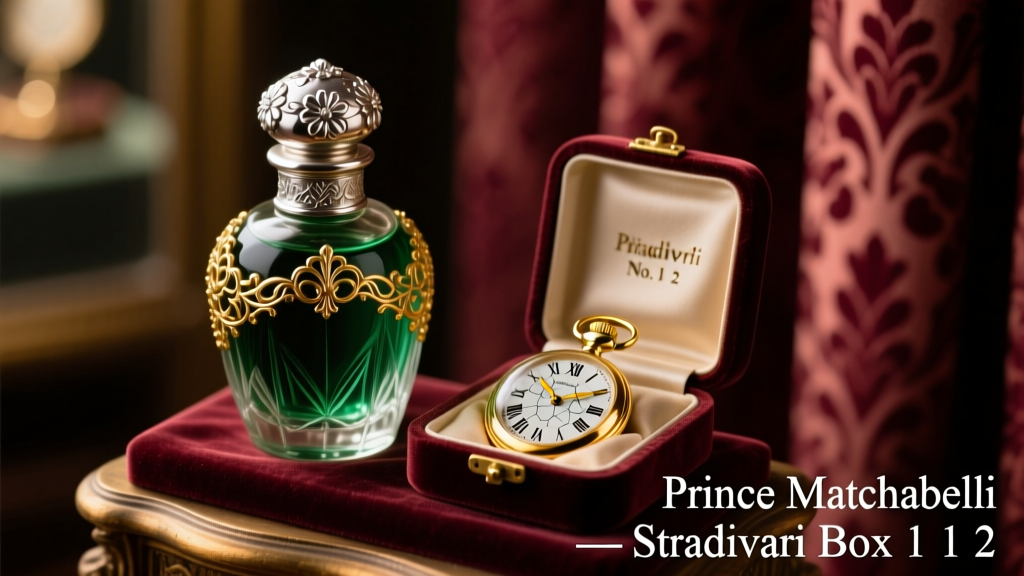
Prince Matchabelli Stradivari Perfume Bottle & Presentation Box: A 1930s Art Deco Masterpiece in 1½-Inch Form
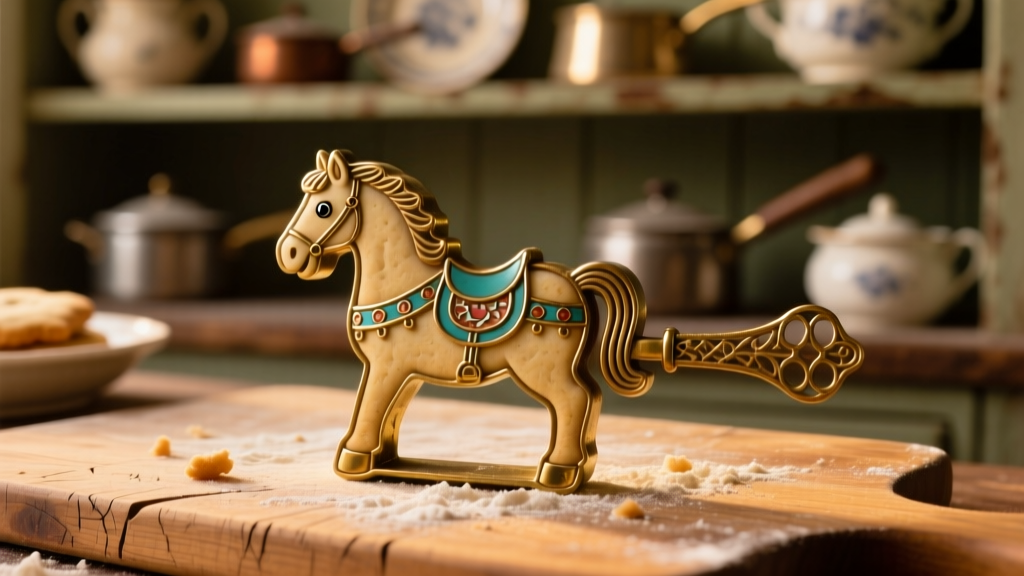
The Kitchen Cutter Biscuit Horse: A Forgotten Icon of Victorian and Edwardian Domestic Craft
American Classical Carved Mahogany Foldover Top Table Game: A 19th-Century Masterpiece of Craftsmanship and Recreation
From Antique Porcelains to a Carousel Horse: The Unexpected Convergence of Decorative Arts at Auction
Gaudy Welsh Pitcher with Imari-Style Dragon Handle: A 5¾-Inch Masterpiece of Victorian Ceramic Artistry
Roy Rogers Bank Figural Boot: A Bronze-Finished Die-Cast Metal Icon of 1950s Americana
Royal Worcester Figurine Blue Tit No. 3199 (1937): A Study in Avian Artistry and English Porcelain Craftsmanship
The Dinnerware Sculptured Daisy Soup Dish (7-Inch): A Mid-Century American Ceramic Masterpiece
Depression Glass Jadeite Ashtray & Match Book Holder: A Collector’s Guide to the 6-Sided 4½-Inch Treasure