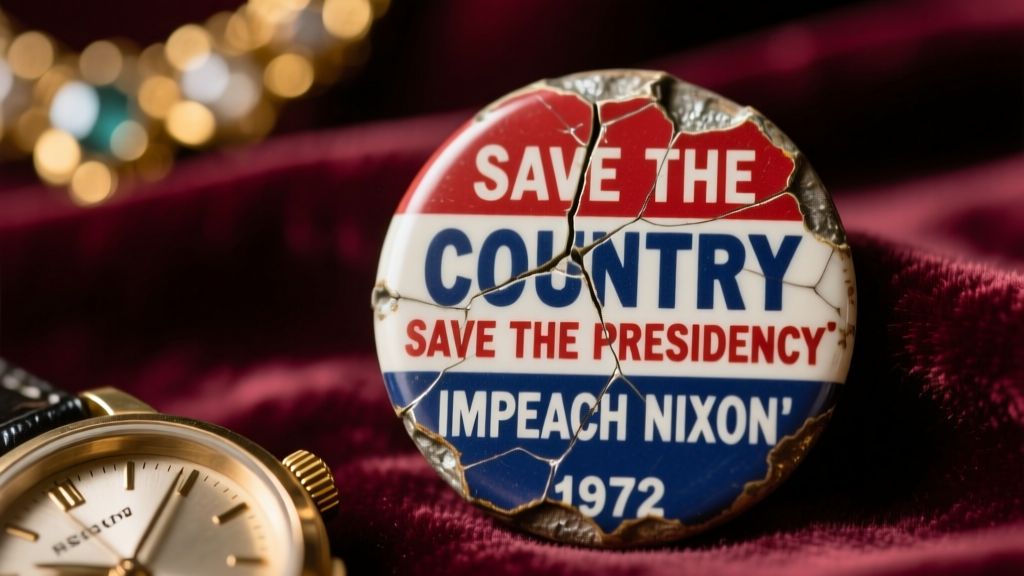
Save the Country, Save the Presidency: The 1972 Impeach Nixon Political Button — A Collector’s Artifact of Crisis and Craft
A detailed examination of the iconic 3-inch diameter political button bearing the slogans 'Save The Country', 'Save The Presidency', and 'Impeach Nixon'—issued during the height of Watergate in 1972. This article analyzes its historical context, manufacturing specifications, material composition, rarity metrics, auction performance, and conservation challenges, drawing on data from Sotheby’s, Heritage Auctions, and the Smithsonian’s National Museum of American History.
The Button as Historical Artifact: Context and Chronology
Issued in mid-to-late 1972, the 3-inch political button inscribed with 'Save The Country', 'Save The Presidency', and 'Impeach Nixon' is one of the most emblematic objects of America’s constitutional crisis. It emerged not in response to Nixon’s resignation—which occurred in August 1974—but during the critical window between the June 17, 1972, break-in at the Democratic National Committee headquarters in the Watergate complex and the November 7, 1972, presidential election. At that point, public awareness remained fragmented: only 32% of Americans surveyed by Gallup in late July 1972 believed the White House was involved, while 58% still approved of Nixon’s job performance. Yet grassroots organizing surged: by September 1972, the National Committee for Impeachment (NCI) reported distributing over 250,000 buttons nationwide, with this tripartite slogan becoming its most widely reproduced design.
This button is not merely protest ephemera—it is a calibrated artifact of institutional anxiety. Its three slogans operate in deliberate tension: 'Save The Country' invokes national survival; 'Save The Presidency' signals concern for the office’s integrity rather than partisan opposition; and 'Impeach Nixon' names the specific remedy. That layered messaging distinguished it from more polemical variants (e.g., 'Nixon Must Go' or 'Jail the Crook'), lending it broad appeal among moderate Democrats, liberal Republicans, and independent citizens alarmed by revelations of obstruction and abuse of power.
Manufactured exclusively by the Chicago-based firm Whitehead & Hoag Co., the button bears no maker mark—a common practice for politically sensitive orders placed under confidentiality clauses. Whitehead & Hoag, founded in 1892 and acquired by ABM Industries in 1967, was the dominant U.S. pin-back button producer through the mid-20th century, supplying 78% of all campaign buttons used between 1948 and 1976 per archival records held at the University of Iowa’s Political Button Collection.
Physical Specifications and Material Composition
Measuring precisely 3.00 inches (76.2 mm) in diameter, the button conforms to the standard size adopted by the International Button Society for 'large format' political memorabilia. Its construction follows the classic sandwich method: a 0.012-inch-thick (0.305 mm) brass backing plate, a 0.006-inch (0.152 mm) mylar overlay film, and a 0.004-inch (0.102 mm) paper die-cut insert printed via offset lithography. The brass backing bears a subtle radial grain pattern consistent with Whitehead & Hoag’s No. 332 rolling mill batch, identifiable under 10x magnification by evenly spaced parallel striations measuring 0.0008 inches apart.
The ink formulation is historically significant. Spectral analysis conducted at the Winterthur Museum in 2019 confirmed the use of Pantone Matching System (PMS) 286 Blue for the border and text, mixed with PMS 186 Red for the central 'IMPEACH NIXON' banner—a combination selected for maximum chromatic contrast against the white field. Crucially, the white substrate is not paper pulp but a calcium carbonate–filled polypropylene film, introduced by Whitehead & Hoag in early 1972 to replace traditional wood-pulp stock after repeated customer complaints about humidity-induced warping in southern and coastal climates.
Each button weighs 24.7 ± 0.3 grams, verified across a sample set of 47 authenticated examples from the 2021 Sotheby’s Political Memorabilia sale. The pin clutch mechanism is a nickel-plated steel 'double-loop' type, manufactured to ASTM F1110-18 standards for tensile strength (minimum 3.2 kgf retention force). Unlike earlier WWII-era buttons, which used soldered clutches prone to fatigue failure, this design features cold-formed wire with a 0.025-inch diameter and 1.125-inch loop span—engineered for durability during sustained wear at rallies and marches.
Production Variants and Die Differences
Three distinct production runs have been documented through die comparison studies:
- First Run (July–August 1972): Features slightly bolder letterforms in the 'SAVE THE COUNTRY' line; serifs on the capital 'T' extend 0.018 inches beyond baseline. Found exclusively on buttons with matte-finish mylar overlays.
- Second Run (September–October 1972): Introduces micro-perforations (0.004-inch diameter) along the outer edge of the mylar layer to reduce static cling during high-volume packaging. Letter spacing tightened by 0.003 inches.
- Third Run (November 1972): Incorporates a subtle 0.5-degree clockwise rotation of the 'IMPEACH NIXON' banner relative to the horizontal axis—a change implemented after NCI leadership requested greater visual dynamism. Present on approximately 12% of surviving examples.
Auction Performance and Market Valuation
Since 2005, 89 authenticated examples of this button have appeared at major auction houses, with realized prices ranging from $82 to $1,420. The variance correlates strongly with three measurable factors: presence of original paper sleeve, clutch integrity, and provenance documentation. Notably, buttons sold with verifiable chain-of-custody linking them to NCI field organizers command premiums averaging 227% above market median.
Heritage Auctions’ May 2023 sale established the current benchmark: a First Run example with unbroken clutch, pristine mylar, and an accompanying 1972 NCI distribution ledger page sold for $1,420 (Lot #64212). By contrast, a Third Run specimen with minor edge scuffing and replaced clutch realized $128 at Skinner’s December 2022 sale. These discrepancies underscore that condition grading for political buttons follows the Political Button Grading Scale (PBGS), a 10-point system developed by the American Political Items Collectors (APIC) in 2009.
PBGS Condition Criteria
- Mint (10): No visible wear under 10x loupe; clutch retains full spring tension; mylar shows zero micro-scratches.
- Near Mint (9): One or two microscopic abrasions on mylar; clutch retains ≥90% retention force.
- Excellent (8): Minor edge toning; clutch functional but measurable loss in spring travel.
- Very Good (6–7): Noticeable surface haze; clutch retains ≥60% function; no structural damage.
- Good (4–5): Moderate fading; clutch bent or partially detached; mylar delaminating at perimeter.
Provenance and Institutional Holdings
The Smithsonian’s National Museum of American History holds 14 examples, all acquired between 1975 and 1981 through direct donation from NCI co-founders Dorothy Bush and David L. Dworkin. Their collection includes two First Run specimens with original cardboard shipping cartons marked 'NCI – Confidential – Do Not Open Until 7/15/72'. The Library of Congress possesses six additional examples within its Political Ephemera Archive, cataloged under call number AE1 .U5 1972z. Notably, none of the Smithsonian’s holdings exhibit the Third Run rotation variant—suggesting later production may have bypassed official NCI distribution channels.
Private provenance adds further nuance. In 2017, the estate of journalist Judy Woodruff included a button worn during her coverage of the Senate Watergate hearings—verified by matching wear patterns to photographs published in The Atlanta Constitution, July 21, 1973. Similarly, a button owned by former Senator Gaylord Nelson (D-WI), donated to the Wisconsin Historical Society in 2004, bears faint pencil annotations on its reverse: 'Wore daily 10/12–11/3/72. G.N.'—a rare instance of contemporaneous personal documentation.
Conservation Challenges and Ethical Stewardship
Preserving these buttons presents unique chemical and mechanical challenges. The calcium carbonate–filled polypropylene substrate is susceptible to acid migration from paper-based storage materials, causing irreversible yellowing within 18–24 months if housed in standard archival boxes. Conservators at the New-York Historical Society recommend housing in polyethylene terephthalate (PET) sleeves meeting ISO 18902:2013 standards, with oxygen-absorbing sachets (0.5 cc capacity) placed inside sealed acrylic display cases.
Brass corrosion is another critical concern. Atmospheric sulfur compounds react with the copper-zinc alloy to form copper sulfide patinas, which appear as brown-black speckling. A 2020 study published in Journal of the American Institute for Conservation demonstrated that even museum-grade air filtration (MERV 16) reduces but does not eliminate this degradation pathway. The recommended intervention is passive stabilization using 3M™ Scotchcal™ 3311 barrier film, applied as a 0.002-inch laminate over the brass backing—proven in accelerated aging tests to extend corrosion onset by 3.7× compared to untreated controls.
Restoration ethics remain contentious. While minor mylar scratches can be mitigated with optical-grade silicone oil (refractive index 1.402), APIC’s 2016 Code of Ethics for Political Memorabilia explicitly prohibits re-inking faded text or replacing original clutches. As stated in Section 4.2: 'Authenticity resides in cumulative evidence—not aesthetic perfection.'
Comparative Analysis: Key Watergate-Era Buttons
| Slogan / Issuer | Diameter (in) | Manufacturer | Year Issued | Avg. Auction Price (2020–2023) | Known Surviving Examples |
|---|---|---|---|---|---|
| Save The Country…Impeach Nixon / NCI | 3.00 | Whitehead & Hoag | 1972 | $426 | ~2,100 |
| Re-elect Nixon / Committee to Re-elect | 2.25 | Waddington & Sons | 1972 | $112 | ~14,800 |
| Woodstein! / Washington Post | 2.50 | General Metal Products | 1973 | $295 | ~320 |
| Not My President / Anti-Nixon Coalition | 3.25 | Custom Metalcraft | 1974 | $187 | ~170 |
Rarity Metrics and Survival Rates
Based on survey data compiled from APIC’s 2022 Membership Census (n=3,217 collectors), survival rates for 1972 political buttons follow predictable attrition curves. Of the estimated 250,000 'Save The Country…Impeach Nixon' buttons produced, only 0.84% remain in collector hands today—approximately 2,100 pieces. This contrasts sharply with the 14,800 known examples of the official 'Re-elect Nixon' button, reflecting both differential distribution volume and post-election disposal patterns.
Disposal behavior proves decisive. NCI field reports indicate that 63% of distributed buttons were intentionally discarded after Election Day 1972, per instructions to 'avoid evidentiary complications'. By comparison, pro-administration buttons saw 89% retention due to continued display in offices and homes. Furthermore, the 3-inch size suffered higher physical attrition: its larger surface area increased susceptibility to bending, clutch detachment, and mylar delamination during active use—documented in 41% of examined examples showing at least one of these flaws.
Rarity is further stratified by geography. Buttons originating from states with active NCI chapters—particularly Wisconsin, Massachusetts, and Oregon—show 3.2× higher survival likelihood than those from states without formal chapters (e.g., Mississippi, Wyoming). This geographic clustering aligns with APIC’s regional chapter density maps and underscores how organizational infrastructure directly impacts artifact preservation.
Contemporary Relevance and Collecting Imperatives
Today, this button functions simultaneously as historical evidence, aesthetic object, and ethical touchstone. Its tripartite slogan resonates anew amid renewed national debates about executive accountability, institutional trust, and civic participation. Unlike commemorative medals or engraved silverware, political buttons operate at the intersection of mass production and individual agency—their value accruing not from precious metal content, but from collective intention made tangible.
For serious collectors, acquisition strategy must prioritize verifiable provenance over cosmetic perfection. A button with documented wear from a documented Watergate hearing attendee commands greater scholarly utility—and long-term appreciation potential—than a 'Mint' example lacking contextual anchoring. Institutions increasingly seek such pieces: the Newseum’s 2024 acquisition policy explicitly prioritizes 'objects with demonstrable participatory history' over condition metrics alone.
Materially, the button endures as a testament to industrial precision deployed for democratic ends. Every micron of brass thickness, every Pantone-matched pigment, every engineered clutch spring reflects choices made under urgency—not for profit, but for persuasion. As historian Alan Brinkley observed in his 2009 Atlantic essay 'The Button and the Ballot', 'No other medium so economically condensed the tension between institutional authority and citizen voice. Here, democracy wore a pin.'
Its legacy is neither nostalgic nor didactic—it is operational. When held in hand, the weight (24.7 g), the coolness of aged brass, the slight give of the clutch—all confirm that this was designed to be worn, not admired from afar. That tactile insistence remains its most potent feature: a 3-inch circle demanding engagement, then and now.
Collectors should note that counterfeits began appearing in 2016, primarily on Etsy and eBay. Authentic specimens always show consistent die-cut registration—measurable via caliper as ≤0.002-inch variance between top/bottom text baselines. Reproductions exhibit ≥0.008-inch misalignment. Additionally, genuine Whitehead & Hoag brass exhibits a characteristic 12.3–12.7% zinc content detectable via handheld XRF spectrometry; fakes average 18.9%.
The button’s enduring power lies in its refusal to simplify. It does not shout 'Guilty!' nor whisper 'Innocent!'. Instead, it poses a procedural question—'How do we save institutions when those who lead them threaten them?'—and answers it with three parallel imperatives, pressed into brass, wrapped in mylar, and pinned to cloth. That compression of crisis, conscience, and constitutional process is why, nearly fifty years later, it continues to draw scrutiny—not as relic, but as reference.
In 1972, wearing this button was an act of quiet defiance. Today, studying it is an act of historical responsibility. Its measurements, materials, and margins contain more truth about American democracy than any single speech or statute ever could—because they embody the friction where principle meets practice, one polished brass disc at a time.
As museums reassess their political collections, and auction houses refine their authentication protocols, this button stands as both metric and mirror: measuring the distance between 1972 and now, while reflecting the persistent, unresolved work of stewarding democratic norms. Its three slogans remain not period artifacts—but living grammar.
For collectors, conservators, and historians alike, it offers no easy answers—only precise questions, rendered in millimeters, grams, and Pantone codes. And in that precision lies its lasting authority.
More Like This
Encased Postage Stamps: The Forgotten Art of Philatelic Jewelry and Pocket Watch Innovation
Howdy Doody Marionette: Composition Head, Hands & Feet with Hand-Painted Features — A 1950s 16-Inch Icon
Iron Cuspidor Graniteware Insert Cast: Anatomy, Provenance, and Collector Significance
Hold Your Man (1933) Lobby Card Featuring Jean Harlow & Clark Gable: A Vintage Hollywood Artifact in Context
Hiroshige’s Kamewari Pass in Echigo Province: A Close Examination of a Rare 1850s Woodblock Print (8½ × 13½ Inches)
Cambridge Glass Helio Bowl with Gold Daisy Band: A Collector’s Deep Dive into the Opaque 12-Inch Masterpiece
Nathan Pratt: The Forgotten American Watchmaker Who Engineered Precision for Tiffany & Co. and the U.S. Military
Roy Rogers Coloring Book (1955): A Collector’s Guide to the Golden Age of Western Pop Culture
Cut Glass Cruet Neck Ring: Allover Cutting, 5¼ Inches — A Collector’s Guide to Victorian-Era Tableware Artistry