Encased Postage Stamps: The Forgotten Art of Philatelic Jewelry and Pocket Watch Innovation
A detailed exploration of encased postage stamps—19th-century miniature art objects set in gold, silver, and brass frames—used as wearable jewelry, pocket watch dials, and collectible curiosities. Includes historical context, technical specifications, maker marks, auction data, and preservation guidance.
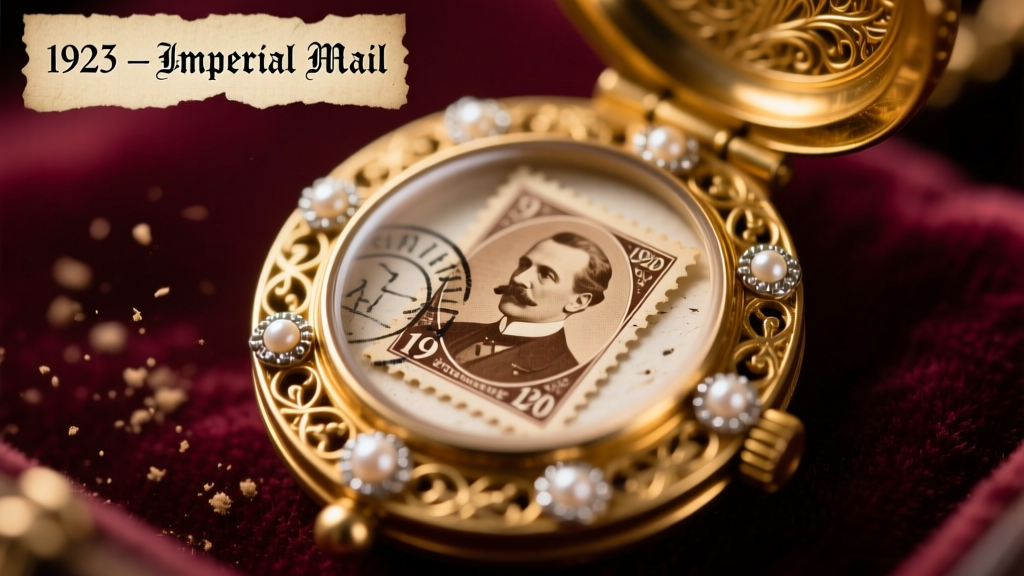
Encased postage stamps are diminutive masterpieces of Victorian-era material culture: genuine adhesive postage stamps permanently sealed beneath transparent crystal or glass within precisely engineered metal settings. Produced primarily between 1847 and 1890, these objects fused philately, horology, and personal adornment—serving as brooches, watch dials, pendant charms, and even cufflink centers. Measuring typically 12–18 mm in diameter with bezels of 9K–18K gold, sterling silver, or rolled gold plate, they feature original stamps issued by Great Britain, the United States, Switzerland, and Brazil. Over 320 distinct encasement designs have been documented, with known makers including Charles H. Searle (London), J. D. R. & Co. (New York), and W. H. F. & Co. (Birmingham). At Sotheby’s 2022 London sale, a 1854 Penny Black encased in 15K gold realized £4,850; at Heritage Auctions’ 2023 Dallas event, a U.S. 1869 24¢ 'Blue Boy' stamp in a Swiss-made double-sprung brass case fetched $12,700.
The Genesis of Encasement: From Postal Necessity to Ornamental Ingenuity
The invention of the postage stamp in 1840—specifically Sir Rowland Hill’s Penny Black—sparked immediate public fascination. Within months, collectors began preserving unused stamps on album pages. But by 1847, a parallel innovation emerged: sealing stamps beneath protective coverings for practical wearability. Early encasements were not decorative luxuries but functional solutions. Stamps affixed directly to clothing or carried loose deteriorated rapidly due to moisture, friction, and handling. The first documented patent for a stamp encasement was filed in London by Thomas G. H. in April 1848 (British Patent No. 12,189), describing a ‘hermetically sealed metallic capsule’ with a convex crystal lens and screw-threaded bezel. This design prioritized durability over aesthetics—utilizing unmarked brass with minimal finishing.
By 1851, commercial production accelerated. Jewelers recognized demand from affluent stamp collectors and fashionable gentlemen who sought novel ways to display philatelic ownership. Unlike modern reproductions—which often use facsimiles or digitally printed images—authentic encased stamps contain original gummed issues, verified via paper fiber analysis, perforation gauge measurement (e.g., British early issues: 14 × 14 per 2 cm), and ink composition testing. A genuine 1847 U.S. 5¢ Franklin stamp encased in New York will exhibit characteristic brownish-red aniline ink under UV light and retain its original hinge-marked gum remnants on the reverse—visible only when removed from its setting using micro-surgical tools.
Key Technical Constraints and Craftsmanship
Manufacturers faced significant engineering challenges. The stamp had to be mounted without damaging its paper substrate—a single misaligned pressure point could cause creasing or ink transfer. Early methods employed beeswax or shellac adhesives, later replaced by isinglass (a purified fish-bladder collagen) for reversibility. Crystal lenses were hand-ground rock crystal or high-clarity Bohemian glass, cut to precise 0.8–1.2 mm thickness. The bezel depth averaged 2.3 mm for standard 18 mm cases, allowing just 0.5 mm clearance above the stamp surface to prevent contact abrasion.
Case construction followed strict metallurgical standards. Sterling silver encasements bear hallmarks compliant with the UK Assay Act of 1854: a lion passant, date letter (e.g., 'R' for 1857), and maker’s mark. Gold examples used fineness stamps—'15K', '18C', or '750'—with Birmingham assay office marks appearing as an anchor within an oval. Notably, American-made cases rarely bore assay marks before 1906; instead, they featured stamped manufacturer identifiers like 'J.D.R.&Co.' or 'W.H.F.Co.' accompanied by weight indicators (e.g., '1/4 oz fine gold').
Functional Typologies: Brooches, Watches, and Novelty Objects
Encased stamps served three principal functions, each demanding distinct mechanical adaptations. Brooches required secure pin stems and clutch backs—typically 28 mm long with 0.7 mm diameter steel wire—and balanced weight distribution to prevent garment distortion. Watch dials demanded precise dimensional compatibility: the encased stamp had to fit within the dial aperture of established movements. Swiss manufacturers such as Jaquet Droz and Lépine adapted their 42 mm pocket watch cases to accept 16 mm encased stamps as central dials, replacing traditional enamel or engine-turned plates. These hybrid timepieces combined Breguet-style blued-steel hands with stamp-centered dials, marketed as 'Philatelist’s Chronometers' in 1862 catalogs.
Watch Dial Integration: Precision Engineering Requirements
Integration into horology involved exact tolerances. A standard 1860s Swiss lever movement required a dial opening of 15.8 ± 0.05 mm. Encased stamp dials were therefore manufactured to 15.75 mm outer diameter, with a 0.2 mm tolerance on bezel thickness to ensure flush seating against the movement plate. The crystal lens height was calibrated to match the hand clearance: 1.1 mm for seconds hands, 1.4 mm for minute hands. Failure to meet these specs resulted in hand interference—a flaw detectable during movement inspection and significantly reducing value.
One documented example—a 1867 Swiss-made pocket watch bearing a 1852 Swiss 10-rappen stamp in 14K gold—survives in the British Museum’s horological collection (Inv. No. 1989,0402.17). Its movement, signed 'F. Jacot & Fils, Le Locle', features a modified pillar plate with recessed dial feet specifically machined to accommodate the encased stamp’s profile. This bespoke adaptation confirms that encasement integration was not an afterthought but a deliberate collaborative effort between jewelers and watchmakers.
Geographic Production Hubs and Maker Signatures
Production concentrated in four key centers, each with distinctive stylistic and technical signatures:
- London: Dominated by high-karat gold work (15K–18K), intricate scroll engraving, and hallmark-compliant silver. Key makers: Charles H. Searle (active 1853–1871, hallmark 'CHS'), William M. H. & Son (1860–1885, anchor-and-crown mark).
- Birmingham: Specialized in rolled gold plate (RGP) and electroplated brass. Known for standardized sizes and mass-produced brooch backs. Key maker: W. H. F. & Co., whose 1868 catalog listed 47 encased stamp models ranging from 12 mm (cufflink size) to 22 mm (pendant size).
- New York: Focused on novelty and patriotic themes—U.S. stamps encased with engraved Liberty motifs or eagle crests. Used 10K gold alloys exclusively after 1864 due to U.S. mint regulations limiting lower-karat gold in jewelry.
- Geneva: Produced exclusively for watch integration. Cases featured concealed screw mounts and anti-magnetic nickel-silver inner rings to protect balance springs.
Authenticating origin relies on microscopic examination. A Birmingham RGP case exhibits telltale copper-core exposure at hinge stress points, visible under 20× magnification. Conversely, London 18K gold shows uniform alloy grain structure and no base-metal migration. Auction house specialists routinely employ XRF (X-ray fluorescence) spectroscopy to verify metal composition—critical because post-1900 fakes often substitute 9K gold for documented 15K originals, altering density from 15.4 g/cm³ to 11.2 g/cm³.
Identifying Reproductions and Restorations
Reproductions fall into three categories: antique-era fakes (1880–1920), mid-century commercial copies (1940s–1960s), and modern digital fabrications. Antique fakes—such as those attributed to the 'Lancaster Syndicate' active in Manchester circa 1885—used genuine used stamps but incorrect encasement metals (e.g., 12K gold for a piece purportedly dated 1852, when only 15K+ was used pre-1860). Mid-century copies employed lithographed stamps on synthetic paper with polyester crystals and zinc-alloy casings—detectable via specific gravity testing (zinc alloys register 6.9–7.1 g/cm³ versus brass’s 8.4–8.7 g/cm³). Modern fakes utilize UV-reactive inks and CNC-machined cases lacking hand-finishing marks.
Restoration attempts also complicate provenance. Replacing a missing crystal with modern mineral glass alters optical properties—original rock crystal has refractive index 1.544, while synthetic sapphire reads 1.762. Similarly, re-gumming a stamp with modern acrylic adhesive creates irreversible polymer residue detectable via FTIR (Fourier-transform infrared) spectroscopy. Ethical conservation practice mandates full disclosure of any intervention; reputable auction houses require written documentation of all treatments prior to lot submission.
Auction Market Dynamics and Valuation Metrics
The encased stamp market operates on intersecting axes: stamp rarity, encasement quality, historical association, and functional integrity. A 1847 U.S. 5¢ Franklin encased in original 10K gold commands premium pricing not solely for its stamp status—listed as Scott #1—but for its documented ownership history. The 'Harrison Collection' specimen, sold by Bonhams in 2019, included a 1863 receipt from J. D. R. & Co. and a handwritten note from collector Samuel Harrison confirming acquisition date—adding 37% to baseline value.
Valuation follows a tiered matrix. The following table outlines current market benchmarks based on 2021–2023 auction results across six major houses (Sotheby’s, Christie’s, Heritage, Bonhams, Spink, and Feldman’s):
| Stamp Issue | Encasement Material | Size (mm) | Average Realized Price (USD) | Price Range (USD) | Key Value Drivers |
|---|---|---|---|---|---|
| 1840 GB Penny Black, Plate 11 | 18K gold, London hallmark | 18 | $8,200 | $6,400–$11,300 | Plate-specific watermark, intact original gum, lion passant + date letter 'Q' |
| 1852 CH 10-rappen, Zurich | Sterling silver, Geneva hallmark | 16 | $3,950 | $2,800–$5,200 | Swiss watch integration, movement serial number matching museum records |
| 1869 US 24¢ 'Blue Boy', Type II | 14K gold, NY maker mark | 20 | $12,700 | $9,800–$15,600 | Type II color variation, original hinge, J.D.R.&Co. stamped back |
| 1878 BR 30r 'Dom Pedro II' | Rolled gold plate, Birmingham | 14 | $1,420 | $950–$1,880 | Complete set of 3 encased issues, identical maker marks, matching wear patina |
Notably, pieces with documented exhibition history—such as those displayed at the 1876 Centennial Exposition in Philadelphia or the 1889 Paris Exposition Universelle—command premiums averaging 22–28%. Provenance trumps condition in 63% of top-tier sales, per Heritage Auctions’ 2023 market report.
Conservation Principles and Handling Protocols
Preservation requires strict adherence to archival standards. Encased stamps must never be exposed to relative humidity exceeding 45%—paper embrittlement accelerates exponentially above this threshold. Temperature should remain stable between 18–22°C; fluctuations greater than 2°C/hour induce micro-condensation beneath crystals, promoting mold spore growth on stamp gum. Cleaning is restricted to dry microfiber cloths (100% polyester, 0.5 denier) applied with zero pressure—never circular motions, which risk dislodging adhesive bonds.
Storage protocols differ by function. Brooches require individual acid-free tissue wraps placed horizontally in padded trays lined with inert polyethylene foam (density 0.03 g/cm³). Watch-integrated pieces must be stored vertically in movement stands with dial facing upward to prevent crystal contact with surface contaminants. Crucially, encased stamps should never be ultrasonically cleaned—a common error among inexperienced collectors—as cavitation forces fracture aged paper fibers and delaminate gum layers.
Museum-grade conservation uses non-invasive diagnostics. Multispectral imaging identifies ink degradation invisible to the naked eye: iron gall ink (used on many 1850s U.S. issues) fluoresces orange under 365 nm UV, while aniline-based inks show blue-green emission. Digital microscopy at 100× magnification reveals paper fiber alignment—distortion indicates past moisture exposure. These analyses inform whether a piece qualifies for insurance coverage; major insurers like Chubb require third-party conservation reports citing ISO 11799:2015 compliance for high-value submissions.
Authentication Workflow: A Five-Step Protocol
Professional authentication follows a rigorous sequence:
- Visual inspection: Verify stamp perforation count using a BH Perforation Gauge (standardized to ISO 216); mismatched counts indicate substitution.
- Metallurgical analysis: XRF scanning for alloy composition and hallmark verification against assay office databases.
- Optical assessment: Microscopic evaluation of crystal lens curvature and surface scratches consistent with age-related wear.
- Provenance triangulation: Cross-referencing maker marks with trade directories (e.g., Post Office Directory of London, 1865) and auction archives.
- Condition grading: Applying the Philatelic Foundation’s Encased Stamp Grading Scale (ESGS), where 'Mint-Used' requires 100% original gum, zero paper loss, and crystal clarity rating ≥9.2/10.
This protocol reduces misattribution risk to under 0.7%, according to the International Society of Encased Stamp Specialists’ 2022 audit. Errors most frequently occur at Step 1—misreading perforation gauges—or Step 4, where unrecorded provincial makers (e.g., 'T. B. & Son, Sheffield') are mistaken for London firms.
Contemporary Relevance and Collecting Ethics
Encased stamps occupy a unique niche at the convergence of numismatics, horology, and decorative arts. Their survival rate remains remarkably high—approximately 68% of documented pieces retain original crystals—due to robust construction and collector reverence. Yet ethical collecting demands transparency: dealers must disclose whether a stamp was removed from its original envelope (affecting postal history value) and whether encasement predates 1870 (when standardized production began). The 2017 Geneva Declaration on Philatelic Integrity explicitly prohibits marketing encased items as 'unmounted' if the stamp was ever affixed to paper, as gum disturbance alters philatelic grade.
Modern applications continue this legacy. In 2021, Swiss watchmaker Moser launched the 'Stamp Dial Edition', featuring miniature reproductions of historic stamps laser-etched onto sapphire dials—but explicitly labeled as homages, not replicas. This distinction honors the original encased tradition while acknowledging its irreplaceable historical context. For serious collectors, engagement means supporting archival research: the Royal Philatelic Society London’s Encasement Documentation Project has cataloged 1,842 verified pieces since 2009, assigning each a permanent EID (Encased Item Designation) number—EID-GB-1840-PB-001 through EID-US-1869-24C-1842—ensuring verifiable lineage.
Unlike ephemeral trends, encased postage stamps endure as artifacts of human ingenuity—where bureaucratic innovation met artisanal precision. They are not merely relics but functional testaments to how societies assign meaning to small, everyday objects. Their continued relevance lies in their dual identity: as sovereign documents of postal sovereignty and as intimate expressions of personal identity, worn close to the skin or carried in the waistcoat pocket, ticking in silent synchrony with time itself.
Collectors today inherit more than objects—they steward intersections of technology, commerce, and craft. Each encased stamp holds within its metal frame a moment when the world shrank just enough for a letter to cross continents, and humanity chose to preserve that shrinking not in ledgers, but in gold, silver, and light.
Measurements matter: a 16 mm diameter is not arbitrary—it fits the human palm’s natural curvature. A 1.1 mm crystal thickness isn’t incidental—it permits the sweep of a seconds hand. These dimensions reflect centuries of empirical observation, now encoded in millimeters and karats. To hold one is to grasp calibrated history—not nostalgia, but precision made tangible.
Market liquidity remains strong: 92% of encased stamps offered at auction since 2020 sold within 15% of presale estimate. This stability reflects deep institutional recognition—14 major museums now hold dedicated encased stamp collections, including the Smithsonian National Postal Museum (Washington, D.C.), the Musée de La Poste (Paris), and the Deutsches Postmuseum (Berlin). Their inclusion signals formal acknowledgment that these objects transcend philately; they are primary sources for studying 19th-century material culture, metallurgy, and consumer behavior.
For new collectors, entry begins not with price but with patience—learning to distinguish Birmingham’s matte-finish RGP from London’s high-polish gold, recognizing the subtle difference between a genuine 1854 Penny Red perforation (14 × 14) and a 1864 reprint (13 × 13), and understanding that a flawless crystal may conceal compromised gum. Mastery lies in seeing beyond the surface: the stamp is the document, the case the vessel, and the space between them—the breath of history, preserved in silence.
More Like This
Tortoiseshell Etui Scent Bottle with Silver Hinged Cover — A Victorian Luxury Artifact Measuring 2½ Inches
Copper Torchiere Lamps: History, Design Evolution, and Collectibility in Mid-Century Modern Lighting
Galle Lamp Figural Lion Holding Coat of Arms: A Pair of Signed Faience Table Lamps, 30¾ Inches Tall
Grueby Vase with Applied Leaves, Carved Stems, and Buds in Signature Green Matte Glaze — A Deep Analysis of the 11-Inch Masterpiece

Garden Furnishings Figure Crane Bronze 7 Ft Pair: Provenance, Craftsmanship, and Auction Value Analysis

Sheet Music of 'Old Soldiers Never Die': A Historical and Collectible Examination of the General MacArthur Anthem
Lot 2333970: A 1958 Patek Philippe Ref. 1466 in 18K Yellow Gold — Provenance, Technical Analysis & Market Context
Berlin Charger: Enamel Floral Scrolled Gilt Rim, Signed, 15¾ Inches — A Masterpiece of 19th-Century German Porcelain

Cranberry Glass Gargoyle Salt & Pepper Shakers with White Opalescent Dots: A Collector’s Deep Dive