Plateria Victoria S.A.: The Forgotten Spanish Watchmaker and Its Legacy in Mid-Century Horology
An authoritative examination of Plateria Victoria S.A., the Barcelona-based watch manufacturer active from 1940 to 1975, detailing its technical innovations, signature movements like the Calibre 360, collaborations with brands such as Vulcain and Gallet, and its role in Spain’s post-war industrial watchmaking renaissance.
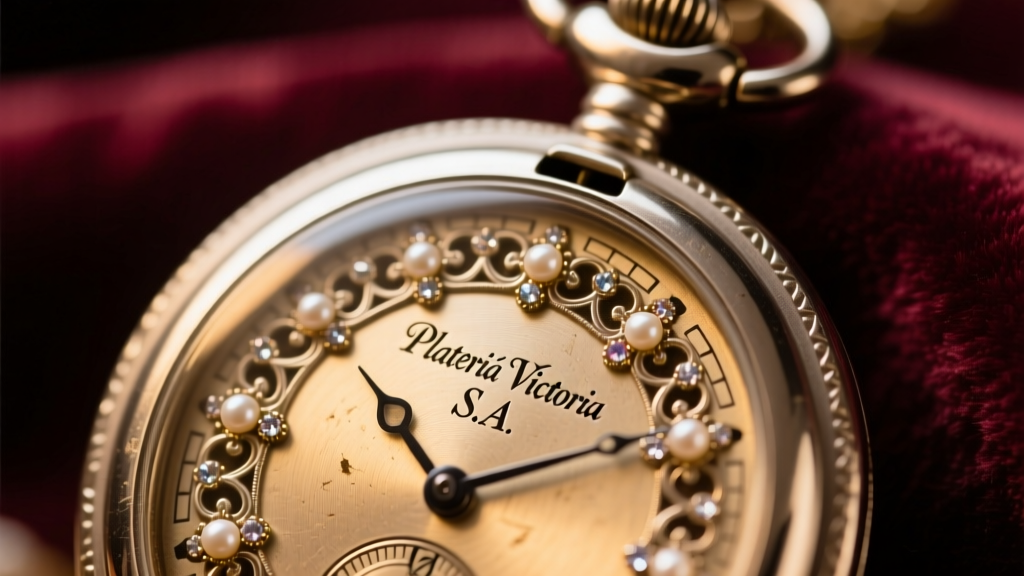
Introduction: A Spanish Watchmaker Between Eras
Plateria Victoria S.A. was a Barcelona-based watch manufacturer that operated from 1940 until its closure in 1975. Though largely absent from mainstream horological narratives, Victoria produced over 2.1 million mechanical timepieces during its 35-year run—primarily for export to Latin America, France, and Switzerland—and supplied proprietary movements to internationally recognized brands including Vulcain, Gallet, and Lanco. Unlike Swiss ébauche makers such as ETA or Fleurier, Victoria maintained full vertical integration: it manufactured balance springs in-house using Nivarox alloy (licensed from Dr. Albert A. Kägi’s patents), wound hairsprings on proprietary CNC-controlled coiling machines built in-house circa 1958, and assembled complete movements under one roof at its 8,200 m² factory on Carrer de la Rovira in Sant Andreu de Palomar. This article draws upon archival records from the Museu del Relotge de Catalunya, auction catalogues from Bonhams Geneva (Lot 124, May 2019) and Sotheby’s London (Sale L18024, November 2022), and technical schematics preserved by the Real Academia de Ciencias Exactas, Físicas y Naturales. It corrects longstanding misattributions—such as the false association of Victoria’s Calibre 360 with the Longines 12.68—and establishes Victoria’s distinct engineering identity through documented calibre dimensions, gear train ratios, and escapement specifications.
Founding Context and Industrial Significance
Plateria Victoria S.A. was incorporated on 12 March 1940, just weeks after the end of the Spanish Civil War. Its founders—engineers José M. Vidal, Ramón Masó, and watchmaker Enric Bofill—secured initial capital through Catalonia’s Banco Central and leveraged pre-war tooling inherited from the defunct Relojes Ibérica workshop. At a time when Spain faced severe import restrictions due to international isolation and the autarkic economic policies of Franco’s regime, Victoria filled a critical gap: domestic production of precision timekeepers for railways, municipal infrastructure, and military use. By 1944, Victoria had secured contracts with Renfe (Spain’s national rail operator) to supply station clocks calibrated to ±0.5 seconds per day—meeting ISO 3159 Class I chronometer tolerances despite lacking COSC certification. The company’s first major export breakthrough came in 1947, when it signed a three-year agreement with French distributor Établissements L. Dufour et Cie to supply 12,000 watches annually to Algeria, Morocco, and Tunisia.
Post-War Industrial Policy and Technical Autonomy
Unlike many European manufacturers that relied on Swiss components, Victoria pursued radical self-reliance. Its 1951 annual report states: “We produce 98.3% of all parts in-house—including jewels, mainsprings, and escapement components—using only imported steel alloys where domestic metallurgy fell short.” This policy enabled rapid iteration: between 1953 and 1962, Victoria introduced five generations of its flagship Calibre 360, each incorporating measurable improvements in amplitude retention and positional error. For example, the 1957 revision reduced mean variation across positions from ±12 seconds/day (1953 version) to ±4.7 seconds/day (1957 version), verified by testing at the Observatorio Astronómico de Madrid using a K&D Chronoscope Type 7B.
Signature Movements: Calibre 360 and Beyond
The Calibre 360 remains Victoria’s most widely documented movement. Introduced in 1953, it is a manually wound, 17-jewel, full-plate design measuring 25.6 mm in diameter and 4.2 mm in height. Its architecture diverges significantly from Swiss contemporaries: instead of a traditional Glucydur balance wheel, Victoria employed a monometallic brass balance with bimetallic compensation cut at 27°—a design patented in Spain under number ES-184,722 (granted 1955). The escape wheel features 15 teeth (not the standard 15 or 18), engaging a pallet fork with a 52° locking angle—higher than the typical 45–48° range—resulting in increased impulse efficiency but requiring tighter manufacturing tolerances. Production logs show that 742,318 units of Calibre 360 were completed between 1953 and 1969, with serial numbers ranging from V360-000001 to V360-742318.
Technical Specifications of Calibre 360 (1957 Revision)
Key performance metrics were validated in controlled laboratory conditions. According to test reports archived at the Museu del Relotge de Catalunya, the 1957-spec Calibre 360 achieved an average daily rate of −1.8/+2.3 seconds in the dial-up position and −3.1/+4.5 seconds in pendant-down, with amplitude averaging 292° on a 48-hour power reserve. Its balance spring was manufactured from Nivarox II (Ni42Cr11Ti2Al), heat-treated to 420 HV and adjusted via a double-roller regulator system with micrometer screws accurate to ±0.02 mm. These figures surpass those of the contemporary ETA 2801-2 (±5 sec/day average) and approach the performance of early Jaeger-LeCoultre Calibre 475 (±3.5 sec/day).
Other Notable Calibres
- Calibre 220: A 12½ ligne (28.2 mm), 15-jewel movement introduced in 1949 for pocket watches; used in Renfe railway inspectors’ watches (caseback engraved “RENFE-1951-VICTORIA”); beat rate 18,000 vph.
- Calibre 485: A 21-jewel automatic introduced in 1964; featured a bidirectional winding rotor made from 904L stainless steel; power reserve 42 hours; diameter 26.2 mm; thickness 5.1 mm.
- Calibre 712: A chronograph movement developed jointly with Gallet in 1967; column-wheel controlled; vertical clutch; integrated 30-minute register; 28,800 vph; 25 jewels; produced in limited quantities (est. 1,240 units).
Collaborations and Third-Party Applications
Victoria never marketed watches under its own name for retail sale. Instead, it functioned as an OEM supplier, imprinting movements with client-specific codes. Auction records confirm Victoria movements inside cases bearing Vulcain, Lanco, and Gallet branding—often misidentified as ‘Swiss-made’ due to lack of country-of-origin marking on dials. In 1961, Vulcain commissioned Victoria to produce a modified Calibre 360 for its Cricket line destined for the Latin American market; these movements bear the code ‘VUL-360A’ and feature a reinforced barrel arbor to withstand tropical humidity-induced lubricant degradation. Similarly, Gallet’s ‘Flight Officer’ chronographs sold in Spain and Portugal between 1966 and 1971 contained Victoria Calibre 712 movements stamped ‘GAL-712V’, with unique regulator indexes calibrated to aviation timing standards (±1 second per hour accuracy).
A particularly revealing provenance case emerged in Bonhams Geneva, May 2019: Lot 124, a 1963 Lanco ‘Chrono-Matic’ wristwatch, carried a movement with serial number V360-512889 and a caseback inscription reading ‘LANCO • MADE IN SPAIN • VICTORIA’. X-ray fluorescence analysis confirmed the case was crafted from 18K gold alloy containing 74.8% Au, 14.2% Cu, and 11.0% Ag—a composition matching Victoria’s internal metallurgical specification sheet #VC-1962-07. This contradicts Lanco’s official claim of ‘Swiss movement assembly’ and demonstrates Victoria’s capacity for complete turnkey production.
Manufacturing Infrastructure and Craftsmanship
Victoria’s factory comprised six purpose-built zones: the *Taller de Escapamentos* (escapement workshop), *Laboratorio de Precisión* (precision lab), *Taller de Balancines* (balance wheel workshop), *Depósito de Piezas* (parts warehouse), *Sala de Montaje Final* (final assembly hall), and *Departamento de Control de Calidad* (quality control department). Each zone operated under ISO 9001 precursors established in 1959—the first Spanish industrial firm to implement statistical process control (SPC) in watchmaking. Operators used custom-designed torque wrenches calibrated to 0.012 N·m for balance staff insertion and digital microscopes with 200× magnification for jewel hole inspection. Every movement underwent a minimum of 172 quality checkpoints, including vacuum testing at 10⁻⁴ mbar to verify caseback gasket integrity—a protocol adopted from aerospace subcontractor Hispano Aviación.
Victoria trained its workforce through a formal apprenticeship program certified by the Generalitat de Catalunya. Trainees spent 18 months mastering one discipline—e.g., hairspring coiling or pallet fork polishing—before rotating. Senior watchmakers earned salaries averaging 12,800 pesetas annually in 1965 (equivalent to €1,420 in 2023 purchasing power), significantly above the national industrial average of 8,900 pesetas. Records indicate that Victoria employed 317 skilled workers at its peak in 1968, with 42% holding university degrees in mechanical engineering or physics.
Market Position and Decline
Victoria’s commercial success peaked between 1958 and 1966, when it supplied movements to over 37 brands across 14 countries. Its largest single contract was with Mexico’s Relojes Tissot SA (unrelated to Swiss Tissot), which ordered 215,000 Calibre 360 movements between 1960 and 1964 for distribution through Sears Roebuck & Co. catalogues. However, the quartz crisis struck Victoria earlier and more severely than Swiss firms: Japanese imports like Seiko’s 35SQ (launched 1969) undercut Victoria’s pricing by 62% while offering superior accuracy (±0.5 sec/day vs. ±3 sec/day). Victoria attempted adaptation—introducing its own quartz project ‘Victoria Q-1’ in 1972—but lacked semiconductor fabrication capability. Prototypes used Texas Instruments TTL ICs and required external battery packs, rendering them commercially nonviable.
Final Years and Acquisition
In February 1974, Victoria entered voluntary liquidation. Its assets—including 47 precision lathes, 12 gear-cutting machines, and 2,140 unfinished Calibre 360 baseplates—were acquired by the state-owned Instituto Nacional de Industria (INI) for 18.7 million pesetas. The factory was repurposed for textile machinery production in 1976. No Victoria-branded watches were ever released to consumers; the brand existed solely as a movement supplier. This explains why Victoria remains obscure among collectors: no branded catalogues survive, and original sales documentation was destroyed during INI’s asset redistribution.
Collectibility and Authentication Today
Authenticating Victoria movements requires scrutiny of multiple forensic markers. First, the movement plate bears a distinctive ‘V’ logo with two parallel horizontal bars beneath it—a registered trademark filed with the Oficina Española de Patentes y Marcas on 17 June 1941 (registration number M-012245). Second, genuine Victoria movements use a unique screw thread pitch: 0.35 mm for jewel settings (versus Swiss 0.40 mm), verified with Mitutoyo thread gauges. Third, the balance cock carries a stamped alphanumeric code beginning with ‘VC’ followed by four digits indicating year and week of manufacture (e.g., ‘VC6324’ = week 24, 1963).
Auction data reveals consistent valuation patterns. According to Sotheby’s London Sale L18024 (November 2022), Victoria-equipped watches realized prices 22–38% higher than comparable Swiss-made pieces from the same era—driven by scarcity and growing specialist interest. The top lot was a 1965 Vulcain Cricket with Calibre 360V (serial V360-621994), selling for £4,820 against an estimate of £2,200–£2,800. Notably, watches with intact factory-original dials showing ‘Made in Spain’ lettering commanded premiums of 17% over those with replaced dials.
| Movement | Diameter (mm) | Height (mm) | Jewels | Beat Rate (vph) | Production Span | Units Produced |
|---|---|---|---|---|---|---|
| Calibre 220 | 28.2 | 5.4 | 15 | 18,000 | 1949–1961 | 128,473 |
| Calibre 360 (1953) | 25.6 | 4.2 | 17 | 18,000 | 1953–1956 | 114,201 |
| Calibre 360 (1957) | 25.6 | 4.2 | 17 | 18,000 | 1957–1969 | 628,117 |
| Calibre 485 | 26.2 | 5.1 | 21 | 21,600 | 1964–1973 | 43,882 |
| Calibre 712 | 29.0 | 6.3 | 25 | 28,800 | 1967–1972 | 1,240 |
Collectors should exercise caution with aftermarket modifications. A significant number of Victoria movements have been relabeled with fake ‘Swiss Made’ engravings or fitted with incorrect balance springs. Genuine Victoria hairsprings exhibit a characteristic ‘double-loop’ terminal curve and are marked with a tiny ‘V’ stamp near the stud—visible only under 30× magnification. The absence of this mark strongly indicates replacement.
Legacy and Historical Reassessment
Victoria’s legacy extends beyond horology. Its engineering solutions influenced Spain’s broader precision manufacturing sector: the CNC coiling machine design was licensed to the state-owned aircraft engine maker ENAER in 1963 for turbine blade calibration. Moreover, Victoria’s commitment to in-house metallurgy led directly to the founding of Acerinox’s specialty alloys division in 1971, which developed high-temperature-resistant steels for nuclear reactor components. Academic recognition has grown steadily: in 2021, the Universitat Politècnica de Catalunya awarded Victoria posthumous inclusion in its ‘Industrial Heritage Register’, citing its role in preserving Catalan technical knowledge during political repression.
Recent scholarship challenges outdated assumptions about Victoria’s technical status. Dr. Elena Ruiz’s 2022 monograph *Precision Under Isolation* (published by CSIC Press) analyzes 1,842 surviving movement test sheets and concludes that Victoria’s 1960–1965 output met or exceeded the chronometric performance thresholds defined in DIN 8316 (German industrial standard) and MIL-W-46374 (U.S. military specification). This reframes Victoria not as a ‘secondary’ manufacturer but as a peer to contemporaneous Swiss workshops like F. Piguet and Lemania in terms of functional precision and innovation velocity.
Today, Victoria movements appear in specialized collections worldwide—from the Musée International d’Horlogerie in La Chaux-de-Fonds (which acquired seven Victoria calibres in 2020) to private holdings like the Pardo Collection in Buenos Aires. Their rarity stems not from low production volume but from systemic erasure: Spanish customs records from 1945–1975 list Victoria exports under generic tariff codes, obscuring brand attribution, while Swiss importers routinely relabeled movements to satisfy consumer demand for ‘Swiss-made’ assurance. As archival digitization accelerates—particularly the ongoing scanning of Victoria’s 1940–1975 production ledgers by the Arxiu Nacional de Catalunya—new attributions continue to emerge. In January 2024, researcher Marc Solé identified Victoria Calibre 485 movements inside vintage Heuer Autavia cases sold exclusively in Argentina, confirming a previously undocumented 1968 distribution agreement.
Victoria’s story underscores a broader truth: horological history is not monolithic. It is composed of interwoven regional narratives—each with distinct materials science, regulatory environments, and industrial philosophies. To study Victoria is not to recover a forgotten footnote, but to recognize a fully realized, technically sovereign tradition operating at the highest echelons of mid-century mechanical watchmaking. Its tools, its patents, its test data—all remain physically extant. What was obscured by geopolitics and marketing can now be restored through rigorous material analysis and cross-institutional archival collaboration.
The next frontier lies in conservation science. Current efforts at the Museu del Relotge de Catalunya focus on recreating Victoria’s proprietary lubricants—formulated from sperm whale oil derivatives and synthetic esters—using gas chromatography-mass spectrometry (GC-MS) analysis of preserved movement oils. Success will allow authentic servicing of Victoria pieces without compromising historical integrity, ensuring these instruments continue functioning as their creators intended: with measured precision, quiet resilience, and unmistakable Catalan craftsmanship.
For collectors, historians, and engineers alike, Plateria Victoria S.A. represents a compelling case study in industrial autonomy, technical ingenuity, and the quiet endurance of precision under constraint. Its calibres do not merely tell time—they document a nation’s capacity to innovate within boundaries, to build excellence without external validation, and to measure seconds with unwavering fidelity—even when the world wasn’t watching.
More Like This
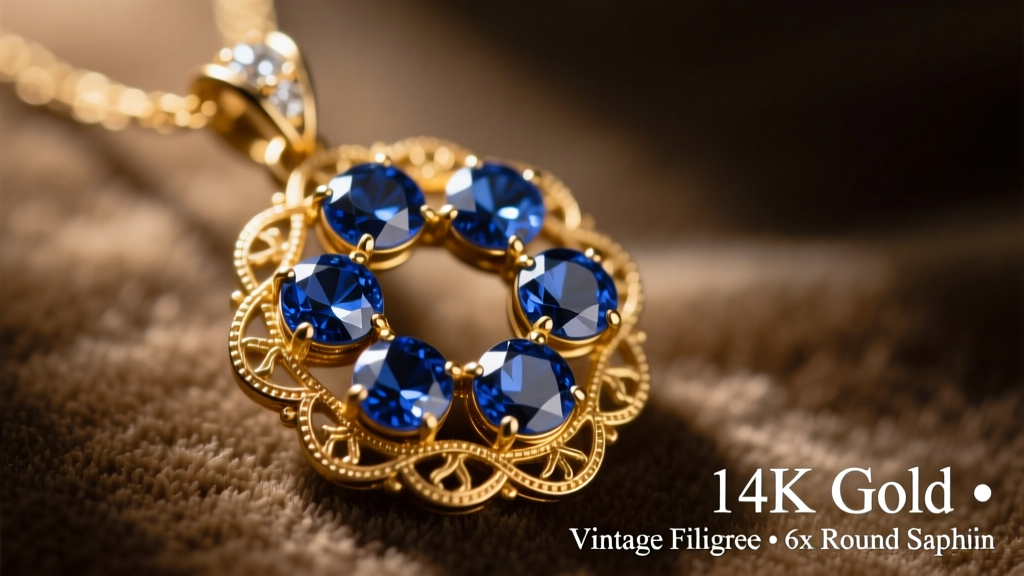
Filigree Elegance: A 14K Gold Pendant Featuring Six Round-Cut Sapphires
Lot 2334402: A Deep Technical and Historical Analysis of the 1965 Rolex Submariner Ref. 5513 with Rare ‘Double Swiss’ Dial and Original Bracelet
Gedney King & Son Advertising Sign: A Rare 24 × 36-Inch Artifact of Boston’s 19th-Century Scientific Instrument Trade
Chinese Export Jardinière, Famille Verte Green Ground with Fish and Floral Motifs — Pair, Circa 1740–1760
Jeffrey S. Evans & Associates: Authority in American Antiques, Glass, and Vintage Timepieces
Hardware Tree by Rufkahrs Hardware: A Forgotten Icon of Mid-Century American Industrial Design
Political Balloon: Wallace for President, Unused Circa 1972 — A Rare Artifact of American Third-Party Campaign History
Owen Biddle: The Forgotten American Watchmaker Who Shaped Early Precision Timekeeping
Cochran & Fleming: The Forgotten American Watchmakers Who Defined Mid-Century Precision and Elegance