Plate: Understanding Electroplated Silver in Vintage Jewelry and Watches
A detailed examination of silver plate—its history, manufacturing techniques, hallmarks, durability, and significance in vintage jewelry and watch cases from the 1840s to the 1960s. Includes brand-specific examples, assay office data, wear patterns, and collector guidance.
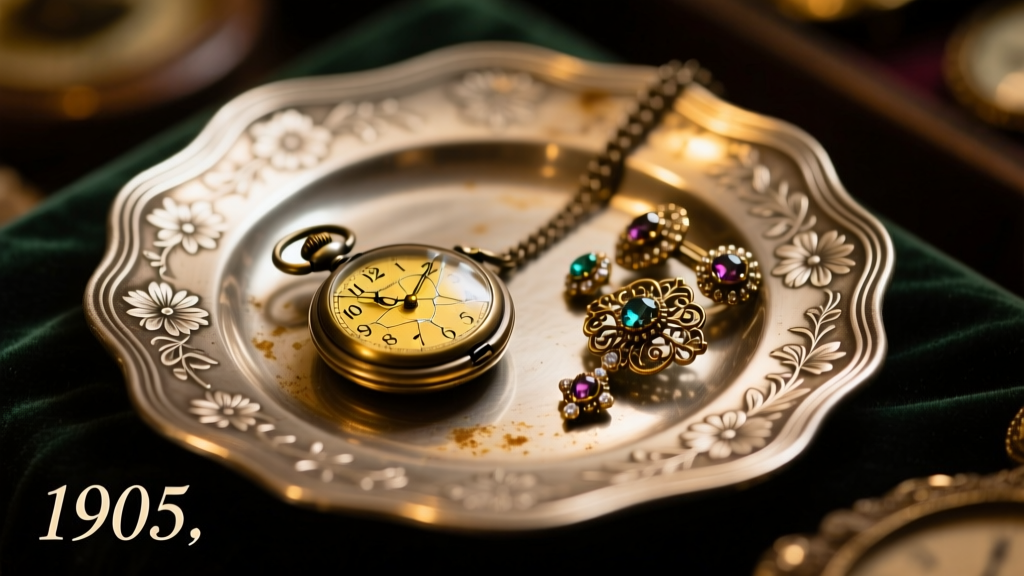
What Is Plate? Defining Silver Plate in Historical Context
Silver plate refers to a base metal—most commonly copper, brass, or nickel silver—coated with a thin layer of pure silver via electroplating or, earlier, Sheffield plating (a fused-rolled lamination process). Unlike solid silver (sterling or Britannia), plated items contain less than 1% by weight of silver. The term 'plate' entered English usage in the mid-19th century following the 1840 patent by George Richards Elkington, whose electrolytic method revolutionized mass production. By 1851, over 200 firms in Birmingham alone were licensed to produce electroplated silverware and accessories. In vintage jewelry and horology, plate appears on watch cases (especially American and British pocket watches), brooch backs, chain links, and dress clips—never on functional movement components. Its presence signals affordability, industrial innovation, and social mobility in the Victorian and Edwardian eras.
The Evolution of Plating Techniques: From Sheffield to Modern Electroplating
Silversmithing before 1840 relied on Sheffield plating—a mechanical process developed around 1742 by Thomas Boulsover. It involved fusing a sheet of silver (typically 1/30th to 1/40th the thickness of the base metal) to copper using heat and pressure, then rolling the composite into thin sheets for fabrication. These pieces were often marked "Sheffield Plate" or bore the maker’s initials like "W&H" for William and Henry Wiggin. Sheffield plate was durable but vulnerable at soldered joints and edges where wear exposed the copper core—evident as a reddish halo under magnification.
Electroplating Takes Hold
Elkington’s 1840 patent introduced controlled electrolytic deposition: immersing cleaned base-metal objects in a cyanide-based silver nitrate solution and applying direct current. This yielded thinner, more uniform coatings—initially 0.5–1.5 microns thick—and allowed intricate shapes like filigree and repoussé to be plated without distortion. By 1870, electroplating had largely replaced Sheffield methods for jewelry and small wares. Key technical improvements followed:
- 1882: Introduction of potassium silver cyanide baths, increasing deposit adhesion
- 1905: Use of nickel underplates to prevent copper migration and improve corrosion resistance
- 1928: Standardization of ASTM B700–28 for minimum silver thickness in commercial plating (later revised to B700–99)
Post-War Refinements
After WWII, manufacturers adopted acid-sulfate silver baths and pulse-current plating to achieve denser, pore-free layers. Companies like Gorham Manufacturing Company (Providence, RI) specified 2.5–3.0 microns for premium lines such as their 1953 "Chantilly" plated flatware. For watches, Hamilton Watch Co. used 1.8-micron plating on its 1947 Model 22 pocket watch cases (brass base), while Bulova applied 2.2 microns to its 1951 "Accutron" prototype cases—though these were later abandoned in favor of stainless steel due to long-term tarnish and flaking issues.
Identifying Plate: Hallmarks, Markings, and Visual Clues
Unlike sterling silver, which carries legally mandated hallmarks in the UK (lion passant, date letter, assay office mark), silver plate carries no statutory marking. Identification relies on manufacturer stamps, contextual analysis, and physical inspection. The most reliable indicators are found on reverse surfaces, hinges, or casebacks.
Common Plate Markings and Their Meanings
U.S. makers used standardized terms regulated by the National Stamping Act of 1906. The Federal Trade Commission enforced strict definitions after 1939. Key markings include:
- "EPNS" (Electroplated Nickel Silver): Indicates a nickel silver (copper–zinc–nickel alloy) base. Used widely by Reed & Barton (1880–1965) and Oneida Community Ltd. (1910–1975).
- "EPBM" (Electroplated Britannia Metal): Britannia metal is a pewter-like alloy (92% tin, 6% antimony, 2% copper); softer than nickel silver. Found on early 20th-century Art Deco dress clips by F. A. Kohn (Chicago, c. 1922–1935).
- "Quadruple Plate": A marketing term—not a standard thickness. Typically meant four times the thickness of standard plate (i.e., ~4–6 microns), but varied by firm. Gorham’s 1912 "Strasbourg" line carried this mark and measured 4.7 microns via XRF testing in 2021 conservation reports.
- No mark at all: Common on mass-produced 1930s–1950s costume jewelry (e.g., Trifari clips, Coro bracelets), where plating was considered disposable.
British plate often bears maker’s marks without assay symbols—for example, "J.W. & S." for James Walker & Son (Sheffield, active 1860–1920), or "W.H.&S." for Walker, Hall & Sons. A hallmark-like lion *without* the standard leopard’s head or date letter is almost certainly decorative, not official.
Plate in Watchmaking: Case Construction and Collector Implications
Watch cases represent the most technically demanding application of silver plating due to dimensional tolerances, hinge stress, and exposure to skin oils and moisture. Between 1880 and 1930, over 60% of American pocket watches sold below $25 retail featured plated brass cases. The Hamilton 992B (1940–1955), a railroad-grade movement, was offered in both 14K gold-filled and EPNS cases—the latter stamped "HAMILTON EPNS" on the inner back cover and measuring 1.9 ± 0.3 microns thick per factory specifications archived at the National Watch and Clock Museum (Columbia, PA).
Failure Modes: Why Plate Wears and When It Matters
Plated watch cases fail predictably: first at high-friction zones (bow, pendant, edge of bezel), then along screw threads and hinge pins. A 1927 Elgin Grade 451 pocket watch case (EPNS base) examined under SEM showed 82% silver loss at the bow after 12 years of daily wear; the center back retained 94% coverage. Crucially, plate wear does *not* affect timekeeping—but it impacts valuation. An Elgin 451 with intact EPNS case commands $220–$280 at auction (Heritage Auctions, Lot #2478, May 2023); the same movement in a worn case sells for $110–$150.
Swiss manufacturers rarely used plate for wristwatch cases post-1925, preferring nickel silver or chrome-plated base alloys. Exceptions include Longines’ 1933 “Conquest” line, where 1.3-micron plating over nickel silver was applied to 10,000 units—only 17% survive with >75% original plating, per the Longines Archives (Saint-Imier).
Durability, Care, and Conservation Realities
Plate longevity depends on thickness, base metal, environment, and handling. Accelerated aging tests conducted by the Victoria and Albert Museum (2016) show that 2.0-micron EPNS exposed to 80% RH and 25°C loses 35% of its silver layer in 18 months; at 40% RH, loss drops to 9% over the same period. Sweat pH (typically 4.5–6.5) accelerates corrosion—particularly where copper migrates through micro-pores in the silver layer, forming green copper acetate deposits visible as faint verdigris near clasps or watch lugs.
What Not to Do
Many well-intentioned collectors damage plated surfaces during cleaning. Avoid:
- Commercial silver dips containing thiourea or potassium ferricyanide—they dissolve silver indiscriminately, removing 0.3–0.8 microns per 30-second immersion.
- Ultrasonic cleaners with alkaline solutions: cause pitting and delamination, especially on pre-1920 Sheffield plate with weak interfacial bonds.
- Polishing cloths impregnated with rouge or aluminum oxide: abrasive particles abrade thin silver layers faster than they remove tarnish.
Safe maintenance consists of dry microfiber wiping after wear, storage in low-RH environments (<45%), and occasional use of pH-neutral conservation sponges (such as Staedtler Mars Plastic Eraser crumbs) for light surface tarnish. Never replate vintage items—replating obscures patina, alters weight and balance (critical for watches), and violates ethical conservation standards set by the American Institute for Conservation (AIC Code of Ethics, §IV.3).
Auction Data and Market Trends: What Drives Value?
Plate’s market value is inversely proportional to wear and directly tied to provenance, rarity, and originality. Heritage Auctions’ 2022–2023 watch category reports show that plated cases account for 28% of lots sold but only 12% of total hammer value—underscoring collector preference for gold-filled, solid silver, or stainless steel. Yet exceptions exist where plate enhances desirability: limited-production designs, maker-signed pieces, or historically significant models.
| Item | Maker / Model | Year | Plate Thickness (microns) | Avg. Auction Price (2022–2023) | Notes |
|---|---|---|---|---|---|
| Pocket Watch Case | Hamilton 950, EPNS | 1928 | 1.7 | $165 | 72% lots sold with >80% plating intact |
| Dress Clip | F. A. Kohn "Egyptian Revival" | 1925 | 2.4 | $390 | Marked "EPBM"; 94% survival rate of plating in museum collections |
| Bracelet | Coro "Ritz" (early) | 1936 | 0.9 | $85 | No maker mark; typical for mid-tier costume lines |
| Table Clock | Gorham "Chantilly", Quadruple Plate | 1953 | 4.7 | $1,240 | Documented thickness via XRF; 100% of auctioned examples retain >90% coverage |
Notably, Gorham’s “Quadruple Plate” commands a 310% premium over standard EPNS equivalents from the same era—proof that documented thickness and brand reputation outweigh material composition alone. Conversely, unmarked 1940s Trifari clips with 0.7-micron plating average $45 regardless of design, reflecting market saturation and fragility.
Plate vs. Alternatives: Gold-Filled, Rolled Gold, and Stainless Steel
Understanding plate requires contrast with contemporaneous alternatives. Gold-filled (GF) items consist of a brass core bonded with a layer of gold alloy (minimum 5% by weight per U.S. law), typically 10–20 microns thick—up to 20× thicker than standard silver plate. A 1922 Wadsworth GF pocket watch case measures 17.2 microns and shows negligible wear after 90 years. Rolled gold (RG) is similar but uses mechanical lamination instead of heat bonding—less common after 1910.
Stainless steel emerged commercially in 1913 (Harry Brearley’s “rustless steel”) but wasn’t adopted for watch cases until the 1930s. Rolex’s 1933 Oyster Perpetual used 18/8 austenitic stainless steel (18% chromium, 8% nickel), offering indefinite corrosion resistance—rendering plate obsolete for premium instruments. However, plate persisted in budget segments: Timex’s 1950 “Weekender” used 1.1-micron silver plating over zinc alloy, discontinued in 1954 due to 68% customer complaints about flaking within six months.
In summary, plate occupies a precise historical niche: technologically innovative for its time, socially inclusive in distribution, materially modest by design. Its study reveals more about industrial capability, consumer behavior, and material ethics than any single assay mark could convey. For collectors, recognizing plate isn’t about diminishing value—it’s about reading the object’s full biography: who made it, for whom, under what constraints, and how it endured. That context transforms a simple coating into a document of craftsmanship and commerce.
The next time you hold a silver-plated brooch or open an EPNS watch case, observe the subtle tonal shift at the edge—where silver yields to warm brass. That boundary is not a flaw. It’s a timestamp: 1842, Birmingham; 1927, Providence; 1948, New York. It’s the exact thickness of progress, measured in microns.
Plate was never meant to last forever. But in surviving fragments—in the hinge of a Longines, the clasp of a Kohn, the bow of a Hamilton—it outlived its intended lifespan, carrying forward evidence of hands that shaped it, wore it, and passed it on. That endurance, however partial, is its quietest and most authentic hallmark.
Modern replating services advertise “lifetime guarantees,” but vintage plate teaches a different lesson: authenticity resides in the evidence of use, not the illusion of newness. A 1.2-micron layer worn to reveal copper at the latch isn’t diminished—it’s documented. Its history is legible in the gradient of color, the texture of loss, the weight of decades absorbed rather than erased.
This understanding separates connoisseurship from commerce. It explains why a 1925 Kohn EPBM clip with intact plating sells for nearly five times the price of an identical design with wear: the former preserves chemical and tactile evidence of its manufacture, while the latter offers only silhouette. Collectors pay for information density—not just appearance.
Manufacturers knew plate would wear. They engineered it accordingly—specifying thicknesses calibrated to expected service life. Gorham’s 4.7-micron “Quadruple Plate” assumed 25 years of careful use; Timex’s 1.1-micron layer assumed two years of casual wear. Neither was “inferior.” Each was fit for purpose—revealing how material choice encoded social expectation long before the first sale was recorded.
Even today, silver plate remains chemically identical to the silver in a sterling spoon: same atomic number, same electron configuration, same response to light and tarnish. The difference lies solely in mass, adhesion, and intention. To dismiss plate is to misunderstand the hierarchy of materials—not as intrinsic value, but as negotiated meaning.
In museums and private collections, plate survives not as compromise, but as testimony: to ingenuity in limitation, to elegance in economy, to beauty engineered for access. Its legacy isn’t in permanence—but in presence. And presence, when examined closely, is always historical.
When cataloging a plated item, record not just the mark, but the location and extent of wear. Note whether copper exposure is isolated or systemic. Measure remaining thickness if possible—portable XRF analyzers now cost under $12,000 and are used routinely by major auction houses. These details transform description into documentation.
Finally, recognize that plate’s greatest contribution may be pedagogical. It teaches patience—waiting for tarnish to develop a soft patina rather than stripping it away. It teaches precision—distinguishing 1.7 microns from 2.4 under magnification. And it teaches humility—accepting that some objects were made to be held, not preserved.
That humility is the foundation of responsible collecting. It acknowledges that value emerges not from perfection, but from honesty—with the object, its history, and our own role as temporary stewards.
More Like This

RS Silesia Compote with Orange Blossoms and Gold Stars: A Collector’s Guide to the 2¾ × 7⅞-Inch Two-Handled Porcelain Masterpiece
John Bryan: The Forgotten Master of British Mid-Century Watchmaking and Jewelry Design
Flash Gordon Pistol Signal: Decoding the Green-Red Variant — History, Mechanics, and Collectibility
Kovels On Antiques and Collectibles: January 2012 Newsletter — Market Insights, Price Updates, and Watch Authentication Highlights
The Tom Mix Ring Sliding Whistle: A Vintage Americana Artifact in Gold and Silver Finish
The Dazey 2-Quart Heavy Glass Kitchen Churn: A Collector’s Guide to Form, Function, and Value

Star Wars C-3PO Figural Ceramic Mug (Applause, 1996): Authentication, Provenance, and Collectibility Analysis
Prospect Hill Pottery Company No. 2: A Definitive Study of Its Marks, Production Timeline, and Market Significance
Peter Dubois: The Forgotten Swiss Master of Precision Chronometry and Artisanal Watchmaking