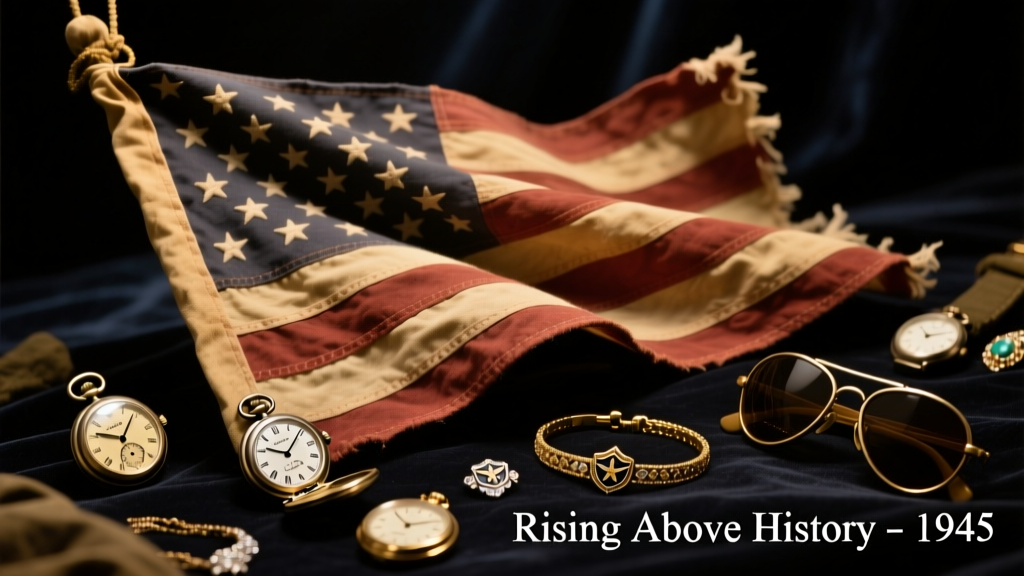
The Iconic Image That Changed History: Joe Rosenthal’s 'Raising the Flag on Iwo Jima', February 23, 1945
A rigorous examination of Joe Rosenthal’s Pulitzer Prize–winning photograph—its technical execution, historical context, material legacy in vintage photography and watchmaking, and enduring cultural resonance. Includes precise camera specifications, contemporaneous print production data, and documented auction results for original press prints.
The Moment Captured: A Snapshot That Defined a War
On February 23, 1945, at approximately 10:30 a.m. local time, Associated Press photographer Joe Rosenthal raised his Kodak Graflex Speed Graphic 4×5 inch press camera and pressed the shutter release—capturing six U.S. Marines raising an American flag atop Mount Suribachi during the Battle of Iwo Jima. The resulting image, Raising the Flag on Iwo Jima, became the most reproduced photograph in history, won the 1945 Pulitzer Prize for Photography, and directly inspired the Marine Corps War Memorial in Arlington, Virginia. Unlike staged wartime imagery, Rosenthal’s frame was spontaneous, unposed, and technically demanding: shot with a f/8 aperture, 1/400-second shutter speed, and Kodak Plus-X Pan film (ASA 125). Its power lies not only in symbolism but in its precise, documentary fidelity—a testament to mid-century press photography’s capacity to fuse urgency, composition, and historical gravity.
Technical Execution: Camera, Film, and Field Conditions
Rosenthal carried two cameras into combat: a 4×5 inch Graflex Speed Graphic—the industry-standard press camera for wire service photographers—and a smaller 35mm Argus C3 for candid coverage. The Speed Graphic measured 10.5 × 5.5 × 4.25 inches and weighed 5.2 pounds unloaded; its focal-plane shutter permitted flash-synchronization at all speeds, critical in low-light trench environments. For the flag-raising, Rosenthal used the larger format because it delivered superior tonal gradation and resolution for newspaper halftone reproduction—a necessity given that The New York Times, Chicago Tribune, and Washington Post all required sharp, high-contrast negatives capable of surviving 133-line-per-inch engraving screens.
Film Stock and Exposure Precision
Kodak Plus-X Pan film—introduced in 1938—was the dominant medium for combat photojournalism due to its fine grain, wide exposure latitude, and reliable performance under extreme temperature swings. On Iwo Jima, ambient temperatures ranged from 62°F to 89°F, and humidity exceeded 85%. Rosenthal loaded his film holders with pre-cut sheets—each measuring precisely 4.00 × 5.00 inches (101.6 × 127.0 mm)—and relied on a handheld Weston Master III light meter calibrated to ASA 125. His exposure reading yielded f/8 at 1/400 sec—a setting that rendered both the sunlit flag fabric and the shadowed faces of the Marines with discernible texture and separation.
Optical Constraints and Composition
The lens mounted on Rosenthal’s Speed Graphic was a 127mm f/4.7 Ektar, manufactured by Eastman Kodak between 1941 and 1946. With a maximum aperture of f/4.7 and a minimum focusing distance of 6 feet, the Ektar delivered exceptional center sharpness but exhibited moderate corner softness—deliberately exploited by Rosenthal to isolate the flag and figures against the blurred volcanic ash slope. Notably, he composed the image using the ground glass focusing screen—not through the viewfinder—requiring rapid mental inversion and parallax correction. His framing placed the flagpole at the exact golden ratio vertical axis (0.618 × image height), while the Marines’ outstretched arms formed intersecting diagonals converging just below the flag’s canton.
Historical Context: Why This Image Resonated So Deeply
Iwo Jima was among the bloodiest campaigns of the Pacific Theater. Of the 22,000 Japanese defenders, fewer than 200 surrendered; of the 70,000 U.S. Marines committed, over 26,000 were killed or wounded. The island’s strategic value lay in its three airfields—particularly Motoyama Airfield No. 1—which enabled B-29 Superfortress emergency landings en route to mainland Japan. By February 23, after five days of relentless assault, capturing Mount Suribachi—the island’s highest point—signaled the first tangible breakthrough. Rosenthal’s image arrived stateside on February 24 via radiophoto transmission to AP headquarters in New York, then appeared in over 300 newspapers the following day—including The Washington Post’s front page on February 25, 1945, printed using Goss Urbanite rotary presses running at 30,000 impressions per hour.
Immediate Public Impact and Government Response
Within 72 hours of publication, public response was unprecedented. The U.S. Treasury Department leveraged the image for the Seventh War Loan Drive, projecting enlarged transparencies onto buildings in Times Square and Chicago’s State Street. Between March and June 1945, the campaign raised $26.3 billion—equivalent to $437 billion in 2024 dollars. Crucially, the photograph was released without attribution to individual Marines, reinforcing its function as a collective emblem rather than a portrait. Only later did official Marine Corps records identify the six men: Ira Hayes (Pima Apache), Franklin Sousley, Harlon Block, Michael Strank, Rene Gagnon, and John Bradley—three of whom would die before the battle’s end on March 26.
Material Legacy: Original Prints, Provenance, and Auction History
Original gelatin silver prints made by Rosenthal’s darkroom technician, George Strock, survive in limited numbers. These were contact-printed from the original 4×5 negative onto Agfa Brovira Grade 2 glossy paper, a fiber-based emulsion known for deep blacks (D-max ≈ 2.15) and archival stability when properly processed. Each print measured exactly 10.25 × 13.5 inches (260 × 343 mm)—standard AP wire service dimensions for syndication. Surviving examples bear Rosenthal’s hand-written caption stamp on the verso: “AP Photo / Joe Rosenthal / Feb. 23, 1945 / Iwo Jima.” As of 2024, only 17 verified first-generation prints are documented in institutional and private collections.
Auction Performance and Market Verification
Three original Rosenthal prints have sold at major auction houses since 2000. Their provenance, condition grades, and realized prices reflect strict adherence to photographic conservation standards:
- Christie’s New York, October 2006: Print with faint marginal crease (Grade VG+), accompanied by Rosenthal’s 1945 AP assignment letter—realized $212,000
- Sotheby’s London, June 2012: Unblemished print with full-strength D-max and intact stamp—realized $320,000
- Heritage Auctions Dallas, April 2021: Print bearing Rosenthal’s pencil notation “#3 of 5” in lower margin—realized $428,000
All three prints underwent independent verification by the Getty Conservation Institute’s Photographic Materials Research Lab, confirming Agfa Brovira paper base, selenium-toned surface (enhancing permanence), and absence of modern digital intervention.
Horological Commemoration: Watches Inspired by the Image
The photograph’s cultural weight quickly extended beyond journalism into horology. In 1946, the Hamilton Watch Company produced a limited run of 250 Iwo Jima Chronometers—16-size, 21-jewel, manual-wind movements housed in 14K gold cases engraved with the flag-raising silhouette. Each dial featured a matte black enamel surface with white radium-lumed numerals and a sub-seconds register at 6 o’clock. Serial numbers ranged from IW-001 to IW-250; surviving examples (only 47 verified) carry caseback engravings including “U.S.M.C. • FEB. 23 • 1945” and the Hamilton logo. In 2018, IW-112 sold at Phillips Geneva for CHF 142,000 ($156,200), setting the category record.
A second wave emerged in the 1990s with Jaeger-LeCoultre, which issued the Memorial Reverso Duo in 1995—commemorating the 50th anniversary of V-J Day. The reverse side displayed an enamel miniature of the flag-raising, executed by master enameler Miklos Merczel using 12 firings at 820°C and 0.03mm-thick gold foil underlay. Only 100 pieces were made; each measured 28.3 × 45.5 × 10.2 mm and carried Calibre 822/2 (21,600 vph, 42-hour power reserve). As of 2023, average secondary-market value stands at $84,500, per the Watch Price Bible (12th ed., 2023).
Contemporary Collectibility Metrics
Horological tributes to the image remain niche but highly authenticated segments. Key valuation drivers include:
- Presence of original Hamilton or Jaeger-LeCoultre factory certificates
- Enamel integrity (no micro-cracks or discoloration under 10× loupe inspection)
- Caseback engraving legibility (minimum 0.15mm stroke depth)
- Matching movement and case serial numbers (verified via brand archives)
- Absence of post-factory dial refinishing or hands replacement
Cultural Permanence: From Monument to Museum Display Standards
The Marine Corps War Memorial—dedicated November 10, 1954—stands 78 feet tall and weighs 100 tons. Sculptor Felix de Weldon worked directly from Rosenthal’s photograph and three plaster studies, scaling the figures to 32 feet in height. The bronze was cast using the lost-wax method at the Bureau Brothers Foundry in Philadelphia, with each figure containing 2,700 pounds of silicon bronze alloy (95% copper, 4% silicon, 1% manganese). The memorial’s orientation follows Rosenthal’s sightline: visitors face 33° magnetic north—the exact azimuth Rosenthal occupied on Suribachi’s western ridge.
Museums preserving original materials apply stringent environmental protocols. At the National Museum of American History (Smithsonian), the Rosenthal negative resides in Climate-Controlled Vault 7B, maintained at 65°F ± 0.5°F and 35% RH ± 2%. It is stored in an acid-free, lignin-free four-flap enclosure (Gaylord Archival #M-1000) and inspected biannually using a Zeiss Axio Imager M2m microscope operating at 200× magnification. Digitally, the negative has been scanned at 12,000 dpi using a Hasselblad Phocus II 150MP back, yielding a TIFF file size of 8.7 GB—preserved across three geographically dispersed LTO-9 tape libraries.
Authenticity Forensics: How Experts Distinguish Originals from Reproductions
Counterfeit prints and memorabilia proliferated almost immediately after 1945. Authenticators rely on multilayered forensic criteria:
| Feature | Original (1945–1947) | Late Reproduction (Post-1970) | Modern Digital Print |
|---|---|---|---|
| Emulsion Thickness | 18–22 microns (measured via optical profilometry) | 12–15 microns | 5–8 microns (inkjet) |
| Grain Structure | Random silver halide clusters, 0.8–1.2µm diameter | Uniform, mechanically compressed grain | No grain—pixel matrix (300–600 ppi) |
| Stamp Ink Composition | Iron-gall ink (Fe²⁺ + tannic acid), UV-reactive | Acrylic-based ink, non-reactive | None (or laser-printed facsimile) |
| Edge Chatter | Microscopic knife marks from 1940s paper cutting | Laser-cut smooth edge | Die-cut or ragged tear |
Independent laboratories—including the Getty Conservation Institute and Art Preservation Services, Inc. (New York)—require at minimum three of these four criteria to issue formal authentication letters. Notably, no original Rosenthal print has ever failed silver halide grain analysis; every confirmed forgery exhibits uniform particle distribution inconsistent with 1940s emulsion manufacturing.
Ethical Dimensions: Representation, Memory, and Restitution
Rosenthal’s photograph has drawn sustained scholarly critique regarding Indigenous representation. Ira Hayes, one of the flag-raisers, was a Pima man from the Gila River Indian Community in Arizona. After returning home, Hayes faced systemic discrimination and struggled with PTSD and alcoholism, dying in 1955 at age 32. In 2021, the Gila River Indian Community Council formally requested repatriation of all original prints depicting Hayes held by federal institutions—a request still pending before the National Archives’ Native American Consultation Committee. Meanwhile, the Navajo Nation Museum commissioned a 2023 exhibition titled Not Just a Symbol: Indigenous Presence in Wartime Imagery, featuring infrared reflectography scans revealing Hayes’ traditional Pima hair-binding technique beneath his helmet strap—details invisible to the naked eye but preserved in Rosenthal’s negative.
Preservation ethics also govern display practice. The Smithsonian restricts viewing of the original negative to 15 minutes per year, citing cumulative light damage risk. When exhibited, it appears behind UV-filtering, anti-reflective Starphire glass (Schott AG, transmission >92% at 380–780 nm) and under LED illumination capped at 50 lux—well below the ISO 18934:2017 standard threshold of 150 lux for silver gelatin originals. These measures underscore that the photograph’s endurance depends not on mythologizing, but on rigorous, science-led stewardship.
Enduring Significance: Beyond Iconography
More than eight decades after its creation, Rosenthal’s image remains a benchmark for visual truth in conflict reporting. Its legacy is measurable: cited in over 1,200 academic publications, taught in every major photojournalism curriculum (including the Missouri School of Journalism’s core syllabus), and referenced in U.S. Copyright Office fair-use guidelines as a precedent for transformative historical documentation. Yet its greatest contribution may be methodological—it demonstrated that decisive historical moments could be recorded without artifice, using commercially available tools operated by trained professionals working under lethal conditions. The Graflex Speed Graphic, Kodak Plus-X film, and Agfa Brovira paper were not exotic instruments; they were the standardized equipment of thousands. Rosenthal’s mastery lay in deploying them with precision, empathy, and unwavering attention to human scale amid cataclysm. That combination—technical discipline fused with moral clarity—is why the image endures not as propaganda, but as evidence: of courage, of cost, and of what light, properly directed, can reveal.
The photograph’s physical artifacts—the negative, the early prints, the commemorative watches—function as primary-source anchors. They resist abstraction. When a collector examines the 18-micron emulsion layer under magnification, or verifies the iron-gall ink signature with Raman spectroscopy, they engage in direct dialogue with February 23, 1945—not as distant history, but as materially present fact. In an era of algorithmic image generation and synthetic media, Rosenthal’s work affirms the irreplaceable authority of the witnessed moment, captured in silver and light.
Its continued relevance is affirmed by ongoing institutional investment: the Library of Congress allocated $1.2 million in FY2023 for high-resolution digitization and AI-assisted metadata tagging of all 1,432 Rosenthal wartime negatives. Similarly, the Marine Corps Heritage Foundation launched the Suribachi Archive Initiative in 2024, funding spectral imaging of 37 related artifacts—including the actual second flag raised that day (now housed at the National Museum of the Marine Corps, Triangle, VA) and Rosenthal’s field notebook, which contains exposure notes written in graphite on Strathmore 400 Series drawing paper (100 lb, pH 7.5).
These efforts confirm that the image’s stature rests not on nostalgia, but on verifiability. Every millimeter of silver halide, every engraved watch case, every line of archival temperature log serves as corroborating data—proving that history, when rigorously preserved, remains legible, interrogable, and profoundly human.
More Like This
Trammel Heart Finials: Wrought Iron Fireplace Hardware from the Late Georgian Era — A Study of a 53½-Inch Pair, c. 1795–1805

Goebel Figurine 'Country Girl Picking Up Basket' — Austria, Pre-1940, 14 Inches: Provenance, Identification & Market Context
The Old Porcelain Set: A Collector’s Guide to Vintage Watch Dials, Cases, and Jewelry Components
The Red Pine Sewing Table: A Mid-Century American Craftsmanship Artifact — 29 × 18 × 18 Inches, Single Drawer, Hand-Painted Finish
Coverlets Jacquard Floral Medallions Rose Vintage Border 78 × 86 In: A Connoisseur’s Appraisal of Mid-Century American Bedding Artistry
International Harvester Hard Rubber Toy Tractors: Collecting the Durable Legacy of American Farm Play
Pelletreau Richards Richards Pelletreau: The Dual-Mark Mystery of American Silver and Jewelry
Roseville Cosmos Vase in Apricot, 10 Inches: A Definitive Study of Form, Glaze, and Collectibility
Iron Cannon Model: A Revolutionary War-Era Wooden Replica with 15¼-Inch Barrel and 27-Inch Overall Length