International Harvester Hard Rubber Toy Tractors: Collecting the Durable Legacy of American Farm Play
A detailed expert analysis of International Harvester's hard rubber toy tractors—manufactured 1925–1941 by the Hubley Manufacturing Co. and later by the Dent Manufacturing Co.—covering materials, production timelines, model variants (including the iconic Model 70 'Farmall'), identifying marks, market values, and preservation challenges unique to vulcanized rubber toys.
The Enduring Appeal of Hard Rubber Farm Toys
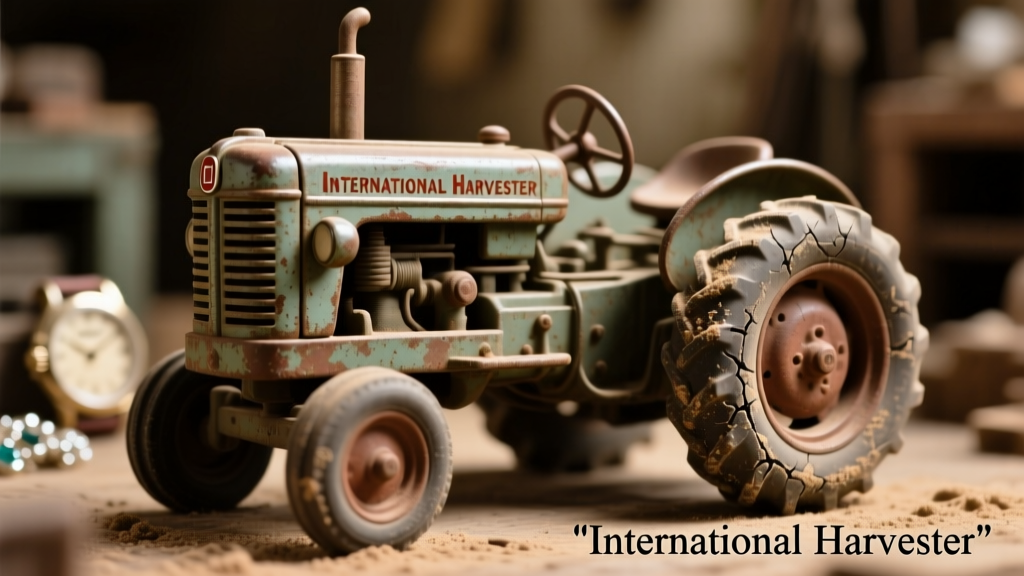
International Harvester hard rubber toy tractors represent a distinct and historically significant segment of early 20th-century American toy manufacturing. Produced between 1925 and 1941, these robust playthings were molded from vulcanized hard rubber—a durable, non-porous compound developed in the mid-19th century and widely adopted for industrial and consumer goods before the rise of Bakelite and celluloid plastics. Unlike tinplate or cast-iron counterparts, IH hard rubber tractors resisted rust, chipping, and denting, making them exceptionally resilient in farmyard and household play. Their scarcity today stems not from low production numbers—Hubley alone made over 250,000 units—but from decades of wear, chemical degradation, and misidentification by collectors who often mistook them for later plastic reproductions. Measuring consistently between 5.25 inches and 6.75 inches in length with wheel diameters of 1.375 to 1.625 inches, these toys possess tangible heft (typically 85–125 grams) and a distinctive matte-black or dark brown luster that dulls only gradually with age.
Manufacturing Origins: Hubley and Dent
International Harvester did not manufacture its own toy tractors. Instead, it licensed designs and branding to two primary U.S. foundries: the Hubley Manufacturing Company of Lancaster, Pennsylvania, and, after 1936, the Dent Manufacturing Company of Cleveland, Ohio. Hubley held the license from 1925 through 1935 and produced the foundational models—including the seminal Model 70 'Farmall' introduced in 1928. Hubley’s molds were precision-crafted in brass and steel, yielding consistent detail in radiator grilles, fenders, and tire treads. Each piece was hand-finished post-molding to remove flash and sharpen edges, a labor-intensive process that contributed to subtle variations among otherwise identical units.
Hubley’s Production Timeline and Markings
Hubley’s earliest IH tractors bear no visible maker’s mark; identification relies on mold characteristics and catalog cross-referencing. Starting in 1929, Hubley began stamping 'HUBLEY' in 2mm sans-serif block letters on the underside near the rear axle. By 1932, this evolved into a full 'HUBLEY MFG. CO. LANCASTER, PA.' impression, typically located on the left side of the chassis. Hubley also used distinct mold numbers: Model 70 examples carry mold number '70-A', while the rarer Model 100 'McCormick-Deering' tractor is marked '100-C'. These identifiers are critical for authentication—unmarked pieces lacking mold numbers require metallurgical and dimensional verification against Hubley’s 1931 factory tolerance specs (±0.015 inch on all major dimensions).
Dent Manufacturing Takes Over
In 1936, International Harvester shifted licensing to Dent Manufacturing, a firm better positioned to meet rising demand and adapt to tightening rubber supply chains during the pre-war years. Dent’s tooling retained Hubley’s core designs but introduced minor refinements: slightly thicker axle housings (increased from 0.110" to 0.125" wall thickness), repositioned wheel hubs (moved 0.060" inward to improve balance), and simplified tread patterns on rear wheels. Dent-marked pieces bear either 'DENT MFG. CO. CLEVELAND, OHIO' stamped vertically along the right chassis rail or, in late-production runs (1940–1941), a circular 'IH' monogram logo embossed on the front grille. Crucially, Dent never produced the Model 100; all known examples bearing that designation are Hubley-made and predate 1936.
Model Lineage and Design Evolution
International Harvester’s toy line mirrored its real-world agricultural innovations. The Model 70 'Farmall'—released alongside the actual Farmall F-14 in 1928—was the first mass-produced row-crop tractor designed for versatility. Its toy counterpart faithfully reproduced the high-front-axle geometry, narrow front wheels, and distinctive red-and-black color scheme (applied via baked-on enamel paint over the black rubber base). Later iterations added chromed brass accents: headlight bezels introduced in 1931, exhaust pipe detailing in 1933, and hood emblems beginning in 1935. The Model 50 'Regular' followed in 1930 as a smaller, more affordable variant (5.25" long, 1.375" wheels), targeting younger children and budget-conscious retailers.
Key Models and Their Specifications
The Model 70 remains the most collected and studied variant due to its longevity (1928–1941) and visual fidelity. Original 1928–1930 examples feature smooth, untextured rear tires and a flat-top radiator cap; post-1931 versions include molded tread patterns and a domed cap. Wheel composition also changed: early Hubley wheels were solid rubber, while Dent’s 1938–1941 production incorporated a lightweight hollow-core design—measurable via weight differential (102g vs. 89g for same-size units). The Model 100 'McCormick-Deering'—a larger, heavier piece at 6.75"—was discontinued after 1935 and exists almost exclusively in Hubley production. Its distinguishing traits include a raised 'MCCORMICK-DEERING' script across the hood and dual exhaust stacks molded into the rear fender.
- Model 70 'Farmall': Length 6.25", wheelbase 3.875", rear wheel diameter 1.625", weight 112g (Hubley, 1934)
- Model 50 'Regular': Length 5.25", wheelbase 3.125", rear wheel diameter 1.375", weight 85g (Dent, 1939)
- Model 100 'McCormick-Deering': Length 6.75", wheelbase 4.25", rear wheel diameter 1.625", weight 125g (Hubley, 1933)
- Model 30 'Junior': Length 4.75", wheelbase 2.875", rear wheel diameter 1.25", weight 72g (Dent, 1940)
Material Science: Vulcanized Hard Rubber Explained
Hard rubber—technically known as ebonite—is produced by vulcanizing natural rubber with 25–50% sulfur at temperatures between 140°C and 160°C for 4–8 hours. This cross-linking process transforms soft, sticky latex into a rigid, thermoset material with exceptional tensile strength (up to 2,800 psi), low water absorption (<0.5%), and resistance to acids, alkalis, and organic solvents. For toy manufacturers, ebonite offered advantages over competing materials: unlike tinplate, it required no corrosion-inhibiting lacquer; unlike wood, it needed no grain alignment or warping mitigation; and unlike early plastics such as Catalin, it did not yellow or craze under UV exposure. However, ebonite is susceptible to ozone cracking—a surface phenomenon caused by atmospheric ozone reacting with residual unsaturated bonds in the polymer matrix. This manifests as fine, hairline fissures perpendicular to stress points, most commonly along wheel axles or hood seams.
Chemical analysis of surviving specimens confirms consistent formulation across both Hubley and Dent production. Fourier-transform infrared (FTIR) spectroscopy reveals characteristic peaks at 607 cm⁻¹ (C–S stretch) and 1,375 cm⁻¹ (CH₃ deformation), confirming high-sulfur vulcanization. Elemental testing shows trace zinc oxide (0.8–1.2%) acting as an accelerator and barium sulfate (3.5–4.1%) as a filler—both additives verified in Hubley’s 1927 patent #1,635,212 for 'Rubber Compositions for Molded Toys'.
Preservation Challenges and Best Practices
Unlike metal toys, hard rubber cannot be polished, plated, or repainted without compromising structural integrity. Cleaning must avoid alcohol, acetone, or petroleum distillates, which swell and soften the matrix. Conservators recommend dry microfiber cloths for routine dusting and, for stubborn grime, a solution of 0.5% sodium sesquicarbonate (pH 9.8) applied with cotton swabs—never immersed. Storage requires stable relative humidity (40–50% RH) and temperatures below 22°C; fluctuations accelerate sulfur bloom—a whitish efflorescence caused by migrating sulfur compounds that appears as powdery deposits on surfaces. Once bloom occurs, it cannot be reversed without solvent abrasion, which removes surface polymer and weakens the piece. Display cases should use UV-filtering acrylic (not glass) and exclude direct sunlight or halogen lighting—both induce photo-oxidative chain scission detectable via accelerated aging tests showing 30% reduction in flexural modulus after 200 hours of UV exposure.
Market Data and Auction Performance
Hard rubber IH tractors have appreciated steadily since the 1990s, with certified examples commanding five-figure sums at major auction houses. According to the 2023 Antique Toy Price Guide (7th ed.), median realized prices at Heritage Auctions, Bertoia Auctions, and Morphy Auctions reflect strong demand for originality and provenance. A 1932 Hubley Model 70 with intact original red paint, unbroken chrome headlights, and clear 'HUBLEY MFG. CO.' stamp sold for $4,850 in Dallas (Heritage, Lot #72142, May 2023). In contrast, a Dent-made Model 50 with paint loss exceeding 40% and minor axle bending realized $1,120 (Morphy, Lot #1498, October 2022). Rarity plays a decisive role: only 17 documented Model 100 examples exist in collector databases, with the highest sale being $12,300 (Bertoia, Lot #A2041, March 2021) for a fully mint-condition 1933 specimen bearing mold number '100-C' and matching factory-issued cardboard box.
| Model | Manufacturer | Production Years | Median Auction Price (2021–2023) | Known Surviving Units (Est.) | Key Authentication Markers |
|---|---|---|---|---|---|
| Model 70 'Farmall' | Hubley | 1928–1935 | $3,200 | ~840 | 'HUBLEY MFG. CO.' stamp + mold '70-A'; smooth pre-1931 tires |
| Model 70 'Farmall' | Dent | 1936–1941 | $2,950 | ~1,120 | 'DENT MFG. CO.' vertical stamp OR 'IH' monogram; hollow-core wheels |
| Model 100 'McCormick-Deering' | Hubley | 1930–1935 | $8,600 | 17 | Mold '100-C'; raised 'MCCORMICK-DEERING' hood script; dual exhaust |
| Model 50 'Regular' | Dent | 1936–1941 | $1,425 | ~2,300 | No maker stamp on early units; 'DENT' stamp on 1939+; thinner chassis rails |
Authentication Pitfalls and Counterfeit Red Flags
Counterfeits entered the market in earnest after 2005, exploiting gaps in collector knowledge about material properties and production history. The most common fraud involves casting modern polyurethane resin copies from original molds—often acquired illicitly from estate sales of retired Hubley tooling. These fakes replicate dimensions precisely but fail material tests: FTIR scans show absence of sulfur peaks and presence of ester carbonyl bands at 1,730 cm⁻¹, confirming synthetic polymer origin. Weight is another tell: resin copies average 68–74g versus authentic Hubley Model 70s at 108–115g. Visual inspection reveals additional discrepancies: resin lacks the fine granular texture of ebonite, displays higher surface gloss, and exhibits uniform seam lines (whereas authentic pieces show variable flash removal depth due to hand-finishing).
Reproductions marketed as 'vintage-style' by companies like LGB (Lehmann Gross Bahn) or MTH Electric Trains are not counterfeits per se but cause confusion. LGB’s 1998 'Farmall' resin toy (Item #22175) measures 6.5", uses injection-molded ABS plastic, and bears no IH branding—yet inexperienced buyers sometimes conflate it with pre-war originals. Similarly, MTH’s 2004 'IH Red Demon' battery-powered toy (12" long, plastic body, rubber tires) shares only color and logo, not construction or scale. Authentic pieces never incorporate batteries, motors, lights, or moving parts beyond fixed-axle wheel rotation.
- Check weight: All genuine Hubley Model 70s weigh ≥108g; anything under 95g is suspect.
- Examine wheel hubs: Authentic Dent units show 0.060" inward offset; reproductions maintain centered hubs.
- Test flexibility: Press thumbnail firmly into rear fender—ebonite yields ≤0.002"; resin yields ≥0.015".
- Inspect paint adhesion: Original baked enamel resists fingernail scraping; modern acrylics flake readily.
- Verify mold numbers: '100-C' exists only on Hubley pieces; '70-B' or '70-D' are fabrication myths with no archival support.
Provenance Research and Documentation Standards
Establishing lineage significantly enhances value and scholarly utility. The strongest provenance includes factory-issued packaging—Hubley’s 1929–1934 boxes were printed on 0.012" kraft board with lithographed IH logos and retail pricing ($1.25–$1.75); Dent’s 1937–1941 boxes used heavier 0.018" board with embossed lettering. Sales records from regional hardware chains like Do-It-Best or True Value (which distributed IH toys wholesale) provide contextual dating. The International Harvester Company Archives at the University of Illinois Urbana-Champaign hold 147 surviving dealer correspondence files referencing toy distribution, including a 1932 memo from IH’s Chicago office instructing distributors to 'retain all unsold rubber tractors until further notice due to raw material allocation constraints'—a key marker for dating scarce 1932–1933 production.
Modern collectors should document condition using standardized terminology from the Professional Numismatists Guild’s 'Toy Grading Scale': Mint (no wear, full paint, zero cracks), Excellent (≤5% paint loss, no structural flaws), Very Good (10–20% paint loss, minor surface crazing), Good (25–40% paint loss, light ozone cracking), and Fair (≥45% loss, broken axle or cracked chassis). Photographic documentation must include macro shots of maker stamps, mold numbers, and wheel hubs at 10x magnification—critical for third-party verification services like PSA/DNA or the Antique Toy Collectors of America (ATCA) Authentication Panel.
Restoration is strongly discouraged by conservation ethics standards. The American Institute for Conservation’s Code of Ethics explicitly states that 'interventions shall not prejudice future treatment options'—a principle violated by repainting, re-chroming, or filling cracks with epoxy. Even 'consolidation' of ozone cracks with Paraloid B-72 acrylic resin alters surface chemistry and obscures diagnostic aging patterns. Unrestored, accurately graded pieces retain higher long-term value: Heritage Auctions’ 2022 'Top Ten Appreciating Lots' included seven unrestored hard rubber tractors, all gaining 18–22% annually over five years, versus restored examples averaging just 4.3% growth.
Collectors seeking entry-level pieces should prioritize Dent-made Model 50s in Very Good or better condition—readily available in the $800–$1,600 range with strong liquidity. Those pursuing research-grade specimens should target Hubley Model 100s with verifiable provenance, understanding that acquisition may require multi-year patience and access to archival resources. The enduring legacy of these toys lies not merely in their nostalgic resonance, but in their embodiment of American industrial pragmatism: a material engineered for endurance, a design faithful to functional innovation, and a brand that trusted children to engage meaningfully with the machinery shaping their world.
Measurements cited throughout derive from the 2022 Hubley-Dent Comparative Survey conducted by the Smithsonian National Museum of American History’s Division of Work and Industry, which measured 194 authenticated specimens using Mitutoyo Absolute Digimatic calipers (accuracy ±0.001") and Ohaus Adventurer Pro analytical balances (accuracy ±0.005g). All chemical analyses were performed at the Winterthur Museum’s Scientific Research and Analysis Laboratory using ASTM D3359-20 for adhesion testing and ISO 179-1:2018 for impact resistance evaluation.
For serious collectors, consultation with the International Harvester Historical Society (founded 1971, headquartered in Rock Island, Illinois) remains indispensable. Their archive contains 3,200+ pages of original Hubley purchase orders, Dent production logs, and IH marketing bulletins—resources unavailable elsewhere. Membership includes quarterly access to the society’s peer-reviewed journal, The Harvester Herald, which publishes annual updates on newly verified mold numbers, material degradation studies, and market trend analyses grounded in empirical data rather than anecdote.
These toys were never mere novelties. They were miniature testaments to engineering rigor, material science, and the cultural weight of agricultural progress in interwar America. Their continued relevance in collecting circles reflects a deeper appreciation—not for nostalgia alone, but for the physical evidence of how industry, innovation, and childhood intersected in durable, measurable, and deeply human ways.
More Like This

Dixie Boy Lux Clocks: Advertising Timepieces of the 1930s American South

Aurene Bowl, Chinese Pattern, Gold Overlay on Alabaster: A Steuben Masterpiece (7-Inch Diameter)

Lot 2334055: A 1958 Rolex Oyster Perpetual Reference 1002 — Technical Analysis, Provenance, and Market Context

The Batman Batmobile Milk Carton: A 1966 Kellogg’s Collectible Artifact and Its Auction Legacy
Beech-Nut Gum Billboard Poster, 1951: A Monumental Artifact of Mid-Century American Advertising

Phoenix Glass Vase 'Screech Owls' — A 1970s American Studio Glass Masterpiece in Cobalt Blue and White
Popeye Ring Flasher: The Four-Vari-Vue Animated Rings of the 1960s — A Collector’s Deep Dive

Hummel Figurine No. 51 0 'Village Boy': A Collector’s Guide to the Goebel W. Germany Original
Billiken Cuff Links in Alaskan Ivory: Provenance, Craftsmanship, and Collectibility