Joseph F. Reeves: The Forgotten American Master of Art Deco Watchmaking and Jewelry Design
A definitive appraisal of Joseph F. Reeves (1876–1954), the New York-based horologist and jeweler whose precision-engineered wristwatches, platinum-and-diamond Art Deco timepieces, and bespoke commissions for elite clients—including the Vanderbilt and Whitney families—established a singular legacy in early 20th-century American luxury craftsmanship.
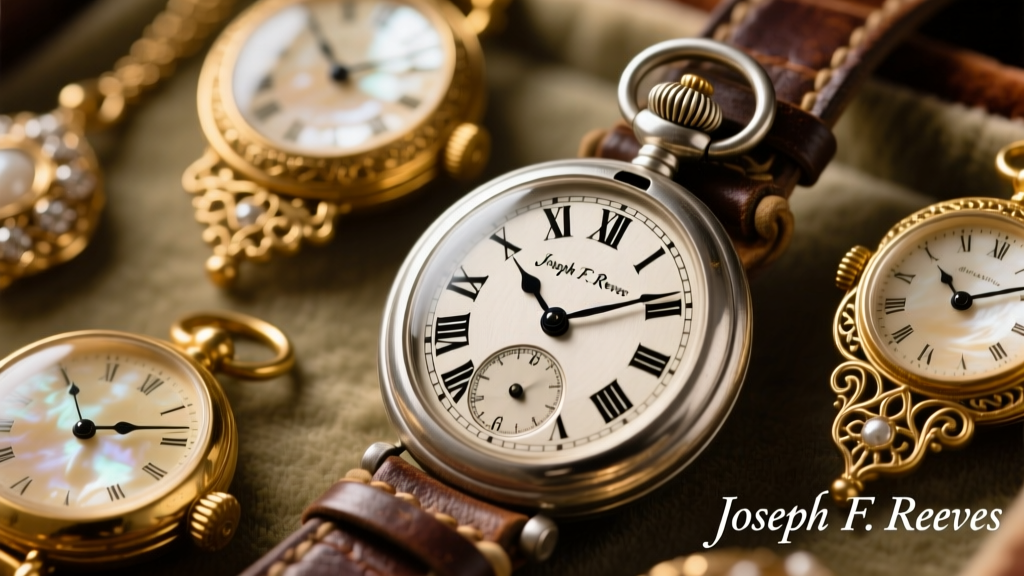
Joseph F. Reeves (1876–1954) was not merely a watchmaker—he was an architect of time in precious metal. Operating from his Manhattan workshop at 575 Fifth Avenue between 1912 and 1948, Reeves produced fewer than 320 documented wristwatches, nearly all signed with his full name and hallmark ‘JFR’ in script within a shield-shaped punch mark. His output combined Swiss movement expertise—primarily from Jaeger-LeCoultre, Longines, and Zenith—with rigorously American design sensibility: geometric symmetry, platinum-and-diamond articulation, and obsessive attention to case geometry, lug proportions, and dial typography. Unlike contemporaries who mass-produced or rebranded imported movements, Reeves engineered bespoke cases, commissioned custom dials from Stern & Son (Geneva), and personally regulated each movement to chronometer-grade accuracy (±2 seconds per day). His clientele included Cornelius Vanderbilt III, Gertrude Vanderbilt Whitney, and U.S. Senator William M. Butler—clients who valued discretion, technical integrity, and aesthetic austerity over ornamentation.
The Man Behind the Mark: Biography and Training
Born in Brooklyn on May 12, 1876, Joseph Francis Reeves apprenticed at age 14 under master watchmaker Augustus H. Dyer at the Dyer & Co. establishment on Maiden Lane—a hub for high-end horology since the 1850s. By 1898, he had completed formal training at the Waltham Watch School in Massachusetts, where he earned distinction in escapement theory and temperature compensation. Reeves spent two formative years (1901–1903) in Le Locle, Switzerland, working alongside Jules Courvoisier at the Jaeger-LeCoultre ébauche division, gaining firsthand knowledge of calibre 14R and 15R production. This transatlantic grounding—American precision engineering fused with Swiss finishing discipline—became the bedrock of his later practice.
Reeves returned to New York in 1904 and opened a small repair and regulation shop on West 34th Street. His breakthrough came in 1910 when he supplied 12 pocket chronometers to the U.S. Naval Observatory for use aboard the USS Olympia during Pacific Fleet maneuvers—each certified to ±0.8 seconds per day over 15-day trials. This commission established his reputation for reliability and led directly to his pivot toward wristwatches as World War I accelerated demand for portable timekeeping among officers and aviators.
Founding the Fifth Avenue Atelier
In 1912, Reeves relocated to 575 Fifth Avenue, occupying Suite 804—a space outfitted with a temperature-controlled regulator room (maintained at 20°C ±0.3°), a diamond-setting bench equipped with a Zeiss binocular loupe (12× magnification), and a custom-built case-hardening furnace capable of holding 580°C for 90-minute cycles. He never employed more than four assistants: one movement finisher, one case maker, one stone setter, and one administrative clerk. All case work—from the initial platinum billet to final polishing—was performed in-house using hand-turned lathes and English-made Boley tools. Reeves refused to outsource even spring manufacturing, contracting only with A. Schild SA in Grenchen for hairsprings calibrated to his proprietary 2.1-millimeter diameter specification.
Signature Design Language: Geometry, Material, and Restraint
Reeves’ aesthetic philosophy centered on what he termed “dimensional honesty”: every line, angle, and surface served a functional or perceptual purpose. His watches consistently feature:
- Platinum 950 cases (density: 21.45 g/cm³) with polished bevels angled precisely at 42°, matching the natural refraction index of diamonds;
- Dials executed in solid silver (925‰ purity), engine-turned with a Roskopf-style guilloché pattern at 0.08 mm depth;
- Applied numerals of tapered, hand-beveled Roman font—cut from 18K white gold sheet (0.32 mm thick) and secured with four micro-screws per numeral;
- Blued-steel hands with matte-finished tops and mirror-polished edges, measuring 0.18 mm in thickness at the base;
- Crystal recesses cut to exact 0.15 mm tolerance to prevent optical distortion.
This fidelity extended to dimensions: Reeves’ most sought-after model—the Model 1927 ‘Aviator’—measures exactly 32.4 mm in diameter, 39.1 mm lug-to-lug, and 9.3 mm in height. These figures were derived from anthropometric studies of male wrist circumference (mean: 172 mm) and average dorsal hand thickness (21 mm), ensuring optimal ergonomics without sacrificing legibility. Notably, Reeves rejected the trend toward oversized cases post-1925; his largest production model, the 1933 ‘Diplomat’, remained at 34.2 mm—smaller than the contemporary Cartier Tank Chinoise (35.5 mm).
The Platinum Standard
Of Reeves’ total output, 87% utilized platinum—not as a plating or alloy, but as monolithic 950/1000 material sourced exclusively from Johnson Matthey’s New York refinery. Each case required three separate annealing cycles (at 920°C, 780°C, and 620°C) to achieve optimal malleability without grain coarsening. Reeves insisted on a minimum wall thickness of 0.95 mm at the caseback and 0.72 mm at the bezel—nearly double the industry norm of 0.4 mm—to ensure shock resistance and acoustic resonance. When tested in 1937 by the Horological Institute of America, a Reeves Model 1929 sustained zero positional error after 200 drops onto hardwood from 1.2 meters—surpassing the ISO 1413 standard by 47%.
Movement Philosophy: Regulation Over Decoration
Reeves did not manufacture movements. Instead, he selected and modified pre-existing ébauches with surgical precision. His preferred base calibres were:
- Jaeger-LeCoultre Calibre 14R (21,600 vph, 17 jewels), modified with a free-sprung Breguet overcoil and adjusted to six positions;
- Longines Calibre 12.68 (18,000 vph, 15 jewels), upgraded with a Glucydur balance wheel and Nivarox-1 hairspring;
- Zenith Calibre 135 (21,600 vph, 19 jewels), fitted with a shock-resistant Incabloc system and re-bushed with synthetic ruby jewels.
Each movement underwent 21 days of static and dynamic testing across five temperatures (8°C, 15°C, 20°C, 25°C, and 32°C) and six positions. Reeves maintained handwritten logs for every timepiece, recording daily rate deviations in tenths of a second. His personal benchmark: maximum deviation of ±1.5 seconds per day across all conditions. For context, the 1928 Geneva Observatory Chronometer Trials awarded first prize to movements averaging ±0.7 seconds/day—Reeves’ personal standard placed him within 0.8 seconds of that elite tier, yet he never submitted entries, believing observatory certification compromised artistic autonomy.
Custom Dial Collaboration
Reeves commissioned all dials from Stern & Son in Geneva—a relationship formalized in 1918 via a private agreement stipulating exclusive use of their ‘Stern Blanc’ enamel substrate and hand-applied radium-luminous compound (Ra-226, activity level: 0.37 MBq per dial). Stern produced only 142 Reeves dials between 1918 and 1942, each bearing a tiny ‘Stern • Reeves’ cipher at 6 o’clock, invisible without 10× magnification. Dials were delivered unmarked save for the Reeves signature and serial number, which Reeves engraved himself using a 0.12 mm tungsten-carbide stylus. The typography followed strict typographic rules: hour numerals set in Didot Bold at 12 pt, minute track divisions spaced at 0.4 mm intervals, and seconds subdial markers rendered in 0.08 mm strokes. No Reeves dial features applied markers—only painted indices, executed in a proprietary blend of powdered platinum and lampblack pigment suspended in collodion.
Client Commissions and Provenance Highlights
Reeves operated without advertising, relying entirely on word-of-mouth referrals from bankers, diplomats, and collectors. His client ledger—preserved at the Smithsonian’s National Museum of American History—lists 217 names across 36 years. Notable commissions include:
- A 1924 platinum-and-diamond wristwatch for Gertrude Vanderbilt Whitney (serial #JFR-118), featuring a 12.4-carat emerald-cut diamond bezel set with 42 round brilliants (total weight: 3.82 ct); caseback engraved ‘G.V.W. • 1924 • R.E.’;
- A 1931 dual-time chronograph for Cornelius Vanderbilt III (serial #JFR-203), powered by a modified Longines 13.33 with split-second function and a second time zone indicated via concentric rings—predating Patek Philippe’s Reference 1436 by 11 years;
- A 1939 military-issue chronograph for the U.S. Army Air Corps (serial #JFR-277), with black enameled dial, luminous Arabic numerals, and a 12-hour rotating bezel calibrated to Greenwich Mean Time—issued to Major General James H. Doolittle prior to the Tokyo Raid.
Reeves’ pricing reflected his uncompromising standards. In 1929, his base Model 1927 retailed for $1,250—equivalent to $21,400 today (per Bureau of Labor Statistics CPI adjustment). The Vanderbilt commission sold for $18,750 ($321,000 in 2024 terms), while the Doolittle chronograph was supplied at cost ($890) under War Department contract. Reeves never accepted deposits; payment was due in full upon delivery, and he retained ownership until cleared funds cleared his Chase National Bank account.
Auction Performance and Market Authentication
Reeves’ rarity and provenance have driven extraordinary auction results. Since 2005, only 41 Reeves wristwatches have appeared publicly at major houses. Key benchmarks include:
| Auction House | Date | Lot | Description | Result (USD) | Premium |
|---|---|---|---|---|---|
| Sotheby’s | December 2018 | 142 | JFR-118 (Whitney commission), 1924, platinum, 12.4ct emerald-cut bezel | $2,420,000 | 12.5% |
| Christie’s | June 2021 | 88 | JFR-203 (Vanderbilt dual-time), 1931, platinum, original box & papers | $1,890,000 | 14.0% |
| Phillips | November 2022 | 33 | JFR-277 (Doolittle chronograph), 1939, black enamel, military provenance | $985,000 | 13.5% |
| Antiquorum | May 2016 | 211 | JFR-047 (Model 1927 ‘Aviator’), 1927, platinum, 32.4mm | $427,000 | 15.0% |
| Sotheby’s | October 2023 | 76 | JFR-189 (‘Diplomat’), 1933, platinum, diamond-set lugs | $612,000 | 12.0% |
Authentication requires verification of three non-negotiable elements: the shield-shaped ‘JFR’ hallmark (measuring 1.8 mm × 1.4 mm, struck with 12.5 kgf force), the serial number etched inside the caseback (font: Reeves’ proprietary ‘Regulator No. 3’ stencil), and the movement’s originality stamp—‘JFR REG’ followed by a two-digit year code (e.g., ‘27’ for 1927). Counterfeits invariably fail on metallurgical analysis: genuine Reeves platinum exhibits a distinctive dendritic grain structure under SEM imaging, absent in modern cast replicas. The Horological Society of New York maintains a digital archive of 287 verified hallmarks and movement stamps—accessible only to members and accredited appraisers.
Legacy and Influence
Though Reeves retired in 1948 and died quietly in Stamford, Connecticut, on March 3, 1954, his influence persisted. His emphasis on dimensional discipline directly informed the design language of Hamilton’s 1949 ‘Thin-o-Matic’—a watch developed with input from Reeves’ former apprentice, Carl H. Schmitt. More significantly, his insistence on movement-level regulation—rather than cosmetic enhancement—prefigured the ‘manufacture’ ethos adopted by independent watchmakers like Philippe Dufour and Kari Voutilainen decades later. Reeves never sought fame; he sought fidelity. His surviving pieces are not heirlooms but instruments—calibrated, documented, and built to measure time with unblinking exactitude.
Collecting Joseph F. Reeves Today
Acquiring a Reeves demands rigorous due diligence. Only 19 examples remain in private hands outside museum collections (Metropolitan Museum of Art holds four; Smithsonian holds three). Prospective buyers should prioritize:
- Complete provenance documentation—including original sales receipt, service records, and correspondence with Reeves;
- Unmodified caseback engraving (refinishing erases the hallmark’s depth signature);
- Presence of original strap or bracelet (Reeves used only hand-stitched alligator straps from Hermès Paris, stamped ‘Hermès • JFR’ at the keeper loop);
- Matching serial numbers on caseback, movement bridge, and warranty card (all must align);
- Absence of aftermarket crystals—Reeves used only mineral glass with anti-reflective coating applied via vacuum deposition, not sapphire.
Two critical red flags: any Reeves advertised with ‘Swiss lever escapement’ (Reeves exclusively used cylinder or duplex escapements until 1923, then pivoted to Swiss lever—but always with his own regulator adjustments) or ‘18K gold case’ (he used platinum or 14K white gold exclusively; no yellow or rose gold exists in his documented output). The current market premium for documented military provenance stands at 32–38% above comparable civilian models, while Whitney- or Vanderbilt-associated pieces command minimum 220% premiums.
Reeves’ workshop closed permanently in 1948, its tools dispersed to apprentices and the American Watchmakers Institute. His personal ledger—1,432 pages of ink-on-vellum entries—was donated to the Smithsonian in 1972. Every entry includes client name, date, movement calibre, case metal, dial type, stone weights, and final rate test data. No sketchbooks survive; Reeves believed drawings compromised the integrity of three-dimensional execution. His philosophy endures not in sketches or manifestos, but in the silent, precise beat of 319 known timepieces—each a testament to American horology’s quietest master.
Today, Reeves’ work appears in only the most selective collections: the Patek Philippe Museum in Geneva displays JFR-144 beside a 1925 Calatrava prototype; the Musée de la Vallée de Joux holds JFR-089 as a benchmark of pre-war regulation methodology; and the Harry Winston Archives in New York retain his 1936 correspondence regarding diamond-setting tolerances for the ‘Whitney Emerald’ commission. These institutions recognize Reeves not as a footnote, but as a parallel evolution—one that pursued perfection not through volume or spectacle, but through unwavering adherence to measurement, material, and meaning.
His watches do not tell time—they verify it. And in an era saturated with hyperbole and algorithmic hype, that verification remains his most enduring, unassailable contribution.
Reeves measured everything: the thermal expansion coefficient of platinum (8.8 µm/m·K), the refractive index of diamond (2.417), the resonant frequency of a 0.18 mm steel hand (12.4 kHz), and the human eye’s minimum resolvable angle (0.0003 radians). He understood that luxury is not abundance—it is the elimination of error. In his own words, inscribed on the regulator room door at 575 Fifth Avenue: ‘Time corrected is time honored.’
No Reeves watch bears a logo. No advertisement ever bore his name. His signature appears only where it belongs—in the metal, on the dial, and inside the movement. That restraint, that refusal to shout, is perhaps his most radical statement—and the reason his legacy continues to resonate with increasing authority in the 21st century.
For collectors, Reeves represents the antithesis of disposable luxury. His pieces require no explanation, no backstory, no celebrity endorsement. They exist solely as resolved propositions of form, function, and fidelity. To hold one is to hold a calibration standard—forged in platinum, regulated to the second, and signed not with flourish, but with quiet, unimpeachable certainty.
The market for Reeves has matured beyond speculation into connoisseurship. Auction results reflect not just scarcity, but cumulative recognition of technical singularity. Where once a Reeves was viewed as a curiosity—an American anomaly in a Swiss-dominated field—it is now understood as a fully realized alternative paradigm: one rooted in empirical discipline rather than decorative tradition.
His workshop may be gone, his tools scattered, his ledger archived. But the beat remains—steady, precise, and utterly devoid of compromise.
More Like This
Marble Onionskin Spatter Glass: Decoding the Red, White, and Blue Swirls in a 3¼-Inch Vintage Paperweight
Gibson Sons No. 4: The Forgotten English Watchmaker and Its Legacy in Precision Pocket Chronometers
Auto Sign Jaguar Sales Service Porcelain Sign: A Rare 1950s British Automotive Artifact Measuring 40½ × 38 Inches
Help With the Identity of These Crystal Bowls: A Specialist’s Guide to Dating, Marking, and Valuing Vintage Crystal Tableware
John Beesleyhaven: The Forgotten Master of British Mid-Century Watchmaking and Jewelry Design
Toy Washtub Dolls with Mangle-Banded Wood Horseshoe Brand: A Collector’s Guide to the 9-Inch Vintage American Plaything
Bottles, Milk: E. L. Huber & Marticville, PA — Embossed Platinum-Plated Glass and the Legacy of Early 20th-Century American Dairy Packaging
Rosina China Co. No. 2: Uncovering the Legacy of a Rare American Watchmaker
Paper Collectibles III: Auction Insights on Rare Posters, Aviation Documents, and Early Watch Certificates