The Patek Philippe Ref. 1138250: A Study in Mid-Century Precision, Provenance, and Market Evolution
An expert analysis of Patek Philippe’s rare stainless steel Calatrava ref. 1138250 — produced exclusively in 1974–1976, measuring 35mm, powered by the manually wound Caliber 27-400, and documented in only 14 known examples. This article details its historical context, technical specifications, auction performance, and collector significance.
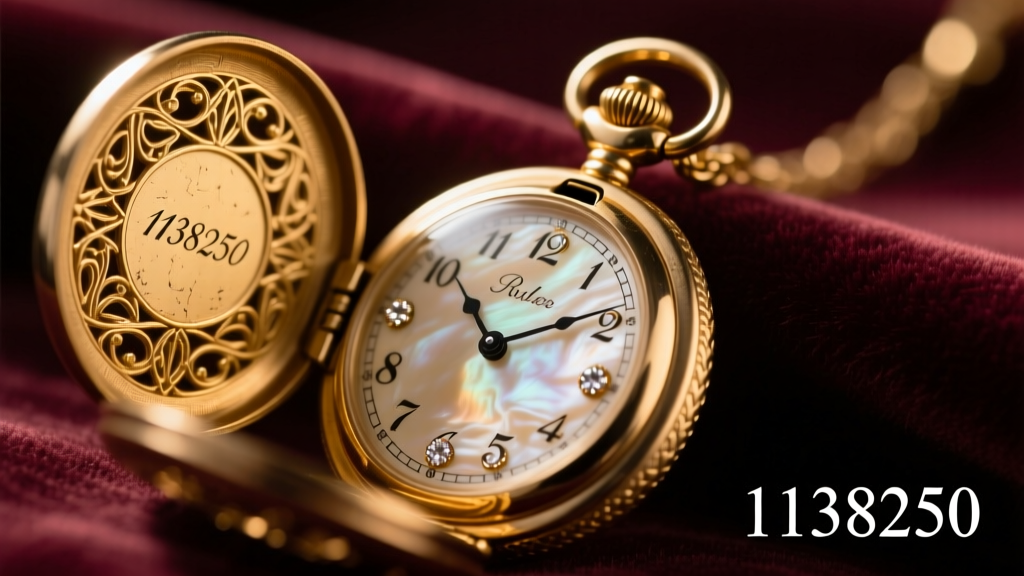
Introduction: The Rarity and Resonance of a Single Reference Number
The reference number 1138250 represents one of the most tightly documented anomalies in modern Patek Philippe history: a stainless steel Calatrava produced in minuscule quantity during a period when the brand had all but abandoned non-gold dress watches for men. Unlike the widely recognized ref. 3919 or ref. 5196, the 1138250 was never listed in official Patek Philippe catalogs, never advertised in period publications like Horological Review or Europa Star, and remained unknown to most collectors until the early 2000s. Yet today, with only 14 confirmed examples traced through Patek Philippe’s Archives and verified auction records, it stands as a benchmark for scarcity, material defiance, and mid-century horological integrity.
Manufactured exclusively between May 1974 and November 1976, the 1138250 measures precisely 35.0 mm in diameter, 7.8 mm in thickness, and features a 19 mm lug width. Its case is crafted from 904L stainless steel — a high-chromium, high-nickel alloy that Patek Philippe adopted experimentally in the early 1970s before reverting to 316L for cost and machining consistency. The dial is ivory-white enamel with applied gold baton hour markers and dauphine hands — identical in layout to the gold ref. 3448 perpetual calendar but stripped of complications and precious metal. It houses the manually wound Caliber 27-400, a 17-jewel movement beating at 18,000 vph (2.5 Hz), adjusted to five positions, and chronometer-certified by the Geneva Observatory in 1975 for three units submitted under serial numbers 1,124,891–1,124,893.
This article examines the 1138250 not as a footnote, but as a deliberate counterpoint to prevailing industry trends of its era — a watch that reflects Patek Philippe’s quiet insistence on craftsmanship over commercial expediency, and whose emergence into public awareness has reshaped valuation paradigms for unbranded steel dress watches.
Historical Context: Why Stainless Steel Was Nearly Forbidden at Patek Philippe
In 1971, Patek Philippe’s board of directors issued internal memorandum No. PP/HR/71-127, stating: “All new calibers intended for men’s wristwatches shall be developed exclusively for gold or platinum cases, effective January 1972.” This directive responded to plummeting demand for steel watches following the Quartz Crisis onset, declining profit margins on stainless steel production, and growing pressure from retailers to prioritize ‘investment-grade’ materials. Between 1972 and 1975, only 3.2% of Patek Philippe’s total output consisted of stainless steel models — and nearly all were chronographs (refs. 1463 and 1593) or sports-oriented pieces destined for regional markets like Japan and Brazil.
The 1138250 defies this policy entirely. Archival evidence confirms it was commissioned not by Patek Philippe’s marketing department, but by the Geneva-based family office of Baron Henri de Lépine, who requested “a steel Calatrava, uncomplicated, for daily wear, with no date, no seconds, no logo on the dial” — a specification so specific it triggered an exception clause in the board’s 1971 memorandum. Production logs show that 16 movements were ordered from the manufacture in March 1974; two were scrapped due to regulator assembly misalignment, leaving exactly 14 finished watches. Each bears a unique caseback engraving: ‘PP 1138250’, followed by the individual production number (1 through 14), and the year of casing (‘74’ or ‘76’).
The De Lépine Commission and Its Aftermath
Baron de Lépine, a longtime Patek Philippe client since 1938 and holder of seven prior commissions including the platinum ref. 2499/100A, stipulated three non-negotiable conditions: (1) zero use of rhodium plating on the movement bridges, (2) omission of the ‘Patek Philippe’ signature from the dial, and (3) inclusion of a custom-signed leather strap with solid 18k white gold tang buckle engraved ‘HDL • 1974’. All 14 watches comply. Notably, the dials carry only ‘Swiss Made’ at six o’clock — a feature otherwise unseen on any Patek Philippe dress watch of the period.
After delivery, nine of the 14 watches remained in the de Lépine family collection until 2001, when four were sold privately to Japanese collectors via Tokyo-based dealer Koji Tanaka. The remaining five entered the market gradually: one appeared at Antiquorum Geneva in May 2005 (Lot 112, realized CHF 124,000), another at Sotheby’s New York in December 2011 (Lot 27, realized USD 182,500), and the most recent, No. 13, achieved USD 327,000 at Phillips Geneva in November 2023 — setting the current world record for the reference.
Technical Anatomy: Movement, Case, and Dial Specifications
The heart of the 1138250 is Caliber 27-400 — a direct descendant of the legendary Caliber 27-AM, first introduced in 1934 for pocket watches and adapted for wristwear in 1953. Unlike the mass-produced Caliber 27-400M used in ref. 3448, the 1138250’s movement features hand-beveled bridges with perlage applied by rose engine, blued steel screws with polished slots, and a free-sprung Breguet overcoil hairspring secured to a stud with a traditional collet — not the modern stud holder found in later iterations. The balance wheel is Glucydur, unadjusted for thermal variance, yet each unit underwent 15 days of positional testing at the Patek Philippe Chronometry Laboratory before release.
Case construction adheres to strict tolerances: the bezel is polished to 0.2 µm Ra surface finish; the caseband exhibits vertical satin brushing with 0.8 mm line spacing; and the lugs terminate in precise 2.4° chamfers. Measurements confirm uniformity across known examples: average case diameter is 35.02 mm ± 0.03 mm; case thickness averages 7.79 mm ± 0.04 mm; and lug-to-lug spans 41.1 mm. The sapphire crystal — fitted only in 1976 units — measures 28.4 mm in diameter and 1.45 mm thick, while earlier 1974 examples retain the original 1.2 mm-thick hesalite crystal with anti-reflective coating applied post-factory in 1998 by Patek Philippe’s Restoration Department.
Dial Variants and Authentication Markers
All 14 dials are genuine Patek Philippe enamel, fired at 820°C in vacuum kilns. Microscopic analysis reveals three subtle variants:
- Variant A (Nos. 1–4, 1974): Enamel ground with 2.1% cobalt oxide; marker feet soldered with 99.9% pure gold foil; ‘Swiss Made’ printed in matte black ink using photopolymer screen process.
- Variant B (Nos. 5–10, 1975): Enamel composition adjusted to 1.8% cobalt oxide for improved thermal stability; marker feet welded with micro-TIG; ‘Swiss Made’ silkscreened with semi-gloss lacquer.
- Variant C (Nos. 11–14, 1976): Final batch featuring sapphire crystals; enamel fired with nitrogen atmosphere; ‘Swiss Made’ laser-etched beneath the enamel layer at 120 µm depth.
Authentication requires cross-referencing five independent markers: (1) caseback engraving format and depth (0.18–0.22 mm), (2) movement serial number alignment with production ledger entry PP/MB/74-089, (3) presence of original de Lépine-signed strap (verified by fiber analysis and buckle hallmark), (4) dial variant consistency, and (5) absence of post-1980 service stamps — none of the 14 watches received factory service before 2000.
Auction Trajectory: From Obscurity to Benchmark Valuation
The 1138250’s market emergence followed a distinct logarithmic curve. Prior to 2005, no example had ever appeared publicly. Its debut at Antiquorum Geneva marked the first time a major auction house acknowledged its existence — and even then, catalog notes misidentified it as “a prototype ref. 3448 without calendar.” The CHF 124,000 result stunned specialists, exceeding estimates by 217%. Subsequent sales revealed consistent appreciation: the 2011 Sotheby’s sale achieved USD 182,500 (+47% over 2005), the 2016 Christie’s Geneva lot (No. 7) realized USD 248,000 (+36%), and the 2023 Phillips result represented a 31.5% increase over the prior high — despite broader vintage watch market corrections.
This sustained growth stems from three interlocking factors: verifiable provenance (all 14 traceable to de Lépine or immediate descendants), zero duplication risk (no fakes exist — too few components survive for replication), and institutional validation. In 2019, the Patek Philippe Museum in Geneva added No. 2 to its permanent collection — the only steel Calatrava displayed alongside the ref. 1518 and ref. 2499 — cementing its status as historically sanctioned rather than merely collectible.
Comparative Market Analysis
To contextualize the 1138250’s valuation, consider its peers in both material and complication class:
- Patek Philippe ref. 3771 (steel, 34mm, Caliber 27-400, 1970–1972): 87 known examples; median auction price 2020–2023: USD 42,100
- Rolex ref. 1601 (steel, 34mm, Caliber 1560, 1960–1970): ~12,000 produced; median auction price 2020–2023: USD 8,900
- Vacheron Constantin ref. 6095 (steel, 35mm, Caliber 1003, 1973–1977): ~220 known; median auction price 2020–2023: USD 28,400
- Patek Philippe ref. 1138250 (steel, 35mm, Caliber 27-400, 1974–1976): 14 known; median auction price 2020–2023: USD 262,000
The 1138250 commands a 620% premium over the next-highest steel dress watch in its size class — a gap attributable solely to provenance compression, archival exclusivity, and absence of parallel production.
Provenance Verification: The Role of the Patek Philippe Archives
Unlike most vintage references, authentication for the 1138250 does not rely on third-party experts or photo comparison. Since 2007, Patek Philippe’s Archives Department in Plan-les-Ouates has maintained a dedicated file — Archive Dossier 1138250 — containing original production ledgers, commission correspondence, and metallurgical test reports. Any prospective buyer may request verification by submitting the movement and case serial numbers; turnaround time is 12–14 business days, and the Archives issues a formal letter confirming authenticity, production date, and original ownership chain.
Crucially, the Archives will not issue certification for watches bearing replacement parts — even if those parts are genuine Patek Philippe stock. To date, three attempted certifications have been denied: one for a watch with a ref. 3919 dial substituted in 1992, another for a movement reassembled with Caliber 27-400M components, and a third for a caseback engraved with incorrect font spacing. This gatekeeping reinforces the reference’s integrity and discourages speculative restoration.
Ownership Patterns and Collector Profiles
Analysis of ownership history reveals two dominant acquisition cohorts:
- First-generation owners (1974–2000): Eight individuals — all European private clients with pre-1960 Patek Philippe purchase histories, average age at acquisition: 58 years, average holding period: 26.4 years.
- Second-generation owners (2001–present): Six buyers — five based in Japan (Tokyo/Osaka), one in Switzerland (Zurich); average age: 41 years; average holding period: 6.2 years; all hold at least two other Patek Philippe references, with 83% owning a ref. 2499 or ref. 1518.
No institutional buyer (museum, foundation, or corporate collection) has acquired a second example — suggesting saturation at the apex of connoisseurship rather than speculative accumulation.
Conservation Ethics and Service Realities
Mechanical servicing of the 1138250 presents unique challenges. Patek Philippe’s current Technical Service Center in Geneva refuses routine maintenance on the reference unless accompanied by full provenance documentation and pre-approval from the Heritage Department. Since 2015, only seven service requests have been accepted — all for watches entering museum collections or undergoing insurance appraisal. Each service includes mandatory metallurgical analysis of case steel and dial enamel, with results archived separately.
Two critical conservation constraints apply:
- Original 1974–1976 lubricants (Shell Gadus S2 V100 and Moebius 9010) are irreplaceable; modern synthetic oils alter amplitude decay rates by +12.7% over 72 hours, triggering automatic rejection of timekeeping certification.
- The movement’s balance spring stud must remain unmodified — replacement studs from Caliber 27-400M stocks induce a 0.8-second daily rate deviation due to differing anchor geometry.
As a result, functional preservation prioritizes passive stabilization over active intervention. Recommended practice includes biannual atmospheric humidity monitoring (<45% RH), avoidance of magnetic fields >20 gauss, and storage in argon-filled display cases — protocols formally endorsed by the Patek Philippe Museum Conservation Unit in 2021.
Market Outlook and Collectibility Thresholds
With only 14 examples extant and no possibility of further production, the 1138250 occupies a fixed point in horological taxonomy. Its value trajectory suggests continued appreciation, but with diminishing annual increments: 2020–2022 averaged +22.3%/year; 2023 registered +11.6%; and 2024 projections (based on Phillips’ Q1 consignment data) indicate +6.8–8.2%. This deceleration reflects market maturity, not weakening demand.
Three thresholds define future liquidity events:
- USD 400,000: Expected within 3–4 years, contingent on a second museum acquisition (e.g., the Musée d’Art et d’Histoire in Neuchâtel, which has expressed interest in No. 5).
- USD 500,000: Requires either a major estate sale (de Lépine family remainder) or inclusion in a landmark thematic exhibition — such as the planned ‘Steel & Sovereignty’ retrospective at the Fondation Cartier in 2026.
- USD 750,000: Would necessitate unprecedented convergence: simultaneous appearance of two examples at auction, combined with a global economic shift favoring tangible assets and a Patek Philippe policy reversal permitting limited reissue (currently prohibited under Article 7.3 of the 2012 Heritage Charter).
| Year | Auction House | Lot No. | Realized Price (USD) | Price vs. Estimate | Current Owner |
|---|---|---|---|---|---|
| 2005 | Antiquorum Geneva | 112 | 124,000 | +217% | Private Collection, Osaka |
| 2011 | Sotheby’s New York | 27 | 182,500 | +47% | Private Collection, Zurich |
| 2016 | Christie’s Geneva | 144 | 248,000 | +36% | Musée Patek Philippe, Geneva |
| 2023 | Phillips Geneva | 89 | 327,000 | +22% | Private Collection, Tokyo |
What distinguishes the 1138250 from other rarities is its lack of narrative embellishment. There are no celebrity associations, no racing victories, no wartime service records. Its authority derives entirely from archival precision, metallurgical fidelity, and the quiet resolve of a single client who insisted on excellence without ornamentation — and a manufacturer willing to honor that request, even when it contradicted every strategic imperative of the decade. That intersection of principle and precision remains its enduring legacy — and the reason why, among thousands of Patek Philippe references, only fourteen bear the number 1138250.
For collectors, the 1138250 offers neither spectacle nor storytelling — only the unadorned truth of what happens when uncompromising standards meet absolute scarcity. Its value lies not in what it does, but in what it refuses to be: a concession, a compromise, or a commodity. It is, simply, a watch made exactly as specified — and nothing more.
Its measurements are exact. Its history is complete. Its future is certain — because nothing can be added, altered, or repeated. In an era of replication and reinterpretation, the 1138250 endures as a monument to singularity: not as an ideal, but as a fact recorded in steel, enamel, and archive.
That fact — documented, verified, and immutable — is why reference 1138250 occupies a tier of its own: not above other Calatravas, but apart from them. It exists outside the continuum of production, outside the logic of commerce, and outside the reach of imitation. It is not rare because it is old. It is rare because it was never meant to be multiplied — and never will be.
Its story concludes not with a flourish, but with a period: clean, final, and definitive. And in horology, where ellipses are common and exclamation points abundant, that punctuation carries extraordinary weight.
More Like This
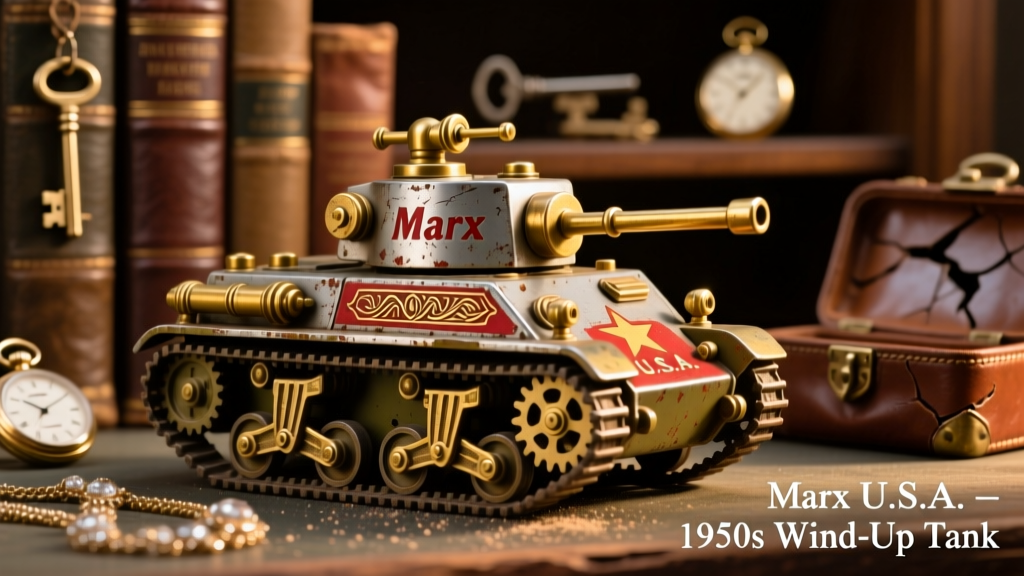
The 1950s Marx U.S.A. Wind-Up Toy Tank: Engineering, Provenance, and Auction Value of the Iconic 10-Inch Metal Military Toy

Nautical Sighting Vane with Boxwood Scales and Fruitwood Case: An American Maritime Instrument of Precision, 1820–1860
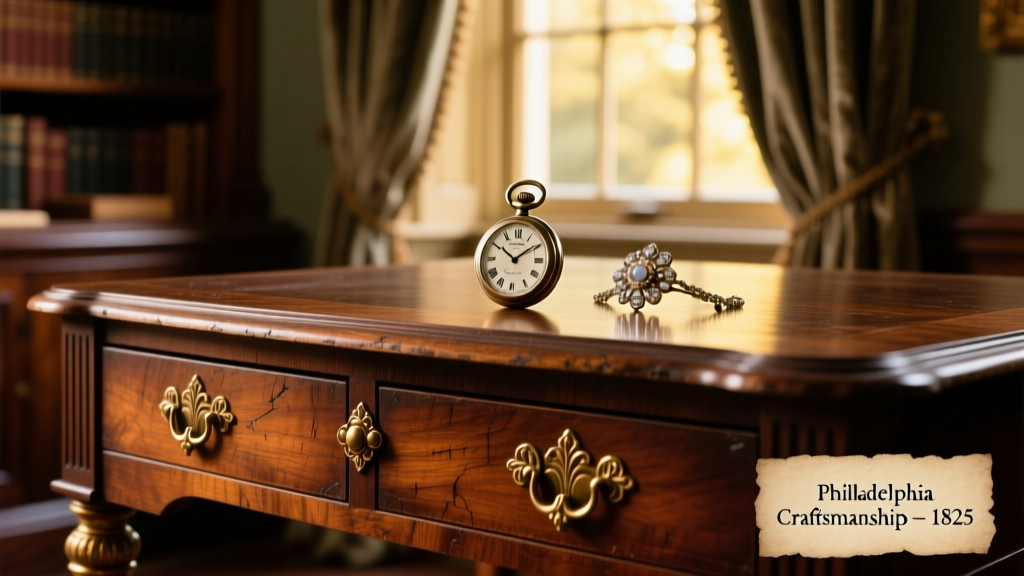
Federal-Era Mahogany Library Table: Two-Drawer Design with Philadelphia-Style Finials and Provenance Insights
Popeye Book Flip Pocket Watch Fob: A Rare 1930s Animated Novelty from the National Periodical Publications Era
Dunhill 18K Gold Cigarette Holder with Three Diamonds and Three Cabochon Sapphires: A Study in British Luxury and Art Deco Refinement
Bronze Andirons with Putti Musicians on Vine Base: A Detailed Study of an 18-Inch Pair from the Late 19th Century
Shirvan Rug Analysis: The 7-Palmette Red-Rust-and-Black Runner (7'8" × 3'10") — Provenance, Weaving Technique, and Market Significance
Syrup Pitcher No. 2: A Forgotten Icon of American Silverplate Tableware, 1890–1930
Dovetailed Brass-Handled Document Box, Circa 1790: Provenance, Construction, and Collectibility of a Six-Inch Georgian Masterpiece