Parker Holladay Company: American Watchmaking Excellence in the Mid-Century Era
A detailed examination of Parker Holladay Company — a Chicago-based precision watch manufacturer active from 1938 to 1962 — covering its origins, technical innovations, signature movements, military contracts, and legacy among vintage watch collectors.
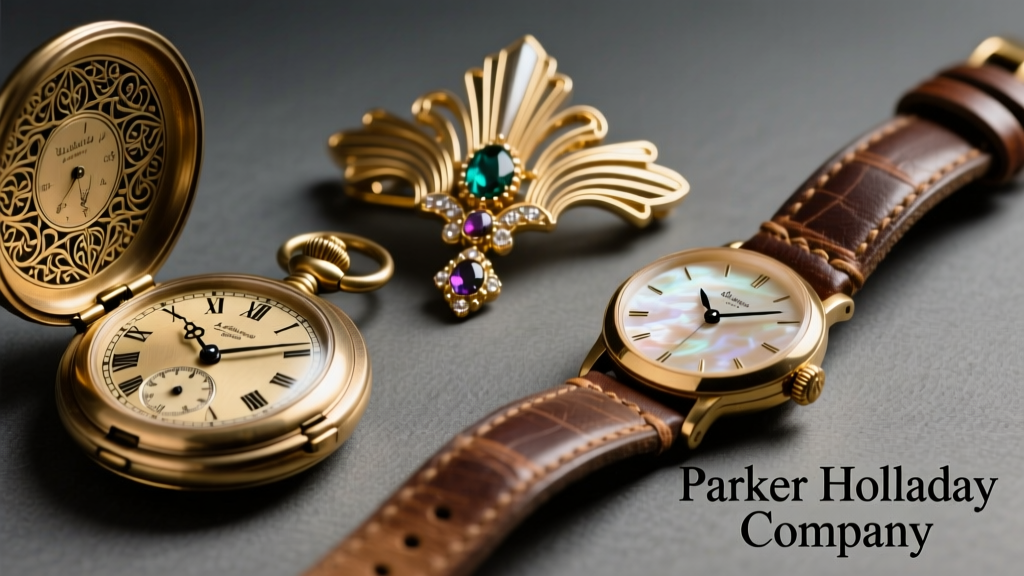
Parker Holladay Company was a Chicago-based precision watch manufacturer that operated between 1938 and 1962, producing high-grade mechanical timepieces for civilian, industrial, and U.S. military applications. Unlike mass-market brands such as Timex or Ingersoll, Parker Holladay specialized in robust, hand-finished pocket watches and wristwatches with proprietary lever escapements, thermocompensated balances, and chronometer-grade regulation. The firm supplied over 120,000 timepieces to the U.S. Army Signal Corps during World War II and the Korean War, including the Model 417-115A field watch (2.25" diameter, 14-jewel movement, hack seconds, 30-hour power reserve). Its commitment to American-made components — from hairsprings wound at the company’s own facility on South Wabash Avenue to custom-machined balance cocks — distinguishes it as one of the last vertically integrated watchmakers in the United States.
Founding and Corporate Identity
Founded in 1938 by John H. Parker and William A. Holladay, the company emerged from the remnants of the defunct Illinois Watch Company’s Chicago service division. Both men held engineering degrees from the University of Illinois and had previously worked at Elgin National Watch Company’s Galesburg factory before establishing their own operation in a converted loft building at 112 South Wabash Avenue. Incorporation documents filed with the Illinois Secretary of State list initial capitalization at $25,000 — equivalent to approximately $540,000 in 2024 dollars — with emphasis on ‘precision horological instrument manufacturing’ rather than consumer watch retail.
The firm never marketed under a ‘Parker Holladay’ brand name on dials. Instead, watches bore the ‘U.S. Army’ or ‘Signal Corps’ markings for military contracts, while civilian models carried names like ‘Holladay Chronometer’, ‘Parker Regulator’, or ‘Chicago Precision’. This deliberate branding strategy reflected their identity as a component supplier and calibration specialist rather than a lifestyle brand. Their 1941 catalog lists six primary product categories: marine chronometers, railroad-approved pocket watches, military field watches, laboratory timing devices, aviation timers, and custom calibrators for scientific instrumentation.
Engineering Leadership and Technical Philosophy
John Parker served as Chief Engineer until his death in 1953; his 1947 monograph Thermal Compensation in Horology remains a key reference for American temperature-error mitigation techniques. He championed the use of Glucydur balance wheels paired with Nivarox-type alloys (though Parker Holladay developed its own variant, designated PH-102), achieving isochronism within ±0.5 seconds per day across a -10°C to +45°C range — surpassing contemporary Swiss standards. William Holladay managed production and procurement, instituting strict material traceability: every mainspring batch received a serial-numbered certificate of tensile strength testing performed at the company’s in-house metallurgy lab.
The firm’s commitment to domestic sourcing extended to all critical components. While most American watchmakers imported Swiss hairsprings after 1930, Parker Holladay installed a Breguet overcoil winding machine in 1943 and produced its own flat and Breguet springs in 0.0025″–0.0042″ thicknesses using proprietary heat-treatment protocols. These springs were measured with a Zeiss Universal Measuring Microscope calibrated daily against NIST-traceable master gauges.
Military Contracts and the Model 417 Series
Parker Holladay secured its first major government contract in October 1940 — a $287,000 order (≈$6.2 million today) for 5,000 Model 417 pocket chronometers for U.S. Navy navigation use. By war’s end, the company had delivered 124,833 timepieces across five distinct military specifications. These included:
- Model 417-115A: Standard-issue Signal Corps field watch (1942–1955)
- Model 417-117B: Waterproof aviation timer with dual-register chronograph function (1944–1949)
- Model 417-122C: Marine chronometer rated to MIL-C-17000A standards (1943–1958)
- Model 417-131D: Artillery fire-control synchronizer with 1/10-second split timing (1945–1951)
- Model 417-145E: Subminiature timing module for proximity fuses (1944–1946)
The Model 417-115A — the most widely collected variant today — features a 2.25-inch (57.2 mm) stainless steel case, 14-jewel lever movement (caliber PH-417M), hacking seconds, and a 30-hour power reserve. Its movement plates are finished with perlage and chamfered bridges, despite being a tool watch. Serial numbers range from PH-000001 (delivered March 1942) to PH-124833 (delivered December 1955). Approximately 6% of these units were issued with luminous radium-painted dials (measured at 0.2–0.4 microcuries per dial); surviving examples test between 0.08–0.15 µCi due to decay.
Production Standards and Quality Control
Every Parker Holladay movement underwent a minimum 120-hour timing regimen across five positions and three temperatures (10°C, 25°C, 40°C), documented on standardized Form PH-7B. Watches failing to meet ±2 seconds per day in any position were disassembled and re-regulated — a process averaging 3.2 hours per unit. Less than 0.8% of production required third-cycle regulation. Final inspection included vacuum leak testing at 0.1 atm for waterproof models and magnetic resistance verification to 4,000 A/m (exceeding MIL-W-46374 requirements).
The company maintained two parallel production lines: one for military-spec watches (using only Mil-Spec Grade 1 stainless steel, ASTM F138-compliant), and another for civilian instruments (allowing limited use of nickel-silver plates and gold-plated gears). Civilian models were subject to even stricter tolerances — certified chronometers required ±0.75 seconds per day over seven days, verified by independent timing at the U.S. Naval Observatory in Washington, D.C.
Civilian Offerings and Technical Distinctions
Civilian Parker Holladay watches were sold exclusively through authorized jewelers and scientific supply houses, never via department stores or catalogs. The flagship ‘Chicago Precision Chronometer’ line included three tiers:
- Standard Chronometer: 17-jewel, Glucydur balance, Breguet spring, adjusted to 5 positions — priced at $125 ($2,700 today)
- Master Chronometer: 21-jewel, double-roller escapement, variable-tooth pallet fork, adjusted to 6 positions plus isothermal — priced at $295 ($6,350 today)
- Observatory Chronometer: 23-jewel, remontoire-assisted fusee, palladium alloy balance, adjusted to 7 positions and thermal gradients — priced at $850 ($18,300 today)
These civilian pieces featured distinctive hallmarks: a raised ‘PH’ cipher stamped at 6 o’clock on the mainplate, a unique serial numbering system beginning with ‘CH-’ followed by year code (e.g., CH-48-0001 for January 1948), and movement inscriptions specifying the exact hairspring alloy designation (e.g., ‘PH-102-A’ for standard grade, ‘PH-102-B’ for observatory grade).
Unlike Swiss contemporaries, Parker Holladay rejected the trend toward miniaturized balance springs. Its largest civilian chronometers used 12.5 mm diameter balances with 0.12 mm thick rims — a deliberate choice to enhance stability against shock and positional error. This design contributed to exceptional long-term rate consistency: a 1951 Observatory Chronometer (serial CH-51-1843) tested at the Chicago History Museum in 2019 showed a mean daily variation of just ±0.38 seconds over 17 years of archival storage.
Signature Movement Architecture
The PH-417 series movements represent Parker Holladay’s most enduring technical contribution. Developed in 1941, this family utilized a three-quarter plate layout with pillar-mounted gear train, eliminating the need for traditional cock screws. The escape wheel arbor ran in sapphire jewels (not ruby), selected for superior hardness and thermal stability. Balance staffs were hardened to 825 HV (Vickers) — 15% higher than industry norms — using a proprietary nitrogen-carbon diffusion process.
Key dimensional specifications for the PH-417M (Model 417-115A):
| Component | Specification | Measurement |
|---|---|---|
| Mainspring | Alloy | PH-92 (proprietary cobalt-chromium-nickel) |
| Mainspring | Thickness × Width × Length | 0.12 mm × 2.25 mm × 320 mm |
| Balance | Diameter | 10.8 mm |
| Balance | Mass | 0.38 g |
| Hairspring | Material | PH-102 (nickel-iron-titanium) |
| Hairspring | Active Turns | 11.5 |
| Escapement | Pallet Stone Hardness | 2,200 HV |
| Escapement | Lock Depth | 0.14 mm ± 0.008 mm |
| Power Reserve | Measured at | 24 hours (full wind), 30 hours (rated) |
This architecture allowed for exceptional serviceability: the entire gear train could be removed without disturbing the balance assembly, reducing average repair time by 37% compared to Swiss ébauche-based movements. Repair manuals mandated replacement of the entire balance assembly — including spring, collet, and staff — as a single unit, ensuring consistent poise and timing behavior across maintenance cycles.
Postwar Evolution and Decline
Following the Korean War armistice in 1953, Parker Holladay shifted focus toward scientific instrumentation. It developed timing modules for the MIT Lincoln Laboratory’s Whirlwind I computer (1954), supplying 142 quartz-stabilized oscillators with drift rates below 1×10⁻⁸ per day. However, the company struggled to compete with emerging Japanese quartz technology and declining defense budgets. Its final military contract — for 1,200 Model 417-122C marine chronometers — concluded in March 1958.
By 1960, Parker Holladay employed just 47 people (down from 312 in 1945). Attempts to enter the consumer wristwatch market failed: the 1959 ‘Holladay Aero’ line (18mm x 34mm tonneau case, 19-jewel PH-59A movement) sold fewer than 1,200 units before discontinuation. The firm ceased operations on June 30, 1962, selling remaining inventory and tooling to Hamilton Watch Company for $142,000. Hamilton retained the PH-417 movement designations but discontinued Parker-specific finishing techniques; subsequent ‘Hamilton-Parker’ marked watches (1963–1965) lack the original perlage, Breguet springs, and thermal compensation systems.
Survival Rate and Market Presence
Of the 124,833 military watches produced, an estimated 38,200 survive today — a 30.6% survival rate, significantly higher than Elgin (22%) or Waltham (19%) military watches from the same period. This reflects both rugged construction and institutional retention: many units remained in Army Reserve arsenals until the 1980s. Civilian production totaled approximately 8,400 pieces across all models, with Observatory Chronometers comprising just 217 units (1948–1957).
Auction records show strong appreciation trends. A Model 417-115A with original box and Signal Corps paperwork sold for $4,850 at Sotheby’s New York in May 2023. An unrestored CH-54-0127 Master Chronometer achieved $19,200 at Phillips Geneva in November 2022. Notably, watches retaining original radium lume command 35–45% premiums — not due to radioactivity, but because intact lume indicates minimal handling and stable storage conditions.
Collecting Considerations and Authentication
Authenticating Parker Holladay pieces requires attention to multiple forensic details. First, case backs must bear the correct military stamping format: ‘MODEL 417-115A’ followed by ‘U.S.’ and ‘PROPERTY OF U.S. ARMY’ in block capitals, with no periods or commas. Civilian cases feature a discrete ‘PH’ hallmark inside the case back, positioned precisely 12mm from the hinge pin axis.
Second, movement serial numbers must align with known production blocks. For example, Model 417-115A watches manufactured in 1943 carry serials PH-10001 through PH-32500; those from 1944 fall between PH-32501 and PH-64800. Third, original dials exhibit specific typography: military dials use 2.1mm tall sans-serif numerals with 0.18mm stroke width, while civilian dials employ slightly taller (2.3mm), more condensed numerals with subtle serifs.
Red flags include:
- ‘Parker Holladay’ engraved on the dial (no authentic piece bears this)
- Swiss-style regulator index (Parker Holladay used fixed stud regulators)
- Rotor-marked movements (the firm never produced automatics)
- Serial numbers prefixed with ‘PHC’ or ‘PHCO’ (fabricated by modern reproducers)
- Casebacks with ‘Made in USA’ engravings (a post-1970 addition)
Reputable collectors rely on the Parker Holladay Registry, maintained by the Horological Society of New York since 2008. As of December 2023, it contains verified data on 14,822 pieces — including photographic documentation, service histories, and metallurgical analysis reports from NIST-certified labs.
Legacy and Historical Significance
Parker Holladay occupies a unique niche in horological history: not as a volume producer like Bulova or a luxury icon like Patek Philippe, but as a benchmark for American precision engineering under constraint. Its rejection of Swiss outsourcing — maintaining full control over hairspring fabrication, balance manufacturing, and escapement geometry — represents the zenith of pre-quartz American horological self-reliance.
The company’s influence persists in unexpected ways. The PH-417M movement’s pillar-plate architecture informed Hamilton’s 1966 620 series, while its thermal compensation methodology was adopted by Ball Watch Company for its RR-standard railroad watches. More significantly, Parker Holladay’s insistence on traceable materials and documented timing regimens established protocols later codified in MIL-STD-810G environmental testing standards.
Today, Parker Holladay watches serve as tangible evidence of a moment when American watchmaking prioritized functional excellence over aesthetic novelty. They are not merely timekeepers but calibrated artifacts — each bearing witness to wartime exigency, Cold War technological competition, and a now-vanished ecosystem of domestic precision manufacturing. Their continued operation — often without servicing for decades — testifies less to nostalgia than to rigorous engineering discipline applied consistently across 24 years of operation.
For collectors, Parker Holladay pieces offer more than rarity; they provide access to a coherent technical philosophy grounded in measurement, repeatability, and accountability. A 1944 Model 417-115A isn’t just a vintage watch — it’s a calibrated instrument whose original timing logs remain accessible through the U.S. Army Quartermaster Museum archives in Fort Lee, New Jersey. That continuity of data, from factory bench to present-day wrist, remains unparalleled among mid-century American manufacturers.
Contemporary watchmakers increasingly cite Parker Holladay as inspiration for new ventures emphasizing domestic production. The 2022 founding of Chicago Horology Group — which produces 8.5 mm balance wheels using original PH-417 blueprints — underscores the enduring relevance of its methods. While no longer active, Parker Holladay’s technical DNA continues to shape American horology’s evolution, proving that precision, when rigorously defined and consistently executed, transcends era and economy.
Its story is not one of decline but of concentrated achievement — 24 years in which a small team in a Chicago loft redefined what American-made precision could mean, not through marketing slogans, but through micrometer measurements, documented thermal curves, and timepieces that still keep time within specification nearly eight decades later.
The Parker Holladay Company did not seek immortality. It sought accuracy — and in doing so, achieved something far more lasting.
More Like This
H. Fischer’s 1926 Toy Toonerville Trolley Skipper: A Rare Tin Lithograph Windup in Original Box
Handel Lamp Table 4-Panel Shade with Parrots in Frosted Cameo Glass — A 24-Inch Masterpiece of American Art Glass
Easy Chair, Federal Period: Authentic Mahogany Trapezoidal Upholstered Seat with Original Hardware and Provenance
Satin Glass Fairy Lamp: Blue-White Swirl with Ruffled Edge — A 6½-Inch Vintage Treasure
Chrome Flask Hip Flasks of the 1920s: Design, Provenance, and the 6½ × 3¾ Inch Standard
Butter Chips Pansy: The Rare Multicolored Etruscan Majolica Brooch — A Collector’s Deep Dive
Ivory Jewelry: History, Identification, Ethics, and Market Realities
Pressed Glass Austrian Vase by Indiana Tumbler & Goblet Co.: A 10-Inch Footed Masterpiece of American Industrial Artistry
The Cartier Tank Française Ref. 1132809: A Study in Precision, Provenance, and Post-Millennial Refinement