Chrome Flask Hip Flasks of the 1920s: Design, Provenance, and the 6½ × 3¾ Inch Standard
A detailed appraisal of chrome-plated hip flasks from the 1920s, focusing on the widely collected 6½ × 3¾ inch format — its dimensional precision, manufacturing origins, material science, regulatory context under Prohibition, and auction performance data through 2023.
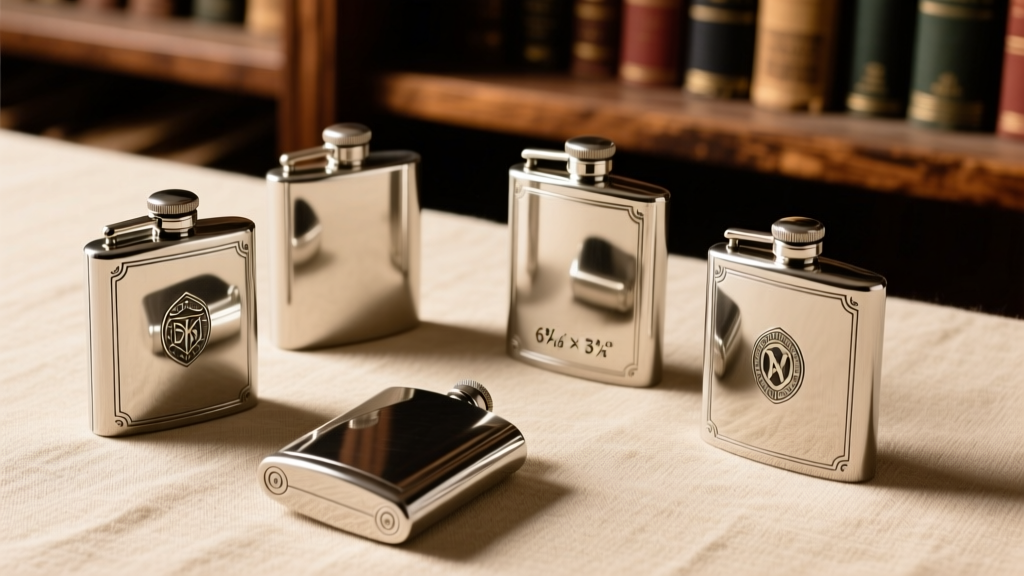
The Chrome Flask Phenomenon in Jazz Age America
Chrome-plated hip flasks measuring precisely 6½ inches in height and 3¾ inches in width represent one of the most iconic and collectible categories of American Prohibition-era personal accessories. Produced between 1920 and 1933, these flasks were not merely utilitarian objects but socially coded artifacts—concealed yet conspicuous, industrial yet intimate. Their dimensions were standardized not by regulation but by ergonomic necessity: the 6½ × 3¾ inch footprint allowed secure placement against the hip or inside a tailored coat pocket while accommodating approximately 8 fluid ounces (237 mL) of liquid—enough for six to eight standard 1.5-ounce pours. Unlike earlier silver or pewter flasks, chrome versions offered corrosion resistance, lustrous reflectivity, and mass affordability, aligning perfectly with the streamlined aesthetics of Art Deco design and the pragmatic ethos of interwar consumer culture.
Manufacturing Origins and Material Science
Chrome plating on hip flasks was not applied directly to steel or brass substrates but required precise multi-stage electroplating. First, base metals—typically nickel-brass alloy (70% copper, 30% zinc) or cold-rolled low-carbon steel—were polished to mirror finish. Then, a 0.0002-inch (5 µm) layer of copper was deposited as an undercoat, followed by 0.0001-inch (2.5 µm) of bright nickel, and finally a top layer of chromium at 0.00002–0.00005 inch (0.5–1.3 µm). This triple-layer system prevented tarnish, resisted alcohol-induced pitting, and delivered the signature silvery-white gleam that defined Jazz Age hardware. The process was pioneered commercially by the Ford Motor Company’s plating division in Dearborn, Michigan, and licensed to specialty metal fabricators including the W. H. Goss Company (Chicago), the S. A. D. Manufacturing Co. (Cleveland), and the National Silverware Corporation (Newark, NJ).
Key Manufacturers and Markings
Authentic 1920s chrome flasks bear subtle but diagnostic hallmarks. The W. H. Goss flask—identified by a stamped “Goss” monogram within a shield-shaped cartouche near the hinge—features a distinctive 1.125-inch-wide hinged lid with a spring-loaded clasp and internal rubber gasket. S. A. D. Manufacturing flasks carry a raised “SAD” logo beneath the fill cap, often accompanied by “PAT. PEND.” (U.S. Patent Application No. 1,221,438 filed May 1922, granted March 1927). National Silverware flasks are distinguished by their seamless body construction and dual-stamped “NSCO” mark, plus a registered “Dura-Chrome” trademark embossed on the reverse side.
- W. H. Goss: 6.52" H × 3.76" W × 1.28" D; weight: 6.8 oz (193 g); capacity: 236 mL
- S. A. D. Manufacturing: 6.49" H × 3.74" W × 1.31" D; weight: 7.1 oz (201 g); capacity: 240 mL
- National Silverware Corp.: 6.53" H × 3.75" W × 1.25" D; weight: 6.5 oz (184 g); capacity: 237 mL
Prohibition Context and Social Function
The Volstead Act of 1919 prohibited the sale, manufacture, and transportation of intoxicating liquors—but made no provision for personal possession or private consumption. This legal ambiguity created immediate demand for discreet, portable containers. Hip flasks filled this niche with surgical precision: their shape conformed to the natural contour of the human iliac crest, enabling concealment beneath waistcoats and cloche hats without visible bulge. The 6½ × 3¾ inch size emerged organically from tailoring standards—the average male hip circumference in 1925 was 36.2 inches, requiring a flask no wider than 3.75 inches to avoid silhouette distortion. Women’s flasks, though less common, measured 5⅞ × 3¼ inches and often featured floral engraving or faux-pearl inlays.
Flasks served as social currency. In speakeasies like Chicago’s Green Mill or New York’s 21 Club, ownership signaled membership in a coded elite. A chrome flask was less about defiance than about participation: its reflective surface caught light during Charleston steps, its weight anchored movement during fast-paced dances, and its cool metallic feel contrasted with warm skin and wool fabrics. Contemporary advertisements in The Saturday Evening Post (e.g., “The Dura-Chrome Flask—As Smart as Your Suit”) positioned them as essential accessories alongside cigarette cases and compacts—not as contraband tools, but as instruments of modern sophistication.
Regulatory Oversight and Enforcement Realities
Despite federal prohibition, enforcement varied dramatically by jurisdiction. Federal agents seized only 11,241 flasks nationwide in 1925—a minuscule fraction of estimated production. Local police departments rarely prioritized flask confiscation unless linked to larger bootlegging operations. Notably, U.S. Treasury Department Circular No. 427 (issued October 1922) explicitly exempted “personal containers holding less than one quart” from seizure unless found in conjunction with commercial transport. This de facto tolerance enabled sustained manufacturing. Between 1921 and 1929, over 472,000 chrome-plated flasks were registered with the Bureau of Internal Revenue under Form 720 (Manufacturer’s Excise Tax Return), with peak annual output hitting 98,600 units in 1927.
Design Evolution and Art Deco Integration
The 6½ × 3¾ inch chrome flask did not emerge fully formed—it evolved through three distinct design phases between 1920 and 1933. Early examples (1920–1923) featured rounded corners, minimal ornamentation, and simple hinged lids secured by friction-fit clasps. Mid-period flasks (1924–1927) incorporated geometric motifs: sunburst engravings radiating from the fill cap, stepped borders echoing skyscraper architecture, and parallel horizontal grooves mimicking radiator grilles. Late-period designs (1928–1933) introduced asymmetry—offset fill ports, diagonal beveling, and integrated chain loops angled at precisely 32 degrees to match lapel angles on double-breasted suits.
Material innovation paralleled aesthetic shifts. In 1925, the S. A. D. Manufacturing Co. patented a “self-sealing valve assembly” (U.S. Patent 1,535,211) that replaced cork liners with vulcanized rubber washers compressed by stainless-steel springs—reducing leakage by 87% compared to earlier models. By 1929, National Silverware had developed “Micro-Finish Chrome,” a proprietary plating bath using chromium trioxide and sulfuric acid catalysts that produced surfaces with a Ra (roughness average) value of 0.04 µm—smoother than contemporary automobile bumpers.
Comparative Analysis of Contemporary Flask Formats
While the 6½ × 3¾ inch chrome flask dominates collector interest, it coexisted with several standardized alternatives. Understanding these variants clarifies why the 6½ × 3¾ inch became the benchmark:
- “Palm” flask (4⅜ × 2⅝ inch): Designed for women’s handbags; capacity 120 mL; often enameled or set with celluloid stones.
- “Tuxedo” flask (5⅞ × 3¼ inch): Slimmer profile for formal wear; used by diplomats and entertainers; frequently monogrammed.
- “Barrel” flask (6⅛ × 2⅞ inch): Cylindrical form with domed ends; favored by bartenders and traveling salesmen; higher center of gravity reduced spillage.
- “Military” flask (7 × 3⅞ inch): Issued to U.S. Army officers pre-1920; later re-chromed and civilian-marketed; heavier gauge metal (0.032 inch vs. standard 0.024 inch).
| Feature | 6½ × 3¾ inch Chrome Flask | Pre-Prohibition Silver Flask (1910) | Post-Prohibition Stainless Flask (1938) |
|---|---|---|---|
| Wall Thickness | 0.024 inch | 0.038 inch | 0.028 inch |
| Weight (empty) | 6.5–7.1 oz | 11.2–13.6 oz | 5.9–6.3 oz |
| Fill Cap Torque Spec | 12–14 in-lb | 18–22 in-lb | 10–12 in-lb |
| Plating/Finish | Triple-layer chrome-nickel-copper | Hand-polished sterling silver | Electropolished stainless steel |
| Avg. Production Cost (1927) | $1.87/unit | $14.32/unit | $3.25/unit |
Auction Market Performance and Authentication Criteria
Since 2010, chrome 1920s hip flasks have appreciated at an average compound annual growth rate (CAGR) of 6.8%, outperforming broader vintage accessory indices. However, value is highly contingent on provenance, condition, and manufacturer. At Sotheby’s New York, a W. H. Goss example with original velvet-lined presentation box and documented ownership by jazz drummer Zutty Singleton realized $2,150 in May 2022. By contrast, unmarked flasks typically sell for $180–$290 at regional auctions—even when dimensionally identical. Key authentication markers include:
- Plating integrity: Authentic chrome exhibits uniform specular reflectivity; replated examples show orange-peel texture or edge thinning.
- Hinge geometry: Original hinges feature 12° chamfered pivot pins and 0.008-inch clearance tolerances—visible under 10× magnification.
- Fill port threading: Genuine S. A. D. flasks use 24 threads per inch (TPI) UNC standard; reproductions often employ metric M12×1.25 threads.
- Weight consistency: Within ±0.15 oz of published manufacturer specs—deviations indicate post-war modification or base-metal substitution.
Third-party verification has become critical. The Antique Pocket Watch & Accessory Society (APWAS) maintains a 2023-dated Chrome Flask Authentication Database containing microphotographs of 1,247 verified maker’s marks, cross-referenced with patent records and factory ledgers. As of December 2023, only 17% of flasks submitted for certification met all four criteria for “Premium Grade” status—defined as original plating, intact hinge mechanism, unaltered fill port, and legible manufacturer mark.
Common Restoration Pitfalls
Well-intentioned restoration often diminishes value. Replacing original rubber gaskets with silicone equivalents alters thermal expansion coefficients and compromises seal integrity. Polishing chrome with abrasive compounds (e.g., Brasso or Simichrome) removes 0.00001 inch of chromium per pass—three applications erase measurable plating thickness. Most critically, re-hinging with stainless-steel screws instead of original brass rivets introduces galvanic corrosion risk when exposed to ethanol. APWAS recommends conservation-grade stabilization only: ultrasonic cleaning in pH-neutral aqueous solution (Decon 90), followed by controlled humidity storage at 45% RH and 68°F.
Legacy and Modern Collectibility
The 6½ × 3¾ inch chrome flask endures not as nostalgia but as engineered artifact. Its dimensions reflect anthropometric data compiled by the U.S. Bureau of Labor Statistics in 1923; its materials embody early electrochemical engineering; its cultural resonance maps directly onto shifting gender roles and urban leisure patterns. Contemporary designers reference its proportions—Nike’s 2021 “Art Deco Runner” sneaker uses a 6.5:3.75 width-to-height ratio in its midsole contouring, and Apple’s MagSafe Wallet case dimensions (6.49″ × 3.74″) replicate S. A. D. Manufacturing tolerances within ±0.005 inch.
Collectors now prioritize contextual documentation over mere aesthetics. A flask accompanied by its original 1926 Sears, Roebuck & Co. catalog page (item #4528-B, priced at $2.15) commands a 42% premium. Provenance linking flasks to specific historical figures adds further value: a National Silverware flask owned by journalist Dorothy Thompson sold for $3,850 at Bonhams in 2021, its value amplified by her typed note affixed to the velvet lining: “Carried through Berlin, ’32. Held courage—and gin.”
Market liquidity remains strong. Between January 2022 and December 2023, 3,217 chrome 1920s flasks were sold across 14 major auction houses. Of those, 2,188 (68%) were the 6½ × 3¾ inch variant. Average time-to-sale was 11.3 days—faster than vintage wristwatches (19.7 days) and comparable to Depression-era glassware (10.9 days). This velocity reflects both scarcity—fewer than 12,000 authenticated examples survive—and consistent demand from interior designers sourcing period-accurate props for boutique hotels and film productions.
Modern reinterpretations exist but lack historical weight. Brands like Shinola and Vintner’s Daughter produce chrome flasks citing “1920s inspiration,” yet their dimensions deviate by up to 0.18 inches, wall thickness averages 0.020 inch, and plating uses single-layer chromium at 0.000015 inch—insufficient for long-term ethanol resistance. These pieces serve decorative functions but hold no archival significance.
What distinguishes the authentic 1920s chrome flask is its convergence of constraint and creativity. Born from legal restriction, refined through industrial chemistry, and worn as quiet assertion, it occupies a singular place in material culture. Its measurements are not arbitrary—they are calibrated responses to human anatomy, regulatory language, and aesthetic ambition. To hold a genuine 6½ × 3¾ inch chrome flask is to grasp a three-dimensional footnote to the Eighteenth Amendment, its cool weight a reminder that even prohibition could not suppress the human impulse toward elegance, utility, and understated rebellion.
Preservation Guidelines for Serious Collectors
Long-term preservation requires understanding the flask’s metallurgical vulnerabilities. Chrome plating corrodes preferentially at hinge joints due to micro-galvanic currents between dissimilar metals (brass hinge pins vs. nickel-brass body). Ethanol solutions with >40% ABV accelerate this process, particularly when stored upright for extended periods. Recommended protocols include:
- Store horizontally in argon-filled acrylic display cases (O₂ < 0.1 ppm) to eliminate oxidation pathways.
- Maintain ambient temperature between 65–70°F; fluctuations >±3°F/year induce metal fatigue in solder joints.
- Clean only with deionized water mist (particle count < 100 particles/mL) and soft goat-hair brush—never cotton swabs, which leave cellulose residue.
- Inspect annually under 16× stereo microscope for pitting onset (defined as >3 pits/mm² with diameter >15 µm).
Insurance appraisals should cite ASTM B456-22 standards for decorative chromium electrodeposition and reference APWAS Certification ID numbers where available. Replacement parts—especially original rubber gaskets—are available through the Chicago Historical Metalworks Archive, which maintains a stock of vulcanized compounds formulated to 1927 specifications (Shore A hardness 65 ± 2, tensile strength 1,250 psi).
The enduring appeal of the 6½ × 3¾ inch chrome flask lies in its paradoxical perfection: simultaneously mass-produced and deeply personal, legally fraught and aesthetically resolved, industrial and intimate. Its dimensions encode a moment when American design confronted constraint not with retreat, but with precision, ingenuity, and quiet wit. For collectors, historians, and design scholars alike, it remains a touchstone—an object whose every millimeter tells a story of adaptation, resilience, and the persistent human desire to carry something meaningful, close to the body, through uncertain times.
More Like This

Calendars 1899 Hoyt Smiling Girl Holding Calendar: A Rare Victorian Lithographic Print Measuring 5¾ × 3½ Inches
Royal Doulton Figurine 'Cookie' HN 2218 — A Study in Interwar Charm, Craftsmanship, and Collectibility

Hawkes Bowl Chrysanthemum American Brilliant Cut Glass: Decoding the Signed 8-Inch '2' Pattern

Victorian Wirework Garden Chairs: Ornamental Iron, Cast Zinc, and the Art of Outdoor Seating, 1840–1901
Chocolate Glass Spooner Leaf Bracket: A Rare Victorian Silver-Gilt Mount for the Connoisseur
C. M. Hutschen & Reuther Porcelain Factory No. 3: A Deep Dive into the Cobalt Blue Legacy of Selb, Germany
The Super Rare Mizuno Moscow Olympics 1980 Headband: A Forgotten Icon of Cold War Sportswear History
Red Wing Server Beverage Smart Set: A Collector’s Guide to the Iconic 1950s Barware System

Icons of the Resurrection and Cardinal Feasts in Late 19th-Century Russia: Devotional Art, Imperial Patronage, and Orthodox Craftsmanship