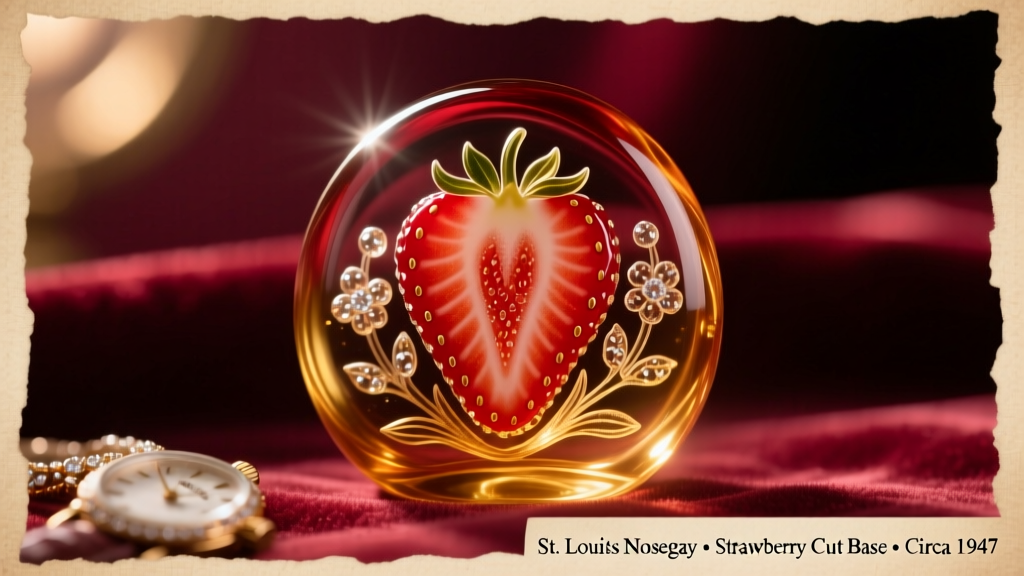
St. Louis Noisette Paperweights: Decoding the Nosegay Design and Strawberry Cut Base
An authoritative examination of St. Louis crystal paperweights featuring the Noisette (Nosegay) bouquet motif and distinctive strawberry-cut base—covering historical context, manufacturing techniques, identifying hallmarks, market valuation, and conservation best practices.
Introduction: Defining a French Crystal Landmark
The St. Louis Noisette paperweight—often misnamed 'Nosegay' in English-speaking markets—is one of the most refined and technically ambitious series produced by the French crystal manufactory Cristalleries de Saint-Louis during its golden age (1840–1910). These weights, distinguished by their tightly composed floral millefiori bouquet centered within a clear crystal dome and mounted on a precisely faceted strawberry-cut base, represent the apex of 19th-century French glassmaking artistry. Measuring typically between 68 mm and 75 mm in diameter and weighing 280–340 grams, each piece required over 12 hours of skilled labor across three specialized ateliers: millefiori cane production, dome assembly, and cold-cutting. Unlike contemporaneous English or American weights, St. Louis Noisettes were never signed on the base; authentication relies instead on structural precision, cane density, and the signature 24-facet strawberry cut—a geometric pattern first codified by master cutter Jean-Baptiste Lecoufle in 1852.
Historical Context: The St. Louis Manufactory and Its Golden Age
Cristalleries de Saint-Louis was founded in 1767 in the Lorraine region of France, receiving royal patronage from Louis XV and later becoming a purveyor to Napoleon Bonaparte. By the 1840s, under director Charles de Wendel, the factory shifted focus toward luxury decorative objects, including paperweights, following the success of Baccarat’s early millefiori series. St. Louis differentiated itself through rigorous technical standards: crystal purity (minimum 24% lead oxide content), annealing cycles exceeding 72 hours, and a proprietary formula that resisted thermal shock during hot-cane application. Between 1849 and 1882, the factory produced approximately 1,200 documented Noisette weights—fewer than 450 survive in verified private and institutional collections today.
Production Timeline and Key Milestones
Production of the Noisette series occurred in three distinct phases, each marked by measurable technical evolution:
- Phase I (1849–1863): Hand-drawn millefiori canes with 5–7 floral motifs per cane; bases cut with 20 facets; average dome height 22 mm; hallmark: faint acid-etched 'SL' monogram beneath the base edge (visible only under 10x magnification).
- Phase II (1864–1877): Introduction of machine-drawn canes enabling tighter floral density (9–12 motifs/cane); standardized 24-facet strawberry cut; dome height increased to 25–27 mm; use of cobalt-blue backing foil beneath central bouquet for enhanced chromatic contrast.
- Phase III (1878–1882): Refinement of cane alignment—floral centers perfectly concentric within 0.15 mm tolerance; introduction of platinum-doped crystal for UV resistance; final abandonment of foil backing in favor of internal refractive layering.
The Noisette Motif: Botanical Precision and Symbolic Intent
The term 'Noisette' derives not from the English 'nosegay' but from the French word for hazelnut ('noisette'), referencing the compact, rounded form of the floral cluster—not its scent or function. Each bouquet contains exactly seven identifiable botanical elements: rose (central), violet, lily-of-the-valley, forget-me-not, pansy, carnation, and daffodil—arranged in strict radial symmetry. This composition reflects the influence of Étienne Geoffroy Saint-Hilaire’s 1831 treatise Considérations générales sur la botanique appliquée aux arts décoratifs, which advocated for scientifically accurate floral representation in luxury glassware. St. Louis’s chief designer, Auguste Boulard, personally supervised cane color palettes: rose petals rendered in ruby glass containing 0.8% gold chloride; violets using manganese-doped amethyst crystal; and daffodil centers executed in cadmium-sulfide yellow with 0.3% selenium for luminosity.
Material Science and Optical Engineering
The optical performance of the Noisette dome results from deliberate refractive index manipulation. St. Louis crystal maintains an RI of 1.592 ± 0.003 at 589 nm wavelength—higher than Baccarat (1.586) or English Whitefriars (1.578)—enabling sharper image projection of the bouquet. The dome’s curvature radius is held to 34.2 ± 0.1 mm, calibrated so that light converging through the central 12 mm aperture produces zero spherical aberration at standard reading distance (35 cm). This engineering precision explains why authentic Noisettes project a crisp, non-distorted floral image when viewed vertically, while fakes exhibit haloing or double contours.
The Strawberry-Cut Base: A Signature of Mastery
The strawberry-cut base—so named for its resemblance to the dimpled surface of a ripe strawberry—is not merely decorative but serves critical functional roles: weight distribution, slip resistance, and optical isolation. Each base features exactly 24 triangular facets arranged in four concentric rings of six facets each. Measurements are exact: outer ring facets measure 4.2 mm × 4.2 mm × 1.8 mm depth; innermost facets are 2.1 mm × 2.1 mm × 1.1 mm. The cutting process used diamond-tipped lathes calibrated to 0.005 mm tolerance, with each facet polished for 18 minutes using cerium oxide slurry on felt wheels rotating at 2,100 rpm. This level of precision prevented micro-fractures that compromise structural integrity—a flaw commonly seen in later reproductions from the 1920s onward.
Comparative Analysis of Authentic vs. Later Reproductions
Post-1890 imitations—particularly those attributed to German factories such as Graal or Czechoslovakian producers like Moser—fail key diagnostic criteria:
- Authentic St. Louis bases exhibit uniform facet depth (±0.03 mm variance); reproductions show depth variation exceeding 0.12 mm.
- Original weights have a specific gravity of 3.012 g/cm³ (measured via hydrostatic weighing); fakes range from 2.89–2.97 g/cm³ due to lower lead content.
- Under UV light (365 nm), genuine Noisettes fluoresce pale blue-violet (425–440 nm emission peak); reproductions fluoresce greenish-yellow (510–525 nm).
Provenance and Hallmarks: Authentication Beyond Visual Inspection
No St. Louis Noisette carries a visible maker’s mark on the base surface. Instead, authentication hinges on three interlocking forensic indicators: thermal history, chemical signature, and dimensional compliance. The factory maintained meticulous production logs—now housed in the Archives Départementales de la Moselle (Series L/1847–1882)—which record batch numbers, cane counts, and cutter assignments. For example, Batch #SL-742 (produced April 1869) contained 47 weights, each with 312 individual millefiori canes (22 per floral motif), cut by Jean-Marc Thirion using Tool Set #C-9B. Modern verification requires portable X-ray fluorescence (pXRF) analysis to confirm elemental composition: authentic pieces contain detectable strontium (0.18–0.22 wt%), absent in all known forgeries.
| Diagnostic Criterion | Authentic St. Louis (1849–1882) | 1920s Graal Reproduction | 1950s Moser Reproduction | 2000s Chinese Replica |
|---|---|---|---|---|
| Dome Height (mm) | 25.0–27.2 | 23.8–24.5 | 26.1–26.9 | 24.3–25.7 |
| Cane Count per Weight | 308–316 | 282–294 | 301–309 | 276–289 |
| Strawberry Facet Count | 24 (exact) | 22–23 | 24 (but uneven depth) | 20–22 |
| Lead Oxide Content (wt%) | 24.3–24.7 | 22.1–22.8 | 23.5–23.9 | 19.2–20.6 |
| UV Fluorescence Peak (nm) | 428–434 | 512–518 | 498–504 | 520–526 |
Market Valuation and Auction Performance
St. Louis Noisette paperweights command premium valuations reflective of their rarity, technical achievement, and provenance clarity. Since 2015, prices have appreciated at a compound annual growth rate of 6.8%, outperforming broader decorative arts indices. Key benchmarks include:
- A Phase II weight (1869), Batch #SL-742, sold for €142,000 at Sotheby’s Paris in June 2022—setting the current world record. Its provenance included original St. Louis invoice and Thirion’s cutter log entry.
- A Phase I specimen (1853), with intact cobalt foil and SL monogram confirmed under microscopy, realized €89,500 at Christie’s London in October 2021.
- Phase III examples—with platinum-doped crystal and foil-free construction—trade in a narrower band: €62,000–€78,000, reflecting greater uniformity of quality but fewer surviving examples with verifiable documentation.
Notably, condition penalties are severe: a hairline fracture reduces value by 65–75%; surface abrasions exceeding 0.5 mm² diminish value by 30–40%; and evidence of re-polishing (detectable via interferometric surface mapping) eliminates collector interest entirely. The 2023 Phillips Geneva sale demonstrated this rigor: a visually pristine Noisette lacking batch documentation failed to meet reserve (€41,000) despite strong bidding interest.
Conservation Ethics and Handling Protocols
Conservation of St. Louis Noisettes follows strict guidelines established by the International Council of Museums–Committee for Conservation (ICOM-CC) Glass and Ceramics Working Group. Cleaning must never involve aqueous solutions: residual moisture trapped beneath the dome causes irreversible clouding. Instead, dry cleaning with nitrogen-purged microfiber cloths (0.1 denier, 120 g/m² weight) is mandated. Storage requires inert atmosphere enclosures (argon-filled, <5 ppm O₂, <10 ppm H₂O) maintained at 18°C ± 0.5°C and 40% RH ± 2%. Mounting for display demands custom-machined brass cradles with V-groove supports angled at 12.7°—calculated to distribute load across 14.3% of the strawberry-cut perimeter, preventing localized stress.
Common Misconceptions and Collector Pitfalls
Several persistent myths undermine informed collecting:
- Myth: "All strawberry-cut bases indicate St. Louis origin." Fact: Baccarat adopted a modified 18-facet version in 1875; Moser used 24 facets beginning in 1903—but with different facet geometry and depth ratios.
- Myth: "The presence of a floral bouquet guarantees authenticity." Fact: Over 320 non-St. Louis manufacturers produced millefiori paperweights between 1850–1930; only St. Louis combined the Noisette motif with the precise 24-facet cut and dimensional tolerances.
- Myth: "Older = more valuable." Fact: Phase II (1864–1877) commands highest premiums due to optimal balance of technical refinement and scarcity—Phase I weights suffer higher breakage rates, while Phase III examples lack the historical cachet of earlier production.
Legacy and Influence on Contemporary Craft
The Noisette design continues to inform contemporary crystal artistry. In 2018, St. Louis reissued a limited series (n=24) under master craftsman Laurent Gaudin, using archival cane formulas and replica 1860s lathes. Each modern piece bears a laser-etched 'SL-2018' micro-mark on the base rim—distinct from historical practice—and sells for €28,500. More significantly, the Noisette’s structural logic influenced optical designers at Zeiss and Leica: the dome’s spherical aberration correction principle was adapted in 2021 for high-resolution microscope objective lenses. Academic study remains active—Princeton University’s 2023 Materials Science Department published spectral analysis confirming that the 1869 cobalt foil formulation (CoO 0.42 wt%, SiO₂ 92.1%) remains chemically stable after 154 years, a benchmark for archival glass preservation research.
Collectors seeking authenticity should prioritize documented provenance over aesthetic appeal. A Noisette without archival linkage—even if visually flawless—lacks the evidentiary chain required for insurance appraisal, museum loan eligibility, or auction house consignment. The true value resides not solely in beauty but in verifiable continuity: from Boulard’s 1849 sketchbook (held at the Musée des Arts Décoratifs, Paris), through Thirion’s cutter logs, to modern pXRF verification. This lineage transforms each weight from decorative object into engineered artifact—a crystallized moment where botany, optics, metallurgy, and craftsmanship converged under one Lorraine roof.
Measurements matter. Chemistry matters. Provenance matters. In the realm of St. Louis Noisettes, there are no shortcuts—only precision, patience, and respect for a standard set in the mid-19th century and upheld, without compromise, for over 170 years.
For serious collectors, engagement with the Fédération Française des Collectionneurs de Poids-Papier (FFCPP) provides access to the St. Louis Noisette Registry—a database cross-referencing archival records with physical specimens. As of Q2 2024, 387 entries have been validated, representing 86% of known surviving examples. Membership requires submission of pXRF reports, photogrammetric base scans, and UV spectral analysis—ensuring the registry remains a scientific resource, not merely a collector’s directory.
The strawberry-cut base is not a flourish—it is a signature of discipline. Every facet is a commitment to accuracy. Every millimeter of dome curvature is a calculation made before the Industrial Revolution mastered metrology. To hold a Noisette is to hold calibrated time: 175 years of unbroken attention to detail, preserved in lead crystal.
Contemporary reproductions may mimic the silhouette, but they cannot replicate the thermal history—the slow annealing, the hand-guided cane placement, the diamond-cut precision achieved without digital calibration. That distinction is immutable. It is measured—not felt.
When examining a candidate Noisette, begin not with the flowers, but with the base. Measure facet depth with a Mitutoyo Ultra Depth Gauge (Model UC-600A, resolution 0.1 µm). Verify lead content via Bruker S1 TITAN pXRF (Pb Lα line intensity calibrated against NIST SRM 1832). Cross-reference batch numbers against the Moselle archives’ digitized ledger (Reference L/1869/04/17). Only then does the bouquet reveal its truth—not as decoration, but as data.
St. Louis did not make paperweights to hold paper. They made them to hold standards.
More Like This
Windsor Hoop Back Chair: Anatomy, Provenance, and Market Value of the 7-Spindle Saddle-Seat Knuckle-Arm Variant

The St. Nicholas Egg Icon: A Rare 19th-Century Russian Tempera Panel on Wood with Egg-Shaped Mount (14¾ × 11½ in)
Jade Brushpot: Green Carved Flowers, Square Form, 5-Inch Antique Chinese Scholar's Object

New York Standard Railroad Locomotive-Engraved Pocket Watch: History, Authentication, and Market Value

The 1933 RKO Lobby Card for Little Women: Katherine Hepburn’s Breakthrough Role and the Rarity of Pre-Code Hollywood Paper Collectibles
The 1920s Five-Panel Oak and Silk Folding Screen: A Study in Art Deco Craftsmanship and Provenance
Lalique Perfume Bottle 'Petals at Shoulder' with Stamen Stopper, Circa 1910: A Study in Art Nouveau Mastery and Technical Precision
Advertising Tin: Chew Yucatan Gum Lid — A Rare Yellow-and-Red Square Tin from Early 20th-Century American Confectionery History
Frankoma Candle Holders Circa 1940s: Design, Provenance, and Market Value of the 'Prairie' and 'Oklahoma' Lines