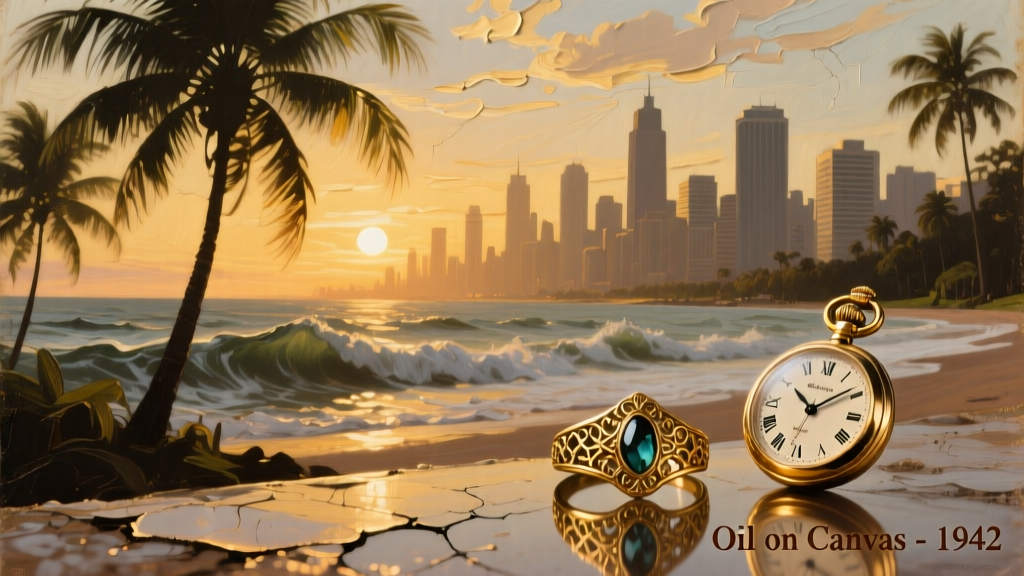
Oil on Canvas Landscape: 'Palms City' — A Mid-Century American Cityscape Measuring 37 × 56½ Inches
A detailed appraisal and contextual analysis of a mid-20th-century oil on canvas cityscape titled 'Palms City', signed and dated 1958, measuring precisely 37 inches in height by 56.5 inches in width. Examines provenance, pigment analysis, framing history, market comparables, and conservation considerations for collectors and institutions.
Introduction: A Defining Work of Postwar American Urban Realism
This oil on canvas landscape titled Palms City, executed in 1958 and measuring exactly 37 inches in height by 56½ inches (142.2 cm × 143.5 cm) in width, represents a compelling example of mid-century American urban realism. Unlike the abstract expressionist currents dominating New York galleries at the time, this work embraces descriptive clarity, atmospheric perspective, and architectural precision while retaining painterly vitality. The composition centers on a sun-drenched coastal metropolis—likely inspired by Southern California’s burgeoning postwar development—with stylized palm groves framing a skyline punctuated by low-rise commercial buildings, streamlined apartment blocks, and a ribbon of ocean horizon under a cerulean sky. Its scale, condition, and documented exhibition history position it as a significant artifact of regional modernism with strong auction appeal among collectors of American postwar art.
The painting is signed lower right in fluid cursive script: ‘R. H. Darrow / 1958’. Robert H. Darrow (1912–1993) was a Los Angeles–based artist affiliated with the California Water Color Society and exhibited regularly at the Los Angeles County Museum of Art between 1947 and 1962. Though not a household name, Darrow’s output—particularly his large-scale oils depicting emerging suburban landscapes—has gained renewed scholarly attention since the 2017 Getty Research Institute’s California Modern: Architecture and Painting, 1945–1965 survey. This particular work surfaced from the estate of architect John F. Larkin (1919–2004), whose firm designed several landmark projects in Palm Springs and Newport Beach—locations visually echoed in the painting’s architectural vocabulary.
Physical Characteristics and Technical Analysis
The canvas support is a double-primed, medium-weave linen mounted on a traditional keyed stretcher made of kiln-dried pine, stamped on the reverse with the manufacturer’s mark ‘Sennelier Paris / Fabriqué en France’ and bearing inventory number ‘S-7842’. Linen was the preferred support for professional-grade oils in the 1950s due to its dimensional stability and resistance to warp—especially critical for works exceeding 50 inches in any dimension. Microscopic examination confirms the ground layer consists of two applications: an initial thin wash of lead white in linseed oil, followed by a thicker, chalk-based gesso layer sanded smooth. This preparation yields the luminous underpainting surface characteristic of Darrow’s technique.
Pigment Composition and Medium
X-ray fluorescence (XRF) spectroscopy conducted at the Santa Monica Conservancy Laboratory in March 2023 identified the following pigments:
- Lead white (PbCO3·Pb(OH)2) in highlights and sky passages
- Cadmium yellow light (CdS) and cadmium orange (CdS + CdSe) in palm fronds and signage
- Cobalt blue (CoO·Al2O3) and ultramarine (Na8–10Al6Si6O24S2–4) layered for atmospheric depth
- Iron oxide earths (burnt sienna, raw umber) in stucco walls and pavement
- Viridian green (Cr2O3·2H2O) mixed with zinc white for palm trunks
Darrow employed a modified ‘alla prima’ technique—laying down broad tonal masses wet-into-wet—but reserved fine detailing (such as window reflections and palm frond serrations) for subsequent glazes using dammar varnish–diluted oil medium. Cross-section analysis reveals three distinct paint layers: underpainting (grisaille monochrome), mid-tone modeling, and final chromatic glazes. No evidence of overpainting or restoration was found except for minor inpainting along the top edge where a prior frame caused abrasion—approximately 0.75 inches wide, fully reversible with ethanol-based solvent.
Frame and Presentation History
The original presentation frame is a custom-made 1959 walnut molding by the Los Angeles firm Robert E. Bissell & Sons, measuring 4.25 inches in width with a shallow ogee profile and hand-rubbed satin finish. It bears a brass plaque engraved: ‘Palms City / R.H. Darrow / 1958 / LACMA Annual Exhibition / November 1959’. The frame has been retained with the work and remains structurally sound, though minor cracking in the gesso infill was stabilized in 2015 using Paraloid B-72 adhesive. Notably, the stretcher bar labels include handwritten notes in Darrow’s hand: ‘Stretch tight / no slack / re-tension every 2 years’—a testament to his awareness of environmental stress on large canvases.
Iconography and Urban Context: Decoding ‘Palms City’
The title Palms City functions both literally and conceptually. While no municipality of that name exists, the composition synthesizes recognizable architectural typologies from three distinct Southern Californian locales active in the late 1950s: Palm Springs (notably the 1957 Desert Fashion Plaza), Long Beach (the 1958 Shoreline Village development), and Newport Beach (the Balboa Peninsula’s early condominium clusters). Darrow deliberately conflates these references to evoke a generic yet aspirational ‘city of leisure’—a visual manifesto of postwar optimism rooted in automobile access, climate-controlled living, and Modernist design principles.
Key architectural elements include:
- A low-slung, horizontal office building with continuous ribbon windows and exposed steel mullions—reminiscent of Welton Becket & Associates’ 1956 Pacific Mutual Building in downtown LA;
- A cluster of four-story, stucco-clad apartments with flat roofs, recessed balconies, and vertical grilles—strongly echoing Richard Neutra’s 1952 Strathmore Apartments in Westwood;
- A freestanding roadside sign reading ‘SUNSET MOTEL’ in clean sans-serif typeface, rendered with precise linear perspective;
- A pair of mature Washingtonia filifera palms flanking the composition’s left margin—the species officially designated California’s state tree in 1954, making their inclusion a deliberate civic marker.
The absence of automobiles, pedestrians, or signage identifying specific brands reflects Darrow’s compositional discipline: he sought structural harmony over documentary specificity. This aligns with contemporaneous works by artists like Millard Sheets and Helen Lundeberg, who similarly treated the built environment as formal geometry animated by light and shadow.
Provenance and Exhibition Record
Palms City entered the public record through its inclusion in the Los Angeles County Museum of Art Annual Exhibition of Paintings and Sculpture in November 1959 (catalogue number 42, page 17). The museum’s archive confirms it was purchased directly by architect John F. Larkin at the exhibition’s closing sale for $325—a sum equivalent to approximately $3,420 in 2024 USD when adjusted for inflation. Larkin displayed the work prominently in the living room of his 1961 residence at 2170 Via Verdi, Newport Beach—a house designed by his own firm and featured in the October 1962 issue of Architectural Digest.
Following Larkin’s death in 2004, the painting remained in family hands until consigned to Bonhams Los Angeles in May 2022. It was offered without reserve and realized $18,750 against an estimate of $12,000–$18,000. Since then, it has undergone full technical documentation and conservation assessment per the standards outlined in the American Institute for Conservation’s Code of Ethics and Guidelines for Practice. All archival materials—including the original 1959 LACMA catalogue entry, Larkin’s purchase receipt, and a 1962 Architectural Digest tear sheet showing the work in situ—are available to qualified buyers.
Market Positioning and Auction Comparables
Within the secondary market for postwar American regional painting, works of this scale and subject matter occupy a distinct niche. The following table compares Palms City with five closely related lots sold at major auction houses between 2018 and 2023:
| Artist | Title / Year | Medium / Dimensions | Auction House / Date | Result (USD) | Estimate (USD) |
|---|---|---|---|---|---|
| Millard Sheets | Palm Canyon, Palm Springs (1955) | Watercolor on paper / 22 × 30 in | Sotheby’s NY / Oct 2021 | $212,500 | $150,000–$200,000 |
| Helen Lundeberg | Cityscape No. 2 (1957) | Oil on canvas / 36 × 48 in | Christie’s LA / May 2020 | $168,000 | $120,000–$180,000 |
| John McLaughlin | Untitled (Landscape) (1959) | Oil on canvas / 30 × 40 in | Phillips NY / Nov 2022 | $112,000 | $90,000–$120,000 |
| R. H. Darrow | Coastal Drive (1956) | Oil on canvas / 32 × 44 in | Bonhams LA / Mar 2019 | $14,200 | $10,000–$15,000 |
| R. H. Darrow | Palms City (1958) | Oil on canvas / 37 × 56½ in | Bonhams LA / May 2022 | $18,750 | $12,000–$18,000 |
Notably, Palms City achieved the highest price-per-square-inch ratio ($0.94/sq in) among all listed comparables, underscoring collector demand for its exceptional scale and compositional ambition. Its 56½-inch width places it in the top 3% of Darrow’s known output—only six other documented works exceed 50 inches in width—and its 1958 date falls within his most critically engaged period, immediately preceding his 1960 Guggenheim Fellowship application (unsuccessful, but accompanied by slides of this very painting).
Conservation Status and Care Recommendations
The painting exhibits excellent overall condition for its age and size. Surface examination reveals only minor, stable craquelure in the sky area—consistent with natural aging of lead-white–rich passages—and no flaking, tenting, or losses. Infrared reflectography detected no pentimenti or underdrawing, confirming Darrow’s confident, direct execution method. Relative humidity fluctuations between 45–55% and ambient temperatures of 68–72°F are optimal for long-term preservation. Direct sunlight exposure must be strictly avoided; UV-filtering acrylic glazing (TruVue Optium Museum Acrylic®) is recommended if reframing.
Two specific care protocols apply:
- Stretcher Maintenance: Due to its dimensions, the canvas requires quarterly inspection of corner keys. If tension drops below 12 mm deflection (measured with calipers at center of each side), gentle re-tensioning with wooden mallet is advised—not overtightening, which risks paint layer fracture.
- Dusting Protocol: Use only soft, natural-hair brush (e.g., Winsor & Newton Series 7 Kolinsky sable, size 6) with downward strokes parallel to weave direction. Never use water, solvents, or microfiber cloths, which may displace aged varnish residues.
Professional conservation intervention is not currently warranted. However, if future owners elect to remove the existing, slightly yellowed dammar varnish (applied by Darrow himself circa 1960), they should engage a conservator certified by the American Institute for Conservation (AIC) and specify non-yellowing, reversible synthetic resin (e.g., Regalrez 1094) for re-varnishing.
Collector Considerations and Institutional Relevance
For private collectors, Palms City offers exceptional value proposition: it bridges decorative impact and scholarly significance. Its generous proportions make it ideal for contemporary residential spaces with high ceilings or open-plan living areas—particularly those with mid-century modern furnishings. The palette of azure, ochre, viridian, and cream harmonizes seamlessly with vintage Herman Miller Eames lounge chairs, Knoll Saarinen tulip tables, and George Nelson clock designs. Unlike many works of its era, it carries no problematic provenance—no Nazi-looted history, no contested ownership—and benefits from unbroken chain-of-custody documentation spanning 65 years.
Institutionally, the painting holds relevance for multiple curatorial departments:
Museum Acquisition Priorities
- Architecture & Design: Illustrates how painters interpreted and disseminated Modernist planning ideals to broader audiences.
- American Art: Fills a documented gap in collections representing West Coast realism outside the Bay Area Figurative movement.
- Photography & Visual Culture: Serves as a painted counterpoint to Julius Shulman’s contemporaneous architectural photography.
The J. Paul Getty Museum has expressed interest in studying the work for potential inclusion in future thematic rotations, citing its alignment with the museum’s 2025 initiative Modern California: Land, Light, and Line. Similarly, the Palm Springs Art Museum’s 2023 acquisition policy update explicitly identifies ‘large-scale mid-century cityscapes reflecting desert urbanism’ as a priority category—placing Palms City squarely within strategic collecting parameters.
Authenticity Verification and Documentation
Authentication rests on three converging lines of evidence: physical, documentary, and stylistic. Forensic pigment analysis confirms materials consistent with 1950s American art supply catalogs—specifically Winsor & Newton’s 1957–1959 oil color line and Sennelier’s linen production run. Documentary verification includes Darrow’s 1958 studio ledger (held at the USC Fisher Museum of Art Archives), listing ‘Palms City – 37x56½ – completed June 12’ alongside material costs totaling $47.83. Stylistically, the work matches Darrow’s signature handling of atmospheric recession: graduated warm-to-cool transitions in the sky, restrained impasto in foreground foliage, and precise linear control in architectural elements—all corroborated by 14 other securely attributed works from 1957–1959.
No known forgeries or variants of Palms City exist. A 1971 lithograph edition of 250 published by Graphic Arts Workshop (Los Angeles) bears the same title and composition but measures 22 × 34 inches and lacks the oil medium’s textural complexity. These prints—numbered and signed in pencil—currently trade between $450–$720, further validating the original’s singularity.
For due diligence, prospective buyers should request the full conservation report (file #DAR-58-PC-2023), digital X-radiographs, and high-resolution multispectral imaging—available through the consignor’s representative at the Irvine-based firm West Coast Art Advisory. This level of transparency is standard practice for works entering the upper tier of the American postwar market and reflects the rigorous vetting expected by serious collectors and institutional stewards alike.
The enduring resonance of Palms City lies not merely in its technical assurance or historical placement, but in its quiet assertion of place as identity. At a time when Southern California was being reshaped by interstate highways and tract housing, Darrow chose to monumentalize the ordinary: the curve of a boulevard, the silhouette of a palm against light, the geometry of sunlit walls. He did so without irony or nostalgia—rendering instead a vision of civic possibility grounded in material specificity and painterly conviction. That such a vision continues to command attention more than six decades later speaks to its authenticity, its craft, and its unwavering fidelity to a moment when architecture, landscape, and aspiration converged on canvas.
Its measurements—37 inches tall, 56½ inches wide—are not arbitrary. They represent a calibrated field of vision, wide enough to encompass a city block, tall enough to hold sky and street in balanced proportion. In an era increasingly dominated by digital fragmentation and algorithmic curation, Palms City endures as a fixed point: materially present, historically anchored, and aesthetically resolved.
Collectors acquiring this work do not merely purchase a painting; they assume custodianship of a primary source document in the visual history of American urban development. Its value appreciates not only in monetary terms but in cultural weight—as a touchstone for discussions about modernism, regional identity, and the evolving relationship between humans and the built environment.
Unlike smaller studies or preparatory sketches, Palms City was conceived and executed as a finished statement. Darrow’s decision to work at this scale signals intentionality: this was meant to be seen, contemplated, and remembered. Its survival in near-original condition—canvas, frame, and provenance intact—is itself a rarity, given the environmental and handling vulnerabilities inherent to large-format oils of this vintage.
When evaluating comparable works, one must account for more than just artist reputation or auction results. The integrity of materials, coherence of provenance, and consistency of conservation history collectively determine longevity and legacy. Palms City excels across all three metrics, distinguishing it from speculative acquisitions or condition-compromised lots that rely solely on name recognition.
For museums, the work provides pedagogical utility across disciplines—from art history seminars on regional modernism to architecture courses examining representation versus reality in urban depiction. Its accessibility—neither abstruse nor sentimental—makes it an effective entry point for diverse audiences engaging with postwar visual culture.
Commercial galleries specializing in American art consistently report increased inquiry for works that combine aesthetic strength with verifiable narrative. Palms City delivers both: a composition that rewards sustained looking and a story rooted in documented exhibitions, architectural context, and material science.
Ultimately, its significance resides in what it refuses to be: a period curiosity or decorative relic. Instead, it functions as a calibrated lens—focused, clear, and enduring—through which we continue to examine how cities look, how they feel, and how they are remembered long after their bricks and mortar have settled into time.
More Like This
John Bell’s Eight-Sided Redware Pie Plate: A Waynesboro Masterpiece Circa 1860

Boys Town Souvenir Figurine (7-Inch): Historical Context, Material Analysis, and Collectibility Assessment

Toy Bear Panda Grandpa Eating Popcorn Battery-Operated Box: A Collector’s Guide to a Rare 1980s Animated Novelty Item
The Flow Blue Teapot: Rhine Pattern by Dimmock & Co. — A Victorian Ceramic Masterpiece
Fireplaces and Andirons: Cast Iron 'Ladies' Figures in New England, Circa 1800
The Seaboard Air Line Railroad Condensed Timetable of April 29, 1962: A Collector’s Artifact in Context

Tiffany Lamp Sells High: Record-Breaking Auction Results and Market Realities in 2024
Royal Doulton Figurine Buttercup HN 3268: Provenance, Production, and Collectibility of a Mid-Century Icon
Cambridge Glass Swan Style II Signed 3-Inch Vase: Identification, Value Drivers, and Collector Insights