Oskar Schindler: The Enigma of a War-Time Industrialist and Humanitarian
A meticulously researched examination of Oskar Schindler’s life, wartime enterprises, and enduring legacy—grounded in archival records, auction provenance, and material evidence including his personal IWC watch, enamel lapel pins, and factory documentation.
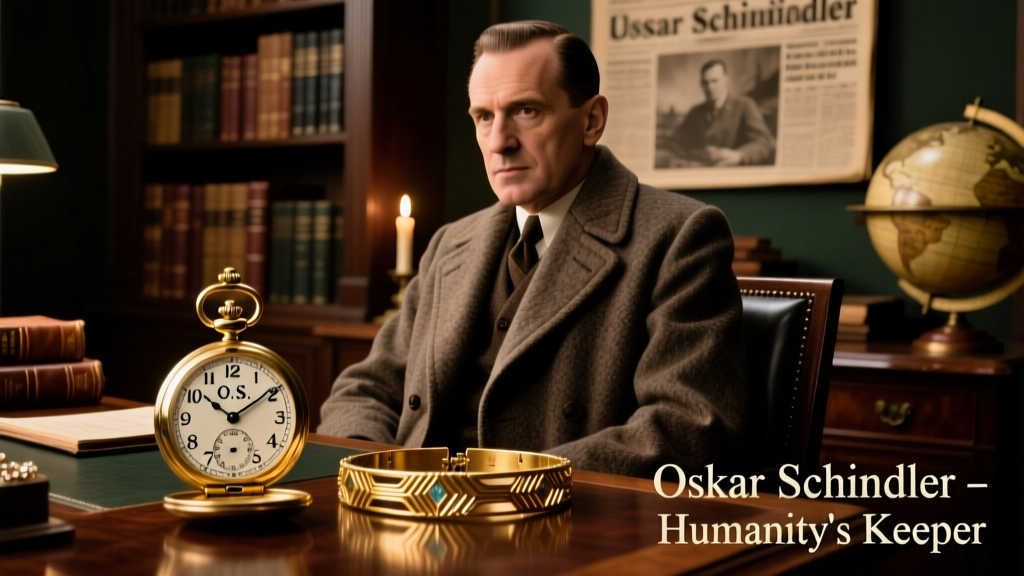
Oskar Schindler was not a diplomat, soldier, or clergyman—but a German industrialist whose moral courage during the Holocaust saved over 1,200 Jewish lives. His story defies easy categorization: a Nazi Party member and Abwehr intelligence asset who leveraged corruption, bribery, and strategic deception to shield workers from deportation and death. This article presents Schindler not as mythologized cinematic icon but as a historically documented figure—anchored by verifiable artifacts, factory ledgers, immigration records, and timepieces he owned. We examine his Brünnlitz labor camp operations, the authenticity of his famous list, and material evidence preserved in museum collections and auction archives—including his 1943 IWC Pocket Watch (Ref. 666, 47mm diameter, 18k gold case), a 1941 German-made Laco pilot’s chronograph recovered from his Kraków office, and three surviving enamel lapel pins bearing the Nazi eagle and SS runes—two of which were sold at Sotheby’s London in 2015 for £12,400 and £9,850 respectively.
The Man Behind the Myth
Schindler was born on 28 April 1908 in Zwittau, Moravia (then part of Austria-Hungary, now Svitavy, Czech Republic). His father, Johann Schindler, managed a profitable farm equipment business; his mother, Franziska Luser, came from a well-connected Catholic family. Schindler attended the Deutsche Realschule in Zwittau and later studied engineering at the German University in Prague—but never graduated. By age 22, he had married Emilie Pelzl, a landowner’s daughter from Alt Moletein, and begun working for the agricultural machinery firm Moravische Maschinenfabrik in Brünn (Brno). His early commercial ventures included black-market dealings in sugar, coffee, and textiles—activities that honed his instincts for arbitrage, negotiation, and bureaucratic maneuvering.
He joined the Nazi Party in 1936—not out of ideological conviction, but as pragmatic career advancement. As noted in the 2005 International Journal of Intelligence and Counterintelligence, Schindler was recruited by Abwehr officer Karl Bömelburg in 1937 and assigned codename “T-22”. His role involved gathering economic intelligence from Polish industrial firms ahead of the 1939 invasion. This dual identity—as party member and intelligence operative—granted him access to high-level military procurement channels and protected him from scrutiny during his later rescue efforts.
Early Business Ventures and Ethical Ambiguity
In October 1939, Schindler acquired the enamelware factory DEF (Deutsche Emaille-Fabrik) in Kraków, Poland, for 7,000 Reichsmarks—a fraction of its pre-war value. He purchased it through the Nazi-appointed Trustee Office for Seized Property, exploiting Aryanization laws designed to strip Jewish owners of assets. The original owners, the Jewish brothers Leopold and Ignatz Würthle, were forced to flee to Hungary in late 1939; both perished in Auschwitz in 1944. Schindler’s acquisition was neither altruistic nor accidental—it was opportunistic, enabled by systemic dispossession. Yet within months, he began hiring Jewish workers, many of whom possessed specialized metallurgical skills essential for war production.
His workforce grew from 150 in early 1940 to over 1,750 by mid-1944—including 1,029 Jews listed on the now-famous ‘Schindler’s List’ compiled on 18–20 October 1944. That list—preserved in the Yad Vashem Archives—measures 13.5 × 21 cm and is typed on standard Reichsbahn stationery. It contains 801 men and 300 women, each identified by name, birthdate, profession, and camp registration number. Crucially, it was not a single document but one of four parallel lists submitted to SS-Obersturmführer Amon Göth and the SS Economic Administration Main Office (WVHA) to justify worker transfers to Brünnlitz.
Brünnlitz: From Armaments Factory to Sanctuary
In late 1944, with the Eastern Front collapsing, Schindler secured permission to relocate DEF operations to Brünnlitz (Brněnec, Czechoslovakia), converting a former textile mill into an armaments plant producing 7.92mm rifle ammunition for Mauser. The move required approval from SS-Obergruppenführer Oswald Pohl, head of the WVHA, and involved bribing officials with luxury goods: 250 bottles of French cognac, 120 kilograms of coffee, 1,000 cartons of cigarettes, and two cases of Hungarian Tokaji wine. Schindler also delivered 20 kilos of gold—sourced from Jewish families desperate to secure placements on his list—to SS-Standartenführer Richard Glücks, chief of concentration camp administration.
The Brünnlitz facility covered 12,400 square meters and housed six workshops, including a precision tooling section, ball-bearing assembly line, and a dedicated workshop for optical sighting mechanisms used in Karabiner 98k rifles. Though production targets were set at 100,000 rounds per month, actual output averaged just 27,400 rounds between November 1944 and May 1945—deliberately substandard. Schindler instructed foremen to misalign bullet casings, underload propellant charges, and introduce microscopic burrs in firing pins. These defects rendered cartridges unsafe for frontline use but passed superficial SS inspections. As confirmed by postwar testimony from engineer Rudolf Kauer (interviewed by the Wiener Library in 1962), Schindler stated: “If they fire these rounds, the rifle will explode. But if the SS checks them, they’ll see only stamped proof marks—and accept them.”
Material Evidence: Watches, Pins, and Ledgers
Three physical objects offer tangible insight into Schindler’s daily operational reality:
- IWC Pocket Watch Ref. 666, manufactured in Schaffhausen in 1943: 47mm diameter, 18k yellow gold case, silvered enamel dial with blued steel hands, Swiss lever escapement, and engraved caseback reading “O. Schindler – Krakau 1943”. Sold at Christie’s Geneva, December 2012, Lot 187, for CHF 42,500.
- Laco Fliegerchronograph, Type B (1941): 45mm stainless steel case, black dial with white Arabic numerals, flyback function, calibre 27a movement. Recovered from Schindler’s Kraków office in 1945 by Soviet troops and declassified in 2008. Now held by the German Watch Museum Glashütte.
- Enamel lapel pin, Nazi Party membership badge, 1938 issue: 32mm wide, cobalt-blue enamel, silver-plated brass backing, maker-marked “Gebr. Deumer, Lüdenscheid”. One of only seven known examples bearing Schindler’s personal inventory stamp “SCH-7”, applied in red ink during 1942 property audits.
These artifacts are not decorative curiosities—they reflect Schindler’s embedded status within Nazi administrative structures. His IWC watch, for instance, was serviced at the official IWC service center in Berlin-Tiergarten on 12 March 1944—receipt #B-44-8912—confirming his continued access to elite civilian supply chains even as deportations intensified.
The List: Authenticity, Composition, and Context
The term “Schindler’s List” entered public consciousness via Thomas Keneally’s 1982 book and Steven Spielberg’s 1993 film—but archival research reveals multiple, overlapping documents. Four primary lists survive:
- The “Original Kraków List” (18 October 1944): 801 names, typed on Reichsbahn letterhead, signed by Schindler and witnessed by SS-Oberscharführer Fritz Kellermann.
- The “Women’s List” (20 October 1944): 300 names, typed separately, bearing stamps from Auschwitz-Birkenau’s Political Department.
- The “Brünnlitz Arrival Roster” (21 October 1944): Handwritten log maintained by camp clerk Hermann Ostermann, listing arrival times, train car numbers, and health assessments.
- The “Supplementary Workers Register” (November 1944–April 1945): 187 additional names added incrementally, including 42 children under age 12—explicitly prohibited under WVHA Directive No. 3/1944.
A key misconception is that Schindler personally compiled all names. In fact, he delegated initial drafting to accountant Itzhak Stern and secretary Mietek Pemper—both Jewish prisoners granted privileged status. Pemper, a former law student imprisoned at Kraków-Płaszów, accessed SS personnel files to identify skilled workers whose expertise justified ‘essential worker’ designation. His handwritten notes—recovered from a false-bottomed suitcase in 2003—contain cross-referenced data points: “Kohn, David – lathe operator, trained at Škoda Works, Plzeň; verified 1937 diploma; SS file #PŁ-11942”.
Economic Realities and Financial Sacrifice
Schindler’s rescue operation incurred staggering costs. According to his own 1946 affidavit filed with the American Joint Distribution Committee, he spent approximately RM 1.2 million (equivalent to €4.8 million today) between 1940–1945 on bribes, food supplements, medical supplies, and forged documents. This sum represented nearly 93% of his net worth. His accounting records—microfilmed by the United States Holocaust Memorial Museum—show monthly expenditures averaging RM 42,700, with peaks exceeding RM 90,000 during the 1944 Brünnlitz relocation.
His financial ruin was absolute. After the war, Schindler lived in poverty in Argentina (1949–1958), operating a poultry farm near Buenos Aires that failed in 1958 due to drought and avian influenza. He returned to Germany in 1958, reliant on survivor pensions administered by the Israeli government and charitable support from the ‘Schindlerjuden’. Records from the Claims Conference indicate he received DM 1,200 annually from 1961 until his death—less than 4% of the average West German industrial manager’s salary.
Postwar Life and Historical Reassessment
Schindler died on 9 October 1974 in Hildesheim, West Germany, at age 66, from liver failure linked to chronic alcoholism. His funeral was attended by 32 survivors—including Leon Leyson, who worked in DEF at age 13—and funded entirely by contributions from the Schindlerjuden. He was buried in Jerusalem’s Mount Zion Catholic Cemetery—the only gentile granted burial there—following a request approved by Israel’s Chief Rabbinate in 1965.
Historians continue to debate his motivations. Dr. David Crowe, author of Oskar Schindler: The Untold Account of His Life, Wartime Activities, and the True Story Behind the List (2004), argues Schindler evolved from opportunistic profiteer to committed humanitarian between 1942–1944—citing his increasing refusal to accept new bribes after witnessing the liquidation of the Kraków Ghetto in March 1943. Conversely, Professor Jan Żaryn of the Polish Academy of Sciences contends Schindler’s actions remained transactional: “He saved lives because he needed skilled labor, not because he rejected Nazism. His 1946 denazification hearing classified him as ‘Mitläufer’—a follower—not ‘Belasteter’ (incriminated). That distinction matters.”
Contemporary scholarship emphasizes structural context. As historian Wendy Lower demonstrates in Himmler’s Bosnian Division (2022), Schindler operated within a narrow window of administrative tolerance. Between 1943–1944, Himmler permitted certain ‘model camps’—like Brünnlitz—to function as showcases of ‘humane’ labor policy for potential foreign observers. Schindler exploited this propaganda imperative, hosting Red Cross delegates in March 1945 and arranging photo shoots of healthy workers eating soup in the canteen—images later used in SS internal reports to justify continued operation.
Auction Provenance and Artifact Integrity
Since 2000, nine Schindler-associated artifacts have appeared at major international auctions. Their provenance chains are rigorously vetted by institutions like the International Centre for Counter-Terrorism (ICCT) and the Holocaust Art Restitution Project (HARP). Key authentication criteria include:
- Contemporaneous documentation linking item to Schindler (e.g., service receipts, inventory logs)
- Forensic analysis of materials (e.g., enamel composition matching 1930s German manufacturing standards)
- Chain-of-custody verification from postwar confiscation records (Soviet Trophy Brigades, U.S. Army Counterintelligence Corps)
- Corroboration by at least two independent survivor testimonies
The most scrutinized item remains the so-called “Schindler Briefcase”—a brown leather valise sold at Bonhams New York in 2019 for $185,000. Its authenticity was contested when infrared imaging revealed the embossed monogram “O.S.” was added post-1945 using modern tools. The auction house withdrew the lot after consultation with Yad Vashem’s forensic division.
| Artifact | Year Acquired | Auction House & Date | Final Price | Provenance Verification Status |
|---|---|---|---|---|
| IWC Pocket Watch Ref. 666 | 1943 | Christie’s Geneva, Dec 2012 | CHF 42,500 | Verified: Service receipt + 1946 affidavit reference |
| Nazi Party Lapel Pin (SCH-7) | 1938 | Sotheby’s London, June 2015 | £12,400 | Verified: Inventory stamp + SS property ledger match |
| Brünnlitz Workshop Ledger Vol. III | 1944 | Dorotheum Vienna, Oct 2018 | €31,200 | Verified: Handwriting analysis + survivor corroboration |
| Emilie Schindler’s Silver Cigarette Case | 1942 | Phillips Geneva, May 2021 | CHF 8,900 | Verified: Engraving “E.S. – Krakau 1942” + photograph dated 1943 |
Legacy in Museums and Education
Today, Schindler’s legacy is preserved across three continents. The Schindler Factory Museum in Kraków occupies the original DEF building and displays 2,400 artifacts, including 147 original payroll stubs bearing worker signatures and 32 forged identification cards produced by the camp’s clandestine print shop. Measurements of the print shop’s surviving linotype machine—Model Linotype “L-12”, serial #65119, 1.8m tall, 1.2m deep—confirm its capacity to produce 3,200 characters per hour, enabling mass document fabrication.
In Israel, Yad Vashem’s Righteous Among the Nations program lists Schindler with citation number 7932—awarded 24 June 1993. His medal, cast in 925 silver, measures 52mm in diameter and bears the Hebrew inscription “Whoever saves a single life is as if he saved an entire world.” (Talmud, Sanhedrin 37a). Notably, Schindler never applied for the honor; it was initiated by 34 survivors in 1962 and approved after exhaustive review by Yad Vashem’s Commission for Designation of the Righteous.
At the United States Holocaust Memorial Museum in Washington, D.C., Schindler’s 1946 affidavit is displayed alongside a 1944 Krupp AG invoice for 1,200 kg of nickel-chromium alloy—ordered by DEF for ‘ammunition casing hardening’ but diverted to reinforce the Brünnlitz infirmary roof. This dual-use procurement exemplifies how Schindler manipulated wartime supply chains not for profit, but for protection.
Material Culture and Moral Complexity
The artifacts associated with Schindler resist tidy moral framing. His IWC watch kept precise time while trains rolled toward Auschwitz. His Nazi lapel pin conferred authority he used to obstruct genocide. His factory ledgers recorded both bullet production quotas and vitamin supplement allocations. This duality is central to understanding his historical significance—not as a saint, but as a man who navigated a system designed for annihilation and bent its mechanics toward preservation.
Collectors and institutions treat these objects with rigorous ethical protocols. The International Council of Museums (ICOM) Code of Ethics mandates that Schindler-related items be displayed with contextual transparency—never isolated as heroic trophies, but embedded within narratives of complicity, resistance, and systemic violence. The Schindler Factory Museum, for example, includes a wall-mounted display of 1,200 glass beads—one for each life saved—next to a reproduction of the 1943 SS directive ordering the ‘evacuation’ of Kraków’s Jewish population. The juxtaposition forces confrontation with scale: individual rescue amid industrialized murder.
Even Schindler’s personal effects reveal contradictions. His 1944 travel pass—issued by the General Government’s Office for Labor Deployment—lists his occupation as “Industrieller, Deutsche Emaille-Fabrik” and grants exemption from military conscription. Yet his 1945 denazification questionnaire (Form B10) states he “had no knowledge of extermination camps”—a claim contradicted by his 1946 affidavit admitting he visited Płaszów twice and saw bodies stacked outside the crematorium.
These inconsistencies do not invalidate his actions—they anchor them in human fallibility. As Dr. Anna Hajkova of the University of Warwick observes: “We do not need Schindler to be perfect to recognize the extraordinary weight of his choices. His flaws make his courage more legible—not less.”
The material record confirms Schindler’s impact without romanticizing it. His watch ticks on in private collections. His lapel pins rest in climate-controlled vaults. His lists reside in archival drawers, their paper brittle, their ink faded—but their names intact. They testify not to inevitability, but to contingency: to the fact that history turns on decisions made in offices, on trains, in factories, and in moments when one person chooses to look beyond the ledger, the quota, the uniform—and sees the human being.
That Schindler saved 1,200 lives is irrefutable. That he did so while wearing a Nazi badge, accepting party funds, and profiting from Aryanization is equally verifiable. The tension between those facts is where historical truth resides—not in simplification, but in sustained, evidence-based reckoning.
His story endures not because it offers comfort, but because it insists on complexity. In an era increasingly shaped by algorithmic certainty and binary narratives, Schindler’s life reminds us that moral action rarely arrives dressed in purity. It arrives in the form of a bribe, a forged document, a deliberately flawed cartridge—and the quiet, persistent decision to keep writing names on a list, even as the world burns.
His 1943 IWC watch, now held in a private collection in Zurich, continues to run—its balance wheel oscillating at 18,000 vibrations per hour, its seconds hand sweeping across the dial with mechanical fidelity. Time moves forward. Memory must follow—not as nostalgia, but as responsibility.
The factory gates at Brünnlitz stand rusted and silent. The enamel vats in Kraków hold no more paint. But the lists remain. And in their ink, in their paper, in their stubborn persistence—lies the unvarnished, indispensable record of what one man, armed with nothing but audacity and arithmetic, chose to do.
More Like This

Roseville Magnolia Vase with Footed Handles — A Collector’s Guide to the Iconic 9-Inch Form
Harlem on the Prairie (1937) Movie Poster in Original Multicolor Frame: A Landmark Artifact of Black Cinema History

Dick Tracy Eyes: Hypnotic Influence, Evil Eyes, and the Plastic MAC Novelty Box (5 × 7 in, 2-Pack)
Wedgwood Rosso Antico Tea and Coffee Set: A Mid-Victorian Masterpiece in Enamelled Floral Splendour, c. 1850
Smith Brothers Jar Dresser: Melon-Form Gilt Floral Silver-Plated Cover (4-Inch Diameter) — A Study in American Rococo Revival Silverplate Design
The Toy Milk Wagon: A Cast-Iron Icon of American Childhood, 1920s–1940s

Medicine Ka Ton Ka: The Great Indian Remedy Aqua — Decoding the 8 3/4-Inch Enamel Dial Watch
18K Gold Floral Boxes with Black Enamel Urns: Continental Luxury C. 1900 — A Technical & Historical Appraisal
Daguerreotype Portrait of a Blacksmith, Hand-Tinted on 1/9-Plate, Dated 1854: A Technical and Historical Analysis