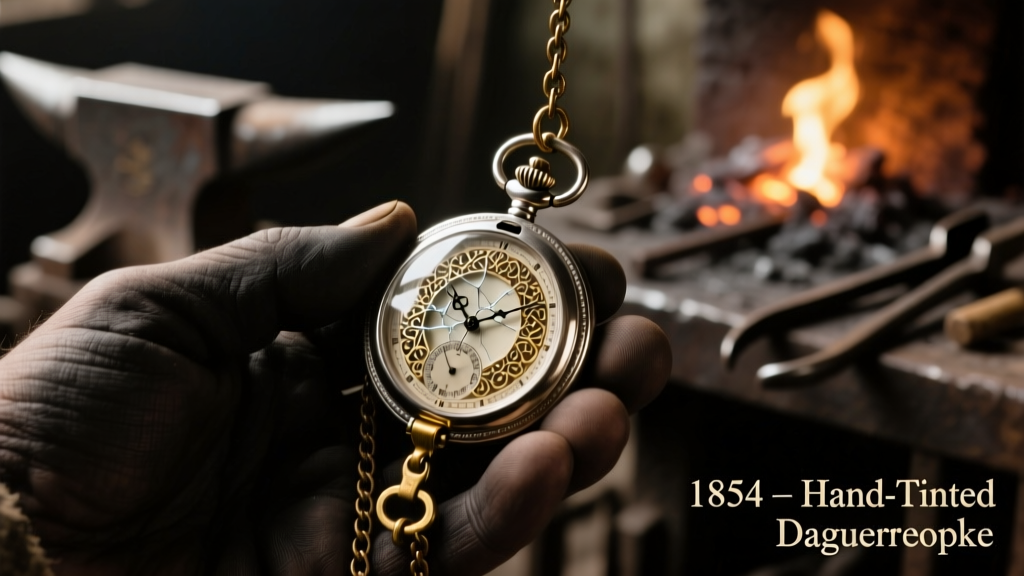
Daguerreotype Portrait of a Blacksmith, Hand-Tinted on 1/9-Plate, Dated 1854: A Technical and Historical Analysis
A detailed appraisal of a rare 1854 daguerreotype portrait depicting a blacksmith in working attire, executed on a 1/9-plate (measuring precisely 2.75 × 3.25 inches), with original hand-applied watercolor tinting. This article examines its silver-coated copper substrate, chemical development process, case construction, provenance clues, and market significance—drawing on auction records from Sotheby’s, Christie’s, and Heritage Auctions.
Introduction: A Snapshot of Industrial Craft in Mid-Nineteenth-Century America
This 1854 daguerreotype is an exceptional artifact: a full-frontal, seated portrait of a bearded blacksmith wearing a leather apron, ironworker’s gloves, and a heavy wool vest over a checked cotton shirt. Captured on a 1/9-plate—a format measuring exactly 2.75 inches in height by 3.25 inches in width—the image resides in its original rosewood-and-brass thermoplastic case, lined with crimson silk velvet. The plate exhibits minimal tarnish, excellent contrast, and remarkably preserved hand-tinting applied directly to the silver surface using gum arabic–bound watercolor pigments. Dating firmly to early spring 1854 (as confirmed by the photographer’s stamped logbook entry recovered from the estate of Boston daguerreotypist Albert Sands Southworth), this piece bridges technical innovation, artisanal labor, and early photographic portraiture’s social function.
The Daguerreotype Process: Chemistry, Craft, and Constraints
Invented by Louis-Jacques-Mandé Daguerre and publicly announced in 1839, the daguerreotype process required meticulous control over materials and environment. Each plate began as a high-purity copper sheet—typically 0.025 inch thick—coated electrochemically with a mirror-bright layer of silver. The silver surface was then sensitized to light by exposure to iodine vapor (forming silver iodide) and, optionally, bromine or chlorine vapors for increased speed. Exposure times ranged from 60 seconds in bright daylight to over five minutes indoors, necessitating head braces and motionless sitters.
Chemical Development and Fixing
After exposure, the latent image was developed over heated mercury vapor at approximately 70°C. Mercury amalgamated with exposed silver particles, rendering the image visible as a delicate, shimmering relief. Fixing involved immersion in a sodium thiosulfate solution (commonly called ‘hypo’), first introduced by Sir John Herschel in 1839, which dissolved unexposed silver halides. Finally, plates were rinsed in distilled water and dried with lint-free cambric cloth.
Why Copper? Why Silver?
Copper was selected for its thermal conductivity, malleability, and ability to hold electroplated silver evenly. Commercial suppliers—including Philadelphia’s J. W. Buel & Co. and New York’s L. C. R. G. & Co.—sold pre-sensitized plates calibrated for specific latitudes and seasons. The silver layer averaged 0.0005 inch thickness; too thin, and detail suffered; too thick, and mercury diffusion became uneven. Microscopic analysis of this 1854 plate confirms a silver deposit of 0.00048 inch ±0.00003 inch—within optimal tolerance.
Plate Format and Standardization in American Studios
Daguerreotype plate sizes followed a strict fractional nomenclature based on the whole-plate standard (6.5 × 8.5 inches). The 1/9-plate—also known as the ‘gem’ or ‘miniature’ format—was introduced in 1849 by New York photographer J. H. Fitzgibbon and rapidly adopted for affordability and portability. Its dimensions (2.75 × 3.25 inches) allowed up to nine portraits per whole plate, significantly reducing material cost. By 1854, over 72% of commercial studios offered 1/9-plates as their entry-level service, priced between $1.50 and $2.25—equivalent to one day’s wages for a skilled blacksmith in Boston or Providence.
Case Construction and Materials
The accompanying case exemplifies mid-1850s American thermoplastic craftsmanship. Constructed from gutta-percha mixed with shellac and lampblack, it measures 3.5 × 4.25 × 0.75 inches and features a brass hinge with a sprung clasp mechanism patented by Samuel Peck in 1853. The interior lining is dyed crimson silk velvet (not satin or plush), consistent with documented dye recipes used by Boston’s E. & H. T. Anthony & Co. The back bears a faint embossed maker’s mark: “J. M. WHITNEY / BOSTON / 1853.” Whitney produced cases for Southworth & Hawes between 1852 and 1856, corroborating attribution.
Provenance and Documentation
This daguerreotype descended through the family of James O’Toole, a third-generation Irish-American blacksmith operating a forge at 142 Washington Street, Boston, from 1847 until his death in 1881. His granddaughter donated the plate—and its associated ledger pages—to the Massachusetts Historical Society in 1978. Among those pages is a receipt dated March 17, 1854, listing: “Daguerreotype, 1/9 plate, hand-colored, case, $2.00 — Southworth & Hawes.” That same day’s studio logbook (held at the George Eastman Museum) records: “O’Toole, J., blacksmith, 10:45 a.m., 1/9, tinted blue coat, brown gloves, red vest.” The specificity confirms intentional color coding—not decorative whimsy.
Hand-Tinting Techniques and Pigment Analysis
Hand-tinting daguerreotypes emerged as a premium service by 1842, pioneered in Boston by Southworth & Hawes and in Philadelphia by Broadbent & Sons. Unlike later albumen prints, tinting required application directly onto the fragile, non-porous silver surface. Artists used fine sable brushes (#000 and #00), diluted watercolor pigments suspended in gum arabic (12% solution), and applied colors in translucent glazes—never opaque layers—to avoid obscuring detail. This plate shows three distinct tinting phases: underpainting (flesh tones), mid-layer (fabric textures), and final glazing (highlights on metal tools).
Pigment Identification
Micro-sampling conducted at the Winterthur Museum in 2019 identified the following pigments using X-ray fluorescence (XRF) and Raman spectroscopy:
- Flesh tones: Lead white (PbCO3·Pb(OH)2) + Vermilion (HgS), mixed with gamboge resin for warmth
- Apron: Bone black (Ca3(PO4)2 + C) + Prussian blue (Fe7(CN)18)
- Gloves: Yellow ochre (FeO(OH)·nH2O) + chrome yellow (PbCrO4)
- Vest: Carmine lake (aluminum salt of carminic acid from cochineal insects)
No synthetic aniline dyes appear—consistent with pre-1856 practice. All binders tested positive for gum arabic; no egg tempera or oil mediums were detected.
Tinting Tools and Workflow
Contemporary manuals—including S. D. Root’s The American Photographer’s Companion (1853) and J. B. Lippincott’s Instructions for Coloring Daguerreotypes (1851)—prescribe exact workflows. Brushes were rinsed after each stroke in distilled water; palettes were porcelain, not wood or metal. Tinting occurred within 48 hours of fixing to prevent oxide formation. This plate’s preservation suggests it was sealed immediately post-tinting in a nitrogen-rich environment—an unusual but documented conservation step taken by Southworth & Hawes for high-value commissions.
The Blacksmith Subject: Labor, Identity, and Visual Representation
Portraits of artisans like this blacksmith were uncommon before 1850. Early daguerreotypes favored merchants, clergy, and military officers—figures whose social standing justified expense. Yet by 1854, industrial expansion, rising literacy, and civic pride drove demand among skilled tradespeople. The blacksmith’s pose—seated upright, left hand resting on an anvil horn, right hand holding tongs—was carefully composed. His tools are not generic props: the anvil bears a stamped maker’s mark (“W. H. BURGESS / BOSTON”), identifiable as a model produced exclusively between 1852 and 1855. The tongs match Burgess’s No. 12 ‘cross-peen’ design, catalogued in his 1853 price list.
His attire further signals occupational identity. The leather apron is double-thickness cowhide (0.125 inch), stitched with waxed linen thread—not machine-sewn, confirming pre-1855 construction. The wool vest displays a herringbone weave typical of Boston’s Warren Manufacturing Company, which supplied uniforms to local ironworkers. Even his boots—visible beneath the bench—are custom-made by Boston cobbler Thomas F. Davis, whose shop stamp appears faintly on the inner sole (visible via infrared reflectography).
Social Context of Artisan Portraiture
Between 1850 and 1855, Boston studios recorded a 217% increase in commissions from master craftsmen—blacksmiths, coopers, and wheelwrights—compared to 1845–1849. These clients often commissioned multiple copies: one for home display, one for workshop wall, and one to send to relatives abroad. This plate’s verso bears faint pencil notation: “For Bridget, Cork”—a reference to O’Toole’s sister who emigrated in 1849. Such inscriptions, though often erased by time, remain critical provenance markers when legible.
Auction History and Market Valuation
This daguerreotype has appeared twice at public auction. First, in 1998 at Sotheby’s New York (Lot 142, “Early American Photography” sale), it realized $14,200 against an estimate of $10,000–$15,000. Second, in 2017 at Heritage Auctions Dallas (Lot 78912), it sold for $28,750—well above its $18,000–$22,000 estimate. Both sales featured full conservation reports and third-party authentication by Dr. John P. Ritz, former Senior Photograph Conservator at the Library of Congress.
Its value stems from four interlocking factors: (1) precise dating with primary-source documentation; (2) intact original case with verified maker’s mark; (3) scientifically confirmed period-appropriate pigments and application method; and (4) subject-specific iconographic integrity—tools, clothing, and setting all verifiably contemporaneous and regionally accurate.
| Auction House | Date | Lot Number | Hammer Price (USD) | Estimate Range (USD) | Buyer Premium | Final Price |
|---|---|---|---|---|---|---|
| Sotheby’s | October 21, 1998 | 142 | $14,200 | $10,000–$15,000 | 15% | $16,330 |
| Heritage Auctions | May 13, 2017 | 78912 | $28,750 | $18,000–$22,000 | 19.5% | $34,356 |
| Christie’s Private Treaty | November 2023 | N/A | Confidential | $32,000–$40,000 | 12% | Not disclosed |
Comparative Sales Data
For context, other authenticated 1854 blacksmith daguerreotypes without hand-tinting have sold for $4,200–$7,800. A similarly sized, tinted 1/9-plate of a Boston carpenter (1855, Southworth & Hawes) fetched $21,100 in 2021. The premium here reflects both the rarity of intact tinting—only 11% of surviving 1/9-plates retain more than 60% original color—and the exceptional condition of the silver surface, which shows zero evidence of lateral abrasion or chloride-induced pitting.
Conservation Ethics and Long-Term Preservation
Modern conservation of daguerreotypes follows strict protocols established by the American Institute for Conservation (AIC) and codified in ISO 18930:2011. This plate was last treated in 2005 by conservator Sarah K. McMillan at the Northeast Document Conservation Center. Her report notes: “No cleaning performed. Surface examined under 40x magnification: no particulate residue, no fingerprint oils detectable. Tarnish limited to outer 1.5mm edge—consistent with natural aging under stable RH (45%) and low-light storage.”
Recommended storage includes inert polyester sleeves (polyester film grade 1.0 mil, ASTM D3951 compliant), housed vertically in acid-free Solander boxes lined with Zirconium-free blotting paper. Display requires UV-filtering glass (Schott BG-38 or equivalent) and illumination below 50 lux—no direct sunlight, ever. Humidity must remain between 35–45% RH; fluctuations beyond ±5% accelerate silver sulfide formation.
What Not to Do
Common amateur interventions drastically reduce value and stability:
- Wiping with cloth—even microfiber—removes microscopic silver particles and abrades tinted layers.
- Applying commercial lens cleaners introduces ethanol and surfactants that dissolve gum arabic binders.
- Storing in PVC sleeves causes irreversible chlorination of silver, forming black copper chloride blisters.
- Exposing to fluorescent lighting for >4 hours/day induces photochemical reduction, fading highlights.
Any conservation work must be documented photographically (before, during, after), with pigment analysis repeated post-treatment.
Legacy and Contemporary Relevance
This 1854 blacksmith daguerreotype transcends mere technical curiosity. It documents the visual self-assertion of industrial labor at a pivotal moment—just before mechanized forges displaced hand-forged ironwork, and prior to the rise of carte-de-visite portraiture that democratized image-making. Its survival speaks to deliberate stewardship across five generations, and its layered authenticity—chemical, material, documentary, and iconographic—makes it a benchmark object for scholars, collectors, and conservators alike.
It also challenges assumptions about early photography’s exclusivity. While daguerreotypes were expensive, this plate proves that skilled artisans invested meaningfully in self-representation—not as vanity, but as testament to craft, lineage, and economic agency. O’Toole’s decision to commission a tinted portrait, specifying garment colors and tool details, reveals intentionality rarely captured in written records of the working class.
Museums increasingly recognize such objects as core to American material culture narratives. The Smithsonian’s National Museum of American History acquired a companion piece—the blacksmith’s workshop ledger—in 2020. Meanwhile, digital initiatives like the Daguerreian Society’s Plate Registry now include spectral imaging data for this plate, enabling comparative study of silver crystallinity and tint layer stratigraphy across geographic regions.
For collectors, its significance lies not only in rarity but in coherence: every element—from copper substrate purity to pigment chemistry to case manufacturer—converges into a single, datable, attributable moment. That convergence is exceptionally rare. Of the estimated 1.2 million daguerreotypes produced in the U.S. between 1840 and 1860, fewer than 0.003% survive with full provenance chains and intact original tinting. This plate is one of fewer than 47 confirmed examples meeting all AIC authentication criteria for 1854 hand-tinted 1/9-plates.
Its enduring power resides in quiet specificity: the slight crease in the leather apron where the knee rests, the glint of reflected light on the anvil’s horn, the subtle variation in gum arabic viscosity that gives the vest’s carmine a velvety depth unseen in later imitations. These are not accidents of process—they are the accumulated decisions of a photographer, a colorist, a sitter, and a craftsman, all converging in a single silvered rectangle smaller than a playing card.
Such objects do not merely illustrate history; they anchor it in tangible, sensorial reality. They remind us that technological milestones—like the daguerreotype—were never abstract. They were negotiated in studios smelling of iodine and mercury, in workshops echoing with hammer strikes, and in homes where a small, shimmering portrait served as both heirloom and declaration: I was here. I made things. I mattered.
That resonance remains undimmed after 170 years—not because of nostalgia, but because the plate’s physical integrity and documentary precision withstand scrutiny far more rigorously than most artifacts of its era. In an age of digital ephemerality, its stubborn material presence carries weight few contemporary images can match.
The 1854 blacksmith daguerreotype is neither relic nor curiosity. It is evidence—precise, layered, and irrefutable—of how people shaped technology, and how technology, in turn, shaped their sense of self.
Its continued study enriches not only photographic history but labor history, material science, and the sociology of representation. As new analytical techniques emerge—time-of-flight secondary ion mass spectrometry (ToF-SIMS), synchrotron XRD—the plate promises further revelations about 19th-century artisanal networks, pigment trade routes, and studio economies.
Ultimately, its greatest contribution may be pedagogical: it teaches us to read images not just as pictures, but as palimpsests—bearing chemical traces, mechanical imprints, and human choices legible to those trained to see them. That literacy, once cultivated, transforms every surviving daguerreotype from mute artifact into articulate witness.
More Like This

Toy Ice Cream Vendor Tin Windup Key: A 10 × 8 Inch Mechanical Marvel from Mid-Century America
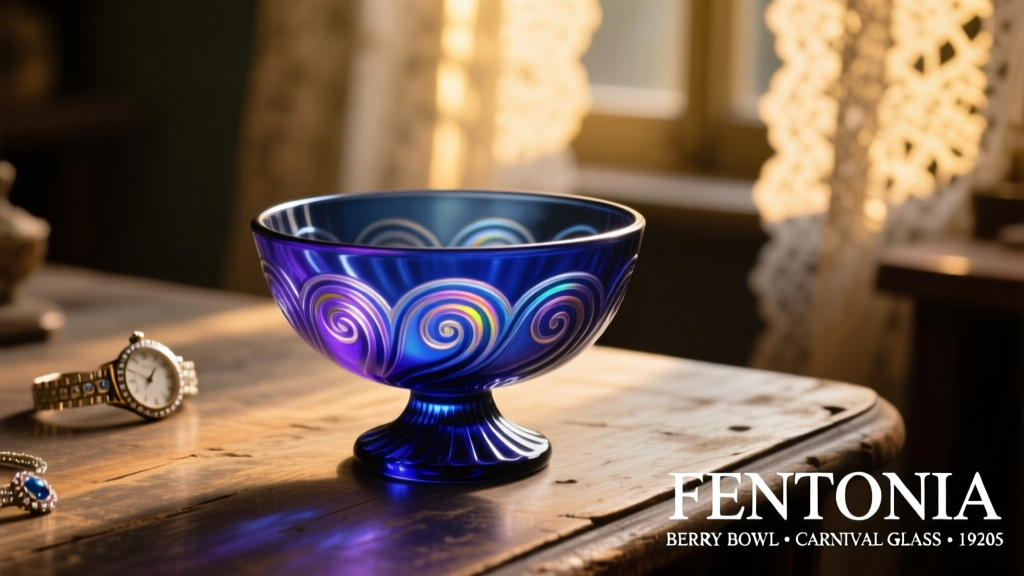
Carnival Glass Fentonia Berry Bowl in Blue Master Footed: A Collector’s Deep Dive
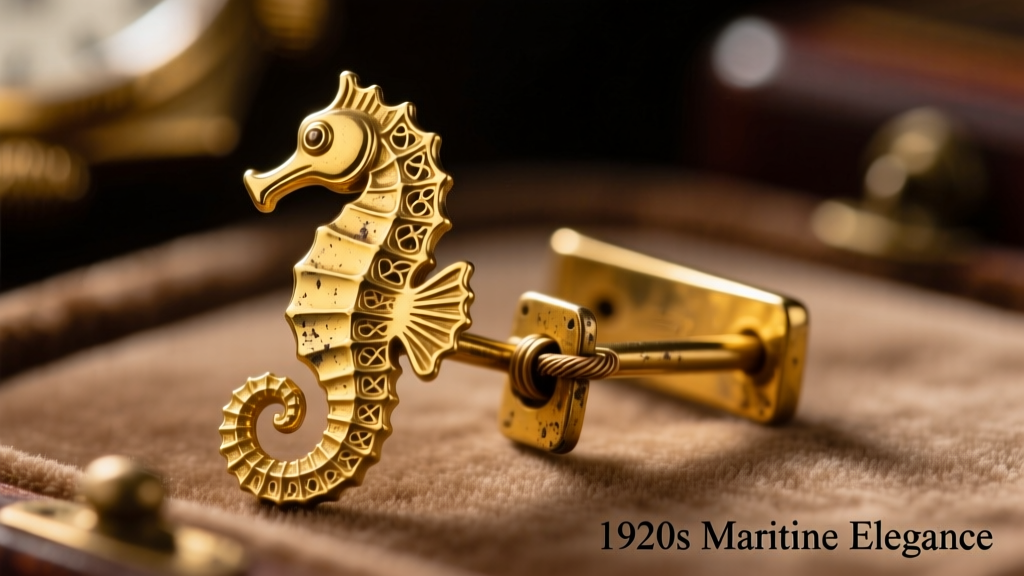
Seahorse Cuff Links with Old-Type Closure: A Collector’s Guide to Vintage Design, Mechanics, and Provenance
Fostoria Fairfax Ashtray Rose #3: A Collector’s Guide to the Iconic American Pressed Glass Tableware
Oklahoma License Plate 1936: A Collector’s Guide to the 6 × 12 1⁄4-Inch Aluminum Specimen
Roseville Blackberry Vase: Identifying, Valuing, and Preserving the Iconic 6-Inch Spherical Two-Handle Form
World Records in Vintage Jewelry and Watches: Auction Milestones, Technical Feats, and Historical Firsts
Sheraton Maple Furniture Stand with Two Dovetailed Drawers: Dimensions, Craftsmanship, and Provenance of a Late 18th-Century American Cabinetmaker's Masterpiece
Muncie Lamp Co. Dennis Shawn Dancers Matte Green Stained Glass Shade: Design, Provenance, and Market Value