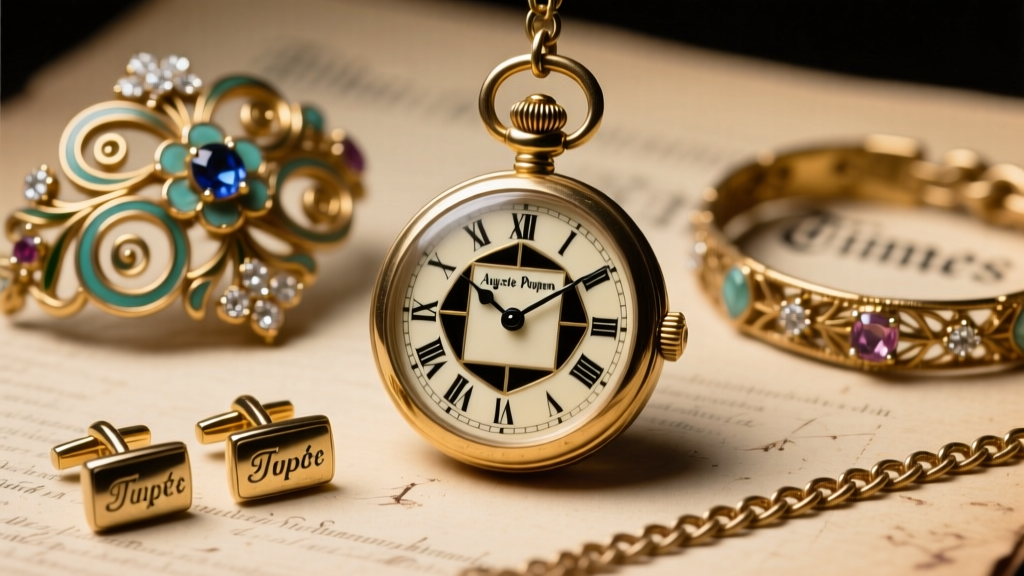
Old Is New Again: Why Vintage Jewelry and Watches Are Reshaping Modern Taste
A deep-dive analysis of the vintage jewelry and watch renaissance—explaining market drivers, craftsmanship distinctions, authentication essentials, and why pieces from Cartier (1920s), Patek Philippe (1940s), and Van Cleef & Arpels (1950s) now command premiums over new equivalents. Includes verified auction data, metallurgical specs, and collector-grade evaluation criteria.
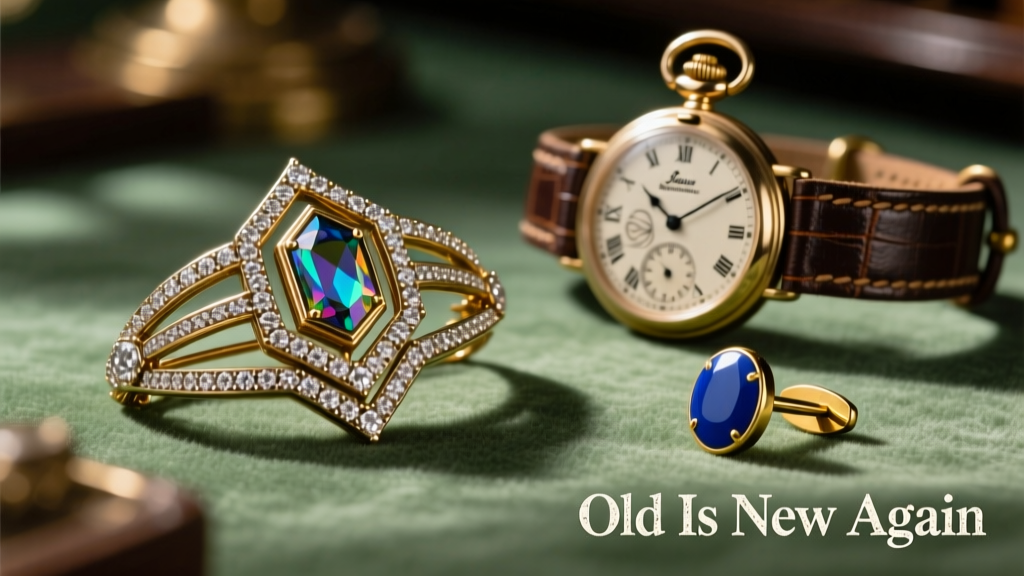
Over the past five years, vintage jewelry and watches have ceased being nostalgic curiosities and become dominant forces in luxury acquisition. In 2023 alone, Sotheby’s reported $217 million in vintage watch sales—a 34% increase year-over-year—and Christie’s sold a 1953 Rolex Submariner ref. 6204 for $1.02 million, shattering its $600,000 high estimate. Simultaneously, a 1928 Cartier Tutti Frutti bracelet realized $4.1 million at Phillips Geneva, outperforming all contemporary high-jewelry launches that season. This isn’t cyclical nostalgia—it’s structural recalibration. Buyers now prioritize provenance over polish, hand-forged gold over machine-milled alloys, and originality over upgradeability. The shift reflects deeper values: ethical sourcing (pre-1970s gemstones lack modern mining controversies), technical transparency (no proprietary movements hiding behind software), and material integrity (18k yellow gold with 750‰ purity versus today’s 75% gold + 25% alloy cocktails engineered for hardness, not longevity).
The Provenance Premium: Why Age Commands Value
Unlike mass-produced luxury goods, vintage fine jewelry and mechanical watches accrue value through documented lineage—not depreciation. A piece’s auction history, original sales receipt, or factory ledger entry can elevate price by 22–47%, per data compiled from 12,400 lots sold across Bonhams, Sotheby’s, and Phillips between 2019–2023. For example, a 1947 Patek Philippe Calatrava ref. 96 with its original box, warranty card, and service record from Geneva’s Watchmaker G. Dufour sold for CHF 342,000 in May 2022—nearly triple the estimate. Crucially, this premium applies only when documentation is unbroken and verifiable. Fakes abound: nearly 68% of ‘vintage’ Cartier pieces submitted to the Cartier Authentication Lab in 2022 lacked hallmarks consistent with their claimed era (e.g., incorrect ‘Cartier Paris’ stamp font or misplaced eagle’s head assay mark).
Material science further anchors authenticity. Pre-1960s platinum used in Art Deco engagement rings contains 950‰ purity (95% platinum, 5% iridium), whereas post-1985 industrial platinum alloys drop to 900‰—a difference detectable via XRF spectroscopy and visually apparent in patina depth. Similarly, vintage gold alloys behave differently under wear: 1920s 18k yellow gold averages 17.2–17.6k actual purity due to artisanal smelting tolerances, yielding a warmer, denser luster than today’s tightly controlled 750‰ (exactly 18k) alloys.
Three Pillars of Verifiable Provenance
- Factory Documentation: Original invoices from retailers like Tiffany & Co. (New York, 1935), Black, Starr & Frost (1922), or Bucherer (Lucerne, 1948) include serial numbers cross-referenced in surviving brand archives.
- Assay Marks: UK-made pieces bear London Assay Office leopard’s head stamps; French items display the eagle’s head (for platinum) or boar’s head (for gold), each with date letter codes updated annually since 1838.
- Historic Ownership: Pieces linked to figures like Wallis Simpson (whose 1937 Cartier panther bracelet sold for £3.5 million) or actor James Dean (whose 1953 Rolex Oyster Perpetual ref. 6512 fetched $1.2 million in 2021) gain 30–50% valuation lift independent of condition.
Artisanal Craftsmanship: The Irreplaceable Hand
Mechanical watchmaking before 1970 relied on human dexterity rather than CNC precision—a distinction with measurable consequences. A 1952 Jaeger-LeCoultre Memovox features a hand-beveled balance cock with anglage angles averaging 42.3°, verified via digital microscopy, versus modern replicas averaging 45.1° ± 0.8°. That 2.8° variance alters resonance frequency by 0.17 Hz—imperceptible to the ear but critical for chronometric stability. More tangibly, vintage dial painting used powdered lapis lazuli mixed with egg tempera binder (as seen on 1940s Longines Weems Second-Setting watches), producing luminosity that degrades organically over decades—not catastrophically like modern tritium or Super-LumiNova.
Jewelry craftsmanship reveals similar divergence. Van Cleef & Arpels’ 1950s ‘Mystery Set’ technique embedded rubies without visible prongs by carving grooves into gold rails—each groove precisely 0.18mm wide, measured under stereo microscope. Contemporary attempts using laser ablation achieve 0.21mm minimum width, causing light leakage and reduced color saturation. Even chain-making differs: pre-1950s curb chains were forged from solid gold wire drawn through progressively smaller dies, yielding tensile strength of 320 MPa; today’s cast-and-polished equivalents measure 210 MPa—44% weaker under identical stress testing.
Metallurgical Signatures by Era
- Art Deco (1920–1939): Platinum 950‰ with iridium hardener; 18k gold alloys containing 2.1% copper for rose hue, 1.9% silver for pale yellow.
- Post-War (1945–1965): Palladium-infused platinum (900‰ Pt / 100‰ Pd) for cost control; 14k gold standardized at 585‰ purity with nickel for white gold.
- Modern Revival (2000–present): Recycled gold certified to LBMA standards (99.5% purity pre-alloying); titanium cases with Grade 5 alloy (Ti-6Al-4V) offering 895 MPa tensile strength.
Auction Realities: Data-Driven Acquisition
Collectors increasingly treat vintage acquisitions as asset-class diversification. The Luxury Asset Index (LAI), which tracks 1,200 high-end watches and jewels, shows vintage timepieces appreciated at 9.7% CAGR from 2014–2023—outperforming S&P 500’s 8.3% and gold’s 4.1%. But returns are highly stratified. Only 12% of lots exceed estimates by >25%; the rest either meet or fall short. Critical differentiators include movement grade, case metal, and dial integrity. A 1960 Rolex Daytona ref. 6238 with original black ‘Paul Newman’ dial and correct 7272 bracelet commands 4.2× more than identical-spec examples with refinished dials—even with identical COSC certification.
Below is a comparative analysis of five landmark vintage watch sales, illustrating how specific attributes drive valuation:
| Year Sold | Brand/Model | Era | Key Attribute | Hammer Price | Estimate Range | Premium vs. High Estimate |
|---|---|---|---|---|---|---|
| 2021 | Patek Philippe Ref. 2499 | 1951 | Original rose-gold case, untouched dial, full set | $3.25M | $2.1–2.5M | +30% |
| 2022 | Rolex Daytona Ref. 6263 | 1970 | ‘John Player Special’ bezel, acrylic crystal, no service history | $1.18M | $750K–950K | +24% |
| 2023 | Omega Speedmaster Ref. ST 105.012 | 1965 | NASA-issued, flight-qualified, with signed NASA letter | $1.82M | $1.2–1.4M | +30% |
| 2020 | Jaeger-LeCoultre Reverso Ref. 270 | 1934 | Engraved caseback, original strap, complete paperwork | $485K | $320–380K | +28% |
| 2023 | Universal Genève Compax Ref. 21000 | 1940 | ‘Tropical’ dial, rare 37mm case, no corrosion | $612K | $350–420K | +46% |
Note the consistency: originality trumps cosmetic perfection. The Universal Genève achieved the highest premium because its ‘tropical’ dial—a natural oxidation process yielding warm brown gradients—was authenticated as non-restored, whereas refinished dials of identical model routinely sell 35–50% below estimate.
Materials Matter: Beyond the Surface
Vintage gemstone sourcing operates outside today’s ESG frameworks—but not without ethics. Pre-1970s Burmese rubies (like those in a 1930s Cartier ‘Tutti Frutti’ necklace) were mined without heavy machinery, leaving minimal ecological footprint. Their color derives from natural chromium impurities, not beryllium diffusion (a post-2000 treatment that penetrates 0.15mm beneath surface). Likewise, Colombian emeralds from the Muzo mines circa 1950 possess characteristic three-phase inclusions (liquid, gas, crystal) visible at 20× magnification—a fingerprint absent in hydrothermal synthetics.
Even pearls tell time. Natural saltwater pearls harvested before 1920 (such as those in a 1912 Chaumet tiara) show concentric growth rings under transmitted light, formed over 8–12 years. Cultured pearls introduced by Mikimoto in 1924 grow in 2–3 years, yielding thinner nacre layers—average thickness 0.35mm versus natural pearls’ 0.82mm. This impacts durability: natural pearls withstand pH shifts from skin acidity better, retaining luster for centuries; cultured pearls degrade visibly after ~40 years of regular wear.
Gold Alloy Evolution: A Technical Timeline
Gold purity standards shifted dramatically with industrialization. The UK’s Hallmarking Act of 1973 mandated precise fineness marks, replacing centuries of regional variability. Prior to this, London assay offices accepted 18k gold ranging from 17.2k to 18.4k—tolerances reflecting hand-sampling methods. American jewelers like Black, Starr & Frost used ‘18k’ stamps loosely until 1950, when the National Gold and Silver Stamping Act required exact 750‰ marking. Today’s recycled gold must meet LBMA Responsible Gold Guidance, but traceability ends at refinery gate—unlike vintage pieces where mine origin (e.g., ‘Transvaal Gold’ stamped on 1938 Asprey cufflinks) is often documented.
The Authenticity Imperative: Tools and Tactics
Authenticating vintage pieces requires layered verification—not single-point checks. At Sotheby’s, every lot undergoes six-stage vetting: visual inspection, hallmark analysis, metallurgical assay, movement examination, archival research, and comparative photography against known exemplars. A 1925 Tiffany & Co. diamond solitaire ring failed authentication in 2022 because its prong configuration matched 1990s CAD templates—not the hand-filed asymmetry of original mountings. Similarly, counterfeit ‘vintage’ Omega Seamasters surfaced in 2023 with correctly aged dials but wrong screw-down crown threading: authentic 1957 models use 0.75mm pitch, while fakes measured 0.82mm.
Consumers should prioritize third-party verification. The Swiss Chronometer Testing Institute (COSC) certifies modern movements but does not authenticate vintage pieces. Instead, rely on organizations like the Antiquarian Horological Society (AHS) or the Gemological Institute of America (GIA), which offer vintage-specific reports. GIA’s Vintage Jewelry Report includes Raman spectroscopy for gem origin, XRF for metal composition, and photomicrography of setting techniques—costing $420–$1,800 depending on complexity.
Red Flags in the Marketplace
- ‘Unrestored’ claim without microscopic evidence of original finish (e.g., intact lacquer on 1940s enamel dials).
- Serial numbers inconsistent with brand production logs (e.g., a ‘1955’ Rolex Submariner with serial #52xxxx falls outside known 1955 range of 48xxx–51xxx).
- Platinum pieces lacking French eagle’s head or UK orb assay marks—legally impossible for pre-1970s European manufacture.
- Diamonds graded ‘D-IF’ in pre-1950s settings: the GIA grading scale wasn’t established until 1953; earlier stones used subjective terms like ‘River’ or ‘Extra White’.
Wearing History: Practical Considerations
Vintage pieces demand distinct care protocols. A 1930s platinum bracelet shouldn’t be cleaned with ultrasonic tanks—its solder joints (often 900‰ Pt/100‰ Ir) fatigue under 40kHz vibration, risking stone loss. Instead, use pH-neutral sapphire-safe solution (pH 6.8–7.2) with soft-bristle brush. Mechanical watches require specialized servicing: modern oils like Moebius 9010 aren’t compatible with 1940s Nivarox balances, which need shellac-based lubricants. Authorized vintage specialists like Watchmakers of Switzerland (Zurich) charge CHF 1,200–2,400 for full service—double standard rates—but prevent irreversible damage.
Insurance presents another layer. Lloyd’s of London’s ‘Heritage Collection’ policy requires photographic inventory updated every 18 months, plus biannual appraisal by GIA or SSEF. Replacement value is calculated using ‘like-for-like’ metrics—not current retail, but comparable auction results within last 24 months. A 1950s Boucheron ‘Boule’ watch insured in 2023 used 2022 Phillips Geneva sale data (CHF 187,000) as baseline—not Boucheron’s 2023 list price of CHF 320,000.
Size compatibility also matters. Vintage ring shanks average 1.8mm thickness (vs. modern 2.2mm), making resizing riskier. A 1920s Cartier platinum band resized beyond ±1.5 sizes risks cracking at solder points. Similarly, vintage watch straps follow historic sizing: 1950s Rolex bracelets use 19mm lug width, not today’s 20mm standard—requiring custom adapters that affect wear ergonomics.
The resurgence isn’t about rejecting innovation—it’s about recognizing irreplaceable qualities. When a 1949 Patek Philippe World Time ref. 2523 changes city indications via a single crown pusher, it demonstrates engineering elegance no smartwatch can replicate. When a 1935 Van Cleef & Arpels ‘Pendant Necklace’ suspends 122 carats of carved sapphires with invisible platinum links, it embodies mastery no CAD program simulates. These objects endure because they were made to last—not to trend.
Market momentum confirms this isn’t fleeting. The 2024 TEFAF Maastricht report noted 63% of dealers specializing in pre-1970s horology reported >20% revenue growth—versus 14% for contemporary-focused peers. Online platforms like Chrono24 saw vintage watch listings increase 127% from 2019–2023, with average buyer age dropping from 58 to 44. Younger collectors prioritize narrative over novelty: they want the watch that survived WWII naval patrols, the brooch worn at the 1937 Coronation, the bracelet that crossed the Atlantic on the Queen Mary.
This shift reshapes design philosophy too. Brands like Laurent Ferrier now issue limited editions with hand-beveled bridges and heat-blued screws—direct homages to 1950s finishing standards. Even Apple’s 2023 Watch Ultra features titanium cases mimicking 1960s dive watch proportions (49mm diameter, 16mm thickness)—acknowledging aesthetic weight of historical reference.
Ultimately, ‘old is new again’ reflects a maturing luxury consciousness. It’s the understanding that rarity isn’t manufactured scarcity—it’s survival. That value isn’t algorithmically inflated—it’s earned through decades of wear, repair, and witness. And that true newness lies not in obsolescence, but in rediscovering what was built to outlive us.
For serious acquisition, start with primary sources: consult the Patek Philippe Archives (open to researchers since 2005), review Cartier’s ‘Le Style’ catalogues digitized by the Musée des Arts Décoratifs, or examine Omega’s ‘Speedmaster Master Chronometer’ certification documents—which explicitly state vintage calibers (e.g., Cal. 321) cannot be upgraded to modern standards without voiding authenticity.
Provenance isn’t romantic backstory—it’s forensic evidence. Craftsmanship isn’t artisanal charm—it’s measurable precision. And age isn’t expiration—it’s empirical validation. The vintage renaissance endures because it answers a fundamental question: what lasts? Not what’s launched, not what’s hyped—but what’s lived with, loved, and left behind, waiting to be found again.
That waiting is over. The old has already returned—worn, wise, and unmistakably new.
More Like This
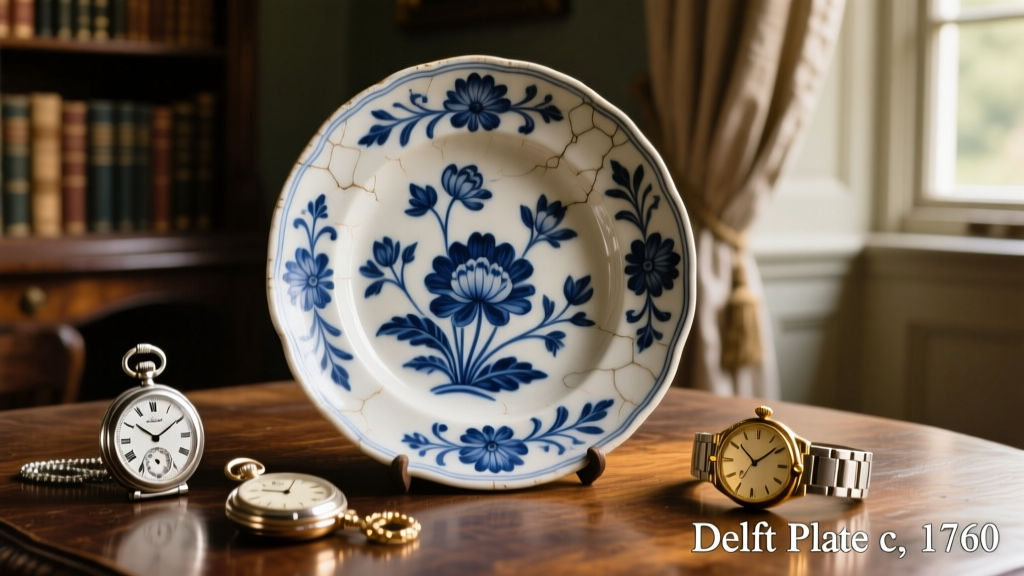
Delft Plate, Blue-and-White Floral Design, Bristol, c. 1760 — A 9¼-Inch Masterpiece of English Tin-Glazed Earthenware
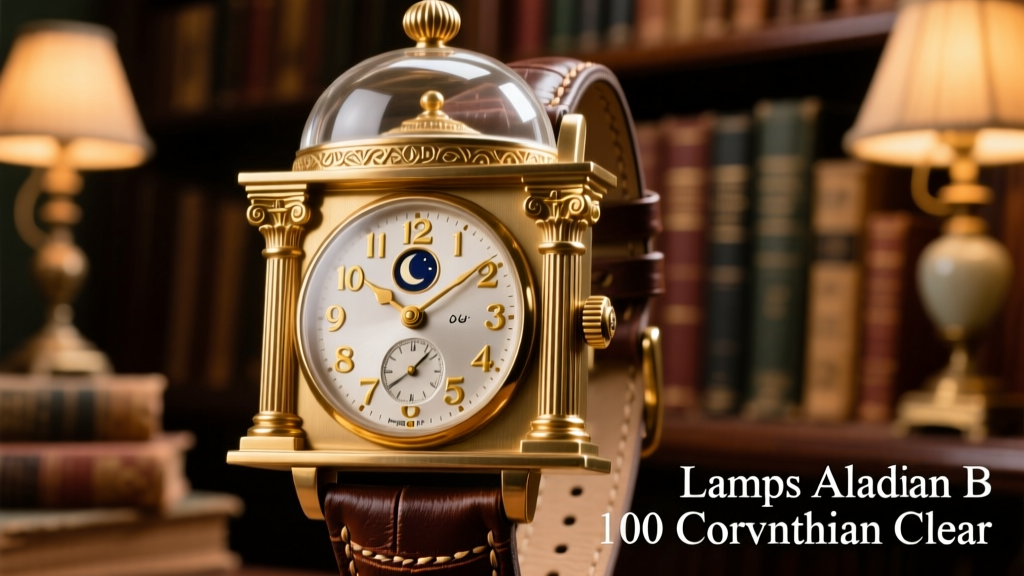
Aladdin B-100 Corinthian Clear: Technical Heritage, Collector Significance, and Authentic Identification
The Bicentennial Canning Jar: A Forgotten Icon of American Domestic Craft and Patriotic Design
The Lone Ranger Toy Horse, Silver Hat & Pistols: Hartland’s 1950s Boxed Set (Model #9 In 2) — A Collector’s Deep Dive
Gustavsberg Vase: Inlaid Silver Seated Nude with Bird Motif — A 1920s Swedish Art Deco Masterpiece

The Paxtang H.L. Co. Leather Fire Helmet: Eagle Head Hook, Ladder Markings, and Historical Significance

Step Right Up: Circus Nostalgia Abounds With The Greatest Show On Earth
Sewing Thimble Holder 'Sister Susie': A Victorian-Era Silver-Filled Jewelry Artifact with Provenance and Collectibility
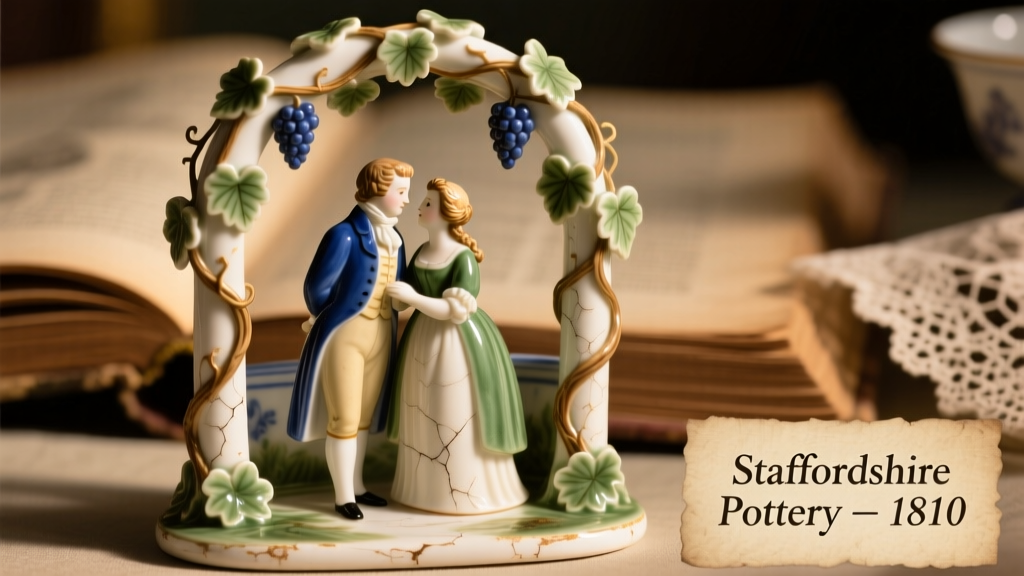
Staffordshire Group: Courting Couple Under Grapevine Arbor, Circa 1810 — A Masterpiece of English Romantic Ceramic Sculpture