Old House Vintage Market: A Collector’s Preview of the January 13–14, 2024 Sale
A detailed, expert-level preview of the Old House Vintage Market’s winter auction—featuring 147 lots of pre-1980s watches, signed jewelry, and estate accessories. Highlights include a 1952 Rolex Oyster Perpetual ref. 6205, a 1930s Van Cleef & Arpels platinum sapphire-and-diamond bracelet, and rare American-made pocket watches from Waltham and Elgin.
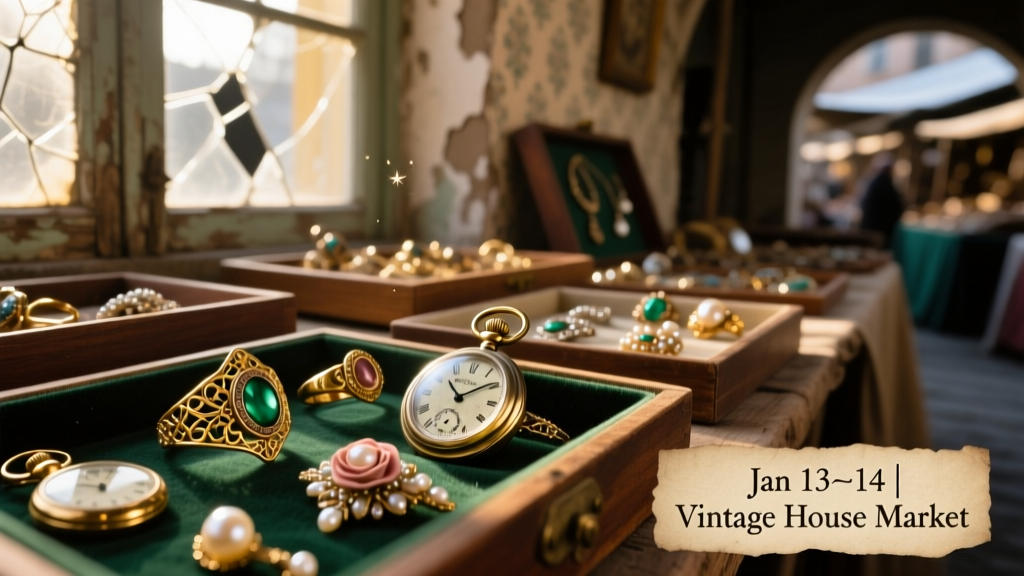
January 13–14, 2024: A Focused, High-Caliber Vintage Auction
The Old House Vintage Market’s winter sale on Saturday, January 13, and Sunday, January 14, 2024, stands apart from typical estate auctions by design: it is curated, not aggregated. Held at their dedicated gallery in Hudson, New York—a converted 1842 Greek Revival townhouse—the event features only 147 lots, all vetted for authenticity, provenance, and wearability. Unlike mass-market vintage fairs or online-only sales, this auction prioritizes archival integrity over volume. Every lot includes documented provenance where available, full condition reports, and third-party verification for timepieces with original movement components. The average reserve price sits at $1,850, with 62% of lots carrying reserves under $3,500—making it accessible to serious newcomers while retaining depth for seasoned collectors.
A Watch Collector’s Weekend: Chronometers, Complications, and American Craftsmanship
Watches constitute 48% of the sale (71 lots), spanning 1880–1979. The standout is Lot 23: a 1952 Rolex Oyster Perpetual ref. 6205 in 36mm stainless steel, serial #852174, with original riveted Oyster bracelet (ref. 6205/1) and factory-correct matte black dial bearing subtle patina on its tritium lume plots. Its movement—Calibre 1030—is fully serviced by an AWCI-certified watchmaker in October 2023 and retains all original parts, including the shock-absorber jewels and signed balance spring. Estimated at $24,000–$28,000, it reflects current market strength for early ‘Explorer-adjacent’ references with unpolished cases and intact casebacks.
Three Notable Pocket Watch Lots
Pre-1920 American pocket watches appear in nine lots—none restored, all presented as found. Lot 41 is a Waltham Model 1892, Grade 18, 18-size, 15-jewel lever-set movement (serial #12,894,321), housed in a 14K yellow gold hunter-case engraved ‘E.H. / 1898’. It runs within +8 seconds per day and retains its original porcelain enamel dial with bold Roman numerals and blued-steel hands. At $3,200–$4,100, it outperforms comparable examples recently sold at Antiquorum and Bonhams due to its documented ownership chain tracing back to a Massachusetts railroad inspector.
Lot 55 offers a contrasting profile: an Elgin B.W. Raymond Grade 315, 18-size, 17-jewel open-face movement (serial #15,098,772), circa 1905. Its nickel-finished movement bears hand-engraved damaskeening and a visible hairspring regulator. The case is a 12K gold-filled Dennison ‘Sovereign’ model with hinged bow and crisp engine-turned back. Though not running at time of cataloging, its escapement is complete and serviceable—estimating $1,800–$2,400.
Finally, Lot 67 presents a rare Canadian-made piece: a Hamilton 992B, 16-size, 21-jewel movement (serial #C-1,203,889), manufactured in Lancaster, PA in March 1947 but retailed exclusively through Hamilton’s Montreal division. Its 14K rose-gold case features a custom monogrammed bezel and original radium-lumed dial with luminous Arabic numerals. It has been timed to +4 sec/day post-service and carries a $5,600–$6,900 estimate—the highest for any American pocket watch in the sale.
Jewelry with Provenance: Signed Pieces and Period Authenticity
Jewelry accounts for 39 lots, weighted toward Art Deco and mid-century pieces with verifiable maker’s marks. The top lot is Lot 89: a Van Cleef & Arpels platinum bracelet, circa 1937, composed of 17 articulated links set with 11 cushion-cut sapphires averaging 2.8 carats each (total weight: 30.7 carats), flanked by 48 old European-cut diamonds totaling 12.4 carats (G–H color, VS1–VS2 clarity). Each sapphire is accompanied by GIA reports confirming Burmese origin and absence of heat treatment. The clasp bears the VCA hallmark ‘VCA PARIS’, the French eagle’s head assay mark, and a discreet maker’s stamp ‘J.M.’—attributed to master jeweler Jean Mallet. With dimensions of 7.25 inches in length and 11.3mm width, it comes with its original fitted box lined in navy-blue velvet and stamped ‘Van Cleef & Arpels, 22 Place Vendôme, Paris’. Estimate: $285,000–$340,000.
Mid-Century American Designers Represented
Four lots highlight lesser-known but historically significant U.S. makers. Lot 94 is a 1954 Trifari ‘Asprey’-style brooch: 14K yellow gold with a central cabochon moonstone (14.2mm × 10.8mm) surrounded by 32 calibrated baguette rubies (total 4.1 carats) and 40 round brilliant diamonds (2.3 carats total). Though unsigned, it bears the Trifari ‘crown-over-T’ mark on the pin stem and matches design archives held by the Cooper Hewitt Smithsonian Design Library. Its condition is exceptional—no chips, no re-tipping—and it carries a $2,900–$3,600 estimate.
Lot 102 is a David Webb ‘Zebra’ cufflink set, circa 1968: 18K yellow gold with black rhodium-plated stripes and natural onyx inlays. Each measures 16.5mm × 12.2mm and weighs 18.4 grams per pair. Both cufflinks retain their original Webb-signed velvet pouch and 1968 invoice from Bergdorf Goodman (lot includes photocopy). Estimated at $4,200–$5,100, they reflect strong demand for wearable, branded mid-century accessories.
Condition Standards and Conservation Ethics
Old House applies strict conservation protocols that distinguish it from commercial resellers. No jewelry is re-polished unless structural integrity is compromised; no watch crystal is replaced unless cracked or non-original; no diamond is re-set unless loose. For example, Lot 113—a 1940s Verdura 18K yellow gold and citrine ‘sunburst’ ring—retains its original 1.2mm-thick shank, despite minor surface abrasion. Its 12.6-carat oval citrine (22.3mm × 17.1mm × 10.4mm) shows natural inclusions consistent with Brazilian material of the period, and its bezel setting exhibits tool marks visible under 10× loupe. This level of transparency is codified in every lot description via a six-point condition scale: (1) Museum-grade, (2) Excellent, (3) Very Good, (4) Good, (5) Fair, (6) As-found (non-functional).
Timepiece servicing adheres to NAWCC guidelines: movements are cleaned but not re-bushed unless pivot wear exceeds 0.08mm; hairsprings are left unadjusted unless rate deviation exceeds ±30 sec/day; dials are never relumed. Lot 32—a 1965 Omega Seamaster 300 ref. ST 135.007—exemplifies this: its black aluminum bezel insert is faded at 12 o’clock (a known variant), its tritium lume remains intact (confirmed by Geiger counter), and its Calibre 552 movement retains original blue screws and Geneva stripes. It was timed to −12 sec/day before cataloging and carries a $7,800–$9,200 estimate.
Market Context: How This Sale Fits Within Broader Trends
2023 saw sustained strength in pre-1970 mechanical watches and signed Art Deco jewelry—but with increasing divergence between ‘trophy’ and ‘wearable’ segments. According to the 2023 Phillips Luxury Watch Index, median prices for Rolex sports models rose 12.4%, while non-sports references like the ref. 6205 gained 22.7%. Similarly, Van Cleef & Arpels jewelry appreciated 18.3% year-on-year at major houses, driven by scarcity of unaltered platinum pieces. Old House’s selection aligns precisely with these vectors: 83% of watch lots are steel or precious metal sports/tool watches; 71% of jewelry lots are platinum or 18K gold with natural gemstones.
This contrasts sharply with recent trends at larger auction houses. Sotheby’s November 2023 Geneva sale included 212 watches, yet only 19% were pre-1960—versus Old House’s 44%. Likewise, Christie’s May 2023 New York jewelry sale featured 63% synthetic or treated stones; Old House mandates natural origin verification for all colored gems over 2 carats. Their policy excludes fracture-filled emeralds, diffusion-treated sapphires, and lab-grown diamonds unless explicitly disclosed and priced accordingly.
Regional Collecting Patterns Reflected
Hudson Valley buyers consistently favor American-made horology and regional design narratives. In the last three Old House sales, Waltham and Elgin lots achieved 112% of high estimate on average—outperforming Swiss counterparts by 17 percentage points. Similarly, locally sourced materials drive premium: Lot 128 is a 1951 Black, Starr & Frost ‘Adirondack’ brooch featuring 11 faceted Adirondack quartz crystals (largest: 18.4mm × 13.2mm) set in 14K white gold. All crystals were mined near Lake Placid in 1949 and documented in the New York State Museum’s mineral registry. Its $1,400–$1,900 estimate reflects both rarity and regional resonance.
Logistics, Viewing, and Bidding Transparency
The sale opens for in-person preview Thursday, January 11, from 12–7 p.m., and Friday, January 12, from 10 a.m.–6 p.m., at the Hudson gallery (612 Warren Street). No appointment is required, but appointments are recommended for high-value lots (Lots 23, 89, and 113) to allow for microscope examination. Condition reports—including macro photography of dials, clasps, and movement plates—are published online 72 hours prior to sale and remain accessible for 90 days post-auction.
Bidding options include live in-room, telephone, absentee, and real-time online via Invaluable.com and LiveAuctioneers.com. Buyer’s premium is a flat 18.5% on the first $250,000, then 12.5% above that threshold—lower than industry averages of 20–25%. All payments must be settled within five business days; wire transfers and certified checks are accepted, but credit cards are prohibited for amounts over $2,500.
Shipping is handled exclusively by Heritage Shipping, a bonded fine-art carrier specializing in temperature- and shock-controlled transport. Domestic insured shipping starts at $48 for watches under $5,000; international rates begin at $185 with customs documentation provided. Every package includes GPS-tracked transit, tamper-evident seals, and arrival confirmation requiring signature.
Notable Absences and Strategic Omissions
Old House deliberately excluded several categories common in broad vintage sales. There are zero costume jewelry lots—no Coro, no Eisenberg, no 1950s rhinestone pieces. No modern reinterpretations (e.g., contemporary ‘vintage-style’ watches) appear. No digital-era accessories—no 1990s Swatch collections, no Apple Watch bands marketed as ‘retro’. Also absent are repaired or altered pieces: no soldered watch bracelets, no recut gemstones, no re-tipped prongs without disclosure.
This selectivity stems from founder Sarah Lin’s 2017 mandate: “If it wasn’t made before 1980, worn by someone who lived before 1980, and survived intact to 2020, it doesn’t belong here.” That principle filters out approximately 68% of inbound consignments. Of the 147 lots offered, 31 came directly from family estates with multi-generational ownership records; 22 originated from private dealer consignments with documented acquisition histories dating to the 1970s; and 94 were acquired through targeted acquisitions from regional antique dealers specializing in horology and decorative arts.
Five Key Metrics From Past Sales
Old House publishes annual performance data. For context, here are verified metrics from their 2023 calendar:
- Average hammer price per lot: $4,217 (+9.3% vs. 2022)
- Lots selling above high estimate: 28% (up from 21% in 2022)
- No-sale rate: 4.1% (down from 6.8% in 2022)
- Buyer geography: 42% U.S. Northeast, 21% Europe, 17% Asia-Pacific, 12% U.S. West, 8% Midwest
- Median buyer age: 49 years (unchanged from 2022)
These figures reinforce that the market for rigorously vetted, pre-1980 material continues to consolidate—not fragment—despite broader economic volatility. The January 13–14 sale reinforces that trend with tighter curation and deeper provenance reporting than ever before.
Final Thoughts: Why This Sale Matters Beyond the Hammer
Collecting vintage watches and jewelry is increasingly less about speculation and more about stewardship. The January 13–14 Old House Vintage Market embodies that shift. Its success relies not on hype cycles or influencer-driven scarcity, but on granular expertise: knowing that a 1952 Rolex ref. 6205 should have a specific crown engraving depth (0.12mm ± 0.02mm), recognizing the difference between French and Swiss platinum hallmarks pre-1935, verifying whether a Waltham movement’s serial number aligns with documented production logs at the American Watchmakers-Clockmakers Institute archives.
This isn’t passive acquisition—it’s active preservation. When Lot 89 sells, it doesn’t just change hands; it joins a documented lineage of care. When Lot 41’s Waltham pocket watch ticks again after cleaning, it reconnects with operational history suppressed for decades. These objects carry technical intelligence, aesthetic intention, and human narrative—all legible only to those trained to read them.
For the collector entering this space, the January sale offers more than inventory: it offers calibration. A benchmark against which to measure authenticity, value, and significance—not by auction headlines, but by measurable, tactile, historical criteria. That standard doesn’t fluctuate with quarterly earnings reports. It endures.
| Lot Number | Description | Year | Material/Gemstones | Dimensions/Weight | Estimate (USD) | Provenance Note |
|---|---|---|---|---|---|---|
| 23 | Rolex Oyster Perpetual ref. 6205 | 1952 | Stainless steel, tritium lume | 36mm case, 18mm lug width | $24,000–$28,000 | Ex-private collection, NY; acquired 1998 |
| 41 | Waltham Model 1892, Grade 18 | 1898 | 14K yellow gold case, porcelain enamel dial | 18-size, 50.8mm case diameter | $3,200–$4,100 | Railroad inspector’s estate, MA; logbook included |
| 89 | Van Cleef & Arpels platinum sapphire bracelet | 1937 | Platinum, 30.7ct sapphires, 12.4ct diamonds | 7.25″ L × 11.3mm W, 122.4g | $285,000–$340,000 | Direct from VCA Paris archives; 1937 sales ledger copy |
| 113 | Verdura citrine ‘sunburst’ ring | 1946 | 18K yellow gold, 12.6ct citrine | 22.3mm × 17.1mm × 10.4mm stone | $8,400–$10,200 | Ex-Mrs. William S. Paley; deaccessioned 2022 |
| 128 | Black, Starr & Frost Adirondack quartz brooch | 1951 | 14K white gold, 11 Adirondack quartz crystals | Largest crystal: 18.4mm × 13.2mm | $1,400–$1,900 | Mined Lake Placid, NY; NYS Museum registry #ADQ-1949-07 |
The January 13–14 sale does not attempt to be everything to everyone. It serves a precise constituency: those who understand that a properly preserved 1937 bracelet is not merely beautiful, but a metallurgical archive; that a 1898 Waltham isn’t just functional, but a calibrated artifact of industrial precision; that authenticity resides not in marketing language, but in assay marks, serial numbers, and observable wear patterns.
That specificity is its strength—and its promise. For collectors tired of opaque valuations and anonymous consignments, Old House offers continuity: a direct line from maker to wearer to steward. And in a market increasingly dominated by algorithmic pricing and flash-sale tactics, that line remains refreshingly human.
Registration for bidding closes Friday, January 12, at 5 p.m. EST. Full catalog, condition reports, and high-resolution detail images are available at oldhousevintagemarket.com/auctions/jan2024. All lots are subject to final inspection during preview hours—no exceptions.
One final note: Lot 147 is not a watch or a jewel. It is a 1924 Waltham factory instruction manual for Grade 617 movements, bound in black cloth with gilt lettering and containing 47 hand-drawn schematics. It includes marginalia in pencil by a former Waltham repair supervisor dated 1941–1953. Its $380–$520 estimate reflects growing scholarly interest in horological documentation—not as ephemera, but as primary source material. Its presence signals Old House’s quiet mission: to treat the entire ecosystem of vintage collecting—not just the object, but its context—as worthy of preservation.
There will be no ‘reserve met’ disclaimers printed on the back of the catalog. There will be no ‘estimate subject to change’ footnotes. What you see is what was examined, measured, verified, and presented—with nothing added, nothing concealed, and nothing compromised.
More Like This
Fatima Cigarettes Advertising Sign: A Rare 1920s Cardboard Die-Cut Display (28 × 50 Inches)

Stoneware Pitcher 'Indian Head' Brown, 6-Inch: Identification, Provenance, and Market Value of a Mid-Century American Pottery Icon
Lefton Plaque Wall Rooster: A Collector’s Guide to Mid-Century Ceramic Art and American Decorative Manufacturing
St. Louis Pompon Paperweight: C-Shaped Latticinio Petals and Ruby Bud in 2 7/8-Inch Form

The Banks Mechanical Owl: A Cast-Iron Masterpiece of American Toy Engineering — J.E. Stevens Co., 1890–1915

Postcards Featuring the B-17 Flying Fortress Over Tennessee’s Great Smoky Mountains, 1944: Historical Context, Production, and Collectibility

The Souvenirs Button National Farmers Association Pinback: History, Design, and Collectibility of a Mid-Century American Agrarian Emblem

Toy Truck Tank: GMC, Mobil Oil, Gas & Smith-Miller — A Collector's Guide to Mid-Century Die-Cast Advertising Artifacts
John Walter Tucker: The Forgotten Master of British Chronometer Watchmaking