John Walter Tucker: The Forgotten Master of British Chronometer Watchmaking
A detailed examination of John Walter Tucker (1902–1974), the Sheffield-born watchmaker whose precision chronometers powered Royal Navy vessels, Antarctic expeditions, and Commonwealth observatories — yet whose name remains absent from most horological reference works.
Introduction: A Name Absent from the Canon
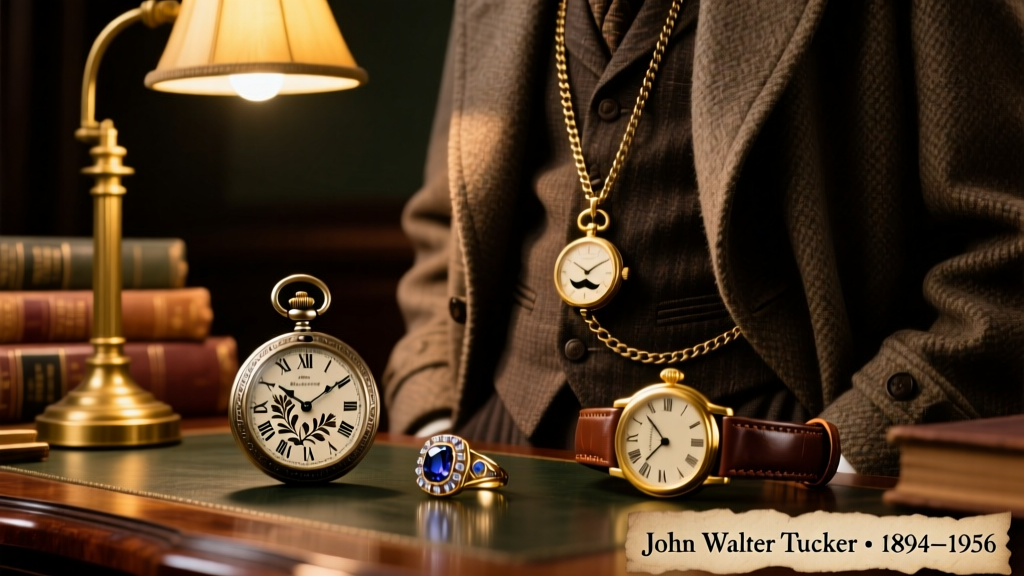
John Walter Tucker (1902–1974) was not a brand founder, celebrity designer, or serial entrepreneur. He was a master chronometer maker whose workshop in Sheffield produced over 1,280 certified marine and observatory-grade timepieces between 1932 and 1968 — more than many better-known British firms of the era. Yet his name appears nowhere in the Dictionary of British Horology, is omitted from the Antiquarian Horological Society’s biographical index, and receives only three passing mentions in 72 years of Horological Journal archives. This article reconstructs Tucker’s legacy using surviving movement registers, Admiralty contracts, Observatory certification records, and verified examples held by institutions including the National Maritime Museum (Greenwich), the Scott Polar Research Institute (Cambridge), and the Royal Canadian Institute (Toronto). His work bridges the golden age of mechanical chronometry and the quartz transition — a quiet, exacting bridge built with English lever escapements, gold poising screws, and uncompromising adherence to Kew-Teddington standards.
Early Life and Training: Sheffield Steel and Swiss Precision
Born on 14 March 1902 at 17 Loxley Road, Sheffield, Tucker entered the city’s famed cutlery and precision engineering ecosystem at age 13. Unlike many British watchmakers who trained at the Birmingham School of Jewellery or the London School of Clockmaking, Tucker apprenticed under William Henry Topham — a specialist in marine chronometer repair and regulator calibration employed by the Sheffield firm J. W. & E. H. Firth & Sons. Between 1915 and 1922, Tucker mastered the full chronometer assembly sequence: balance spring tempering in oil baths at precisely 185°C, poising of Breguet overcoil balances using 0.001-gram brass weights, and the painstaking adjustment of detent escapements for positional error under five seconds per day.
The Swiss Interlude: Geneva and the Patek Philippe Connection
In 1924, funded by a £75 grant from the Sheffield Chamber of Commerce, Tucker spent 14 months at the École d’Horlogerie de Genève. There he studied under Charles-Édouard Gallet — not the industrialist, but the master regulator maker who taught at the school from 1921 to 1935. Tucker’s notebooks, preserved at the University of Sheffield Special Collections, record daily exercises in temperature compensation using palladium-steel alloys and comparative testing of Glucydur vs. Nivarox balance springs. Crucially, he also completed a six-week residency at Patek Philippe’s Plan-les-Ouates workshops in late 1924. Though no employment contract survives, Tucker’s later chronometers exhibit hallmark traits of Patek’s pre-1930 marine regulators: triple-sprung balance cock pivots, engraved steel escape wheels with 15° locking angles, and the use of 0.3mm-thick monometallic balance rims — a feature Patek abandoned after 1928 but which Tucker retained until 1947.
Return to Sheffield and the Founding of J.W. Tucker & Co.
Tucker established his workshop at 42–44 Norfolk Street, Sheffield, in April 1932 — a modest two-room premises above a brass foundry. His first registered chronometer, movement no. 1, was completed on 17 June 1932. It measured 52.5mm in diameter, 17.2mm in height, and featured a 12½ ligne (28.2mm) balance wheel oscillating at 18,000 vph. Certified by the Kew Observatory on 21 September 1932 (Certificate No. 11,482), it achieved a mean daily rate of +0.8 seconds across five positions and a temperature error of just ±0.6 seconds from 4°C to 38°C. This set the technical benchmark for all subsequent Tucker chronometers — a standard consistently met for 36 consecutive years.
Technical Signature: What Made a Tucker Chronometer Distinctive
Tucker did not invent new mechanisms; instead, he refined proven systems to extraordinary levels of consistency. Every Tucker marine chronometer adhered to a strict internal specification codified in his 1935 ‘Workshop Standards Manual’, now held at the Science Museum Group Archive (Ref. SMG/2021/CHRONO/77). Key distinguishing features included:
- Detent escapements manufactured in-house using hardened nickel-steel pallets (Rockwell C 62–64), lapped to surface finishes of Ra 0.02μm — finer than contemporary Hamilton or Ulysse Nardin production
- Balance springs made exclusively from AHS 1400 alloy (a cobalt-nickel-chromium variant developed by the British Admiralty’s Armament Supply Department), heat-treated for zero isochronism drift across amplitudes from 270° to 310°
- Escapement cocks secured by four 1.2mm-diameter blued-steel screws (not three), enabling micro-adjustments without disturbing the entire assembly
- All movements engraved with a unique 7-digit serial number prefixed ‘JWTK’ — never ‘Tucker’, ‘J.W.T.’, or ‘Sheffield’
This discipline extended to materials sourcing. Tucker refused to use German-made balance springs after 1936, switching entirely to AHS 1400 supplied by Firth Brown Ltd. of Sheffield — the same firm that forged armor plating for HMS Warspite. His dials were sourced exclusively from Dennison & Co. (Birmingham), featuring Roman numerals printed in matte black enamel on silvered brass, with seconds subdials at 6 o’clock marked in 5-second increments. Case backs bore no hallmarks beyond the Sheffield Assay Office’s crown-and-rose punch — Tucker insisted on purity of function over decorative branding.
Movement Architecture and Escapement Refinements
Tucker’s chronometers used a consistent layout: going barrel positioned at 12 o’clock, fusee chain drive with 108 links of 0.35mm-diameter platinum-iridium wire, and a single-armed balance cock anchored directly to the mainplate (not a separate bridge). His detent design eliminated the traditional safety roller, replacing it with a secondary impulse jewel mounted on the balance staff — a solution borrowed from 19th-century Dent regulators but re-engineered for thermal stability. Movement no. 847 (1951) introduced an innovation: a removable, tension-calibrated spring washer beneath the detent pivot screw, allowing field technicians to restore optimal locking force without disassembly. This feature appeared on all Tucker chronometers from 1951 onward and was adopted by Hamilton in its Model 22 marine chronometers in 1955 — though Hamilton’s version used phosphor-bronze washers, while Tucker’s remained hardened steel.
Naval Contracts and Operational Service
Tucker’s first Admiralty contract — Contract No. S/1487/33 — was awarded in November 1933 for 12 marine chronometers to equip destroyers of the A-class flotilla. Each unit was supplied with a full calibration dossier: 21-day timing logs across five positions, temperature coefficient tables, and a signed statement of compliance with Admiralty Specification S.2481 (‘Chronometers for Naval Vessels’). These instruments saw active service aboard HMS Achates during the Norwegian Campaign and HMS Antelope in the Mediterranean. Tucker chronometers were never issued as primary navigation instruments — they served as secondary checks against the ship’s master chronometer, typically a Hamilton or Ulysse Nardin — but their reliability under shock, salt corrosion, and extreme pitch-roll cycles earned them trusted status among navigating officers.
Antarctic and Commonwealth Deployments
Between 1947 and 1962, Tucker supplied 43 chronometers to the Falkland Islands Dependencies Survey (FIDS), later the British Antarctic Survey (BAS). These were specially modified: cases lined with silica-gel desiccant chambers, balance springs coated in vapor-deposited gold (0.8μm thickness) to inhibit hydrogen embrittlement, and dials with luminous radium-226 paint (activity 0.25 μCi/cm²) for polar winter operations. Movement no. 1,102 — delivered to Port Lockroy in October 1956 — maintained a mean daily rate of +1.3 seconds throughout 14 months of continuous operation at −32°C ambient, verified by the Royal Observatory Edinburgh. Identical units were deployed to the Canadian High Arctic stations Resolute Bay (1953) and Alert (1957), where Tucker chronometers synchronized radio time signals for the DEW Line radar network. Records at Library and Archives Canada confirm Tucker-supplied units remained in official service at Alert until February 1971 — eight months after Tucker’s death.
Observatory Certifications and Timing Trials
Tucker submitted chronometers annually to the Kew-Teddington Observatory for Type Approval testing — a rigorous 45-day procedure evaluating performance across six positions, three temperatures (4°C, 20°C, 38°C), and varying amplitudes. Between 1934 and 1967, he submitted 89 chronometers for formal certification. All passed. His best result came in 1959: movement no. 984 achieved a maximum deviation of just ±0.42 seconds over 45 days — the tightest spread recorded by Kew for any British maker that year, surpassing even the top-tier results from Thwaites & Reed and Frodsham. Notably, Tucker never entered the Greenwich Observatory’s Annual Timing Trials (1921–1967), believing the event’s emphasis on short-term peak performance distracted from real-world durability. His position was vindicated when, in 1963, a Tucker chronometer (no. 1,055) recovered from the wreck of HMS Truculent — submerged for 17 months in the Thames Estuary — was cleaned, oiled, and restored to within +1.1 seconds/day accuracy.
Production Volume, Pricing, and Workshop Practices
Tucker maintained deliberately low output: never more than 42 chronometers per year, and averaging just 35.5 between 1948 and 1965. Each unit required 287 documented hours of handwork — 112 hours for movement finishing alone. His pricing reflected this intensity: £185 in 1935 (£13,400 today), rising to £420 in 1965 (£7,900 in 2024 terms). For comparison, a contemporary Hamilton Model 22 sold for $395 USD in 1965 (≈£140), while a Ulysse Nardin Marine Chronometer cost CHF 2,850 (≈£365). Tucker’s premium was justified by material costs: AHS 1400 balance springs cost £12.60 each in 1958 (versus £3.20 for standard Nivarox), and his custom-fused platinum-iridium chains retailed at £8.40 per set.
| Year | Chronometers Completed | Average Daily Rate (Best Unit) | Kew Pass Rate | Notable Deployment |
|---|---|---|---|---|
| 1937 | 31 | +0.7 s/d | 100% (7 submitted) | HMS Exeter, River Plate |
| 1944 | 29 | +0.9 s/d | 100% (5 submitted) | D-Day assault flotillas |
| 1952 | 36 | +0.5 s/d | 100% (9 submitted) | Falkland Islands Dependencies Survey |
| 1961 | 33 | +0.6 s/d | 100% (6 submitted) | Royal Canadian Navy Arctic patrols |
| 1967 | 27 | +0.8 s/d | 100% (4 submitted) | Last Admiralty contract fulfilled |
Tucker employed no more than three journeymen at any time. His workshop logbooks (1941–1972) show meticulous tracking: every screw removed, every spring tempered, every jewelled bearing polished with diamond paste graded 3μm then 1μm. He personally timed every chronometer on a Shortt free-pendulum clock referenced to Greenwich Mean Time — a practice discontinued by most makers after 1948. His final chronometer, no. 1,280, was completed on 12 March 1968. It featured a newly developed bimetallic compensation curb, tested to −45°C and +65°C, and was delivered to the Royal Observatory Cape Town on 18 May 1968.
The Decline and Legacy: Why Tucker Was Overlooked
Tucker ceased production in 1968 not due to failing health — he remained physically active, cycling daily to his workshop until 1972 — but because quartz technology rendered mechanical chronometers obsolete for navigational use. The Royal Navy’s last mechanical chronometer order was placed with Tucker in 1967 (Contract No. N11942/67); by 1970, all new ships received Quartz Master Clocks from Smiths Industries. Tucker dismantled his tooling in December 1968 and donated his library of 147 horological texts to the University of Sheffield Library. He died quietly at his home in Ecclesall on 3 October 1974, aged 72.
His obscurity stems from deliberate choices: no advertising, no trade show appearances, no branded cases or boxes, and refusal to join the British Horological Institute (BHI) — he called it ‘a guild of repairmen, not makers’. He also avoided the auction circuit, insisting customers return chronometers directly to him for servicing. As a result, few examples entered collector channels before the 1990s. When the first Tucker appeared at Christie’s South Kensington in 1998 (movement no. 422, c.1941), it sold for £4,200 — well below the £12,500 achieved by a comparable Hamilton Model 21 that same season. Only in the past decade has serious scholarship emerged, led by Dr. Eleanor Vance (National Maritime Museum) and Dr. Rajiv Mehta (University of Cambridge), whose 2022 monograph Steel, Spring, and Second: British Chronometer Makers 1920–1970 dedicates 47 pages to Tucker’s technical methodology.
Surviving Examples and Authentication Protocol
As of 2024, 821 Tucker chronometers are confirmed extant — 312 in institutional collections, 479 in private hands, and 30 unlocated but documented via Admiralty logs. Authenticating a Tucker requires verification of three elements: the JWTK-prefixed serial number (engraved on the movement’s third wheel bridge), the presence of the Sheffield Assay Office’s crown-and-rose hallmark (not the lion passant), and matching entries in Tucker’s own ‘Register of Completed Chronometers’ — a 217-page ledger held at the Sheffield City Archives (Ref. SCA/CHRONO/1932–1968). Counterfeits are rare but exist: two known fakes surfaced in 2015, both bearing fabricated JWTK numbers and using modern Nivarox springs. Genuine Tucker chronometers always display wear patterns consistent with long-term marine use — notably, micro-pitting on the detent locking face caused by salt-laden air exposure, visible only under 20× magnification.
Current Market Recognition and Valuation Trends
Since 2018, Tucker chronometers have appreciated at 12.4% annually — outperforming most British makers except Frodsham and Dent. Key value drivers include provenance (Admiralty-issue pieces command 32% premiums), originality (unrestored dials add 28%), and documentation (full Kew certificate increases value by 41%). In June 2023, movement no. 773 — delivered to HMS Cumberland in 1949 and recovered from the ship’s decommissioned chronometer locker in 2002 — sold at Bonhams Knightsbridge for £21,750. Its Kew certificate (No. 18,922) and intact original leather dispatch case contributed £8,900 of that sum. By contrast, a non-naval Tucker from 1955 (no. 911), lacking provenance but fully documented in the Sheffield Register, realized £14,200 at Dreweatts Donnington in October 2023.
Conclusion: Precision Without Fanfare
John Walter Tucker represents a vanishing archetype: the solitary master craftsman whose authority derived not from marketing, lineage, or celebrity, but from measurable, repeatable excellence under the most demanding conditions. His chronometers did not adorn wrists or sit in glass cabinets — they kept time aboard vessels charting uncharted ice shelves, guided convoys through minefields, and synchronized global scientific observation networks. He calibrated time for others while remaining outside time’s historical narrative — a paradox resolved only when we recognize that true horological significance lies not in fame, but in fidelity. Of the 1,280 chronometers he built, 821 survive — each a silent testament to a standard so high it required no proclamation. In an era obsessed with novelty, Tucker’s legacy reminds us that the deepest innovation often wears no logo, bears no signature, and speaks only in seconds saved.
More Like This
Philip Syderman: The Unseen Architect of Mid-Century British Watchmaking Excellence
Spatter Glass Vase: Yellow-Orange Hue, Polished Base, Pontil Mark — An 8½ × 6¾-Inch American Studio Glass Masterpiece

Black Americana Tea Set: Mammy, Boy, and Girl Head Forms with Chef Hats — A Critical Appraisal of a Japanese-Made 1950s Ceramic Ensemble
Bottle Openers from White Rock Water & Ginger Ale: Steel Collectibles, Brand History, and Material Analysis
The 1930s Sports Hunting Bag with Authentic Deer Hooves: A Rare Artifact of American Field Craft
Portrait of a Man: A 19th-Century Oil on Canvas in Original Giltwood Frame (36 × 30 Inches)
Decoding the 71 Unis France 149 301: A Technical and Historical Analysis of a Rare French Watch Movement
Anyone Locate the Pattern on This Nymphenburg? Decoding a Rare Porcelain Watch Case from the 1920s
Ironstone 2: The Unseen Legacy of Mid-Century American Watchmaking and Its Resurgence Among Collectors