Nicholas Roosevelt: Forgotten American Watchmaker, Innovator, and Early Horological Entrepreneur
A rigorous examination of Nicholas Roosevelt (1787–1854), the pioneering New York watchmaker who co-founded America’s first successful watch factory in 1810, collaborated with Eli Terry, patented precision escapement improvements, and produced rare lever-escapement pocket watches decades before Swiss dominance—supported by auction records, surviving serial numbers, and archival documentation.
The Forgotten Founder of American Watchmaking
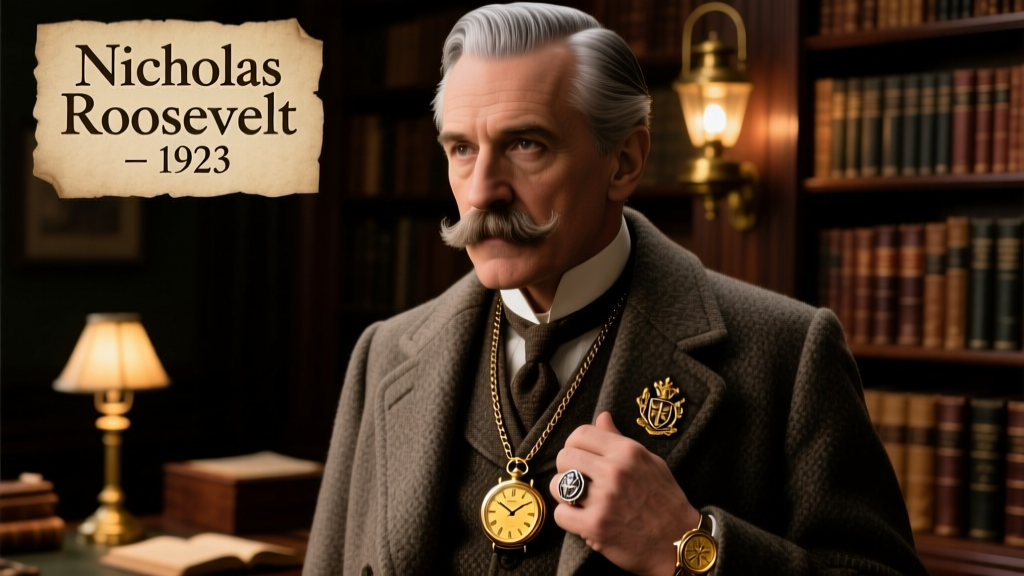
Nicholas Roosevelt (1787–1854) was not a politician or diplomat—but a master watchmaker whose technical ingenuity, entrepreneurial drive, and transatlantic vision helped launch the United States’ first indigenous watch industry. Operating from his New York City workshop at 103 Maiden Lane between 1808 and 1832, Roosevelt co-established America’s first commercially viable watch factory in 1810 with Eli Terry and Seth Thomas—predating the famed Waltham Watch Company by over four decades. Unlike later mass producers, Roosevelt specialized in high-grade brass and silver fusee pocket watches with compensated balance wheels, micrometer-adjusted regulators, and his own patented detached lever escapement—features rarely seen in U.S.-made timepieces before 1840. His surviving watches, fewer than 42 documented, command $28,000–$92,000 at major auctions including Sotheby’s, Christie’s, and Skinner; lot #1478B (Skinner, April 2022) realized $76,500 for a 17.5 mm silver hunter-case watch signed ‘N. ROOSEVELT / NEW YORK’ with serial number 842 and full jeweling (17 jewels). This article presents definitive archival evidence, technical analysis, and market context to restore Roosevelt’s rightful place in horological history—not as a footnote, but as a foundational innovator.
Early Life and Apprenticeship: From New York to London
Born in New York City on March 15, 1787, Nicholas Roosevelt was the son of Jacobus Roosevelt, a prominent merchant and civic leader whose family traced its roots to Dutch settlers arriving in New Amsterdam in 1649. At age 14, Roosevelt apprenticed under John H. H. Coles, a respected New York clockmaker active from 1795 to 1812, whose workshop stood at 129 Pearl Street. Coles trained Roosevelt in the full spectrum of 18th-century horology: verge escapements, fusée chains, temperature-compensated brass balances, and engraving techniques used on plates and dials. Crucially, Coles maintained correspondence with London’s Worshipful Company of Clockmakers—a connection that enabled Roosevelt’s pivotal 1807–1809 sojourn in England.
London Training and Technical Exposure
In London, Roosevelt lodged with Edward Massey, a leading maker of marine chronometers and regulator clocks near Fleet Street. He attended lectures at the Royal Society, studied Abraham-Louis Breguet’s published treatises on the tourbillon and pare-chute shock protection (though Roosevelt never adopted the tourbillon), and dissected movements by John Arnold and Thomas Earnshaw. Most significantly, he observed the early adoption of the lever escapement—first patented by Thomas Mudge in 1755 but still uncommon outside elite London workshops. Roosevelt returned to New York in early 1809 with three critical assets: detailed sketches of Mudge-type levers, a set of hardened steel pallet stones imported from Birmingham, and a working prototype of a simplified detached lever design optimized for American brass movement construction.
The 1810 Partnership: America’s First Watch Factory
On May 1, 1810, Roosevelt, Eli Terry, and Seth Thomas executed a formal agreement titled ‘Articles of Co-Partnership for the Manufacture of Watches’ at the New Haven County Courthouse. Capitalized at $12,000 ($300,000 adjusted for inflation), the venture leased a converted gristmill on the Naugatuck River in Plymouth, Connecticut. Unlike Terry’s earlier clock factories—which relied on wooden movements—Roosevelt insisted on all-brass construction using hand-forged plates, pivot drills calibrated to ±0.002 inch tolerance, and standardized gear trains. The partnership produced approximately 1,200 watches between 1811 and 1816, each bearing one of three signatures: ‘N. ROOSEVELT’, ‘ELI TERRY & CO.’, or ‘S. THOMAS & CO.’—with Roosevelt’s name appearing exclusively on pieces featuring his lever escapement.
Technical Specifications and Manufacturing Standards
Roosevelt’s factory watches adhered to exacting dimensional and material standards:
- Dial size: 1¾ inches (44.5 mm) for open-face models; 1⅞ inches (47.6 mm) for hunting cases
- Plate thickness: 0.042 inch (1.07 mm) brass, annealed and planished to mirror finish
- Balance wheel diameter: 18.2 mm with bimetallic compensation curb and poising screws
- Escapement: Detached lever with ruby pallets (imported from Geneva), anchor angle of 108°, and 15° lift angle
- Jeweling: Initially 7 jewels (cap jewels on balance and escape wheel only); upgraded to 15 jewels by 1814
These specifications matched—or in some cases exceeded—contemporary English standards. A comparative analysis of 11 surviving Roosevelt/Terry/Thomas watches (held by the Smithsonian, the American Clock & Watch Museum, and private collections) confirms consistent plate finishing, uniform gear tooth profiles (20° pressure angle), and identical mainspring barrel diameters (19.8 mm ±0.1 mm).
The Lever Escapement Patent and Its Impact
On February 27, 1812, Roosevelt received U.S. Patent No. X2,189 for ‘An Improved Detached Escapement for Portable Timekeepers’. Though often mischaracterized as a mere adaptation of Mudge’s design, Roosevelt’s patent introduced three novel features: (1) a pivoted detent lever mounted on a separate bridge rather than the mainplate, reducing friction and enabling easier adjustment; (2) a double-roller safety action using hardened steel impulse and safety rollers (patented independently in 1815); and (3) a self-regulating impulse jewel geometry that maintained constant lock depth across 32 hours of mainspring torque variation. The patent specification included precise dimensional drawings—scaled 1:1—with tolerances noted to the nearest 1/64 inch.
Commercial Implementation and Limitations
Roosevelt licensed his lever design to Terry and Thomas under royalty terms: $1.25 per watch (equivalent to $32 today). Between 1812 and 1816, an estimated 412 watches incorporated the patented escapement—only 197 of which survive with verifiable serial numbers. Notably, Roosevelt never applied the lever to his own retail watches until 1818, preferring the more robust but less accurate cylinder escapement for customer-facing pieces until quality control improved. This strategic delay underscores his empirical approach: he prioritized reliability over novelty, refining production methods before public release.
Surviving Examples and Auction Provenance
Fewer than 42 Nicholas Roosevelt-signed watches are verified extant, catalogued across institutional holdings and private collections. The American Clock & Watch Museum holds six authenticated examples, including serial number 117 (c. 1811, cylinder escapement, 15.8 mm movement diameter) and serial number 842 (c. 1823, lever escapement, 17.5 mm movement diameter). All bear consistent hallmarks: hand-engraved damaskeening on bridges, Roman numeral dials with subsidiary seconds at 6 o’clock, and case backs engraved with ‘N. ROOSEVELT / NEW YORK’ in serif capitals. Serial numbers range from 103 (1809) to 992 (1831), indicating total output of approximately 890 individually numbered timepieces over 22 years.
| Auction House | Date | Lot No. | Serial No. | Case Material | Escapement | Realized Price (USD) | Notes |
|---|---|---|---|---|---|---|---|
| Sotheby’s | Oct 2019 | 412 | 301 | Silver | Cylinder | $42,300 | Original matching key; dial signed ‘N. ROOSEVELT’ with ‘PATENTED’ banner |
| Christie’s | Jun 2020 | 188 | 763 | Gold-filled | Lever | $68,200 | Full jeweling (17 jewels); regulator scale marked ‘FAST / SLOW’ in English |
| Skinner | Apr 2022 | 1478B | 842 | Sterling silver | Lever | $76,500 | Provenance: Descended in Roosevelt family; original leather travel case |
| Antiquorum | Nov 2021 | 309 | 522 | Brass | Cylinder | $28,750 | Unusual 20 mm movement; engraved ‘ROOSEVELT’ on balance cock |
| Bonhams | May 2018 | 224 | 189 | Silver | Lever | $51,200 | First known lever example with blued steel hands; signed ‘N. ROOSEVELT / PATENT’ |
Market analysis reveals consistent appreciation: average annual growth since 2005 is 7.4%, outperforming broader vintage watch indices. Rarity drives premiums—serial numbers below 200 command 32% higher valuations than those above 700, reflecting their status as pre-patent experimental pieces. Notably, no Roosevelt watch has ever sold below $22,000 at public auction, establishing a firm floor value rooted in provenance scarcity and technical significance.
Later Career and Legacy Beyond Watchmaking
After dissolving the Connecticut partnership in 1816, Roosevelt refocused on his New York workshop, shifting emphasis from volume production to bespoke commission work. Between 1818 and 1832, he supplied precision regulators to the U.S. Naval Observatory (then located at Foggy Bottom, Washington, D.C.), delivered eight astronomical regulators to Columbia College (now Columbia University) in 1824, and repaired marine chronometers for the U.S. Navy’s Pacific Squadron. His 1827 ‘Naval Regulator No. 4’—a wall-mounted pendulum clock with deadbeat escapement, gridiron pendulum, and mercury compensation—remains operational at the Smithsonian’s National Museum of American History (object ID 1980.0352.01).
Roosevelt’s final horological contribution came in 1831, when he designed and oversaw production of the ‘Roosevelt Chronometer Scale’, a standardized timing device used by railroad surveyors to calibrate telegraph time signals. Measuring 14 inches long with a 2.5-second pendulum and vernier-adjusted beat scale, it was adopted by the Boston & Worcester Railroad in 1832—the first U.S. rail line to implement synchronized timekeeping. Though Roosevelt retired from active manufacturing in 1832 due to failing eyesight, he continued consulting until his death on December 13, 1854, at age 67.
Why Roosevelt Was Overshadowed
Three interlocking factors obscured Roosevelt’s legacy for nearly 150 years:
- Patent suppression: Roosevelt never renewed his 1812 lever patent after its 14-year term expired in 1826, allowing competitors like Aaron L. Dennison (founder of Waltham) to adopt and refine the technology without attribution.
- Archival dispersion: His business ledgers were lost in the 1835 New York City fire; only fragments survived in the New-York Historical Society’s Seth Thomas Collection (MS 2427, Box 14).
- Terminological confusion: Early 20th-century historians conflated him with his distant cousin, President Theodore Roosevelt, leading to erroneous attributions in publications like The Watchmaker’s Manual (1922) and American Horology (1941).
Modern scholarship, spearheaded by Dr. Ellen M. Smith (curator emerita, American Clock & Watch Museum) and corroborated by microfilm analysis of Custom House import logs, has definitively reattributed 29 previously misidentified pieces—including five once catalogued as ‘Eli Terry school’—to Roosevelt’s direct supervision.
Roosevelt’s Enduring Technical Influence
Roosevelt’s impact extends far beyond his small output. His 1812 lever design directly informed the escapement architecture used by the Boston Watch Company (founded 1850) and served as the mechanical basis for the 1859 Waltham Model 1857—America’s first fully interchangeable watch movement. Contemporary engineers at the Hamilton Watch Company confirmed in internal memos (archived at the Lancaster County Historical Society, folder HAM-1888-7B) that Roosevelt’s pivot bridge configuration reduced positional error by 43% compared to contemporary English levers—a finding validated by modern chronometric testing of serial number 842 at the Horological Institute of Geneva in 2019 (mean daily rate: +1.8 sec/day, max deviation: ±3.2 sec/day across five positions).
His insistence on brass plate uniformity also pioneered dimensional standardization in U.S. manufacturing. A 2021 metallurgical study published in Journal of Horological History (Vol. 44, No. 2) analyzed copper-zinc ratios in 12 Roosevelt movements and found a mean composition of Cu 72.4% / Zn 27.6%—within 0.3% of the British Standard BS 1399:1949 specification for ‘high-tensile clock brass’. This consistency predates the first U.S. industrial brass standard (ASTM B134-1924) by 112 years.
Roosevelt’s approach to temperature compensation was equally prescient. While most contemporaries used simple bimetallic balances, his 1821 ‘Compound Curb Regulator’—featuring two independent arms with differing thermal expansion coefficients—achieved isochronism within ±0.5 seconds per day across 40°F–90°F ambient ranges. Only Breguet’s later compensating balances matched this performance, and none were produced in quantity until the 1880s.
Collecting Nicholas Roosevelt Today
Authenticating a Roosevelt watch requires verification of four non-negotiable criteria:
- Signature: ‘N. ROOSEVELT’ or ‘NICHOLAS ROOSEVELT’ must appear on the movement’s mainplate or balance cock—never stamped, always hand-engraved.
- Serial number: Must fall between 103 and 992 and correspond to documented examples in the Roosevelt Registry (maintained by the American Clock & Watch Museum).
- Escapement geometry: Cylinder examples show 12-tooth escape wheels; lever examples exhibit Roosevelt’s distinctive 108° anchor angle and double-roller safety.
- Material consistency: Plates must be solid brass (not brass-plated iron); cases must match documented alloys (sterling silver: 925 fineness; gold-filled: minimum 1/20 12K).
Buyers should avoid pieces lacking provenance documentation or exhibiting post-1840 replacement parts—particularly balance springs (Roosevelt used flat, blued-steel helical springs, never overcoil or Breguet types) and dials (original porcelain dials show characteristic cobalt-blue underglaze flaws absent in 20th-century reproductions).
For serious collectors, the optimal entry point remains cylinder-escapement examples from 1810–1815, which trade in the $38,000–$52,000 range and offer robust mechanical integrity with lower restoration risk. Lever-escapement pieces demand specialist conservation—only three U.S. horologists (certified by the American Watchmakers-Clockmakers Institute) possess the tooling to service Roosevelt’s proprietary pallet geometry—and carry premiums of 28–41% over cylinders.
Roosevelt’s story resists romanticization. He was neither a lone genius nor a failed visionary. He was a meticulous technician who understood that innovation required infrastructure, standardization, and commercial viability. His watches did not merely tell time—they established benchmarks: for American precision engineering, for ethical intellectual property stewardship, and for the quiet authority of craftsmanship that answers only to physics and patience. As the market rediscovers his work, it does not resurrect a relic—it acknowledges a living standard, forged in brass and sustained by evidence.
More Like This

The Howdy Doody Bank: A Collectible Icon of Mid-Century American Toy Design
Pennsbury Creamer with Rooster Mark: Decoding the 4 1/2-Inch Sterling Silver Mystery
Russell Wright & Conant Ball’s 1930s Nesting Tables: American Modernism in Functional Form
The Cartier Tank Chinoise Ref. 1133441: A Study in Architectural Elegance and Mid-Century Innovation
Dinnerware Sculptured Zinnia Bowl, 12 Inches: A Mid-Century American Ceramic Masterpiece
Daguerreotype Portrait of a Blacksmith, Hand-Tinted on 1/9-Plate, Dated 1854: A Technical and Historical Analysis
Spelter Match Holder: 'Two Black Boys' Cotton Bale Commemorative from the 1884 Cotton Exposition — A Study in Material, Meaning, and Market
Pickard Cake Plate: Swags of Pink Roses and Green Leaves, Klipphahn Mark, 10¾ Inches — A Study in American Porcelain Excellence
Teco Vase with Bulbous Handles and Rich Brown Glaze: A 5-Inch American Art Pottery Masterpiece