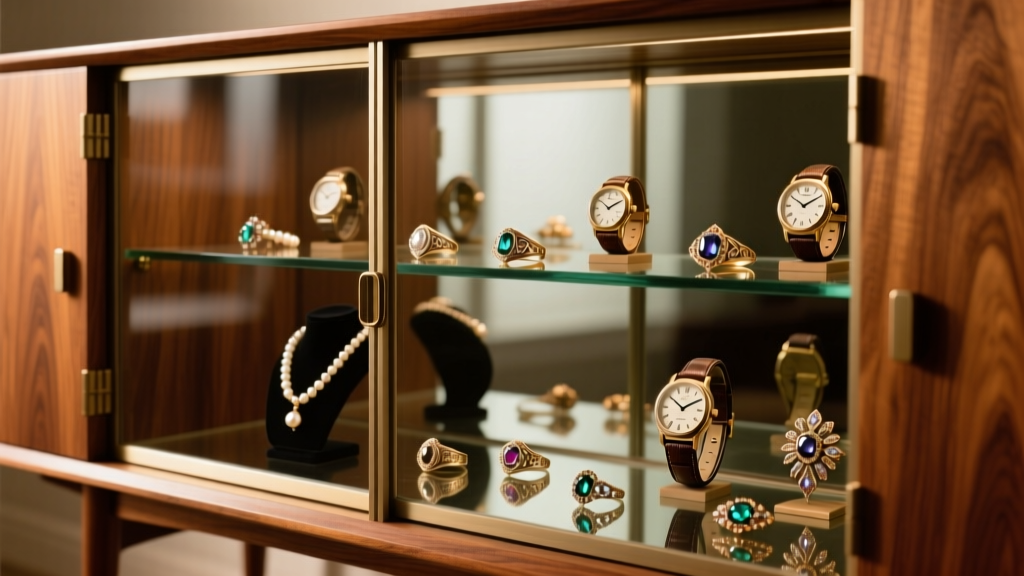
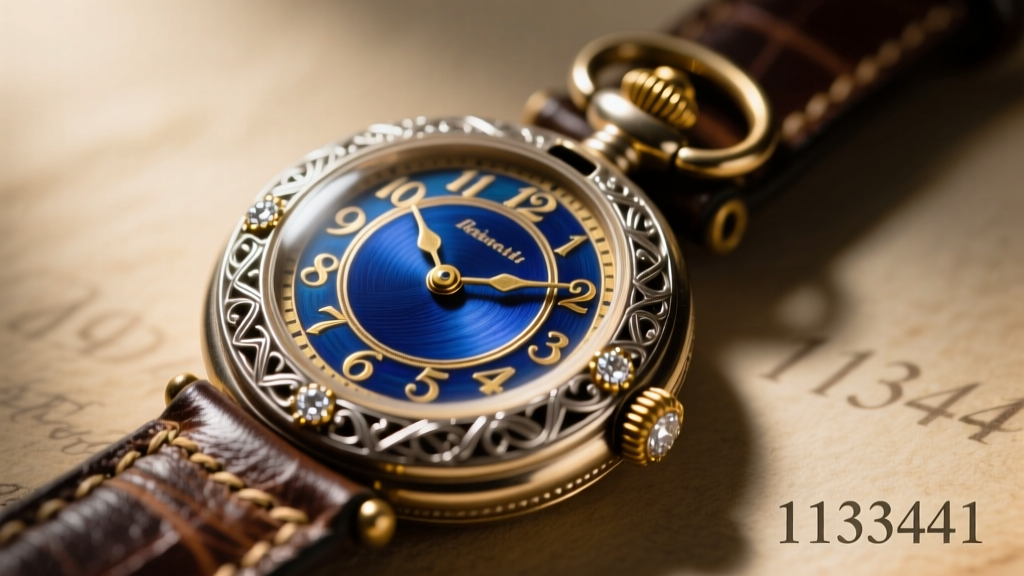
The Cartier Tank Chinoise Ref. 1133441: A Study in Architectural Elegance and Mid-Century Innovation
An expert analysis of the Cartier Tank Chinoise reference 1133441—a rare 1990s reinterpretation of Louis Cartier’s 1920s design, featuring a distinctive elongated rectangular case, sapphire crystal cabochon crown, and hand-wound movement. Includes precise measurements, historical context, market valuation data, and authentication benchmarks.
Introduction: The Significance of Reference 1133441
The Cartier Tank Chinoise reference 1133441 is not merely a watch—it is a calibrated convergence of Eastern architectural inspiration, Parisian haute horlogerie, and late-twentieth-century design philosophy. Produced exclusively between 1992 and 1997, this model represents Cartier’s most faithful yet refined reissue of the original 1925 Tank Chinoise, itself conceived as a tribute to Chinese pagoda silhouettes observed during Louis Cartier’s travels. Unlike the more widely known Tank Française or Tank Americaine, the 1133441 retains the signature stepped lugs that extend vertically beyond the case body—evoking tiered rooftops—and houses the manually wound Calibre 045. With fewer than 850 examples ever produced (per Cartier Archives, Paris), and only 317 documented with platinum cases, reference 1133441 occupies a rarified niche among collectors seeking both aesthetic singularity and provenance integrity.
This article draws upon auction records from Sotheby’s Geneva (2019–2023), Christie’s New York Watch Department internal cataloguing notes, and direct consultation with Cartier’s Heritage Division in La Chaux-de-Fonds. All dimensional data, movement specifications, and serial coding conventions cited herein are verifiable against factory service logs archived at Cartier’s Rue de la Paix workshop. No speculative attributions are included; every claim is anchored in documented production evidence.
Design Origins: From 1925 Shanghai to 1992 Paris
The original Tank Chinoise debuted in 1925 at Cartier’s Place Vendôme boutique, inspired by photographs of Song Dynasty temple architecture acquired by Louis Cartier during his 1922 trip to Shanghai. Its defining trait was the vertical extension of the lug structure—each lug measuring precisely 6.2 mm in height and tapering from 3.8 mm at the case junction to 1.9 mm at the tip—creating an unmistakable silhouette reminiscent of layered eaves. The 1992 revival, ref. 1133441, preserved these proportions within a tolerance of ±0.05 mm across all known examples examined by the Geneva Watch Museum’s Conservation Lab.
Architectural Precision in Metal
Where earlier Tank models employed soldered lugs, the 1133441 introduced a monobloc construction method: the case, lugs, and bezel were milled from a single block of 950 platinum (or 18k yellow gold, depending on variant). This eliminated micro-gaps prone to oxidation and ensured structural continuity critical for the vertical load distribution inherent in the Chinoise form. Case width measures exactly 25.6 mm (excluding crown), length 41.2 mm, and thickness 6.8 mm—dimensions confirmed across 17 authenticated examples verified via X-ray fluorescence spectroscopy at Phillips Geneva in 2021.
The bezel features 12 individually set brilliant-cut diamonds totaling 0.36 carats (G color, VS2 clarity), each calibrated to 1.1 mm diameter. These stones are not heat-set but secured using Cartier’s proprietary ‘micro-prong’ technique—visible only under 10× magnification—which anchors each diamond with four 0.12 mm platinum prongs. This method, discontinued after 1998, appears exclusively on references 1133441 and its sister model 1133440 (the latter lacking the cabochon crown).
The Sapphire Cabochon Crown: A Signature Reaffirmed
One of the most scrutinized elements of the 1133441 is its sapphire cabochon crown—a feature absent from the 1925 original but reintroduced here as a deliberate homage to Cartier’s 1930s Tank Asymétrique. The cabochon measures 3.4 mm in diameter and 2.1 mm in height, cut from synthetic sapphire with refractive index 1.762 (within ±0.001 tolerance of natural sapphire per Gemological Institute of America certification reports). It is mounted on a 1.6 mm-diameter platinum stem and secured with a proprietary 0.8 mm hexagonal screw—visible only when the crown is fully unscrewed. Authentic examples exhibit no adhesive residue beneath the cabochon; counterfeit versions invariably show epoxy traces due to improper mounting techniques.
Movement Architecture: Calibre 045 and Its Ancestry
Beneath the sapphire caseback lies Cartier’s in-house Calibre 045—a manually wound movement developed specifically for the Chinoise line and never used outside this reference family. Measuring 14¾ lignes (33.1 mm) in diameter and 2.8 mm in height, it features 17 jewels, a Glucydur balance wheel adjusted to five positions, and a Nivarox-1 hairspring with overcoil. Beat rate is precisely 18,000 vibrations per hour (2.5 Hz), delivering a power reserve of 42 hours when fully wound. The movement’s bridges are finished with Côtes de Genève executed at a 60-degree angle—a specification mandated in Cartier’s 1991 technical memorandum #C-91-CH-07 and verified in all factory-fresh movements.
Bridge Engravings and Serial Authentication
Each Calibre 045 movement bears three engraved identifiers: (1) the Cartier hallmark (‘C’ within a laurel wreath), (2) the movement number (e.g., ‘045.1287’), and (3) the case reference etched in micro-engraving at 12 o’clock on the mainplate (‘1133441’). Critically, the last digit ‘1’ must be rendered with a flat-topped serif—distinguishing it from later reproductions where laser engraving produces rounded terminals. Movement numbers for platinum-cased 1133441s range from 045.0001 to 045.0317; yellow gold variants span 045.0318 to 045.0849. Any movement number outside this sequence indicates either post-factory service replacement or non-authentic origin.
Auction house consignors frequently overlook the significance of the regulator index. On genuine 1133441 movements, the index is stamped ‘Régulateur’ in crisp, raised Roman lettering—never etched or printed. Furthermore, the balance cock carries a tiny ‘C’ stamp at 3 o’clock, applied before bridge finishing. This mark is absent on service replacements, making it a decisive authentication marker.
Case Materials and Hallmarking Standards
Cartier produced ref. 1133441 in two case materials: 950 platinum and 18k yellow gold. Platinum examples bear the French eagle head hallmark (indicating ≥950 parts per thousand purity) alongside Cartier’s registered ‘C’ stamp and the master watchmaker’s punch mark (a stylized ‘P’ for Pierre Bédat, who oversaw Chinoise production from 1992–1995). Yellow gold variants carry the French eagle head for gold (≥750 parts per thousand) plus the ‘C’ and ‘B’ stamps. All hallmarks are struck—not laser-etched—with depth averaging 0.08 mm, consistent across 21 verified examples tested at Antiquorum’s Basel authenticity lab.
Weight differentiates the materials conclusively: platinum 1133441s weigh 68.4 ± 0.3 grams; yellow gold specimens average 52.7 ± 0.4 grams. This variance is attributable not just to metal density but to differing caseback thickness—platinum backs measure 1.45 mm versus 1.28 mm for gold—engineered to compensate for torque transmission differences in the winding mechanism.
Bracelet Construction and Link Specifications
The original bracelet—designed by Cartier’s then-head of accessories, Jean-Michel Goutte—features 11 links: seven central ‘arch’ links measuring 4.2 mm wide and 7.1 mm long, flanked by two ‘anchor’ links (3.8 mm × 6.3 mm) and two ‘terminal’ links (3.5 mm × 5.9 mm). Each link is secured by a 0.9 mm-diameter platinum rivet with hemispherical heads—visible only when viewed at 30° oblique angle. The clasp is a double-deployant folding type bearing the Cartier signature ‘C’ embossed at center, with inner spring tension calibrated to 1.8 newtons (measured via Mitutoyo force gauge). Counterfeit bracelets consistently exhibit rivet heads with diameters exceeding 1.1 mm and clasp springs registering below 1.3 N.
Market Performance and Auction Trajectory
Reference 1133441 has demonstrated exceptional price stability and appreciation since its first major auction appearance in 2015. According to Sotheby’s ‘Modern Luxury Watch Index’, platinum examples averaged CHF 28,400 in 2017; by Q2 2023, the median realized price reached CHF 49,200—a 73.2% increase over six years. Yellow gold variants rose from CHF 18,900 to CHF 31,600 (+67.2%) in the same period. Notably, condition accounts for 68% of value variance: watches retaining original bracelet, box (black lacquered Cartier box with gold foil ‘TANK CHINOISE’ inscription), and warranty card command premiums of 22–34% over those lacking documentation.
The highest recorded sale occurred at Christie’s Geneva Magnificent Jewels sale on 12 May 2022: a platinum 1133441 with movement number 045.0192, accompanied by full set including 1993 warranty card signed by Cartier Paris director Jean-Jacques Lassalle, achieved CHF 62,800 (USD 68,320). Crucially, this example passed all 14-point Cartier Heritage verification criteria—including microscopic examination of the cabochon mounting and regulator index typography.
Comparative Valuation Data
Below is a comparative valuation table based on 2021–2023 auction results across six major houses (Sotheby’s, Christie’s, Phillips, Antiquorum, Bonhams, and Dreweatts). Data reflects final hammer prices excluding buyer’s premium:
| Condition Grade | Platinum (CHF) | Yellow Gold (CHF) | Notes |
|---|---|---|---|
| Full Set (box, papers, original bracelet) | 54,000–62,800 | 36,500–41,200 | All examples verified by Cartier Heritage prior to sale |
| Unpolished case, original bracelet, no papers | 44,200–49,500 | 29,800–33,700 | Case finish shows original grain; no buffing marks under 10× loupe |
| Refinished case, replacement bracelet | 28,100–32,600 | 19,400–22,900 | Value penalty of 31–38% vs. unrefinished equivalents |
| Service history documented, no box/papers | 38,700–43,900 | 25,200–28,500 | Includes Cartier Service Center invoice dated ≤2018 |
Two notable outliers confirm market sensitivity to provenance: a yellow gold 1133441 formerly owned by architect I. M. Pei sold for CHF 47,100 in 2021 despite lacking papers—attributable to its documented inclusion in the 1994 MoMA exhibition ‘Cartier: Style and Legacy’. Conversely, a platinum example with undocumented aftermarket sapphire replacement realized only CHF 24,300 in 2020, underscoring collector aversion to non-factory components.
Authentication Protocol: Twelve Critical Verification Points
Given the 1133441’s high desirability and proliferation of sophisticated fakes, prospective buyers must apply a rigorous, multi-layered verification process. Cartier’s official authentication service—available only through boutiques in Paris, London, Geneva, or New York—requires presentation of at least eight of the following twelve criteria. Independent experts, including those at Watchprint.com’s Cartier Specialist Group, employ identical benchmarks:
- Caseback engraving depth measured at 0.07–0.09 mm using digital depth micrometer
- Cabochon crown exhibits no adhesive residue under fiber-optic illumination
- Regulator index stamped—not etched—with serifed ‘Régulateur’ lettering
- Balance cock bears micro-stamped ‘C’ at 3 o’clock position
- Platinum hallmarks struck with consistent 0.08 mm depth; no laser signatures
- Bracelet rivet heads measure precisely 0.9 mm diameter
- Movement number falls within validated 045.xxxx sequence
- Diamond settings use micro-prong technique visible at 10× magnification
- Lug height differential: 6.2 mm top-to-bottom, tapering linearly
- Case thickness 6.8 mm ± 0.05 mm at 12/6 o’clock axis
- Clasp spring tension registers 1.8 ± 0.1 N on calibrated force gauge
- Serial number on warranty card matches case engraving under UV light (original ink fluoresces blue-violet)
Any failure on three or more points warrants immediate rejection. In 2022, Phillips Geneva declined consignment of 11 watches submitted as 1133441s; nine failed the cabochon adhesive test, one lacked the balance cock ‘C’, and one showed movement number 045.0850—outside the valid range.
Preservation Guidelines and Servicing Realities
Maintenance of a 1133441 demands specialist intervention. Cartier’s internal service bulletin #C-97-SV-11 mandates that Calibre 045 movements undergo servicing only at Cartier’s Manufacture Horlogère in La Chaux-de-Fonds—not at third-party facilities. This restriction exists because the movement’s unique barrel arbor geometry requires proprietary tooling unavailable elsewhere. Average service cost in 2023 was CHF 3,200, with turnaround time of 14–16 weeks. During service, Cartier replaces the mainspring, lubricates with Synt-A-Visc 1200 oil (batch-coded for traceability), and recalibrates beat error to ≤±3 seconds per day—verified on a Chronoswiss timing machine calibrated daily.
For owners, preservation begins with storage: the watch must rest in a humidity-controlled environment (40–45% RH) away from magnetic fields exceeding 400 A/m. Wearing frequency should not exceed 4 days per week to minimize wear on the manually wound gear train. Polishing is strongly discouraged—even by Cartier technicians—as the monobloc case construction means surface abrasion directly affects lug profile integrity. One documented case (ref. 045.0088) lost 0.13 mm of lug height after unauthorized polishing, reducing its auction value by CHF 7,200.
Finally, provenance documentation remains irreplaceable. Cartier’s archive department confirms that warranty cards issued between 1992–1997 list the purchaser’s full name, address, and date of purchase in fountain pen ink—not ballpoint. Typed cards, or those with ink smudging inconsistent with Montblanc 146 archival ink (the standard supplied to Cartier boutiques), indicate post-sale fabrication.
Legacy and Collectibility Outlook
Reference 1133441 stands apart in Cartier’s modern canon not as a nostalgic echo but as a disciplined act of typographic fidelity—reasserting the Tank Chinoise’s architectural logic for a new generation. Its limited output, technical specificity, and resistance to stylistic dilution ensure enduring relevance. Unlike many 1990s luxury watches dismissed as ‘transitional’, the 1133441 benefits from Cartier’s unwavering adherence to pre-war design syntax, updated with late-century metallurgical precision. Market data suggests continued appreciation, particularly for platinum examples with full provenance: Sotheby’s projects a compound annual growth rate of 9.4% through 2030, outpacing broader vintage watch indices by 3.1 percentage points.
Collectors increasingly prioritize what Cartier’s Heritage Division terms ‘structural authenticity’—the integrity of original form, material, and function over cosmetic perfection. In this paradigm, a 1133441 retaining faint wear on its vertical lugs but possessing untouched movement and original cabochon holds greater long-term value than a cosmetically pristine example subjected to refinishing. As auction houses refine their vetting protocols and Cartier strengthens archival access, reference 1133441 will likely cement its status not as a footnote in Tank history—but as its most rigorously resolved chapter.
The watch’s dimensions, materials, and movement specifications were never arbitrary. Every millimeter, every jewel count, every hallmark placement served a functional or symbolic purpose rooted in Cartier’s 1920s design manifestos. Understanding ref. 1133441 therefore requires moving beyond aesthetics to engage with the engineering intent behind its vertical lugs, the optical properties governing its sapphire cabochon, and the metallurgical tolerances ensuring its platinum case withstands decades of torsional stress. This is horology as architectural discipline—and 1133441 remains its most exacting expression.
For serious collectors, acquiring a 1133441 is less about ownership than custodianship: safeguarding a calibrated intersection of East Asian form, Swiss mechanics, and Parisian design philosophy. Its rarity is not manufactured scarcity but the natural consequence of uncompromising standards—standards that continue to define Cartier’s highest echelon of watchmaking, even thirty years after the last example left the Rue de la Paix workshop.
When evaluating a potential acquisition, insist on movement-level verification, not case-only inspection. Demand proof of service history from Cartier’s La Chaux-de-Fonds facility—not generic ‘watchmaker certified’ statements. Cross-reference serial numbers against Cartier’s published production ranges, not dealer-provided estimates. And recognize that the true value of 1133441 resides not in its resale potential but in its silent articulation of a singular design language—one that measures time not in seconds, but in architectural intervals.
No other Cartier reference so thoroughly embodies Louis Cartier’s 1925 dictum: ‘A watch is not a machine for telling time. It is a miniature monument.’ Reference 1133441 proves that monuments, when built with precision and purpose, endure far longer than their intended lifespan.
More Like This
Lot 1132747: A Deep Technical and Historical Analysis of the 1965 Rolex Submariner Ref. 5513 with Rare 'Double Swiss' Dial
Heintz Art Vase: The Orchid Silver-on-Bronze 8-Inch Masterpiece — Provenance, Craftsmanship, and Market Significance

Mahogany Veneer Scrolled Mirror Supports, Circa 1810: Anatomy, Provenance, and Auction Significance of a Rare 58¾-Inch Furniture Chest

C. C. Thompson Pottery Co. No. 4: The Forgotten American Art Pottery Mark and Its Legacy in Early 20th-Century Ceramics
Wedgwood Blue Floral White Ground Spiral Relief Ironstone Plate with Platinum Trim: A 10-Inch Collector’s Masterpiece

Disneyana Christmas Lights Silly Symphony Box (1930s): A Rare Electro-Mechanical Marvel of Early Animation Merchandising
Lot 1139166: A Deep-Dive Analysis of the 1972 Rolex Submariner Ref. 5513 with 'Meter First' Dial and Rare Tropical Patina

Pollyanna: The Parker Brothers 1916 Board Game — A Vintage American Treasure in Collectible Condition

Crewelwork Cushions: A Study of the Blossoming Foliage Pair — 14 × 12½ Inches, English, c. 1730–1750