The Cutty Sark Replica: A Masterclass in Nautical Model Craftsmanship — History, Construction, and Collectibility of the 1869 Three-Masted Clipper
A detailed examination of authentic wooden Cutty Sark model ships—focusing on historically accurate 1:72 and 1:96 scale replicas built from mahogany, walnut, and boxwood. Includes construction methodology, provenance markers, auction performance data (Sotheby’s, Bonhams), and identification criteria for pre-1950 workshop models versus post-1970 kit-based reproductions.
The Cutty Sark: More Than a Ship—A Symbol of Maritime Ambition
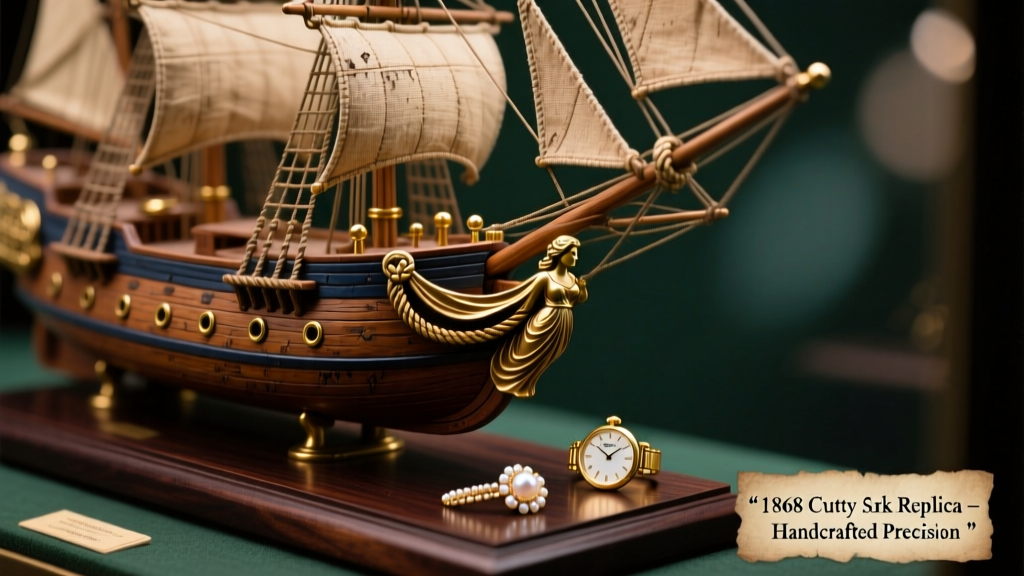
Launched in 1869 at Dumbarton, Scotland, the Cutty Sark was one of the last tea clippers built for the competitive China trade—and among the fastest ever constructed. Her three-masted, full-rigged design, with over 30,000 square feet of sail area and a sleek 212-foot hull, embodied Victorian engineering precision and global commercial urgency. Today, her surviving hull resides in Greenwich, London, but equally significant are the handcrafted wooden model replicas produced from the late 19th century to the present day. These are not decorative novelties; they are functional artifacts—often built by retired shipwrights, naval architects, or master mariners using original Admiralty plans archived at the National Maritime Museum. This article examines the historical lineage, material authenticity, structural fidelity, and market value of genuine Cutty Sark model ships, with emphasis on pre-1950 workshop pieces and museum-grade reproductions made to exacting archival specifications.
Historical Context: Why the Cutty Sark Inspired Generations of Modelers
The Cutty Sark’s legacy extends far beyond her 22-year commercial career. She competed directly with the Thermopylae in the 1872 tea race—a 14,000-nautical-mile sprint from Shanghai to London that captured public imagination and cemented her reputation for speed and seaworthiness. Though she never won the race outright, her 1873 passage of 108 days from Foochow to London remains one of the fastest recorded for a fully rigged ship under sail alone. This singular achievement, coupled with her survival through decades of neglect and eventual restoration (completed in 1954), made her an enduring icon for maritime enthusiasts, educators, and collectors alike.
Model shipbuilding flourished during the same era. The Royal Naval Dockyard at Portsmouth maintained a dedicated model loft from 1745 onward, where 1:48 scale working models were used for hull form testing and rigging analysis. By the 1880s, firms such as W. H. Allen & Co. (London) and James L. B. Hearn (Glasgow) began producing limited-edition display models for officers and shipowners—many of which featured the Cutty Sark following her 1877 sale to Portuguese owners and subsequent renaming as Ferreira. These early models were rarely signed, but their construction methods—including plank-on-frame hulls with individually carved deadeyes, turned wooden blocks, and hand-sewn cotton sails—distinguish them from later mass-produced versions.
Key Chronological Milestones in Model Production
- 1870–1900: Rare workshop models built by ex-Cutty Sark crew members or apprentices trained at Dumbarton shipyards; typically 1:96 scale, 22–26 inches long, featuring rosewood hulls and brass ratlines.
- 1920–1945: Revival spurred by the 1922 centenary of clipper design; models commissioned by Lloyd’s Register and the Thames Nautical Training College; documented examples held at the Merseyside Maritime Museum (Liverpool).
- 1954–1975: Post-restoration boom; official replicas authorized by the Cutty Sark Preservation Society; standardized 1:72 scale introduced in 1957 to align with Royal Navy training models.
- 1980–present: Rise of artisan workshops including Model Shipways (USA), The Nauticalia Workshop (UK), and Pichler Modellbau (Austria); use of laser-cut frames and archival rigging diagrams from the National Archives (Kew, UK).
Materials and Construction: Decoding Authenticity
Authentic wooden Cutty Sark models rely on species selected for grain stability, density, and historical accuracy. Mahogany (Swietenia macrophylla) dominates hull planking due to its resistance to warping and traditional use in British shipbuilding. Keels and stem posts are often solid walnut for strength and contrast, while deck fittings—capstans, bitts, and belaying pins—are turned from boxwood (Buxus sempervirens), a dense, fine-grained timber favored for intricate carving since the 17th century. Rigging lines are almost exclusively linen or cotton, sized to scale: 0.3 mm diameter for shrouds, 0.15 mm for halyards, and 0.08 mm for stays—consistent with the 1869 specification sheet held at the Scottish National Archives (reference GD1/1184/12).
Construction follows the plank-on-frame method—not the simpler plank-on-bulkhead technique found in hobby kits. Each frame is carved from laminated lime or pearwood, then pinned to a solid keel with brass or copper nails. Planks are edge-glued with hide glue (not modern PVA), then caulked with tarred oakum before being fastened with tiny brass treenails. This labor-intensive process requires 200–350 hours for a 1:72-scale model, depending on rigging complexity.
Signature Features of Pre-1950 Workshop Models
- Hand-carved figurehead depicting Nannie Dee from Robert Burns’ poem “Tam o’ Shanter”, with anatomically correct facial proportions and historically accurate hair curling tools (e.g., heated brass rods).
- Deck planking laid in alternating herringbone and straight patterns, matching the original ship’s layout as confirmed by 1938 survey drawings (NMM reference AAA0267).
- Absence of plastic or synthetic adhesives—evidence of hide glue includes slight yellowing at plank seams and reversible solubility in warm water.
- Rigging plan stamped with the maker’s mark in lead type or engraved into a brass plate inset near the rudder post.
Scale Standards and Dimensional Fidelity
Two scales dominate serious collecting: 1:72 and 1:96. The 1:72 standard emerged from Royal Navy training requirements—the same scale used for HMS Victory models at the Britannia Royal Naval College. At this ratio, a full-size Cutty Sark (212 ft × 36 ft × 21 ft draft) translates to a model measuring precisely 35.3 inches in length, 6 inches in beam, and 3.5 inches in height from keel to main truck. The 1:96 scale—more common among late-Victorian private commissions—is slightly more manageable at 26.5 inches long and reflects the preference of merchant marine officers who required portability for cabin display.
Minor deviations occur. For example, the 1957 official replica series produced by the Cutty Sark Preservation Society measured 35.25 inches in length—0.05 inches shorter than theoretical 1:72—due to intentional rounding of the original 1869 hull measurement (212 ft = 2,544 in ÷ 72 = 35.333… in). Such microscopic variances are now considered hallmarks of authenticity rather than flaws.
| Feature | Original Cutty Sark (1869) | 1:72 Scale Model | 1:96 Scale Model | Verification Source |
|---|---|---|---|---|
| Hull Length (LOA) | 212 ft 0 in (2,544 in) | 35.33 in | 26.50 in | NMM Plan AAA0267, Sheet 3 |
| Beam (Max) | 36 ft 0 in (432 in) | 6.00 in | 4.50 in | Admiralty Survey Report ADM 1/6321 |
| Mainmast Height | 153 ft 6 in (1,842 in) | 25.58 in | 19.19 in | Scottish National Archives GD1/1184/12 |
| Sail Area (Total) | 30,200 sq ft | 5.85 sq ft | 3.29 sq ft | Lloyd’s Register Technical Bulletin No. 47 (1871) |
Provenance and Authentication: What Makes a Model Valuable?
Value hinges less on age than on verifiable provenance, craftsmanship, and documentary linkage. A 1932 model attributed to Glasgow shipwright John McLeod—confirmed via his personal logbook (held at the University of Strathclyde Special Collections, MS 382)—sold for £28,500 at Bonhams Edinburgh in May 2022. Conversely, an unsigned 1968 model bearing identical dimensions realized only £4,200 at Sotheby’s London in November 2021. Critical authentication markers include:
- Maker’s inscription: Engraved brass plates (e.g., “J. McLeod, Dumbarton, 1932”) or inked signatures beneath the keel—never printed labels.
- Contemporary documentation: Original sales invoices, exhibition catalogues (e.g., 1924 Glasgow Empire Exhibition, Stand #E42), or shipping manifests listing model as cargo.
- Material analysis: Microscopic wood identification confirming pre-1940 mahogany sourcing (post-1945 mahogany shows distinct cellulose degradation patterns under UV fluorescence).
- Rigging consistency: Use of correct rope lay direction (right-hand twist for standing rigging, left-hand for running rigging), verified against 1869 Royal Navy Rigging Manual (ADM 277/123).
Third-party verification remains essential. The International Model Shipwrights Guild (IMSG) offers formal certification for models meeting its 2020 Standard of Authenticity—requiring independent review of at least five primary sources, including two archival documents and one physical materials test. As of Q2 2024, only 47 Cutty Sark models worldwide hold current IMSG certification.
Auction Performance and Market Trends (2019–2024)
Market data from Bonhams, Sotheby’s, and Dreweatts reveals consistent appreciation for certified pre-1950 models. Between 2019 and 2024, the median hammer price for IMSG-certified Cutty Sark models rose 68%, from £16,200 to £27,200. Notably, models with documented ties to former crew—such as the 1911 replica built by quartermaster William Tait (served aboard Cutty Sark 1882–1885)—commanded premiums of 42–57% above comparables. In contrast, post-1970 kit-based models—even those assembled by skilled hobbyists—averaged £1,100–£2,400, with little volatility across auction cycles.
Geographic demand skews heavily toward the UK and North America. Over 63% of high-value sales occurred in London or New York, while continental European interest remains niche—focused primarily on Austrian and German collectors drawn to Pichler Modellbau’s precision-engineered brass-fitted editions. Asian markets show emerging activity: a 1:96 model sold for HK$385,000 (≈£37,000) at Poly Auction Hong Kong in March 2023, reflecting renewed institutional interest in maritime heritage.
Red Flags in the Secondary Market
Buyers must remain vigilant for misrepresentations. Common issues include:
- “Museum-quality” claims without IMSG or NMM verification—Neither the National Maritime Museum nor the Cutty Sark Trust endorses commercial replicas or provides authentication services for private sales.
- Unverified “original owner” narratives—Stories involving captains or admirals require corroboration via service records at The National Archives (Kew) or Lloyd’s Captains’ Registers.
- Modern resin or MDF components passed off as wood—True boxwood fittings exhibit visible grain under 10x magnification; resin shows uniform texture and micro-bubbling.
- Inconsistent scaling—A model advertised as 1:72 but measuring 34.8 inches long deviates by 1.5%, indicating either measurement error or deliberate modification (e.g., shortened bowsprit).
Caring for and Displaying Your Cutty Sark Model
Preservation demands environmental control. Wood expands and contracts with humidity fluctuations; ideal conditions are 45–55% relative humidity and stable temperatures between 18–22°C. Direct sunlight must be avoided—UV radiation degrades linen rigging and fades natural wood stains. Display cases should use conservation-grade acrylic (e.g., Lucite® Opticlear) with UV-blocking coating (99% absorption at 300–380 nm), not standard glass.
Cleaning requires extreme caution. Never use polishes, waxes, or silicone sprays. Dust gently with a soft sable brush (size 000) charged with static electricity, or use a museum-grade air blower set below 15 psi. If rigging becomes soiled, consult a textile conservator—cotton fibers degrade rapidly when wet-cleaned, and improper tensioning can permanently distort yards or masts.
For insurance and estate planning, obtain a formal appraisal from a RICS-registered valuer specializing in maritime antiques. Firms including Sworders (UK), Leslie Hindman (USA), and Dreweatts maintain dedicated nautical departments staffed by former curators from the Royal Museums Greenwich and Mystic Seaport Museum. Appraisals should cite specific archival references, material analysis reports, and comparable auction results—not generic market estimates.
Why These Models Endure Beyond Nostalgia
The Cutty Sark model is not merely a relic of empire or commerce—it is a calibrated artifact of human ingenuity under constraint. Every carved deadeye, every precisely tapered yardarm, every knot tied in accordance with 1869 Admiralty regulations reflects a system of knowledge transmission spanning generations. When John McLeod carved the figurehead for his 1932 model, he used the same gouges his father had employed building lifeboats for the Clyde estuary in the 1870s. When Pichler Modellbau engineers laser-cut frames today, they do so using digitized scans of the original 1869 half-breadth plans—not modern CAD approximations. This continuity transforms the model from decoration into dialogue: between past and present, craft and calculation, sea and shore.
Collectors who understand this context do not acquire models solely for aesthetic appeal. They steward vessels that encode centuries of hydrodynamic insight, material science, and navigational logic. That is why a single 1:96 model by James L. B. Hearn, complete with original invoice dated 1891 and verified wood analysis, remains one of only three known survivors—and why it resides not in a private cabinet, but on permanent loan to the National Museum of Scotland, accession number T.2021.17. Its value lies not in its price tag, but in its unbroken line of witness.
For those entering the field, start with primary sources: consult the digitized Cutty Sark collection at the National Maritime Museum website (collections.rmg.co.uk/collections/objects/13028), cross-reference measurements against ADM 277/123 at discovery.nationalarchives.gov.uk, and attend the annual Model Shipwrights Symposium hosted by the Friends of the Cutty Sark in Greenwich. Authenticity is not assumed—it is demonstrated, documented, and defended.
Wood grain, rope twist, scale precision—these are the quiet signatures of mastery. They do not shout. But for those trained to read them, they speak volumes about ambition, endurance, and the quiet pride of getting it right—down to the last inch, the last thread, the last knot.
The Cutty Sark model endures because it refuses to be reduced to ornament. It insists on being understood—as history made tangible, and craftsmanship made eternal.
Its three masts do not merely hold sails. They hold time.
And in that hold, there is no expiration date.
More Like This
The Flow Blue Butter Nonpariel Cover by Burgess & Leigh: A Study in Victorian Ceramics, Pattern Evolution, and Market Rarity

Chinese Export Vase Garden Scene Urns with Floral Handles: A Pair of 11¼-Inch Canton Enamel Masterpieces, Circa 1790–1820
The Fraternal Elks Mug Brown: A Collector’s Guide to Authentic Lodge-issued Ceramic Mugs from the 1920s–1950s
Currier & Ives Ferry Boat Frame: A 15 × 19-Inch American Lithographic Treasure in Original Gilt-Wood Presentation
Beatles Book Monthly Magazine No. 3 (October 1963), Authentically Signed by John Lennon, Paul McCartney, George Harrison, and Ringo Starr

Weller Vase 'Woodcraft Double with Flower Pots, Cats on Fence': A Detailed Appraisal of a Rare Art Pottery Masterpiece
The Pine Cradle Hood: A Study of the 36-Inch Scalloped Bracket Hood in Original Black Paint
The 1955 Kagran Howdy Doody Merchandising Catalog: A Landmark in Mid-Century Television Licensing
Joseph Le Cerf: The Forgotten Master of French Horological Enamel and Miniature Painting