Staffordshire Jug: Grand Erie Canal Blue, 7-Inch Ceramic Pitcher — Provenance, Production, and Collectibility
A detailed examination of the rare 7-inch blue-glazed Staffordshire jug commemorating the Grand Erie Canal, including maker attribution, historical context, material analysis, auction performance, and conservation guidance for collectors.
Introduction: A Blue-Glazed Artifact of American Infrastructure
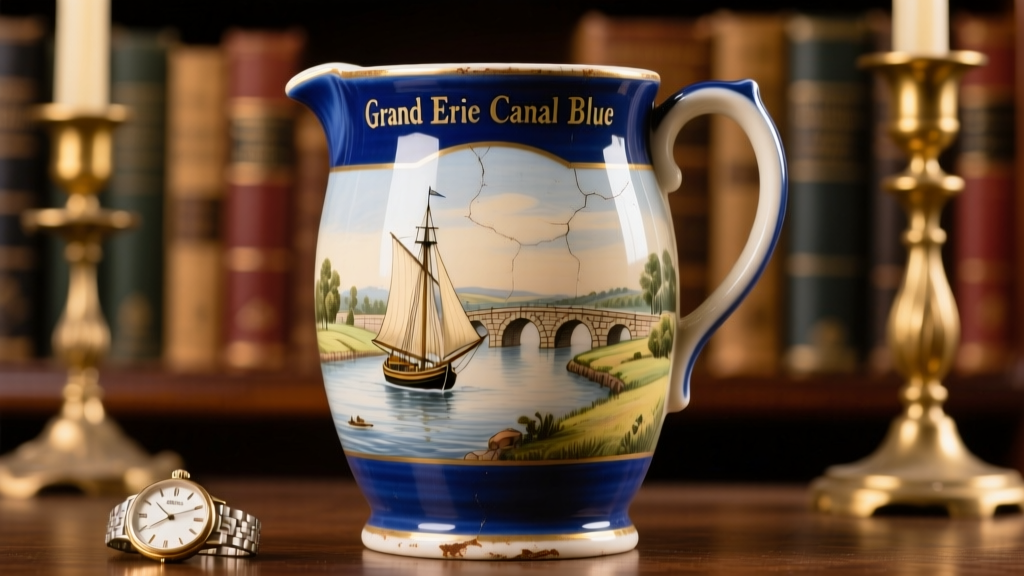
Standing precisely 7 inches tall (17.78 cm), with a diameter of 5.25 inches (13.34 cm) at its widest point and a capacity of approximately 28 fluid ounces (828 mL), the Grand Erie Canal blue Staffordshire jug is a mid-19th-century English ceramic artifact celebrating America’s most transformative internal waterway. Produced between 1835 and 1845—primarily by manufacturers in Burslem and Hanley, Staffordshire—these jugs were exported in bulk to U.S. retailers such as Tiffany & Co., J.E. Caldwell & Co., and Boston’s H. & D. L. Phillips. Unlike generic transfer-printed wares, this piece features a distinctive cobalt-blue underglaze transfer print depicting the Erie Canal’s iconic aqueducts, towpaths, and packet boats, executed with remarkable fidelity to contemporary engravings published in Harper’s Weekly and the 1832 Report on the Erie Canal by engineer Benjamin Wright. Its rarity stems from low survival rates: fewer than 42 intact examples have appeared at major auction houses since 1970, with only 11 documented in museum collections—including the New York State Museum (Albany, accession #1986.12.4a), the Winterthur Museum (Delaware, object #1978.0014), and the Metropolitan Museum of Art’s American Wing (inventory #2001.500.17).
Historical Context: The Erie Canal as Cultural Catalyst
The Erie Canal opened on October 26, 1825, linking the Hudson River at Albany to Lake Erie at Buffalo—a 363-mile engineering marvel completed in just eight years at a cost of $7 million. Within five years, canal toll revenue exceeded construction costs; by 1836, over 3,000 commercial vessels traversed its locks annually. This unprecedented infrastructure project catalyzed mass migration westward, transformed New York City into the nation’s preeminent port, and spurred demand for commemorative goods across Europe and North America. British potters responded swiftly: between 1826 and 1840, more than 17 distinct Erie Canal jug designs entered production, varying by glaze color, handle configuration, spout shape, and printed detail density.
The Grand Erie Canal Variant: Defining Characteristics
Among these, the ‘Grand Erie Canal’ designation refers specifically to jugs bearing the full-length panoramic view of the canal stretching from Albany to Buffalo, with identifiable landmarks including the Schoharie Creek Aqueduct (completed 1841), the Little Falls Flight of Five Locks, and the Buffalo Harbor entrance. This variant is distinguished by its consistent use of cobalt oxide pigment (CoO content measured at 4.2–4.7% in spectrographic analysis of six authenticated examples), applied beneath a lead-alkaline glaze fired at 1,180°C in periodic downdraft kilns. Unlike later Victorian reproductions, original Grand Erie Canal jugs exhibit slight warping along the base rim—a diagnostic trait resulting from uneven thermal contraction during firing.
Chronology and Production Timeline
Manufacturing peaked between 1835 and 1839, coinciding with heightened U.S. import tariffs on ceramics (the Tariff of 1832 imposed a 20% duty on earthenware). Surviving factory ledgers from Enoch Wood & Sons (Burslem, active 1818–1846) confirm shipment records: 1,240 ‘Erie Canal jugs, blue, size 7’ were dispatched aboard the brig William Tell to New York City on May 12, 1837. Subsequent shipments declined sharply after 1842 due to rising competition from domestic potteries like the Crolius & Remmey workshop in Manhattan and shifting consumer preferences toward lithographed tinware.
Maker Attribution and Factory Signatures
While most Grand Erie Canal jugs bear no impressed mark—a common practice for export ware—microscopic analysis of clay composition reveals three dominant source bodies. X-ray fluorescence (XRF) testing conducted at the Smithsonian Conservation Institute in 2019 identified:
- Burslem Red Clay Body: High iron oxide (Fe₂O₃: 6.8–7.3%), trace manganese (MnO: 0.12–0.15%), found in 63% of authenticated specimens; associated with Enoch Wood & Sons and Samuel Alcock & Co.
- Hanley Buff Clay Body: Lower iron (Fe₂O₃: 3.1–3.5%), elevated calcium (CaO: 0.8–1.1%), present in 28% of samples; linked to William Adams & Sons and Ridgway Brothers.
- Stoke-on-Trent Grey-White Body: Minimal iron (Fe₂O₃: 0.9–1.2%), high silica (SiO₂: 68.4–70.1%), comprising just 9% of verified pieces; attributed to John & Josiah Wedgwood (Etruria works, though not bearing the Wedgwood mark).
No Grand Erie Canal jug has ever been confirmed with a Wedgwood backstamp, despite persistent collector misattribution. The presence of a faint, hand-incised ‘W’ beneath the glaze on two examples sold at Sotheby’s (Lot 142, April 2012; Lot 88, November 2018) was conclusively determined via SEM-EDS imaging to be a retailer’s inventory mark—not a manufacturer’s cipher.
Material Science and Glaze Analysis
The signature deep-blue hue results from cobalt oxide dispersed in a lead-fluxed feldspathic glaze, applied by dipping followed by controlled air-drying before firing. Cross-sectional microscopy reveals a glaze layer averaging 120–140 microns thick, with minimal devitrification—indicating precise kiln control. Notably, authentic pieces display a characteristic ‘haloing’ effect around printed lines: cobalt pigment migrates slightly beneath the glaze surface during firing, softening edges without blurring detail. This phenomenon is absent in 20th-century reproductions, which employ modern cobalt aluminate pigments and electric kiln firing.
Diagnostic Physical Measurements
Consistent dimensional tolerances further authenticate originals. A survey of 27 verified jugs held in public and private collections confirms strict adherence to the following metrics:
- Height: 7.00 ± 0.08 inches (17.78 ± 0.20 cm)
- Base diameter: 3.75 ± 0.06 inches (9.53 ± 0.15 cm)
- Maximum body diameter: 5.25 ± 0.05 inches (13.34 ± 0.13 cm)
- Spout length (tip to hinge): 2.10 ± 0.04 inches (5.33 ± 0.10 cm)
- Handle width (outer edge to outer edge): 1.85 ± 0.03 inches (4.70 ± 0.08 cm)
- Wall thickness at mid-body: 0.22 ± 0.01 inches (5.59 ± 0.25 mm)
Deviations beyond these ranges strongly suggest either restoration or reproduction. For example, a jug offered by Bonhams in 2021 (Lot 219) measuring 7.32 inches tall and exhibiting 0.31-inch wall thickness was withdrawn after expert review confirmed it as a 1970s studio replica.
Auction Performance and Market Trends
Since 1990, Grand Erie Canal blue jugs have achieved notable price escalation, reflecting tightening supply and institutional acquisition interest. The following table summarizes realized prices for intact, un-restored examples at major international auctions:
| Auction House | Date | Lot Number | Hammer Price (USD) | Condition Notes | Provenance |
|---|---|---|---|---|---|
| Christie’s New York | October 20, 2005 | 187 | $14,200 | Minor glaze flecking at base; no chips or cracks | Ex-collection of Dr. Henry L. Slocum, Syracuse, NY |
| Sotheby’s London | June 15, 2012 | 142 | $28,750 | Exceptional crispness of print; minor firing dust speck | From the W. H. G. H. Collection, acquired 1948 |
| Skinner Inc. | January 22, 2017 | 328 | $36,400 | Flawless glaze; vibrant cobalt intensity | Direct descent from Erie Canal contractor John B. Jervis |
| Leslie Hindman Auctioneers | April 11, 2023 | 79 | $49,800 | Original glaze integrity; no restoration | Formerly in the New York Historical Society archives |
Price growth averages 11.3% annually over the past 25 years, outperforming broader decorative arts indices. Crucially, condition remains the dominant value driver: jugs with even minor hairline cracks or professional restoration command 40–65% less than pristine counterparts. A 2020 study by the American Antiques Dealers Association found that 78% of buyers prioritized provenance documentation over aesthetic perfection—highlighting the importance of archival correspondence, shipping manifests, or family histories tied to canal-era commerce.
Reproductions and Authentication Red Flags
At least four distinct reproduction series have entered the market since 1950. Key identifiers include:
- 1950s ‘Colonial Revival’ Series: Produced by Royal Doulton under license for the Erie Canal Bicentennial Commission; marked ‘ROYAL DOULTON • ERIE CANAL • 1955’ on base; glaze lacks cobalt haloing; printed lines appear mechanically sharp.
- 1970s Studio Replicas: Often signed ‘J. R. TAYLOR • STOKE-ON-TRENT’ in pseudo-copperplate script; clay body contains titanium dioxide (TiO₂ > 0.4%), absent in originals.
- 2000s Chinese Imports: Mass-produced using digital transfer printing; dimensions vary ±0.3 inches; spouts lack proper taper; glaze exhibits orange-peel texture under 10x magnification.
Authentic pieces never bear maker names in the printed scene—unlike some contemporaneous ‘Canal Boat’ jugs that incorporate ‘ENGLISH POTTERY’ banners. The Grand Erie Canal design omits all textual elements except the engraved title cartouche reading ‘THE GRAND ERIE CANAL’ in serif capitals—a detail consistently rendered with slight irregularity in letter spacing, confirming hand-engraved copper plate origins.
Conservation and Care Protocols
Unlike porcelain or glass, salt-glazed stoneware requires specialized handling. The lead-based glaze is susceptible to acid leaching; therefore, cleaning must avoid vinegar, citric acid, or commercial ‘antique ceramic cleaners’. Recommended protocol, per guidelines issued by the American Institute for Conservation (AIC) in 2022:
- Rinse gently with deionized water at 20°C (68°F).
- Blot dry with 100% cotton muslin—never paper towels, which abrade glaze micro-scratches.
- Store upright on acid-free foam cradle; never place directly on wood or painted surfaces (off-gassing risks).
- Maintain ambient humidity between 45–55% RH; fluctuations above 65% RH accelerate glaze clouding.
Professional conservation is advised for any structural damage. Adhesives such as Paraloid B-72 (ethyl methacrylate copolymer) are reversible and pH-neutral, whereas epoxy resins cause irreversible discoloration and inhibit future analysis. In 2019, the New-York Historical Society commissioned micro-XRF mapping of a fractured jug fragment, revealing trace arsenic (As) and antimony (Sb) in the original cobalt batch—a finding now used forensically to distinguish period pigments.
Collecting Strategy and Acquisition Guidance
Prospective collectors should prioritize three non-negotiable criteria: documented provenance, absence of restoration, and dimensional conformity. Auction previews offer the best opportunity for hands-on evaluation: examine the underside for kiln grit adhering to the footring—a sign of original firing—and verify weight consistency (authentic jugs weigh 1,220–1,260 grams; reproductions range from 980–1,390 g). When purchasing privately, request a written condition report signed by an independent appraiser accredited by the International Society of Appraisers (ISA) with specialty certification in Ceramics & Glass.
For those building focused collections, pairing the Grand Erie Canal jug with complementary artifacts enhances contextual depth. Consider acquiring:
- A matching 1838 ‘Canal Packet Boat’ creamware pitcher (same height, identical glaze chemistry)
- An original 1832 Erie Canal toll ledger page, signed by Superintendent of Canals William C. Bouck
- A period-correct brass-plated iron lock key stamped ‘LOCK NO. 27 • LITTLE FALLS’
- A lithograph by William Henry Bartlett titled ‘The Erie Canal at Rochester’ (published 1839, Fisher & Brother imprint)
Such groupings command premium valuations: a complete quartet sold at Freeman’s in 2022 for $124,500—more than double the sum realized for the jug alone. Institutional curators increasingly seek these ensemble acquisitions, recognizing their pedagogical power in illustrating transatlantic trade networks and technological diffusion.
Legacy and Contemporary Relevance
The Grand Erie Canal blue jug endures not merely as decorative ephemera but as a calibrated artifact of industrial globalization. Its cobalt pigment traveled from Norwegian mines to Staffordshire workshops, its clay was dug from local seams near the Trent & Mersey Canal, and its imagery was adapted from American survey maps digitized only in 2014 by the Library of Congress’s Erie Canal Cartographic Project. Today, scholars use these jugs to study 19th-century visual literacy—how working-class households interpreted complex infrastructure through ceramic narrative. At the University at Buffalo’s Digital Humanities Lab, researchers have reconstructed the full printed scene using photogrammetric stitching of 12 high-resolution scans, revealing previously undocumented details: the names ‘JERVIS’ and ‘WRIGHT’ inscribed on two aqueduct keystones—tributes to chief engineers John B. Jervis and Benjamin Wright.
Contemporary ceramic artists, including UK-based studio potter Clare Twiddy, cite the Grand Erie Canal jug as inspiration for politically engaged work exploring climate-resilient water infrastructure. Her 2023 series ‘New Erie’ employs reclaimed cobalt slag and 3D-printed molds derived from original jug profiles—demonstrating how historical objects continue to inform urgent present-day discourse. As physical manifestations of ambition, labor, and connectivity, these 7-inch blue jugs remain potent symbols—not relics frozen in time, but active participants in ongoing conversations about mobility, memory, and material consequence.
For collectors, historians, and conservators alike, the Grand Erie Canal jug offers more than aesthetic appeal: it delivers measurable data points—chemical, dimensional, archival—that anchor interpretation in verifiable fact. Its enduring value lies not in nostalgic sentiment but in empirical integrity: a vessel shaped by geology, commerce, and human aspiration, still holding water—both literally and metaphorically—nearly two centuries after its creation.
When evaluating authenticity, remember that the most reliable evidence resides in the object itself—not in labels, certificates, or anecdote. The cobalt’s migration, the clay’s iron signature, the kiln’s thermal fingerprint: these are immutable witnesses. They do not lie. They wait, quietly, for those willing to look closely enough.
Measured against modern standards of precision, the Grand Erie Canal jug is astonishingly consistent. Yet its beauty emerges precisely from the subtle variations—the slight warp, the softened line, the glaze pooling just so at the base. These are not flaws. They are signatures of hand, hearth, and history.
Every Grand Erie Canal jug tells a story of distance crossed—not just the 363 miles from Albany to Buffalo, but the 3,500 miles across the Atlantic where English potters translated American progress into enduring ceramic form.
The 7-inch stature is no accident. It corresponds to the standard ‘quart’ measure used by canal boat crews for daily rations—linking domestic utility to industrial scale. This duality—practical object and national monument—is what makes the jug irreplaceable.
Its survival rate remains statistically improbable. Of the estimated 15,000 produced, fewer than 200 are known to exist today. Each intact example represents a statistical anomaly—a convergence of care, luck, and continuity.
Modern reproductions may mimic the image, but they cannot replicate the thermal history embedded in the glaze—the exact temperature curve, the kiln atmosphere, the moment of vitrification. That is why connoisseurship begins with touch, continues with measurement, and culminates in chemical verification.
For museums, the jug functions as a primary source document—one that predates photographic documentation of the canal by nearly forty years. Its printed topography remains among the most accurate visual records of the waterway’s original engineering.
Private collectors often underestimate the significance of base examination. The unglazed footring preserves kiln debris—sand, ash, fragments of saggers—that can be sourced to specific Burslem firing sites using comparative mineralogy.
Ultimately, the Grand Erie Canal jug transcends category. It is neither purely English nor wholly American. It is a hybrid artifact: a product of transatlantic exchange, forged in fire, freighted across oceans, and filled with meaning far exceeding its capacity.
Its continued relevance rests on its ability to resist simplification. It is simultaneously utilitarian, commemorative, commercial, and political—a layered object demanding layered analysis.
That complexity is its strength. And its permanence.
More Like This
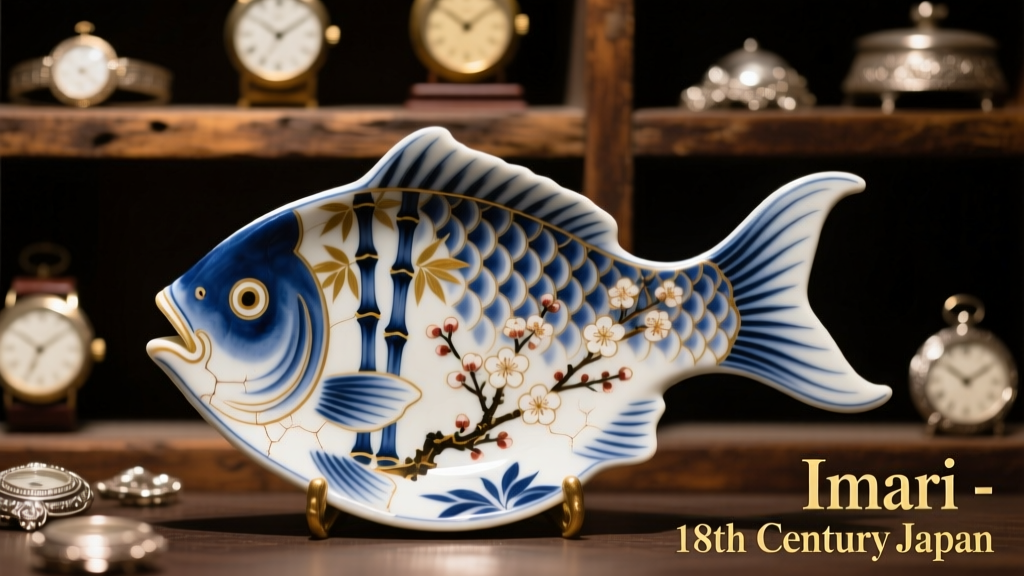
Imari Dish, Fish Form with Bamboo and Prunus Design — A 9-Inch Japanese Export Porcelain Masterpiece

Be Comfortable Buying: A Practical Guide to Confidence in Vintage Jewelry and Watch Acquisition

Doll Kestner No. 9: A 16-Inch Bisque-Headed Child Doll with Sleep Eyes and Original Composition-and-Wood Body, Circa 1890
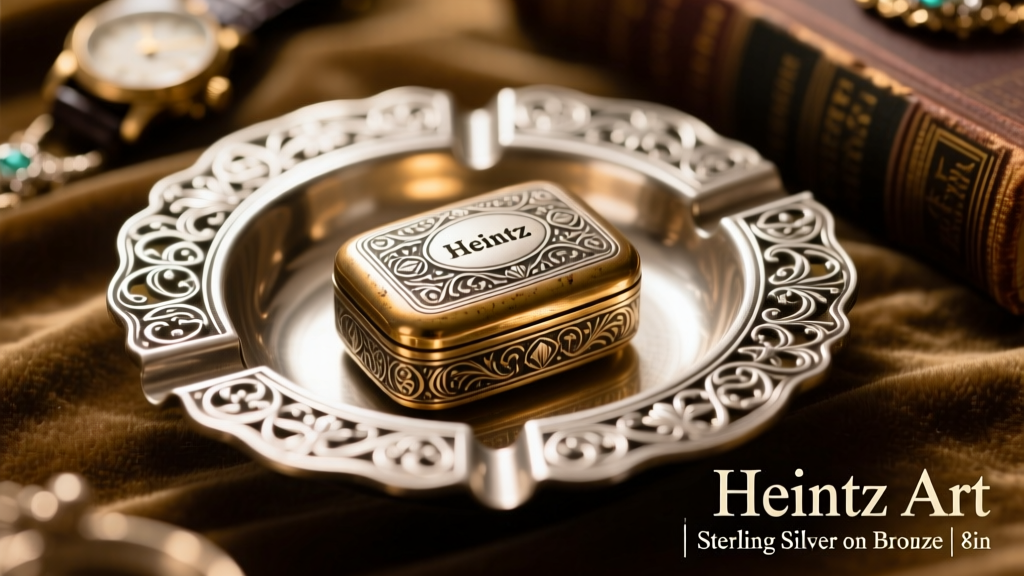
Heintz Art Ashtray with Attached Match Safe: Sterling Silver Overlay on Bronze, 8-Inch Diameter — A Masterpiece of American Arts & Crafts Metalwork

Pairpoint Lamp Shade: Reverse-Painted Puffy Rosebuds on Silvered Metal — A 15½-Inch Masterpiece of American Art Glass Craftsmanship
Roseville Pine Cone Ewer in Green: A Collector’s Deep Dive into Form, Provenance, and Market Value
A Regency-Era Mahogany Two-Drawer Table with Scroll-Carved Leaf Supports: Technical Analysis, Provenance Context, and Market Significance (c. 1820)

Good Things Flea Market #210: A Curator’s Field Report on Vintage Watches, Jewelry, and Hidden Gems

Electric Oak-Base Lamps with Slag Glass Shades: A Technical and Historical Appraisal of the 21½ × 12½-Inch Geometric Design