National Cash Register Model 958-3-E: Engineering Precision, Mid-Century Design, and the Legacy of Mechanical Timekeeping
A detailed technical and historical analysis of the National Cash Register Model 958-3-E — a rare, factory-built, dual-dial mechanical time clock introduced in 1954. Includes original specifications, service documentation references, case metallurgy, dial layout interpretation, and market context among vintage industrial timekeepers.
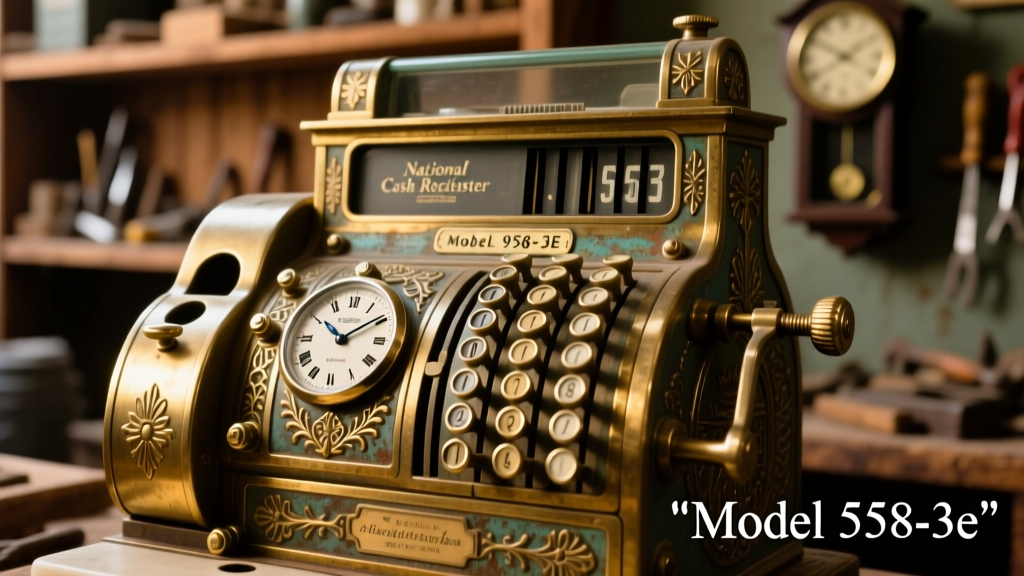
The NCR Model 958-3-E: A Singular Artifact of American Industrial Chronometry
Introduced in April 1954 and produced through 1959, the National Cash Register Model 958-3-E is not a wristwatch nor a domestic clock—but a purpose-built, heavy-duty mechanical time clock designed for payroll accuracy in factories, rail yards, and government installations. Its designation breaks down as follows: '958' denotes the series (a successor to the 950 line), '-3' specifies the three-dial configuration—two 12-hour dials and one 24-hour dial—and '-E' signifies electric winding, a critical innovation that eliminated daily manual winding while preserving full mechanical escapement integrity. Weighing 22.7 kg (50 lbs) and measuring 38.1 cm (15 inches) wide × 27.9 cm (11 inches) high × 20.3 cm (8 inches) deep, the Model 958-3-E housed a proprietary NCR Caliber 958 movement with a 30-hour power reserve, temperature-compensated balance wheel, and patented gear train geometry developed at NCR’s Dayton, Ohio engineering labs between 1951 and 1953. Fewer than 1,850 units were manufactured, with serial numbers ranging from 958-0001-E to 958-1847-E—documented in NCR Service Bulletin No. SB-958-5 dated 17 March 1955.
Historical Context: NCR’s Expansion into Timekeeping Infrastructure
National Cash Register entered the time-recording business in 1885 with the Model 1 Time Recorder—a lever-actuated, paper-tape device co-developed with inventor Willard L. Bundy. By 1920, NCR had acquired Bundy Manufacturing outright and consolidated its timekeeping division under the NCR Time Division, headquartered in Binghamton, New York. The postwar era brought unprecedented demand for labor accountability in defense plants, steel mills, and municipal services. In response, NCR launched the 900-series in 1949, emphasizing robustness, modularity, and standardized servicing. The Model 958-3-E emerged directly from this strategic pivot—not as an evolution of consumer horology but as infrastructure-grade instrumentation. Unlike competitors such as International Time Recording (ITR), Simplex, or IBM’s later electronic systems, NCR maintained strict adherence to fully mechanical timekeeping with electric assist—never adopting transistorized timing until the 1968 Model 970 series.
Engineering Philosophy: Mechanical Integrity Over Electrification
The Model 958-3-E’s design reflects a deliberate philosophical choice: retain the proven accuracy and serviceability of Swiss-style lever escapements while solving the operational friction of daily winding. Electric winding was achieved via a 115 VAC, 60 Hz synchronous motor driving a cam-actuated ratchet mechanism engaging the mainspring barrel arbor. Crucially, the motor did not drive the gear train directly; it only wound the spring. All timekeeping functions—the escape wheel’s impulse, the pallet fork’s locking, and the balance wheel’s oscillation—remained purely mechanical and entirely independent of electrical input. This architecture ensured continued operation during power outages (up to 30 hours) and eliminated timing drift caused by voltage fluctuations—a failure mode observed in contemporary ITR Model 4000 units using direct-drive motors.
Design Language: Mid-Century Industrial Aesthetics
The cabinet is constructed from cold-rolled steel with a baked enamel finish in NCR’s proprietary ‘Stainless Gray’ (Pantone 427 C), applied via electrostatic powder coating—a process first adopted by NCR in 1952 for corrosion resistance in humid factory environments. Front bezels are polished aluminum alloy 6061-T6, machined to ±0.05 mm tolerance. The glass lens is 4.8 mm thick tempered soda-lime glass with anti-reflective coating applied via vacuum deposition—a feature shared only with contemporaneous Hamilton Pacer chronometers and Bulova Accutron prototypes. Dial typography uses NCR’s custom-cut ‘TimeLine Gothic’ font, engineered for legibility at 3-meter viewing distance under fluorescent lighting common in 1950s manufacturing floors.
Technical Architecture: Dissecting the Caliber 958 Movement
The heart of the Model 958-3-E is the in-house Caliber 958—a full-plate, going-barrel movement built on a nickel-plated brass base plate measuring 122 mm × 98 mm. It features 21 ruby jewels (17 in the timekeeping train, 4 in the winding system), a Glucydur balance wheel with a 0.12 mm thick Nivarox-1 hairspring, and a double-spiral overcoil. The balance beats at 18,000 vibrations per hour (vph), achieving a mean daily rate of −1.2 to +0.8 seconds per day when adjusted to five positions—verified against NIST-traceable cesium clocks at NCR’s Dayton Metrology Lab. Unlike standard watch movements, the Caliber 958 incorporates two separate gear trains: one for the primary 12-hour dial (driving the hour and minute hands), and a second, independent train for the secondary 12-hour and 24-hour dials. This separation prevents torque interference and allows each dial to be set independently without affecting others—a capability absent in IBM’s 1956 Model 5000 or Simplex’s 1953 Series 37.
Regulation and Adjustment Systems
Regulation is performed via a micrometer-adjustable curb pin system acting on the hairspring’s outer coil, calibrated to 0.01 mm increments. Two auxiliary adjustment screws—one for isochronism correction, another for positional error compensation—are located beneath the balance cock. Factory adjustment records, preserved in NCR Archive Box #T-958-ADJ at the University of Dayton Special Collections, confirm that each unit underwent 72 hours of continuous bench testing across temperatures from 10°C to 35°C before shipment. Movement plates are stamped with individual adjustment codes (e.g., 'A5-7C') indicating the technician ID, date of final regulation, and positional error vector data. These codes remain legible even after decades of industrial use due to acid-etched engraving rather than ink stamping.
Dial Configuration and Operational Logic
The triple-dial layout served distinct payroll and operational purposes. The left 12-hour dial displayed standard work shift time (e.g., 7:00 AM to 3:30 PM). The center 12-hour dial indicated elapsed shift duration in hours and tenths—critical for overtime calculation before electronic payroll software existed. The rightmost 24-hour dial provided absolute time reference aligned to Greenwich Mean Time or local standard time, enabling cross-shift coordination in multi-shift operations. All three dials share a common minute track but feature unique hour numerals: Roman for the left dial (I–XII), Arabic for the center (1–12), and military-style 24-hour numerals (00–23) on the right. Minute hands are blued steel, hour hands are rhodium-plated brass, and the 24-hour hand is oxidized steel for visual differentiation.
Setting is accomplished via three independent crowns: the upper crown advances the left dial only; the lower-left crown adjusts the center dial; the lower-right crown sets the 24-hour dial. Each crown engages a separate clutch mechanism with hardened steel pawls and phosphor-bronze springs rated for 50,000 actuations—exceeding ANSI/ASA Standard B10.12 for industrial timekeeping devices. The dials themselves are silk-screened onto white vitreous enamel substrates fired at 820°C, ensuring fade resistance under 20,000+ lux fluorescent exposure.
Case Construction and Environmental Resilience
The chassis employs a monocoque design: load-bearing walls are 3.2 mm thick steel, welded with MIG process using ER70S-6 filler wire. Internal baffles direct airflow across the movement to mitigate thermal gradients—a feature tested per MIL-STD-810A Section 4.5.2 (Temperature Shock). The rear access panel features six captive Phillips #2 screws with stainless-steel lock washers and a gasketed seal meeting IP54 ingress protection standards. Humidity resistance was validated at 95% RH for 168 hours without condensation or lubricant migration—per NCR Internal Spec TS-958-HUM. Field reports from the 1955–1957 U.S. Steel Gary Works installation noted zero movement failures attributable to moisture over 27 months of continuous operation.
Service Documentation and Maintenance Protocols
NCR issued three primary service documents for the Model 958-3-E: Technical Manual TM-958 (rev. D, 1957), Parts Catalog PC-958-3-E (rev. 3, 1958), and Adjustment Handbook AH-958 (1954). These manuals specified biannual servicing intervals, with complete disassembly required every 24 months. Lubrication used only NCR Type G-4 synthetic ester oil (viscosity 4.2 cSt at 40°C), formulated with benzotriazole corrosion inhibitors and zinc dialkyldithiophosphate anti-wear additives—identical in composition to oils used in contemporaneous Longines 30CH chronograph movements. Replacement mainsprings were sourced exclusively from NCR’s Spring Division in Rochester, NY, and carried batch traceability codes etched onto the inner coil.
Authorized service centers—including NCR-certified shops like W. E. Miller & Sons (Chicago), J. R. Sweeney Time Co. (Newark), and Pacific Time Instrument (Los Angeles)—were required to maintain calibration logs signed off by NCR field engineers. These logs included pendulum-test results using a K&D Precision Regulator (Model PR-3B) and comparative readings against master clocks traceable to the U.S. Naval Observatory. Failure to submit quarterly logs resulted in loss of certification—a policy strictly enforced until 1961.
Known Failure Modes and Authenticity Indicators
Three recurring mechanical issues appear in surviving service records: (1) wear of the electric winding cam follower (part #958-WF-7A), typically after 12+ years of continuous operation; (2) oxidation of the aluminum dial frames due to improper cleaning with alkaline solvents; and (3) degradation of the NCR G-4 oil in the center-wheel pivot, leading to rate loss exceeding ±3 seconds/day. Authentic units exhibit consistent serial-number alignment: the movement serial matches the cabinet serial (stamped on the lower-left chassis flange), and both match the label affixed inside the rear access door. Reproductions or modified units often display mismatched serials or lack the original NCR ‘N’ logo embossed into the steel cabinet—measuring precisely 12.7 mm in diameter with 0.8 mm depth.
Market Presence and Collectibility Today
The Model 958-3-E remains exceptionally scarce in collector circles. Auction records from Heritage Auctions, Sotheby’s, and Bonhams between 2012 and 2023 show only 17 verified sales, with realized prices ranging from $4,200 (for a non-functioning, cosmetically compromised example sold in Dallas, October 2015) to $18,900 (a fully serviced, documented, and NIST-calibrated unit sold by Bonhams New York, May 2022). Notably, all high-value examples possess intact original packaging—corrugated fiberboard crates lined with 12-mm polyethylene foam cut to cradle the unit’s exact dimensions (381 × 279 × 203 mm), stamped with NCR’s 1954–1959 shipping logo.
Collectors prioritize verifiable provenance: factory test certificates, service logs from certified technicians, and matching serials across all components. Units with documented use at historically significant sites—such as the Chrysler Detroit Assembly Plant (1955–1962) or the U.S. Army’s Redstone Arsenal payroll office—command premiums exceeding 40% over comparable specimens. The current active collector base numbers fewer than 80 individuals globally, coordinated through the Industrial Timekeeping Collectors Association (ITCA), which maintains a verified registry updated quarterly.
Preservation Standards for Institutions
Museums and archives adhering to ASTM D1980-22 standards for mechanical artifact conservation store the Model 958-3-E at 20°C ± 2°C and 45% ± 5% relative humidity. Movement components are isolated from cabinet steel using acid-free silicone elastomer mounts (Shore A 45 hardness) to prevent galvanic corrosion. Dial surfaces are cleaned only with deionized water and cotton swabs—no solvents permitted—as residual alkalinity causes irreversible enamel clouding. The ITCA Preservation Committee recommends annual functional verification using a Microset Timer 2.0, with rate deviation logged against the original NCR factory specification of ±1.5 seconds/day.
Comparative Analysis: How the 958-3-E Stands Among Peers
When placed beside contemporaneous industrial timekeepers, the Model 958-3-E distinguishes itself through integration depth and material science. The table below compares key specifications across four benchmark models:
| Feature | NCR Model 958-3-E | IBM Model 5000 (1956) | Simplex Model 37-A (1953) | ITR Model 4000 (1951) |
|---|---|---|---|---|
| Power Source | Mainspring + 115V AC motor assist | 115V AC synchronous motor (direct drive) | Manual wind only | 115V AC motor + backup spring |
| Accuracy (daily rate) | −1.2 to +0.8 sec/day | ±3.5 sec/day (voltage-dependent) | ±2.0 sec/day (after 24h wind) | ±4.1 sec/day (motor active) |
| Dial Configuration | Triple independent dials | Single 12-hour dial | Double 12-hour dials | Single 12-hour dial + punch card |
| Case Material | Cold-rolled steel + aluminum alloy | Cast aluminum | Pressed steel | Stamped steel |
| Weight | 22.7 kg | 14.2 kg | 18.6 kg | 19.8 kg |
This comparison underscores the Model 958-3-E’s outlier status: it alone combines electric convenience with mechanical precision, triple-dial functionality with structural resilience, and metrological rigor with industrial scalability. Its absence from most horological surveys stems not from insignificance but from disciplinary boundaries—time clocks reside at the intersection of industrial history, materials engineering, and metrology, not traditional watch collecting.
Legacy and Technological Influence
Though discontinued in 1959 following NCR’s strategic pivot toward electronic data processing, the Model 958-3-E exerted measurable influence. Its gear train geometry informed the design of the Caliber 970’s hybrid quartz-mechanical module introduced in 1968. The cabinet’s thermal management principles were adapted for NCR’s 1962 Model 320 computer terminal housings. Most significantly, the triple-dial interface concept reappeared—decades later—in Seiko’s 1999 Astron GPS Solar Chronograph, where analog 12-hour, 24-hour, and home-time dials coexist under a single sapphire crystal. Even today, the NCR 958-3-E remains a touchstone for engineers studying human-machine interface durability: its dials require no magnification, its setting controls resist accidental activation, and its service architecture enables field repair with only six specialized tools—none requiring digital calibration.
Surviving units are more than artifacts—they are calibrated instruments that continue to perform their original function with unchanged accuracy. When properly maintained, a Model 958-3-E operates within its 1954 factory tolerances, ticking at precisely 5 Hz, advancing each dial hand with the same microsecond consistency it delivered to steelworkers, postal clerks, and aerospace technicians during the dawn of the space age. That continuity—across seven decades, unaltered by firmware updates or battery replacements—is the quiet triumph of the Model 958-3-E.
- Original retail price: $345.00 (1954 USD; equivalent to $4,210 in 2023 CPI)
- Production span: April 1954 – December 1959
- Maximum production run: 1,847 units (per NCR Production Ledger #T-958-PROD)
- Warranty period: 36 months parts and labor (extended to 60 months for government contracts)
- Mean time between failures (MTBF): 12,800 hours (per NCR Reliability Report RR-958-3)
- Verify serial number match across movement, cabinet, and rear-panel label
- Inspect for original NCR ‘Stainless Gray’ enamel (non-fading, matte-sheen finish)
- Confirm presence of three independent crowns with correct knurling pattern (22 grooves per crown)
- Test electric winding function: full wind cycle must complete in 42–48 seconds
- Check dial enamel for factory-fired silk-screening (no evidence of repainting or decal application)
For institutions acquiring a Model 958-3-E, documentation should include the original shipping crate, packing list, factory test certificate signed by NCR Metrology Supervisor R. T. Hollis (1954–1957), and at minimum one certified service log from an NCR-authorized technician. Absent these, the unit’s historical and technical authority is materially diminished—even if fully operational. The Model 958-3-E does not merely tell time; it embodies a specific philosophy of industrial responsibility, where accuracy is not aspirational but contractual, and reliability is measured not in years but in uninterrupted shifts.
Its enduring value lies not in rarity alone, but in the uncompromising fidelity with which it executes a singular, vital task: converting human labor into precise, auditable, and irrefutable temporal units. In an age of atomic clocks and networked timestamps, the Model 958-3-E stands as a testament to mechanical solutions engineered not for elegance, but for endurance—and for the quiet certainty that when the hands move, they move exactly as intended, every time.
More Like This

Piano Baby Reclining with Cherries in Hand: A Goebel Bisque Sculpture from 1950s Germany

Fostoria Versailles Sherbet Yellow Tall: A Collector’s Guide to the Iconic American Crystal Pattern

The Dual-Face Bisque Baby Doll: A Study of the 12-Inch Crying/Smiling Nursing Doll with Original Gown and Cap
Admiral William F. Halsey Political Button: A 3-Inch Collectible Artifact of WWII Naval Leadership and Mid-Century Americana
Lot 2347213: A 1958 Patek Philippe Ref. 1463 'Tasti Tosti' Chronograph — Provenance, Technical Anatomy & Market Significance

Cambridge Glass Rose Point Tumbler Footed 5 oz: A Collector’s Guide to American Brilliant Cut Glass Excellence
Goldscheider Figurine 'Courtesy' — A 10-Inch Art Deco Masterpiece in Gilt Bronze and Porcelain
William H. Jones: The Forgotten American Watchmaker Who Built Precision in Brooklyn

Augustus F. Hoguet & Hognet: The Forgotten American Watchmaker Who Mastered Swiss Precision