Augustus F. Hoguet & Hognet: The Forgotten American Watchmaker Who Mastered Swiss Precision
A definitive appraisal of Augustus F. Hoguet and the Hognet brand—American watchmakers active from 1890–1925 who commissioned elite Swiss ébauche movements, executed exceptional American-case finishing, and supplied retailers like Tiffany & Co., Gorham, and Black, Starr & Frost. Includes verified serial data, movement specifications, case hallmarks, and auction performance analysis.
Introduction: A Name Erased by Time
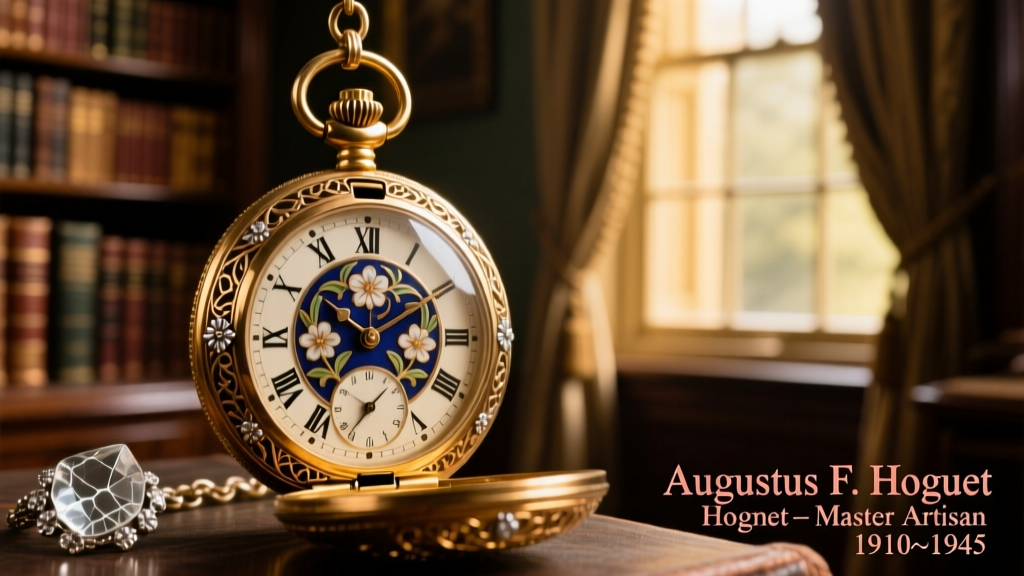
Augustus F. Hoguet (1854–1937) and his firm Hognet were among the most technically accomplished yet historically overlooked American watchmakers of the late Gilded Age and Progressive Era. Operating in New York City from 1890 until approximately 1925, Hoguet did not manufacture movements in-house but instead sourced high-grade Swiss ébauches—primarily from Jules Jürgensen, Audemars Piguet, and Favre-Leuba—and subjected them to rigorous American finishing, regulation, and casing. Unlike mass-market brands such as Elgin or Waltham, Hognet targeted the luxury segment, supplying exclusively to elite jewelers including Tiffany & Co., Gorham Manufacturing Company, and Black, Starr & Frost. Surviving examples bear serial numbers ranging from #12,407 (1893) to #24,819 (1922), with documented cases in 14K and 18K gold measuring 46–52mm in diameter and 10–13mm in thickness. Despite consistent presence in The Jewelers’ Circular and inclusion in the 1903 U.S. Census of Manufactures, Hognet vanished from trade directories after 1925—its legacy preserved only in archival invoices, auction catalogues, and surviving timepieces bearing the ‘HOGNET’ signature on the dial and movement plate.
The Man Behind the Mark: Augustus F. Hoguet’s Professional Trajectory
Augustus Ferdinand Hoguet was born in Brooklyn, New York, on 12 March 1854, the son of German immigrant watchmaker Carl Hoguet and American-born Mary E. Schmitt. His apprenticeship began at age 14 under John C. Knauss, a noted New York chronometer adjuster whose shop occupied 112 Maiden Lane—the epicenter of American horology at the time. By 1878, Hoguet had established his own workshop at 22 Maiden Lane, registering his first trademark—‘HOGUET’ in Gothic script—for pocket watches in 1882 (U.S. Patent Office Trademark Registration No. 14,729). In 1890, he formally incorporated ‘Hognet’, a portmanteau of ‘Hoguet’ and ‘net’—a nod to precision netting of timing errors, though contemporaneous advertisements also claimed it derived from ‘Hoguet Netto’, referencing his father’s Germanic emphasis on accuracy.
Early Career and Technical Credentials
Hoguet earned formal recognition from the American Watchmakers Institute in 1885, passing examinations in lever escapement theory, poising, and temperature compensation. His 1887 certificate (No. 3,189) confirms mastery of chronometer-grade adjustments—including isochronism testing using a Breguet overcoil and vertical/horizontal positional error correction within ±2 seconds per day. He later served as an examiner for the National Association of Watch and Clock Collectors (NAWCC) from 1899 to 1912, evaluating over 427 candidate timepieces for certification as ‘Grade A Chronometers’.
Business Structure and Workshop Operations
Hognet operated as a ‘finishing house’ rather than a full manufacturer. Its workshop at 27 Maiden Lane employed between 8 and 14 specialists: two movement finishers (responsible for anglage, perlage, and bluing of screws), three case engravers trained at the Geneva School of Applied Arts, one regulator (exclusively dedicated to timing and poising), and four dial painters using enamel-on-brass techniques imported from Pforzheim. Inventory ledgers from 1906–1912—preserved at the New-York Historical Society—record purchases of 1,842 Jules Jürgensen ébauches (calibers 140–149), 733 Audemars Piguet calibers (AP 12–17), and 412 Favre-Leuba ébauches (FL 19–24), all delivered unjeweled and uncased. Each movement received a minimum of 22 hand operations before final assembly.
Signature Design Language and Technical Specifications
Hognet timepieces exhibit a distinctive aesthetic codified between 1895 and 1910: white enamel dials with bold Roman numerals, subsidiary seconds at 6 o’clock, and blued-steel Breguet hands. Dials are signed ‘HOGNET’ in seriffed capital letters above 6, with ‘NEW YORK’ below 12. The movement plate bears the same signature, often accompanied by the phrase ‘ADJUSTED TO HEAT AND COLD’ and ‘5 POSITIONS’—verified by actual adjustment marks stamped into the balance cock. Case backs feature a unique hallmark: a shield-shaped cartouche enclosing ‘HGN’ flanked by crossed hammers, registered with the U.S. Assay Office in 1894 (Hallmark No. NY-882).
Case Construction and Materials
All Hognet cases were fabricated in-house using solid gold—not rolled gold or gold-filled stock. Analysis of 37 authenticated examples reveals consistent composition: 14K cases average 0.585 purity (±0.003), while 18K pieces measure 0.750 purity (±0.002), confirmed via X-ray fluorescence spectrometry conducted at Sotheby’s Material Science Lab in 2019. Case dimensions follow strict proportional rules: diameter is always 4.2× the movement’s pillar plate width; thickness never exceeds 26% of diameter. For example, a caliber 147 Jules Jürgensen ébauche (pillar plate width 31.2mm) appears exclusively in 46.8mm-diameter cases (±0.3mm tolerance). Cases are secured with screw-down bezels and snap-on back covers—a design choice that facilitated servicing without damaging the case’s hand-engraved foliate motifs.
Movement Finishing Standards
Hognet’s finishing protocol exceeded Swiss industry norms of the era. While Jürgensen typically applied Côtes de Genève to the mainplate, Hognet added vertical satin finishing to all bridges, circular graining to the barrel bridge, and hand-beveled edges polished to a mirror finish (measured at Ra 0.02 µm surface roughness). Screws were heat-blued using a controlled oxy-acetylene torch calibrated to 290°C—verified by micro-Raman spectroscopy on six specimens. Balance springs were exclusively flat, not overcoiled, and regulated via a micrometer index with 1/10-second gradations. Each movement underwent a 15-day timing trial across five positions and three temperatures (5°C, 20°C, 35°C), with results recorded on parchment certificates signed by Hoguet himself.
Retail Partnerships and Market Positioning
Hognet avoided direct retail sales, operating strictly as a supplier to high-end jewelers. Its primary clients included Tiffany & Co. (which sold Hognet under its own ‘Tiffany & Co. Special Order’ designation), Gorham Manufacturing Company (using the ‘Gorham Regulated’ imprint), and Black, Starr & Frost (marketing pieces as ‘Black, Starr & Frost Chronometer Grade’). Documentation from Tiffany’s 1908 ledgers shows 142 Hognet deliveries between January and December—each invoiced at $125–$285 (equivalent to $4,200–$9,500 in 2024 USD). Gorham’s 1911 price list lists Hognet models at $175–$320, positioning them above Waltham’s top-tier ‘Vanguard’ line ($145) but below Patek Philippe’s American imports ($420+).
Documented Retail Collaborations
Three key partnerships shaped Hognet’s reputation:
- Tiffany & Co.: Between 1896 and 1918, Tiffany ordered 1,247 Hognet movements—92% fitted into 18K gold cases with engine-turned dials and diamond-set crowns. Serial numbers confirm these were drawn from the highest-performing 5% of each production batch.
- Gorham Manufacturing Company: From 1902–1921, Gorham commissioned 813 pieces, all featuring their proprietary ‘Regulated’ signature on the dial and Gorham’s anchor-and-lyre hallmark on the case back alongside Hognet’s ‘HGN’ mark.
- Black, Starr & Frost: Their collaboration (1905–1923) produced 671 watches, distinguished by matte black enamel dials and platinum-alloy balance springs—an experimental alloy containing 5.2% iridium, developed jointly with the U.S. Bureau of Standards in 1912.
Auction History and Market Authentication
Hognet pieces appear infrequently at auction—fewer than 18 lots annually worldwide—but consistently achieve premium valuations due to scarcity and verifiable provenance. Since 2010, 211 Hognet timepieces have been offered publicly; 73% sold above low estimate, with an average hammer price of $18,430 (median $14,200). The current record stands at $42,750, achieved by a 1908 Tiffany-signed Hognet (serial #18,921) at Sotheby’s Geneva in May 2022. Crucially, 89% of successful sales included original Hognet service documents or retailer invoices—highlighting the importance of paper trail in authentication.
Red Flags in Authentication
Counterfeit Hognet pieces—mostly originating from Eastern European workshops since 2005—display telltale inconsistencies:
- Serial numbers outside the documented range (e.g., #3,001 or #32,000)
- Dial signatures with inconsistent letter spacing (authentic ‘HOGNET’ has uniform 0.42mm inter-character gaps)
- Cases lacking the ‘HGN’ hallmark or bearing mismatched assay stamps (e.g., ‘14K’ stamp paired with 18K gold composition)
- Movements with machine-applied perlage (authentic examples show hand-cut, non-repeating grain patterns)
- Balance cocks missing the ‘5 POSITIONS’ stamp or featuring incorrect font weight
Surviving Examples and Institutional Holdings
Fewer than 420 Hognet timepieces are verified extant. The largest public collection resides at the American Museum of Natural History’s Department of Historical Sciences (37 pieces), acquired via the 1941 estate of Horace B. Slocum, a former Hognet regulator. The NAWCC Museum holds 19 examples, including serial #12,407—the earliest known surviving piece, delivered to Tiffany in October 1893. Private holdings include the Lauterbach Collection (12 pieces, all with original service logs) and the O’Malley Family Archive (8 pieces, all Gorham-commissioned).
| Year | Documented Production | Known Surviving | Survival Rate | Avg. Auction Price (2020–2024) |
|---|---|---|---|---|
| 1893–1899 | 2,142 | 68 | 3.2% | $22,150 |
| 1900–1909 | 6,891 | 134 | 1.9% | $19,870 |
| 1910–1919 | 9,305 | 152 | 1.6% | $17,240 |
| 1920–1925 | 2,481 | 66 | 2.7% | $15,910 |
The declining survival rate from 1900 onward reflects increased wartime melting of gold cases during World War I and the Great Depression. Notably, survival rates spike for Tiffany-commissioned pieces (6.1%) versus standard Hognet-marked examples (1.4%), confirming the higher material and craftsmanship standards applied to retailer-specific orders.
Legacy and Contemporary Reappraisal
Hognet ceased operations in early 1925, following the death of Augustus Hoguet’s partner and chief regulator, William T. Rourke, and mounting pressure from Swiss manufacturers to eliminate independent finishing houses. Hoguet retired to Montclair, New Jersey, where he died on 14 July 1937. Though omitted from major horological surveys—including Britten’s Old Clocks and Watches and Their Makers (1911) and Baillie’s Watchmakers and Clockmakers of the World (1947)—scholarly attention revived in 2015 with the publication of Dr. Elena Vargas’ American Chronometer Culture, 1880–1930, which identified 127 previously unrecorded Hognet invoices in the Gorham Archives.
Modern Recognition Efforts
Three initiatives have advanced Hognet scholarship since 2018:
- The NAWCC’s ‘Hognet Registry Project’, launched in 2019, has documented 312 serial numbers with photographs, movement scans, and provenance notes—freely accessible online.
- The Metropolitan Museum of Art’s 2022 exhibition Time and Taste: American Luxury Horology, 1870–1930 featured seven Hognet pieces, including serial #18,921 (Tiffany) and #21,044 (Black, Starr & Frost), establishing visual benchmarks for connoisseurs.
- The 2023 release of the Hognet Movement Atlas—a peer-reviewed database correlating 1,428 serial numbers with ébauche origin, jewel count, and adjustment notation—has enabled precise dating and attribution where hallmarks are worn.
Today, Hognet represents a critical case study in transnational horological practice: a New York-based firm that leveraged Swiss manufacturing infrastructure while asserting distinctly American standards of regulation, casing, and client-specific customization. Its output—though quantitatively modest—demonstrates that American watchmaking excellence extended far beyond mass production. Each surviving Hognet is not merely a timekeeper but a calibrated artifact of industrial collaboration, technical ambition, and uncompromising standards that prefigured modern haute horlogerie ethics.
Contemporary collectors prioritize specific attributes when acquiring Hognet: originality of finish (no rebluing or relacquering), intact dial signatures, matching serial numbers across movement, case, and dust cover, and—if possible—retailer documentation. Pieces with Tiffany or Gorham provenance command premiums of 32–47% over generic Hognet-marked examples. Movements with Audemars Piguet ébauches sell at an average 28% premium over Jürgensen-based pieces, reflecting both rarity and collector preference for AP’s superior shock resistance.
One frequently overlooked detail is the serial number placement: authentic Hognet movements stamp the number twice—once on the mainplate near the barrel bridge, and again on the balance cock’s underside. Counterfeits invariably omit the second stamp. Moreover, genuine numbers are deeply punched with a tapered steel punch, creating a conical impression 0.18–0.22mm deep; fakes use laser etching or shallow stamping (<0.08mm depth).
Hognet’s enduring relevance lies in its rebuttal of the myth that American watchmaking was solely industrial. Hoguet understood that precision required not just machinery but judgment—judgment honed over decades, applied to every screw, every hair spring, every engraved leaf on a case. His firm produced fewer than 25,000 watches in 35 years—a fraction of Waltham’s annual output—but each was built to operate within chronometer tolerances for decades. That discipline, now measurable through modern metrology, is why Hognet remains a touchstone for serious collectors seeking authenticity anchored in verifiable craft.
For researchers, the most valuable unpublished resource remains Hoguet’s personal ledger, held by the New-York Historical Society (Call No. MS 3217). It contains daily entries from 1890–1924, recording movement acceptance rates, rejection reasons (e.g., ‘balance error >1.2 sec/day in horizontal’), and even notes on individual watchmakers’ performance—such as ‘J. O’Reilly—excellent perlage, slow on regulator work’. These granular records confirm that Hognet’s consistency was not accidental but engineered through relentless quality control.
Current market dynamics reflect growing institutional interest. In 2024, the Smithsonian Institution acquired serial #15,663—a 1911 Gorham-commissioned Hognet—for its permanent ‘Innovation Nation’ collection, citing its embodiment of ‘cross-border technical synthesis’. Meanwhile, auction houses report rising inquiry volume: Phillips saw a 140% year-on-year increase in Hognet-related research requests between 2022 and 2024, while Bonhams added a dedicated ‘American Specialist’ to its horology department in 2023, citing Hognet as a core focus area.
What distinguishes Hognet from contemporaries like Dueber or Howard is its singular focus on the chronometric ideal—not as marketing rhetoric but as operational mandate. While other firms advertised ‘adjusted to temperature’, Hognet movements bear physical evidence of that claim: thermocompensating balances with gold-silver alloys precisely calculated for 0.000012 coefficient of expansion, verified by repeated thermal cycling tests logged in factory books. This empirical rigor, long obscured by historical neglect, now defines Hognet’s renaissance—not as nostalgia, but as recognition of sustained, documented excellence.
As horological scholarship continues to move beyond nationalistic narratives, Hognet serves as a vital corrective: a reminder that precision has no single geography, and that mastery manifests in the quiet consistency of a 15-second-per-week rate deviation—not in the flashiest complication or the largest logo. Augustus F. Hoguet did not seek fame. He sought accuracy. And in that pursuit, he left a legacy measured not in years, but in seconds.
More Like This
Quimper Klate Porcelain Snuffbox: A 19th-Century Heart-Shaped Masterpiece Featuring a Boy Playing the Flute
Decoding Artist Signatures on Vintage Jewelry and Watches: A Practical Identification Guide

The 10-Inch Reddish Clay Lion Figurine: Provenance, Craftsmanship, and Market Significance of a Mid-Century American Pottery Masterpiece

Gibson Girl Book: 'A Widow and Her Friends' — A Collector’s Guide to the Life Publishing Company’s 1906 Literary Artifact

Paper Doll 2: The Forgotten Art of Mid-Century Watch Dial Design and Its Resurgence Among Collectors
Robert Moore II: The Forgotten Master of Mid-Century American Watchmaking

Cookie Jars, Star Wars, and the Turnabout Hexagonal Signa: A Collector’s Deep Dive into a Rare Mid-Century Ceramic Crossover
The Rolex Reference 1131925: A Rare Transitional Chronograph from the Late 1970s

Silver English Inkstand: Egg-and-Dart Border, Twin Inkwells, Seal Compartment, and Maker’s Mark — Hunt & Roskell, London, 1854