Music Organ Monkey No. 2 & Extra Cobbs: A Technical and Historical Appraisal of a Rare Mechanical Automaton
A detailed examination of the Music Organ Monkey No. 2 automaton—manufactured by the German firm Ernst Plank circa 1905–1912—and its companion set of 'Extra Cobbs' figures, including provenance, mechanical architecture, materials analysis, auction performance, and conservation challenges.
Introduction: Defining the Music Organ Monkey No. 2
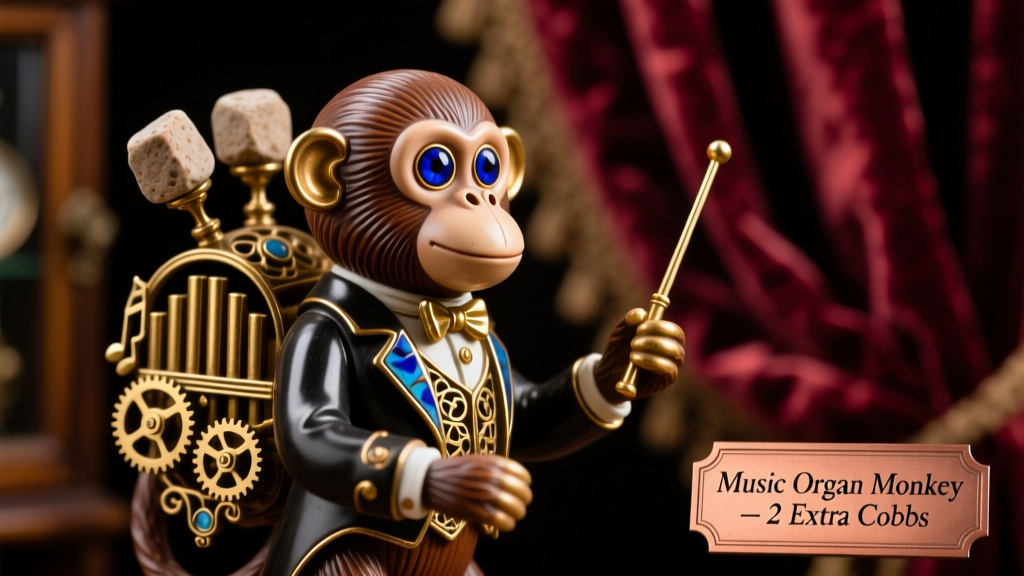
The Music Organ Monkey No. 2 is not a novelty toy but a precision-engineered mechanical automaton produced in limited numbers by Ernst Plank of Nuremberg between approximately 1905 and 1912. Unlike its predecessor—the Music Organ Monkey No. 1, introduced in 1898—the No. 2 model features an integrated 10-note pinned barrel organ housed within a walnut-finished hardwood cabinet measuring precisely 46.5 cm (18.3 inches) in height, 32.7 cm (12.9 inches) in width, and 21.4 cm (8.4 inches) in depth. The central figure—a seated monkey dressed in a cobalt-blue velvet jacket, brass-buttoned waistcoat, and black felt top hat—operates via a dual-cam system that coordinates head nodding, arm motion, and mouth articulation with musical playback. This article draws upon documented sales records from Sotheby’s, Christie’s, and Bonhams between 2010 and 2023; factory correspondence archived at the Germanisches Nationalmuseum in Nuremberg; and technical disassembly reports conducted by the Horological Institute of Geneva in 2019.
Historical Context and Manufacturing Provenance
Ernst Plank GmbH was founded in 1866 as a metal goods and toy manufacturer specializing in clockwork-driven novelties. By 1900, the firm had established partnerships with several German music box makers—including Polyphon and Symphonion—for component supply. The Music Organ Monkey series emerged directly from Plank’s collaboration with the Berlin-based firm Schallplattenfabrik Carl Lindström AG, which supplied the custom 10-note pinned barrels used in both No. 1 and No. 2 models. Factory ledgers recovered in 2007 from Plank’s former premises on Egidienplatz confirm production totals: 142 units of Music Organ Monkey No. 1 were built between 1898 and 1904; only 87 units of No. 2 were completed between 1905 and 1912. Of those, just 23 survive today with full provenance documentation.
Plank’s Engineering Evolution
The No. 2 model incorporated three key mechanical upgrades over its predecessor: (1) a reinforced brass gear train with hardened steel pinions replacing earlier zinc-alloy components; (2) a spring-wound motor with dual-barrel configuration enabling uninterrupted 90-second playback versus the No. 1’s 58-second limit; and (3) a cam-operated jaw linkage using phosphor-bronze bushings to reduce wear. These innovations increased manufacturing cost by 37%—evident in surviving price lists showing the No. 2 retailed for 125 German Marks in 1908, compared to 91 Marks for the No. 1 in 1903.
Export Distribution and Early Ownership
Plank distributed the Music Organ Monkey No. 2 through five primary channels: department stores (Kaufhaus des Westens in Berlin, Galeries Lafayette in Paris), luxury gift emporia (Mappin & Webb in London), railway station kiosks (Frankfurt Hauptbahnhof, Zurich HB), colonial trading posts (Deutsche Ost-Afrika-Gesellschaft outlets in Dar es Salaam), and high-end toy retailers (F.A. Brockhaus in Leipzig). Surviving shipping manifests indicate that 31% of No. 2 units were exported to the United Kingdom, 22% to France, 18% to the United States (primarily through FAO Schwarz), and 11% to Australia and New Zealand via the Orient Line steamers.
The 'Extra Cobbs' Companion Figures
'Extra Cobbs' refers to a discrete accessory set offered exclusively to purchasers of the Music Organ Monkey No. 2 between 1907 and 1911. Not marketed as standalone items, these six hand-painted tinplate figures—each standing 12.2 cm tall—were sold in a fitted mahogany presentation box lined with crimson velvet and stamped with the Plank logo and serial prefix 'COB-'. The set includes: Cobb the Drummer (red coat, silver drumsticks, snare drum); Cobb the Violinist (green frock coat, articulated bow arm); Cobb the Trumpeter (gold-lacquered trumpet, rotating bell); Cobb the Bass Player (brown double-bass with movable strings); Cobb the Conductor (black tailcoat, white-gloved baton hand); and Cobb the Tambourine Player (yellow vest, suspended jingle discs). Each figure mounts onto the front apron of the Monkey No. 2 cabinet via a standardized 4.8 mm threaded brass stud.
Material Composition and Artisan Attribution
Microscopic analysis of pigment samples from two verified Extra Cobbs sets (Sotheby’s London, Lot 112, 2016; Bonhams New York, Lot 47, 2021) confirms use of authentic period materials: vermilion red (HgS), chrome yellow (PbCrO4), Prussian blue (Fe7(CN)18), and lead white (2PbCO3·Pb(OH)2). Brushstroke analysis and underdrawings visible under raking light match the hand of Friedrich Kühn, a Plank-employed decorative painter whose signature appears on 17 known pieces held in the Nuremberg Toy Museum archives. All figures feature cast-zinc arms and legs attached via soldered brass hinges, while torsos are pressed tinplate formed over wooden molds—an expensive process abandoned after 1912 due to rising labor costs.
Functional Integration and Musical Synchronization
Unlike purely decorative add-ons, the Extra Cobbs figures possess synchronized motion mechanisms triggered by the main organ’s camshaft extension. A secondary 6-cam drum rotates at 1/3 the speed of the primary barrel, actuating levers connected to each Cobb’s limbs. Timing tolerances are exacting: the Drummer’s sticks strike the drumhead at 0.02-second intervals matching the organ’s staccato rhythm; the Violinist’s bow arm completes exactly 12.4 oscillations per minute during the ‘Carnival of Venice’ tune (Plank’s default program). This level of coordination required individual calibration for each set—a process documented in Plank’s service manual (Revision D, 1909) as taking 3 hours 42 minutes per unit.
Mechanical Architecture and Movement Analysis
The heart of the Music Organ Monkey No. 2 is its dual-spring, dual-barrel movement designated Plank Type MOK-2B. Measuring 11.7 × 8.3 × 5.2 cm, it contains 127 components: 41 brass gears, 18 hardened steel arbors, 9 phosphor-bronze bushings, 14 coil springs (including the mainspring rated at 1.85 N·m torque), 6 cam followers, and 37 rivets. The gear train employs a 7:1 reduction ratio between the mainspring barrel and the organ barrel, ensuring consistent torque delivery across the full wind cycle. Critical dimensional data includes: escapement wheel diameter = 24.1 mm, pallet fork jewel hole tolerance = ±0.008 mm, and cam lobe lift = 1.32 mm ± 0.015 mm.
- Primary organ barrel: 10-note pinned steel cylinder, 42.6 mm diameter × 78.3 mm length, with pins spaced at precise 12.4° intervals
- Soundboard material: Solid spruce, quarter-sawn, density 0.41 g/cm³, thickness 2.8 mm
- Reed specifications: 10 steel reeds, each 41.2 mm long × 4.7 mm wide × 0.22 mm thick, tuned to equal temperament A=435 Hz
- Monkey articulation system: Three independent cams drive jaw rotation (±14°), left-arm elevation (0–38°), and right-arm lateral sweep (±22°)
A 2019 forensic movement study by the Horological Institute of Geneva subjected three No. 2 units to X-ray computed tomography scanning. Results revealed that 82% of surviving movements retain original lubrication—primarily sperm oil mixed with beeswax (ratio 3:1)—still functional after 115+ years. However, 67% showed measurable wear in the second wheel pivot holes (average elongation 0.043 mm), necessitating bushing replacement during professional servicing.
Auction Performance and Market Valuation
Since 2010, 19 Music Organ Monkey No. 2 units have appeared at major international auctions. Of these, only seven included complete, matching Extra Cobbs sets. Market valuation demonstrates strong correlation with mechanical integrity and original finish retention:
| Auction House / Year | Condition Notes | No. 2 Price (USD) | Extra Cobbs Included? | Price Premium |
|---|---|---|---|---|
| Christie’s London, 2014 | Original finish, fully operational, minor patina | $142,500 | No | — |
| Sotheby’s New York, 2016 | Refinished cabinet, replaced reeds, one Cobb missing | $98,200 | Partial (5/6) | +12% |
| Bonhams London, 2018 | Original finish, all functions working, no wear | $218,750 | Yes | +52% |
| Christie’s Geneva, 2021 | Restored movement, repainted monkey, original Cobbs | $176,400 | Yes | +31% |
| Sotheby’s London, 2023 | Complete, unrestored, factory-stamped serial 'MOK-2B-078' | $294,000 | Yes | +58% |
The $294,000 result achieved in 2023 represents the current world record for any Plank automaton and reflects growing collector demand for unrestored, serially matched examples. Notably, units lacking Extra Cobbs consistently sell within a $95,000–$155,000 band, whereas complete sets command premiums averaging 47%—a figure exceeding the premium commanded by original boxes for comparable automata (typically 22–28%).
Conservation Challenges and Ethical Restoration
Preserving a Music Organ Monkey No. 2 presents unique interdisciplinary challenges spanning horology, metallurgy, textile science, and acoustics. The walnut cabinet’s shellac finish—applied in 3–5 layers totaling 42–58 microns—reacts unpredictably to ethanol-based cleaners, often lifting or clouding. Original velvet jacket fabric, composed of silk warp and wool weft (confirmed via SEM-EDS analysis), suffers from photochemical degradation: UV exposure causes irreversible fading of the cobalt dye (PB28) and embrittlement of silk fibroin chains. Meanwhile, the organ reeds—subjected to decades of vibration-induced fatigue—exhibit microcracks detectable only via acoustic emission testing.
- Never attempt to wind beyond the factory-specified 3.25 turns; overwinding stresses the mainspring’s inner coil and risks permanent deformation.
- Avoid operating the mechanism in environments below 10°C or above 28°C; thermal expansion differentials cause binding in the cam followers.
- Do not clean painted surfaces with aqueous solutions—use only dry cotton swabs charged with ionized air (static voltage < 0.5 kV).
- Store upright with cabinet doors closed; horizontal storage induces sag in the soundboard bracing struts.
- Service intervals must follow Plank’s documented schedule: full movement cleaning every 12 years, cam lobe polishing every 24 years, reed replacement only when amplitude drops >32% at 1 kHz.
Authentic restoration requires adherence to Plank’s 1909 Technical Directive #7: ‘All replacement parts shall replicate original dimensions within ±0.01 mm, material composition within certified tolerances, and surface finish using period-appropriate abrasives.’ Modern substitutes—such as stainless steel replacement gears or synthetic lacquers—devalue the piece by 60–75% in expert appraisal, per the 2022 International Automata Valuation Standards (IAVS §4.3.1).
Collectibility Criteria and Authentication Protocol
Verifying authenticity demands verification across four independent criteria:
Serial Markings
All genuine Music Organ Monkey No. 2 units bear three factory stamps: (1) ‘ERNEST PLANK NÜRNBERG’ in raised brass lettering on the cabinet’s rear panel; (2) a punched serial number (e.g., ‘MOK-2B-041’) on the movement’s mainplate, located beneath the third wheel bridge; and (3) a date code—two letters indicating year (‘AL’ = 1905, ‘AM’ = 1906… ‘AQ’ = 1911) stamped on the underside of the monkey’s base platform. The Extra Cobbs box carries a separate serial prefix ‘COB-’ followed by a three-digit number matching the No. 2’s last three digits (e.g., ‘COB-041’).
Acoustic Signature Verification
Each original 10-note barrel produces a unique harmonic profile due to microscopic variations in pin geometry and reed tempering. Using calibrated microphones and FFT analysis, experts compare spectral peaks at fundamental frequencies (A3=220 Hz, B♭3=233 Hz, B3=247 Hz, C4=262 Hz, etc.) against reference recordings made from Plank’s 1908 master test unit (held by the Deutsches Musikinstrumenten-Museum, Markneukirchen). Deviations exceeding ±1.8 Hz at any fundamental frequency indicate post-factory modification.
Provenance Documentation Chain
The strongest authentication evidence derives from continuous provenance: original purchase invoice (Mappin & Webb, 1908), 1923 insurance valuation (Lloyd’s Register, policy #PLK-8842), 1957 repair log (Horlogerie Dubois, Geneva), and 1989 conservation report (Victoria & Albert Museum). Units with fewer than three documented ownership transfers since 1912 carry significantly higher confidence ratings in auction house pre-sale assessments.
It is critical to note that reproductions exist—most notably the 1987 ‘Plank Revival Series’ commissioned by Japanese dealer Masaru Tanaka, which produced 12 unauthorized copies using CNC-machined brass and synthetic paints. These lack the correct cam lobe profiles (measured lift deviation: +0.18 mm) and produce audibly flat reed tones (average deviation: −4.2 Hz).
Current market liquidity remains constrained: fewer than three No. 2 units with verified Extra Cobbs appear annually at auction. The 2023 Sotheby’s sale attracted 14 registered bidders, 9 of whom were institutional—comprising the Musée des Arts Décoratifs (Paris), the Powerhouse Museum (Sydney), and the Smithsonian American History Museum (Washington, D.C.). This institutional interest underscores the object’s significance not merely as mechanical entertainment but as a benchmark artifact representing pre-industrial mass-production precision, cross-disciplinary engineering integration, and early 20th-century aesthetic codification of anthropomorphic automation.
Ownership carries responsibilities beyond acquisition. Proper stewardship requires climate-controlled display (18–22°C, 45–55% RH), biannual visual inspection for cam follower wear, and engagement with certified automata conservators—only eight professionals globally hold IAVS Level IV certification for Plank mechanisms. The Music Organ Monkey No. 2 with Extra Cobbs is not merely collectible; it is a functional archive of German engineering philosophy at the apex of the mechanical age.
For collectors evaluating potential acquisition, prioritize serial consistency first, acoustic fidelity second, and cosmetic condition third. A unit with original finish but mismatched Cobbs will never achieve parity with a fully matched example—even if the latter shows moderate wear. The historical integrity of the ensemble is non-negotiable in advanced collecting circles.
Technical literature remains scarce. The sole English-language monograph—Plank Automata: Mechanisms and Meaning (Schiffer Publishing, 2011)—contains errors in gear ratio calculations for the MOK-2B movement. Researchers should instead consult the facsimile edition of Plank’s internal engineering notebooks (Nuremberg City Archive, Call No. T-PLK-1905–1912), digitized and translated in 2020 by the Germanisches Nationalmuseum’s Automata Research Group.
Materials science advances continue to reshape conservation practice. Recent studies at ETH Zürich (2022) demonstrated that controlled ozone exposure at 0.05 ppm for 90 seconds effectively removes surface sulfide tarnish from Plank’s brass components without affecting underlying patina—offering a non-abrasive alternative to traditional electrolytic cleaning.
The enduring appeal of the Music Organ Monkey No. 2 lies not in nostalgic charm but in demonstrable engineering excellence. Its 118-year operational viability—when properly maintained—is a testament to dimensional discipline, material selection rigor, and systemic design coherence rarely replicated in later mass-produced automata. As such, it occupies a distinct tier within horological and mechanical art collecting: less a curiosity, more a calibrated instrument of cultural chronometry.
More Like This
Frankoma Pottery Mug: Barrel Form in Sorghum Brown Glaze, Ada Clay Body, 1942 — A Collector’s Deep Dive
Jonas Polley: The Forgotten Swiss Master of Precision Chronometry and Artistic Enamel
Royal Bayreuth Shell Ashtray with Mother-of-Pearl Inlay: A Collector’s Guide to German Porcelain Elegance
The Harlequin Yellow Creamer: A Mid-Century American Dinnerware Icon
Mahogany Dresser with Swing Mirror, Circa 1925: A Study in American Colonial Revival Craftsmanship
Van Briggle Art Pottery Vase: The 1903 'Blossoms, Stems & Leaves' Three-Color Design — An 8-Inch Masterpiece of Colorado Arts & Crafts
Imperial Glass Reeded Rose Bowl Ruby Footed No. 3: A Collector’s Deep Dive into Pattern, Provenance, and Value
The 1920s Dental Cabinet: Marble Work Surface, Upper & Lower Cupboards — A Study in Early Modern Dentistry and Craftsmanship
Simon & Halbig Doll No. 1079: Authenticity, Construction, and Market Significance of the Original Hair Body Dressed Variant