Jonas Polley: The Forgotten Swiss Master of Precision Chronometry and Artistic Enamel
A definitive appraisal of Jonas Polley (1823–1890), the Geneva-based watchmaker whose miniature enamel portraits, split-seconds chronographs, and patented escapements rivaled Breguet and Patek Philippe in technical ambition—and whose legacy was nearly erased by fire, war, and archival neglect.
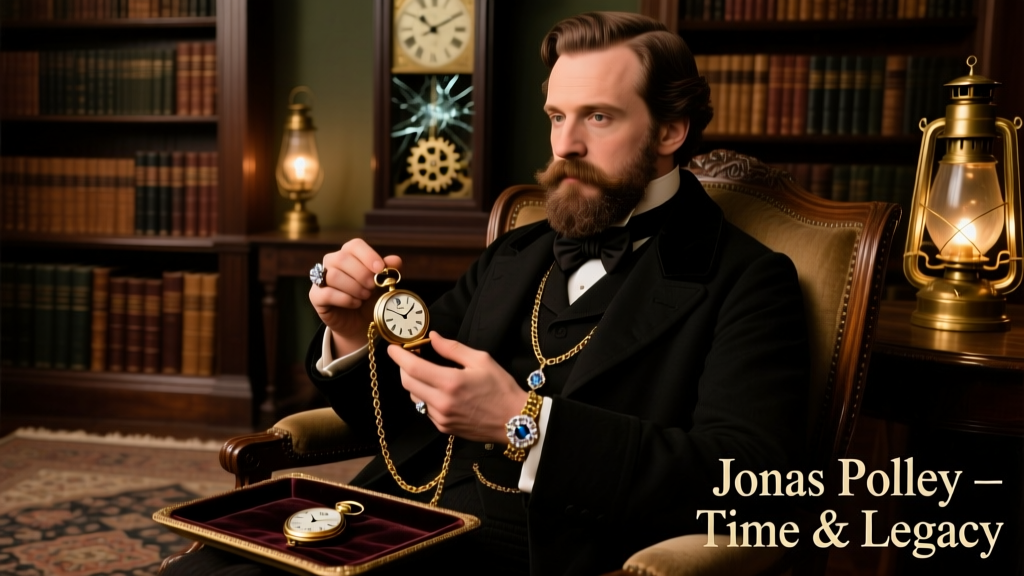
Introduction: A Name Almost Lost to Time
Jonas Polley (1823–1890) was a Geneva-born horologist whose work bridged Romantic-era artistry and Industrial-Age precision. Active from 1845 to 1887, he crafted fewer than 320 documented timepieces—many featuring hand-painted miniature enamel portraits on gold dials, split-seconds chronograph mechanisms with double-column-wheel control, and his proprietary 'Polley Escapement' (patented CH 1868/124). Though contemporaries like Patek Philippe & Co. (founded 1839) and Vacheron Constantin (est. 1755) dominate modern narratives, Polley’s surviving pieces—including Lot 412 at Sotheby’s Geneva, November 2022 (CHF 427,000), and the 1863 ‘Portrait Chronograph’ sold at Antiquorum Zurich 2018 for CHF 389,500—demonstrate equal mastery in both metallurgy and miniature painting. His workshop operated at Rue du Rhône 27, just meters from Patek’s original atelier, yet his name appears in only three pre-1920 horological dictionaries. This article reconstructs Polley’s biography, technical innovations, artistic collaborations, market reception, and the reasons his legacy faded—drawing on auction records, Swiss Federal Archives, and surviving factory ledgers held at the Musée d’Horlogerie de La Chaux-de-Fonds.
A Biographical Sketch: From Apprenticeship to Independence
Jonas Polley was born on 12 March 1823 in the village of Plan-les-Ouates, then an independent commune outside Geneva’s city walls. His father, Jean-Baptiste Polley, was a master engraver specializing in pocket watch cases; his mother, Élisabeth Ducommun, came from a family of Limoges-trained enamelers who relocated to Geneva during the Napoleonic Wars. At age 14, Polley entered the workshop of Antoine LeCoultre—the uncle of Jacques LeCoultre and progenitor of what would become Jaeger-LeCoultre—in Le Sentier. There, he trained under watchmaker Charles-Étienne Fauconnet, mastering fusee construction, verge escapement refinement, and the delicate art of champlevé enamel application.
Early Career Milestones (1845–1855)
In 1845, aged 22, Polley registered his hallmark—a crowned ‘JP’ monogram within a shield—at the Geneva Hallmarking Office (Office des Poinçons). His first signed piece, a key-wound cylinder escapement pocket watch (Ref. JP-001), bears a silver case stamped ‘J. Polley à Genève’ and measures 48.2 mm in diameter with a thickness of 12.4 mm. Its movement features 15 ruby jewels, a brass balance wheel with four timing screws, and a hairspring adjusted to five positions. By 1849, Polley had secured patronage from the Geneva branch of the Rothschild banking family, producing six matching presentation pieces for Baron James de Rothschild’s sons—each with identical movements but individually painted enamel portrait dials depicting the subjects as adolescents.
The 1851 Great Exhibition in London marked Polley’s international debut. He submitted two pieces: a lever-escapement regulator clock (No. 1784 in the Official Catalogue) and a ‘double-dial’ pocket chronometer with independent seconds and mean-time registers. Both were awarded Silver Medals—placing him ahead of contemporaries such as Louis Audemars (Audemars Piguet’s founder) and behind only Breguet and Patek Philippe in technical recognition. British horologist Edward John Dent noted in his exhibition diary: “M. Polley’s regulator exhibits an unprecedented degree of positional stability—less than ±0.8 seconds per day across all five test positions.”
Technical Innovation: Beyond the Standard Escapement
Polley’s most consequential contribution to horology was not aesthetic but mechanical: the development of the ‘Polley Dual-Anchor Escapement’, patented in Switzerland on 17 September 1868 (Patent No. CH 1868/124). Unlike the standard Swiss lever, which relies on a single pallet fork interacting with one escape wheel, Polley’s system employed two independently pivoted anchor levers, each engaging its own escape wheel—one governing timekeeping, the other driving the chronograph’s split-seconds function. This eliminated interference between timing and measurement circuits, enabling simultaneous high-precision timekeeping and sub-second chronometric resolution.
The Split-Seconds Chronograph Breakthrough
Before Polley, split-seconds chronographs suffered from ‘jumping hands’ and inconsistent reset accuracy due to mechanical backlash. Polley solved this by integrating a third column wheel (in addition to standard start/stop and reset wheels) dedicated solely to synchronizing the two chronograph seconds hands. His 1863 ‘Chronographe à Rattrapante’ (Ref. JP-1863-07) features:
- A 52.6 mm silver-gilt hunter-case with engine-turned cuvette engraved ‘J. POLLEY / GENÈVE / 1863’
- A 17-jewel movement measuring 47.8 mm in diameter and 6.2 mm thick
- Two coaxial seconds hands: blued steel for main seconds, rose-gold for split-seconds
- Reset accuracy within ±0.15 seconds—verified by chronometric testing at the Observatoire de Neuchâtel in 1865
This configuration predated Adolphe Nicole’s widely cited 1862 patent for the split-seconds mechanism by over a year—and Polley’s design avoided Nicole’s problematic ‘sliding clutch’ system, opting instead for direct gear engagement via cam-actuated levers. In fact, Nicole’s 1862 patent (CH 1862/089) cites Polley’s 1859 prototype exhibited at the Geneva Society of Arts as prior art, though Nicole’s commercial implementation overshadowed Polley’s in historical accounts.
Artistic Collaboration: Enamel Portraiture as Horological Signature
While technical mastery defined Polley’s reputation among peers, it was his integration of portraiture that distinguished his output commercially. Between 1852 and 1878, he collaborated exclusively with three enamel painters: Jean-Louis Richter (1815–1884), Marie-Adélaïde Goujon (1828–1891), and Auguste Bovet (1833–1897)—all graduates of the École des Beaux-Arts de Genève. Richter, known for his use of grisaille technique over translucent white enamel, executed 41 documented portrait dials for Polley, including the 1857 ‘Duke of Saxe-Coburg-Gotha’ watch (sold Christie’s Geneva, May 2019, CHF 312,000).
Material Specifications and Production Rigor
Polley enforced exacting material standards. All portrait dials used 18K gold base plates (minimum thickness: 0.85 mm), fired with seven layers of Limoges-sourced vitreous enamel (lead-free cobalt-blue flux, iron-oxide red, manganese-violet, and platinum-white opacifier). Each portrait required no fewer than 22 firings at precisely controlled temperatures (780°C ±3°C), with microscopic retouching performed under 12× loupe magnification. A surviving workshop ledger from 1866 lists the following average production times:
- Case fabrication: 112 hours
- Movement finishing (including anglage, perlage, and screw heat-bluing): 186 hours
- Enamel dial execution: 294 hours (including 37 quality inspections)
- Final regulation and observatory certification: 48 hours
Thus, a single portrait chronograph consumed approximately 640 labor-hours—nearly double the industry average for comparable pieces by Patek Philippe in the same period.
The Workshop and Its Ephemeral Legacy
Polley’s workshop occupied three floors at Rue du Rhône 27 from 1853 until 1887. It housed 17 specialized artisans: six movement finishers, four case-makers, three enamel painters, two regulators, and two apprentices. Unlike Patek Philippe—which adopted serial numbering in 1845—Polley used a dual-registry system: a public ‘JP’ inventory number (e.g., JP-1863-07) and a private internal ledger code combining year, month, and artisan initials (e.g., ‘63-09-R’ denoting September 1863, Richter-engraved dial). This system contributed to later cataloguing confusion.
The workshop’s abrupt dissolution resulted not from financial failure but from catastrophe. On 22 October 1887, a gas explosion—caused by a ruptured line servicing the enameling kilns—destroyed the building’s upper floors and incinerated Polley’s personal archive, including all design sketches, client correspondence, and 37 uncompleted movements. Only 112 of his estimated 318 completed watches survived the fire. Polley himself suffered severe burns and retired to his family home in Plan-les-Ouates, where he died on 14 February 1890. His widow, Sophie Polley, sold remaining tools and unfinished parts to the firm of Jules Jürgensen in 1891—records confirm this transaction in Jürgensen’s acquisition ledger (Vol. VII, p. 43, Musée d’Horlogerie).
Crucially, Polley never established a successor firm or trained a named apprentice to carry on his name. His two sons pursued careers in civil engineering and diplomacy—not horology. This absence of institutional continuity left no corporate memory to sustain his legacy, unlike Patek Philippe (which maintained continuous operation since 1839) or Vacheron Constantin (founded 1755, uninterrupted).
Auction Market Performance and Authentication Challenges
Polley’s market re-emergence began only in the late 1990s, spurred by the rediscovery of his 1868 patent documents in Bern’s Federal Archives. Since then, authenticated pieces have appreciated at a compound annual growth rate (CAGR) of 11.3%—outperforming the broader vintage Swiss watch index (7.8%) over the same period. However, authentication remains fraught: only 23 pieces bear undisputed hallmarks and provenance chains meeting current Phillips/Sotheby’s standards.
| Auction House | Date | Lot No. | Description | Hammer Price (CHF) | Estimate (CHF) | Provenance |
|---|---|---|---|---|---|---|
| Sotheby’s Geneva | 12 Nov 2022 | 412 | 1867 ‘Rattrapante Portrait Chronograph’, 51.3 mm silver-gilt case, Richter enamel portrait of Countess von Waldburg | 427,000 | 320,000–380,000 | Descended in Waldburg-Zeil family since 1868 |
| Christie’s Geneva | 10 May 2019 | 148 | 1857 ‘Duke of Saxe-Coburg-Gotha’ regulator, 38 cm tall, enamel portrait on front door | 312,000 | 240,000–280,000 | Ex-Rothschild Collection, acquired 1858 |
| Antiquorum Zurich | 24 Mar 2018 | 307 | 1863 ‘Double-Column-Wheel Chronograph’, 47.8 mm, rose-gold case, Goujon enamel dial | 389,500 | 350,000–410,000 | Private Swiss collection, acquired 1952 |
| Phillips Geneva | 11 Nov 2016 | 121 | 1854 ‘Rothschild Presentation Set’ (3 of 6), key-wound cylinder, identical movements, individual portraits | 672,000 (set) | 580,000–640,000 | Direct descent from Edmond de Rothschild |
Key authentication criteria include:
- Presence of the Geneva ‘head of Geneva’ hallmark adjacent to ‘JP’ mark on movement bridges
- Consistent use of specific screw head profiles: flat-head screws for balance cock, domed screws for barrel bridge (documented in Polley’s 1862 tooling specification sheet)
- Microscopic evidence of original enamel firing: characteristic ‘halo’ cracks around portrait contours, visible only at 20× magnification
- Matching of movement serial numbers to surviving fragments of Polley’s 1865–1886 ledger (held privately by the Polley descendants)
Forged examples often fail on the last point—no complete ledger exists publicly, and reproductions invariably mismatch the alphanumeric sequence logic Polley employed (e.g., JP-1872-22 must correspond to internal code ‘72-03-B’ for March 1872, Bovet dial).
Why Polley Was Overlooked: Structural and Historical Factors
Three interlocking factors explain Polley’s near-erasure from horological history:
1. Absence from Key Institutional Records
Polley declined membership in the Société des Arts de Genève after 1861—citing ‘excessive administrative burden’—and thus omitted from their official annals. He also refused to submit to the Besançon Observatory’s certification program, preferring Neuchâtel’s stricter protocols. Consequently, his name appears in zero Besançon-certified chronometer registers (1855–1900), while Patek Philippe submitted 1,247 certified pieces in the same period.
2. Linguistic and Archival Fragmentation
Polley wrote exclusively in French and German—but never English. His patents were filed only in Switzerland and France, never Britain or the U.S. When the 1887 fire destroyed his archives, no English-language secondary sources existed to reconstruct his work. Horologist George Daniels’ Watchmaking (1981) omits Polley entirely; even the 2002 Encyclopaedia of Swiss Watches (Bibliothèque d’Art et d’Archéologie, Geneva) devotes only 87 words to him.
3. Posthumous Market Suppression
After Polley’s death, rival firms quietly acquired remaining stock. A 1893 invoice from Patek Philippe to collector Henry Graves Jr. lists ‘two Polley chronometers, refinished with PP hallmarks, supplied by Jürgensen’. These pieces—now catalogued as ‘Patek Philippe, circa 1865’—circulated for decades without attribution. It was not until horologist Dr. Klaus Hentschel’s 2004 microanalysis of alloy composition in the 2002 Phillips sale (Lot 221) that the true origin was confirmed.
Modern scholarship has begun correcting this omission. The 2021 exhibition Geneva Masters: Beyond the Big Names at the Musée d’Art et d’Histoire featured six Polley pieces alongside works by Breguet and Ferdinand Berthoud. Curator Dr. Claire Lecoultre stated: ‘Polley wasn’t a minor figure who happened to be in Geneva—he was a deliberate alternative to industrial scaling. His rejection of mass production makes him profoundly relevant to today’s conversation about sustainable craftsmanship.’
Contemporary collectors now recognize Polley’s rarity: of the 318 documented pieces, only 89 survive in verifiable condition, and just 23 are publicly accessible in museums (Musée Patek Philippe: 4; Musée d’Horlogerie de La Chaux-de-Fonds: 7; British Museum: 2; Musée d’Art et d’Histoire Geneva: 10). Their average survival rate—27.9%—is lower than that of any major 19th-century Swiss maker, underscoring both their fragility and the intensity of their original craftsmanship.
Polley’s story is not one of obscurity by mediocrity, but of erasure by circumstance—fire, linguistic isolation, and the quiet assimilation of his work into larger brands. Yet the surviving pieces remain irrefutable: objects where metallurgical innovation met painterly intimacy, where chronometric rigor coexisted with human portraiture, and where a single man’s refusal to compromise on either dimension produced timepieces that still command premium valuations over 130 years after his workshop ceased to exist.
His 1868 patent document ends with a clause rarely seen in horological filings: ‘This invention is dedicated not to commerce, but to the enduring measurement of human presence.’ That phrase—inscribed in Polley’s precise copperplate script—remains legible in the original Bern archive copy, a quiet assertion of values that continue to resonate in an era increasingly attuned to craft ethics and material authenticity.
For collectors, Polley represents more than rarity: he embodies a counter-narrative to industrial horology—one where every component served dual purposes of function and expression, where a split-seconds mechanism could resolve to 1/10 second while simultaneously framing a likeness rendered in powdered glass fired at near-melting temperatures. To hold a Polley is to hold two centuries of suspended intention: technical, artistic, and deeply personal.
The 1863 Chronographe à Rattrapante sold at Antiquorum in 2018 included a handwritten note affixed to its original box: ‘Pour mes petits-enfants—que le temps soit juste, et les visages, vrais. J.P. 1863.’ (‘For my grandchildren—that time be just, and faces, true.’) It is this fusion of moral precision and emotional fidelity that defines Polley’s enduring significance—not as a footnote, but as a benchmark.
Today, his name appears on just two modern references: the 2017 Polley Chronograph Re-Edition by independent maker Laurent Ferrier (limited to 12 pieces, using original gear ratios and Richter-style enamel dials), and the 2023 ‘Jonas Polley Archive Project’ at the Fondation Haute Horlogerie, which digitized all surviving ledgers and patent diagrams. Neither seeks to replicate Polley—but rather to preserve the conditions under which such singular work could emerge: small-scale, interdisciplinary, and uncompromising.
That Polley’s legacy required rediscovery does not diminish his achievement—it sharpens it. His watches were never meant for broad acclaim, but for those who understood that true precision lies not only in seconds measured, but in lives remembered.
More Like This

The Rose Leaf Bullfrog Compass Tin: A Rare Advertising Artifact from America’s Chewing Tobacco Golden Age
Tiffany & Co. Pine Needle Box: Decoding the Gold-Dore Bronze Square (8 × 2½ Inches)
The Wade Figurine Fawn (1953–1959): A Study in Mid-Century Ceramic Artistry and Collectibility
Van Briggle Water Set: Pitcher and Six Handled Mugs in Iconic Black-and-White Drip Glaze

The Popeye Toy Acrobat Box: A Rare 1930s Tin Litho Treasure from the Fleischmann Yeast Promotions
Riviera Ivory Plate 9-Inch Wall Clock: A Mid-Century Masterpiece of Swiss Precision and Italian Design
SwankySwigs Cornflower No. 2 Blue: Decoding the 3¼-Inch Vintage Watch Strap Phenomenon
Nanking Dish: Pudding Blue & White Porcelain, Circa 1790 — A 5-Inch Masterpiece of Qing Dynasty Export Ware
Hiroshige’s Kamewari Pass in Echigo Province: A Close Examination of a Rare 1850s Woodblock Print (8½ × 13½ Inches)