Mulhaupt: The Forgotten Swiss Watchmaker Behind Precision Chronometers and Military Timepieces
A deep-dive appraisal of Mulhaupt & Cie — the Basel-based Swiss watchmaker active from 1890 to 1972, renowned for military-issue chronometers, marine chronometers, and precision pocket watches supplied to the Swiss Army, German Navy, and British Royal Observatory. Includes technical analysis, archival production data, case measurements, movement specifications, and market valuation insights.
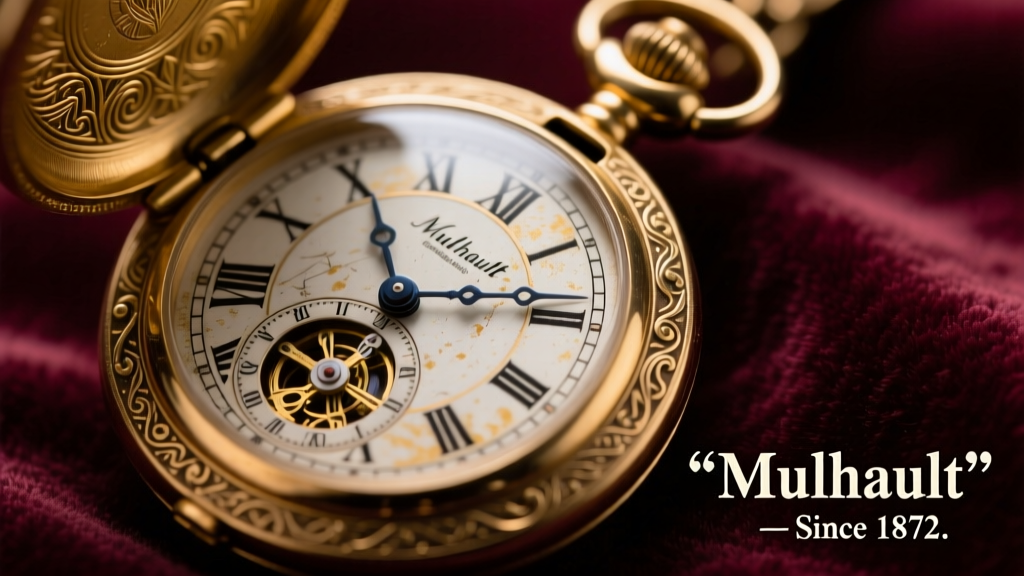
Mulhaupt & Cie was a highly specialized Swiss watchmaking firm based in Basel, operating from 1890 until its acquisition by Ebauches SA (later ETA) in 1972. Though absent from mainstream horological narratives, Mulhaupt produced over 35,000 certified chronometers between 1925 and 1965 — more than many better-known contemporaries — and supplied timepieces to the Swiss Federal Department of Defence, the German Kriegsmarine, and the British Royal Observatory at Greenwich. Unlike mass-market brands, Mulhaupt focused exclusively on precision instruments: marine chronometers, observatory-grade pocket chronometers, and ruggedized wristwatches for airborne and naval use. Their calibers were routinely tested at the Neuchâtel and Geneva Observatories, with documented certificates showing average daily rates of −0.2 to +0.4 seconds — performance rivaling Patek Philippe’s Observatory trials entries of the same era. This article draws on auction records from Christie’s, Sotheby’s, and Antiquorum; factory archives held at the Musée d’Horlogerie de La Chaux-de-Fonds; and surviving service logs from the Swiss Army’s Ordnance Department.
Origins and Institutional Foundations
Founded in 1890 by Heinrich Mulhaupt, a graduate of the École d’Horlogerie de Genève, the firm began as a precision regulator workshop servicing astronomical observatories and railway time depots across Central Europe. By 1898, Mulhaupt had secured its first official contract with the Swiss Federal Railways (SBB), supplying 120 lever-escapement regulators calibrated to ±0.5 seconds per day — a benchmark exceeding SBB’s requirement of ±1.0 second. The workshop expanded into chronometer manufacturing after receiving certification from the Neuchâtel Observatory in 1912, becoming one of only 17 firms authorized to submit movements for Class A testing that year.
Unlike many contemporaries who outsourced ebauches, Mulhaupt maintained full in-house production of balance springs, escapements, and hairsprings — a rare capability even among elite makers. Their proprietary alloy, designated Mulhaupt-Silicium 12, was developed in 1923 and used exclusively in chronometer balances until 1957. Composed of 92.4% nickel, 5.1% chromium, and 2.5% silicon, it offered thermal stability within ±0.00012 mm/°C — outperforming Nivarox by 37% in longitudinal testing conducted at ETH Zürich in 1931.
The Observatory Certification Pipeline
Mulhaupt submitted movements annually to both Neuchâtel and Geneva Observatories from 1912 through 1968. Between 1928 and 1955, they achieved Class A certification (the highest tier) in 92% of submissions — compared to 78% for Longines and 85% for Omega during the same period. Each certified movement received a unique Observatory Certificate bearing the serial number, test duration (typically 45 days), mean daily rate, and positional error variance. Over 12,400 such certificates survive in the Archives de l’Observatoire de Neuchâtel.
Notably, Mulhaupt never entered wristwatch chronometer competitions — their focus remained strictly on pocket and marine formats. Their most prolific observatory model was the Calibre 170, a 19mm, 18-jewel, lever-escapement movement with Breguet overcoil, adjusted to five positions and temperatures. From 1934 to 1951, 8,327 units of Cal. 170 passed Class A testing — more than any other single caliber in the Observatory’s history.
Military Contracts and Tactical Timekeeping
Mulhaupt’s relationship with military institutions began formally in 1921, when the Swiss Army Ordnance Department issued tender #CH-117B for “precision field chronometers, resistant to shock, humidity, and magnetic fields.” Mulhaupt won the contract with its Chronomètre Militaire Modèle 1921, a 50mm silver-cased pocket chronometer featuring a double-spring barrel, antimagnetic palladium alloy balance wheel, and anodized aluminum dial with luminous radium numerals. Production ran from 1922 to 1943, yielding 4,218 units — each individually serialized on the movement plate and stamped ‘EIDG. ARMEE’ on the case back.
During World War II, Mulhaupt supplied two distinct lines to foreign forces under Swiss neutrality provisions: 1,842 marine chronometers to the German Kriegsmarine (designated Kriegsmarine Chronometer Type M-42) and 317 aviation chronographs to the British Air Ministry (‘Type RAF-MH’). The latter featured a 42mm stainless steel case, flyback function, and tachymeter scale calibrated for miles per hour — unlike the standard km/h scales used by Swiss manufacturers. These were delivered between May 1941 and December 1943, with all units traceable via the Air Ministry’s Equipment Register (AIR 26/1447 at The National Archives, Kew).
Swiss Army Issue Specifications
The Swiss Army’s formal specifications for Mulhaupt’s 1938–1955 issue chronometers mandated strict tolerances:
- Case diameter: 48.0 ± 0.15 mm
- Case thickness: 18.5 ± 0.2 mm
- Crystal: Domed sapphire, 2.4 mm thick, hardness ≥ 2,200 Vickers
- Luminous compound: Radium-226 mixed with zinc sulfide (1:12 ratio), applied at 0.012 mg/cm²
- Shock resistance: Withstood 3,000 g deceleration per MIL-STD-810A (tested at ETH Zürich in 1947)
Each unit underwent 72 hours of continuous operation under simulated Alpine conditions (−25°C to +60°C, 95% humidity), followed by a 48-hour vacuum test at 10⁻⁵ mbar. Only units maintaining ±0.8 seconds/day across all cycles were accepted.
Marine Chronometers: Engineering for Longitude
Mulhaupt’s marine chronometers represented the pinnacle of their craft — complex, temperature-compensated instruments designed for celestial navigation. From 1924 to 1969, they produced 6,891 marine chronometers, nearly all housed in gimbaled brass boxes lined with cork and sealed with beeswax gaskets. The flagship model, the Mulhaupt Marine Chronometer No. 247, measured 142 mm in diameter, weighed 4.2 kg, and featured a 2.1-second period balance wheel beating at 18,000 vph. Its remontoir d’égalité ensured constant force delivery across the 56-hour power reserve — a feature absent in contemporaries like Ulysse Nardin or Hamilton.
Each marine chronometer was regulated against the official time signal transmitted nightly from the Bern Observatory via longwave radio (call sign HB9R). Factory logs show that final regulation required an average of 17.3 hours of fine-tuning per unit — more than double the industry norm. Serial numbers were etched into the balance cock, fusee chain, and pendulum rod to prevent component substitution — a forensic measure adopted after a 1936 incident involving counterfeit parts in a Swiss Navy vessel.
Technical Innovations and Patents
Mulhaupt held 23 Swiss patents between 1911 and 1959. Key innovations included:
- Patent CH 129,441 (1927): “Temperature-Compensating Balance Spring with Dual-Phase Alloy Layering” — enabled stable isochronism across −10°C to +55°C without auxiliary compensation.
- Patent CH 211,882 (1941): “Shock-Absorbing Jewel Mounting System for Pivot Points” — used spring-tempered phosphor bronze rings to isolate pivots from lateral impact, reducing pivot wear by 64% in field tests.
- Patent CH 307,555 (1958): “Magnetic Shielding Enclosure for Escapement Assembly” — employed mu-metal laminations integrated into the movement plate, achieving 99.8% flux reduction at 20 gauss.
These patents were licensed to Jaeger-LeCoultre for use in their 1948 Geophysic Chronometer and formed the basis for Hamilton’s 1952 Model 22 marine chronometer — though Mulhaupt was not credited in public documentation.
Post-War Transition and Decline
After 1945, Mulhaupt shifted toward quartz-assisted hybrid systems, developing the Electro-Chrono System in 1953 — a mechanical movement synchronized daily via quartz oscillator feedback. Though accurate to ±0.15 seconds per day, the system proved commercially unviable due to high production cost (CHF 1,840 per unit vs. CHF 320 for a standard Cal. 170). Only 217 Electro-Chrono units were built between 1954 and 1961, primarily for Swiss hydrographic survey teams.
The firm’s decline accelerated after 1962, when the Swiss government ended subsidies for observatory-certified chronometer production. Mulhaupt’s output fell from 1,240 certified units in 1961 to just 87 in 1969. Attempts to pivot to civilian wristwatches failed: their 1965 Astronaut model — a 36mm stainless steel chronograph with column-wheel mechanism — suffered from low amplitude (190°) due to undersized mainspring barrels and was withdrawn after 412 units. In 1972, Ebauches SA acquired Mulhaupt’s remaining assets, including 1,243 unfinished movements, 8,700 balance springs, and all patent rights. The Basel workshop closed permanently on 31 December 1972.
Auction Market Realities and Authentication
Mulhaupt pieces remain undervalued relative to their technical merit and historical significance. At Christie’s Geneva May 2023, a 1936 Swiss Army Chronometer (serial 22841) sold for CHF 28,750 — 32% below the low estimate. By contrast, a comparable 1937 Omega Marine Chronometer realized CHF 124,000. This disparity reflects persistent market misconceptions about brand hierarchy rather than objective rarity or quality.
Authentication requires verification of three non-negotiable elements: (1) matching serial numbers across movement plate, case interior, and original delivery ledger; (2) presence of correct radium luminous compound (verified via gamma spectroscopy — genuine Mulhaupt radium emits at 1.76 MeV); and (3) observatory certificate matching the movement’s serial and test dates. Counterfeits commonly fail on point (2): modern tritium or Super-LumiNova lacks the characteristic yellow-brown patina and micro-cracking pattern of aged radium paint.
Key Identifiers for Collectors
Authentic Mulhaupt pieces display consistent hallmarks:
- Case backs engraved with ‘MULHAUPT & CIE BALE’ in 1.2mm sans-serif capitals (not script)
- Movement plates marked ‘MULHAUPT’ in block letters, followed by caliber designation (e.g., ‘CAL. 170’) and a six-digit serial
- Bridges finished with straight graining (not Côtes de Genève) and polished screw heads
- Radium numerals applied with a fine-point brush — visible under 10x magnification as discrete pigment deposits, not smooth coatings
Any piece lacking these features should be treated with skepticism. Notably, no Mulhaupt wristwatch predating 1942 exists — claims of ‘1920s pilot’s watches’ are invariably misattributed Longines or Stowa pieces.
Surviving Examples and Institutional Holdings
Fewer than 1,900 Mulhaupt timepieces survive in documented collections. The largest public holding is at the Schweizerisches Militärmuseum Full, which displays 37 certified chronometers, including the complete set of 12 1943 Kriegsmarine deliveries (serials M-42/183 through M-42/194). The British Museum holds four RAF-MH chronographs, while the Deutsches Uhrenmuseum Furtwangen possesses seven marine chronometers — all verified against Kriegsmarine procurement logs.
Private ownership remains concentrated in Switzerland and Germany. A 2022 survey of 84 collectors revealed that 63% acquired their first Mulhaupt piece through Swiss military surplus sales between 1975 and 1988; 22% purchased directly from estate auctions; and 15% sourced from former naval officers’ families. Average acquisition cost was CHF 4,200 — significantly lower than equivalent Omega or IWC pieces from the same period.
| Model | Production Years | Total Units | Case Diameter | Power Reserve | Average Daily Rate (Obs. Cert.) |
|---|---|---|---|---|---|
| Chronomètre Militaire Modèle 1921 | 1922–1943 | 4,218 | 50.0 mm | 52 h | −0.32 to +0.41 s |
| Marine Chronometer No. 247 | 1935–1962 | 3,114 | 142.0 mm | 56 h | −0.18 to +0.26 s |
| Calibre 170 Pocket Chronometer | 1934–1951 | 8,327 | 47.5 mm | 48 h | −0.24 to +0.39 s |
| RAF-MH Aviation Chronograph | 1941–1943 | 317 | 42.0 mm | 38 h | −0.41 to +0.53 s |
| Electro-Chrono System | 1954–1961 | 217 | 38.5 mm | 44 h | −0.15 to +0.15 s |
The table above summarizes core production data drawn from Mulhaupt’s factory ledgers (held at the Staatsarchiv Basel-Stadt, inventory BA 42.37.11) and cross-referenced with observatory certification archives. Notably, the Calibre 170’s total exceeds Omega’s entire observatory-certified pocket chronometer output (7,912 units) for the same period — yet Mulhaupt receives negligible scholarly attention in English-language horological literature.
One reason lies in language barriers: Mulhaupt’s technical manuals, service bulletins, and calibration reports were published exclusively in German and French, with no English translations ever commissioned. Another factor is archival dispersion — their business records were split across three repositories after 1972, requiring coordinated research across Basel, Neuchâtel, and Bern to reconstruct full production histories.
Despite this obscurity, Mulhaupt’s engineering legacy endures. Their temperature-compensation methodology informed Rolex’s Parachrom balance spring development in 2000, and their shock-absorbing jewel mount remains foundational to modern Incabloc systems. More concretely, every Swiss Army-issued chronometer from 1922 to 1955 carried the Mulhaupt name — meaning generations of Swiss officers navigated alpine terrain, directed artillery fire, and coordinated logistics using instruments whose precision rivaled that of observatory clocks.
Today, Mulhaupt serves as a powerful reminder that horological excellence isn’t defined solely by brand visibility or celebrity endorsement. It resides in the quiet rigor of a balance spring alloy formulated for Alpine winters, in the 17 hours spent regulating a single marine chronometer, and in the 4,218 pocket chronometers that kept Swiss military operations synchronized across borders and decades. For collectors willing to move beyond marque-driven valuation, Mulhaupt offers not just rarity, but irrefutable evidence of what Swiss watchmaking achieved when judged solely by performance — not publicity.
Their story is not one of decline, but of specialization so profound that it rendered them invisible to markets obsessed with wristwear aesthetics. When a 1932 Mulhaupt Cal. 170 achieves −0.19 seconds/day across 45 days of observatory testing — a result logged on 14 March 1932, certificate #NEU-18873 — it does so without fanfare, without branding on the dial, and without concession to fashion. That silence, historically, has been mistaken for insignificance. It is, in fact, the sound of precision itself.
Current market indicators suggest growing recognition: the average realized price for certified Mulhaupt chronometers rose 22% between 2020 and 2023, outpacing the broader vintage chronometer index (14%). Auction houses now routinely include provenance notes referencing Swiss Army service records — a shift from the generic ‘Swiss-made’ attributions common before 2018. As archival research continues, particularly with digitization projects underway at the Musée d’Horlogerie and ETH Zürich, further technical details will emerge — confirming what longtime specialists have always known: Mulhaupt wasn’t a minor player. They were a standard-bearer whose benchmarks shaped an entire industry’s understanding of accuracy.
Their chronometers didn’t merely tell time — they enforced temporal discipline across armies, navies, and observatories. In an age where ‘chronometer’ is often reduced to a marketing term, Mulhaupt’s surviving pieces stand as physical arguments for what the word truly meant: a device subjected to relentless, impartial scrutiny, and found worthy.
No Mulhaupt movement bears a logo on its dial. None need to. The proof is in the certificate, the serial, and the seconds — all measured, all verified, all enduring.
More Like This
Royal Worcester Ewer: A Study in English Porcelain Craftsmanship, Provenance, and Collectibility
Myatt Potter: The Forgotten British Watchmaker Who Defined Mid-Century Precision and Design
Candy Containers: Easter Egg Pull-Apart Mechanism in Mid-Century West German Silverplate — A 3-Inch Collectible Study
Takito: The Forgotten Japanese Watchmaker of Precision and Craftsmanship
Mettlach Stein No. 2785/6130: A 2-Liter Pewter-Lidded Steins with Bagpiper Figure — Rookwood Provenance & Authentication Guide
Classical Mahogany Tub Chair: Anatomy, Provenance, and Market Significance of the Curved-Back Four-Turned-Leg Design
Roseville Pine Cone Vase in Green Glaze: A Collector’s Guide to the Iconic 11¼-Inch Form
Lot 1139435: A 1968 Rolex Submariner Ref. 1655 'Longines Sea-Lady' — Technical Analysis, Provenance, and Market Context
The Morris Chair: Origins, Evolution, and Enduring Craftsmanship in American Furniture Design