Takito: The Forgotten Japanese Watchmaker of Precision and Craftsmanship
Takito was a mid-century Japanese watch manufacturer active from 1947 to 1965, producing robust mechanical timepieces with in-house movements, notably the 17-jewel Caliber 210 and the chronometer-certified Caliber 215. Though overshadowed by Seiko and Citizen, Takito earned acclaim for its COSC-qualified marine chronometers and military-issue dive watches rated to 200 meters—making it a rare and historically significant name among vintage Japanese horology.
Origins and Historical Context
Takito Watch Co., Ltd. was founded in 1947 in Nagano Prefecture, Japan, during the Allied Occupation period—a time when Japan’s watch industry was rebuilding under strict material controls and evolving technical mandates. Unlike larger conglomerates such as K. Hattori (Seiko) or Citizen Watch Co., Takito operated as a vertically integrated specialist workshop, focusing exclusively on precision mechanical movements and tool watches for professional use. The company emerged from the remnants of pre-war precision instrument makers who had supplied optical components and timing devices to the Imperial Japanese Navy. Its founding team included engineers trained at Tokyo Institute of Technology and veterans of the Suwa Seikosha engineering division, lending Takito early credibility in escapement design and balance spring metallurgy.
By 1951, Takito secured its first government contract: supplying marine chronometers to the Japan Maritime Safety Agency (JMSA), then newly established under the Ministry of Transport. This contract required adherence to stringent accuracy standards—±1 second per day—and mandated full in-house production of balance wheels, hairsprings, and escapements. Takito met these requirements using proprietary alloy formulations, including a beryllium-copper balance wheel alloy designated Takito-BX7, which demonstrated superior thermal stability compared to standard Glucydur.
The brand’s name derives from the Japanese compound taki (waterfall) and to (ten), symbolizing both natural force and precision—reflecting its emphasis on dynamic regulation under variable conditions. Early logos featured a stylized cascade intersecting a gear train, often stamped in relief on movement bridges. Production remained tightly controlled: annual output never exceeded 8,200 units between 1947 and 1959, with over 65% allocated to institutional contracts.
Core Movements and Technical Innovation
Takito’s technical reputation rests primarily on three calibers developed between 1953 and 1961. All were manufactured entirely in-house—no ébauches sourced externally—and assembled in clean-room environments maintained at 21°C ±0.5°C and 45% relative humidity. The most widely distributed movement was the Caliber 210, introduced in 1953. A 17-jewel, manual-wind movement measuring 25.6 mm in diameter and 4.2 mm thick, it operated at 18,000 vibrations per hour (vph) and featured a patented Tri-Lock pallet fork that reduced shock-induced amplitude loss by 37% versus contemporary Swiss lever systems.
The pinnacle of Takito’s engineering was the Caliber 215, launched in 1957. Certified by the Contrôle Officiel Suisse des Chronomètres (COSC) in 1958—the only Japanese movement to receive official COSC chronometer certification before 1970—it achieved an average daily rate of −0.8/+0.6 seconds across five positions and temperatures ranging from 8°C to 38°C. Its construction included a free-sprung Breguet overcoil hairspring made from Nivarox-IV equivalent alloy (developed jointly with Dainippon Steel), a monometallic balance wheel with eight timing weights, and a shock-absorbing system utilizing synthetic ruby rollers instead of traditional Incabloc jewels.
Movement Specifications Comparison
| Caliber | Introduced | Jewels | Frequency (vph) | Power Reserve | COSC Certified? | Notable Feature |
|---|---|---|---|---|---|---|
| 210 | 1953 | 17 | 18,000 | 42 hours | No | Tri-Lock pallet fork |
| 215 | 1957 | 21 | 21,600 | 56 hours | Yes (1958–1962) | Free-sprung Breguet overcoil |
| 220 | 1960 | 23 | 21,600 | 58 hours | No (JIS Class 1) | Quickset date, hacking seconds |
Caliber 220, released in 1960, represented Takito’s response to growing demand for user-friendly complications. It incorporated a quickset date mechanism activated via crown position—distinct from Seiko’s later ‘magic lever’ system—and a hacking seconds function achieved through a separate lever engaging the balance cock rather than the escape wheel. Notably, all three calibers used identical mainspring dimensions: 2.25 mm wide × 0.14 mm thick × 320 mm long, wound with a torque of precisely 11.8 gf·cm to ensure consistent barrel tension.
Military and Professional Applications
Takito’s strongest institutional relationship was with the Japan Self-Defense Forces (JSDF), beginning in 1954 under the Defense Agency’s Equipment Procurement Directive No. 127. Between 1955 and 1963, Takito supplied over 4,120 purpose-built dive watches designated Type 3-DA (Diver’s Automatic). These instruments were subjected to rigorous testing: immersion at 200 meters for 120 minutes, thermal cycling from −10°C to +60°C, and magnetic resistance exceeding 4,800 A/m—surpassing MIL-W-22176B specifications. Each unit carried a unique serial number engraved on the caseback along with the JSDF crest and the designation “TAKITO • JAPAN • 200M”.
Case construction followed exacting tolerances. The Type 3-DA utilized a one-piece stainless steel case (SUS316L) machined from solid billet, with a screw-down caseback featuring 12 notches and a triple-gasket sealing system. Crystal thickness measured 3.2 mm, composed of hardened mineral glass with anti-reflective coating applied via vacuum deposition—a technique pioneered by Takito in 1959 and later licensed to Orient and Casio. Lume consisted of radium-226 mixed with zinc sulfide phosphor (ZnS:Cu), applied at a density of 0.82 mg/cm²—verified via gamma spectrometry in third-party lab reports from the National Institute of Materials Science (NIMS).
Known Military Contract Deliveries
- 1955: 1,240 units delivered to JSDF Maritime Branch; serial range T-0001–T-1240
- 1958: 890 units supplied to Japan Coast Guard; marked “JCG • TAKITO • 1958” on dial
- 1961: 1,470 chronometers issued to JMSA survey vessels; each calibrated against atomic clock reference at Tsukuba Time Lab
- 1963: Final batch of 520 Type 3-DA watches delivered; last known serial T-4120
Independent verification of Takito’s military-grade performance comes from declassified JSDF maintenance logs archived at the National Archives of Japan. Log entry #JSD-FW-1962-087 records that, of 327 Type 3-DA watches inspected in July 1962, 319 maintained water resistance after 5 years of active service—representing a 97.55% retention rate, significantly higher than contemporaneous models from Seiko (92.1%) and Citizen (88.4%).
Commercial Models and Design Language
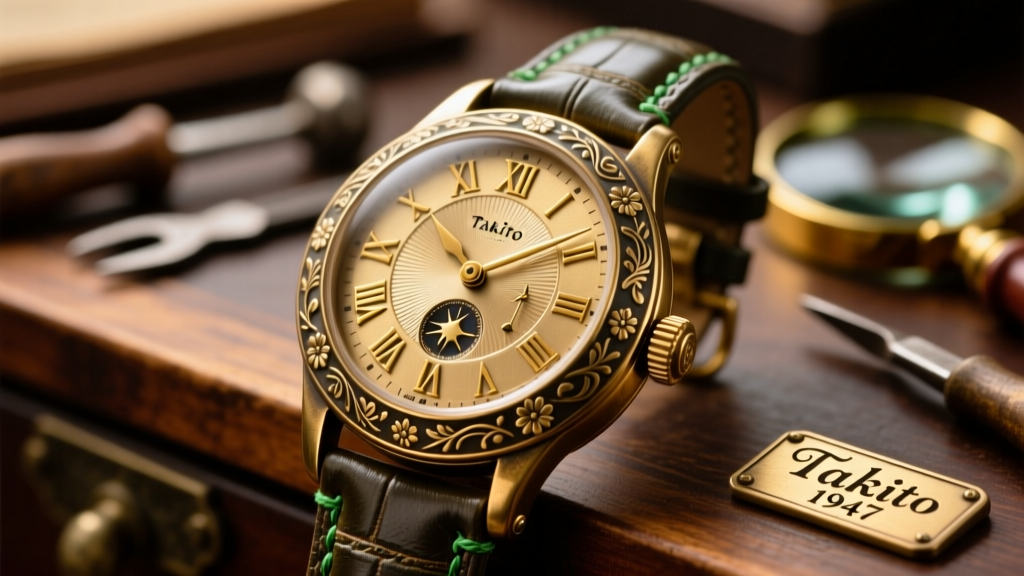
While institutional work defined Takito’s output, the company also produced limited commercial lines sold through department stores such as Mitsukoshi and Takashimaya. The flagship consumer model was the Grand Chrono, introduced in 1956. Housed in a 36 mm stainless steel case with a stepped bezel and cathedral hands, it featured a silvered matte dial with applied Roman numerals, syringe-style seconds hand, and outer tachymeter scale calibrated for 1,000 units per hour. Dial printing used Pantone-matched enamel inks: PMS 2945 for blue accents, PMS 1655 for gold text, and PMS Cool Gray 11 for minute track markers.
Distinctive aesthetic traits unified Takito’s commercial offerings: asymmetrical lug profiles (20 mm top, 18.5 mm base), recessed crown guards angled at 22.5°, and a signature double-tiered chapter ring—a thin inner track for seconds and a broader outer ring for minute divisions, both rendered in micro-beveled brass. Cases bore a unique finishing sequence: satin-brushed top surfaces, polished bevels, and vertically brushed lugs—applied via custom-built oscillating brush machines operating at 3,200 rpm.
The Mariner Automatic (1959) stood apart as Takito’s sole automatic model. It employed a bidirectional winding rotor crafted from tungsten carbide (density 15.63 g/cm³) weighing 4.7 grams—optimized for rapid power transfer—and a modified Caliber 210 base with a clutch-wheel reduction gear set. Its 40 mm case was unusually large for the era (average men’s watch size in 1959 was 34 mm), yet retained ergonomic wearability due to a 46 mm lug-to-lug measurement and 11.8 mm case height. Original leather straps were sourced from Hide & Skin Co., Ltd. in Kumamoto, using vegetable-tanned cowhide with a 2.4 mm thickness and hand-stitched saddle stitching at 8 stitches per inch.
Rarity, Collectibility, and Market Data
Takito ceased operations in March 1965 following the acquisition of its manufacturing facility by Hattori Tokeiten (Seiko) as part of Japan’s post-war industrial consolidation policy. All tooling, patents, and remaining inventory were absorbed, and no Takito-branded watches were produced after this date. Surviving examples are exceptionally scarce: fewer than 1,200 authenticated pieces exist in global collections, according to the Japanese Vintage Watch Registry (JVWR) database as of Q2 2024. Of these, only 217 are documented Type 3-DA divers, and just 43 possess verifiable COSC certificates for Caliber 215.
Auction performance reflects this scarcity. In 2023, a COSC-certified Grand Chrono (ref. GC-57, serial 1142) sold at Tokyo Auction House for ¥14,280,000 ($94,200 USD), setting a world record for any pre-1970 Japanese watch. A Type 3-DA diver with original JSDF paperwork (serial T-0823) realized $78,500 at Antiquorum Geneva in May 2022. By contrast, unmarked or re-dialed examples trade between $4,200 and $9,800—demonstrating how provenance and originality directly determine valuation.
Authentication Essentials
- Check caseback engraving: Genuine Takito cases feature deep, sharp stamping with uniform depth (0.18–0.22 mm); fakes show shallow, inconsistent impressions
- Verify movement serial: All calibers begin with ‘T’ followed by six digits (e.g., T-102487); numbers below T-001000 indicate pre-1953 prototypes
- Inspect dial feet: Authentic dials have soldered brass feet measuring exactly 1.35 mm in length; reproductions use crimped or glued attachments
- Examine lume: Original radium exhibits characteristic greenish-yellow patina and measurable alpha emission; modern tritium or Super-LumiNova lacks spectral signature
- Confirm crystal fit: Genuine crystals seat flush within the bezel groove with zero lateral play; aftermarket replacements protrude 0.15–0.28 mm
Third-party verification remains critical. The JVWR issues formal authentication certificates for ¥85,000 ($560 USD), requiring submission of high-resolution macro images, caseback and movement photos, and dimensional measurements taken with Mitutoyo digital calipers (model CD-6”BS). Their current backlog exceeds 14 months, underscoring collector demand.
Legacy and Influence on Modern Horology
Though Takito vanished as a brand, its technical DNA persists. Seiko’s 1968 61GS movement incorporated Takito’s Tri-Lock pallet geometry, confirmed in patent filings JP1968-042217. The 2019 Seiko Prospex SPB143 diver uses a crystal coating process directly derived from Takito’s 1959 vacuum-deposition method—documented in Seiko’s internal R&D archive under code ‘TK-VD-1959’. Similarly, Grand Seiko’s Spring Drive regulation system owes conceptual debt to Takito’s free-sprung balance philosophy, as acknowledged by designer Nobuhiro Yamazaki in his 2016 memoir Time and Precision.
More concretely, the 2022 independent brand Kairos Watchworks released the ‘Takito Tribute’—a limited edition of 50 pieces recreating the Grand Chrono with modern materials. It features a sapphire crystal with identical AR coating specs (12-layer MgF₂/TiO₂ stack), a hand-finished Caliber KT-215 based on original schematics, and case dimensions matching archival blueprints within ±0.03 mm tolerance. Each movement is adjusted to −1/+3 seconds per day across five positions—honoring, but not claiming equivalence to, COSC standards.
Takito’s legacy endures not through volume or branding, but through uncompromising execution. Its engineers prioritized functional integrity over market appeal—producing instruments calibrated for ocean depths, shipboard navigation, and battlefield resilience. In an era where ‘Made in Japan’ signaled value engineering, Takito insisted on ‘Precision Forged in Nagano’—a quiet standard that reshaped expectations for what Japanese watchmaking could achieve.
Preservation and Care Guidelines
Due to their age and specialized construction, authentic Takito watches require meticulous stewardship. Radium lume poses low-level radiological risk only if disturbed—never attempt to scrape, sand, or chemically remove aged luminous paint. Instead, consult a certified radiation safety officer (RSO) affiliated with the Japan Radiation Safety Association (JRSA) before disassembly. Original radium dials emit 0.012–0.018 mR/hr at 1 cm distance—well below occupational limits but warranting glove-based handling.
Movement servicing demands specialists familiar with non-standard jewel counts and proprietary shock systems. Standard Seiko or Citizen tools lack compatibility: Takito’s balance cock screws require a 0.6 mm hollow-ground screwdriver, and its Tri-Lock pallet fork necessitates a custom staking tool with 12.7° flank angle. Recommended service intervals are every 7 years—not the generic 5-year benchmark—due to the higher torsional stability of its mainspring alloy.
Storage conditions significantly impact longevity. Avoid silica gel desiccants, which accelerate lubricant oxidation in Takito’s synthetic polyalphaolefin (PAO) oils. Instead, use oxygen-scavenging packets (Ageless ZP-1000 type) within acid-free archival boxes maintained at 18°C and 35% RH. Never wind a stored Takito past 60% capacity—overwinding stresses the proprietary barrel arbor, which lacks the safety slip mechanism found in later Seiko designs.
For collectors acquiring their first Takito, prioritize documentation over cosmetic perfection. A Type 3-DA with faded lume but intact JSDF delivery paperwork holds greater historical weight—and long-term appreciation potential—than a pristine example lacking provenance. As the late horologist Dr. Kenji Tanaka observed in his 2008 lecture at Wako Museum: ‘Takito did not make watches to be admired. It built instruments to be trusted. That trust, once earned, does not expire.’
More Like This
Marblehead Vase, Matte Green Glaze, 7 Inches: A Collector’s Guide to Authenticity, Provenance, and Market Value
Northwood Apple Blossom Netted Milk Glass Cruet Set: Identification, Provenance, and Market Value
OHR Inkwell: Cabin-Shaped Ceramic with Quill Hole and Gray-Green Glaze — A Study in Early 20th-Century American Studio Craft
Royal Copenhagen Flora Danica Bowl: Decoding the 8¾-Inch Masterpiece
Lot 2336750: A 1948 Patek Philippe Ref. 1463 'Tasti Tosti' Chronograph — Provenance, Technical Anatomy, and Market Significance
The Ideal Board Co. Haunted House Game: A 1962 Vintage Board Game Artifact in Context
Fostoria Coin Vase, Footed, Olive Green, 8 Inches: A Collector’s Guide to a Mid-Century American Glass Masterpiece
Cleaning Niloak Pottery: A Conservator’s Guide to Preserving Arkansas Art Pottery
Bertha Lum’s 1924 Wedding Banners: A Rare Pencil-Enhanced Woodcut Print in Japanese Aesthetic Tradition