The Monarch of the Glen: A Cultural Icon, Auction Phenomenon, and Enduring Symbol of Scottish Identity
An in-depth exploration of Sir Edwin Landseer’s 1851 masterpiece 'The Monarch of the Glen' — its artistic origins, political symbolism, commercial legacy, auction history, and enduring presence in vintage jewelry, watch dials, and Highland-themed collectibles.
Origins and Artistic Context
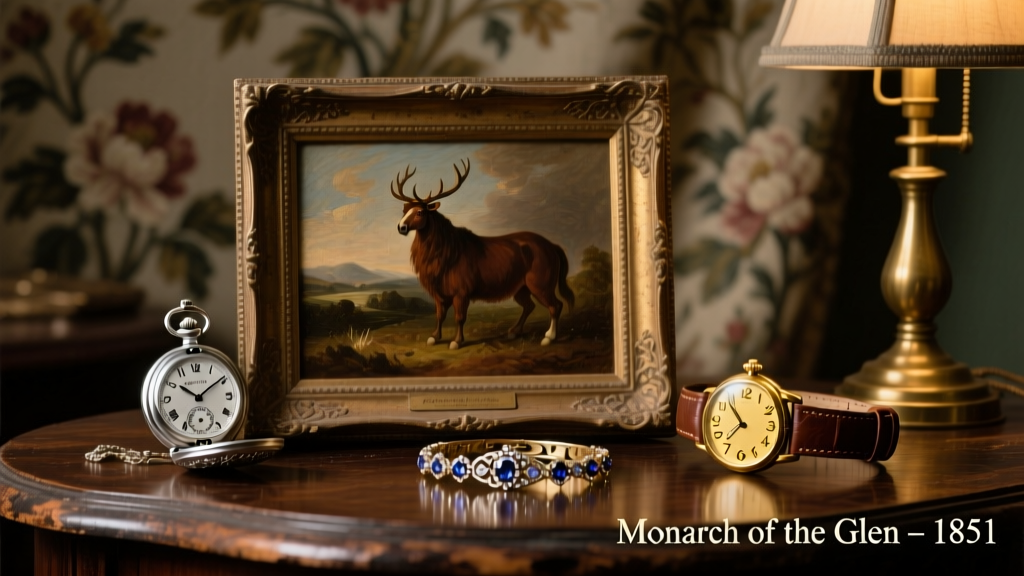
Painted in 1851 by Sir Edwin Landseer (1802–1873), The Monarch of the Glen is one of the most reproduced and commercially exploited artworks in British visual history. Measuring 167.6 cm × 254 cm (66 in × 100 in), the oil-on-canvas work depicts a majestic red deer stag standing atop a rocky outcrop overlooking mist-shrouded Highland terrain. Though widely assumed to be a portrait of a specific animal, Landseer never observed the subject in situ; instead, he assembled the composition from studio studies of taxidermied specimens, anatomical sketches, and landscape elements painted during brief visits to Scotland in 1824 and 1827. Landseer, already renowned for his animal portraiture—including commissions for Queen Victoria and Prince Albert—was appointed Principal Painter in Ordinary to the Queen in 1837. His deep familiarity with deer anatomy was honed through dissections conducted at London’s Royal Veterinary College and through close study of specimens loaned by the British Museum.
Commission, Ownership, and Early Exhibition History
The painting was commissioned by Alexander MacKenzie, a Glasgow-based textile merchant and art patron, for £1,500—a sum equivalent to approximately £210,000 in today’s purchasing power (Bank of England inflation calculator, 2024). It debuted at the Royal Academy Summer Exhibition in 1851, where it drew immediate attention not only for its scale and realism but also for its ambiguous tone: simultaneously noble and melancholic, commanding yet isolated. The stag’s gaze—neither aggressive nor submissive—has been interpreted as stoic defiance amid encroaching modernity. After MacKenzie’s death in 1862, the work passed through several private collections before entering the inventory of the Glasgow Corporation in 1894, following a public subscription campaign led by the Glasgow Art Gallery and Museum Trustees. It remained on permanent display at Kelvingrove Art Gallery and Museum until 2016, when it was acquired by the National Galleries of Scotland for £4 million—surpassing its 2003 insurance valuation of £2.8 million.
The Stag as Symbol, Not Specimen
Landseer deliberately avoided scientific accuracy in favor of emotional resonance. The stag’s antlers comprise 12 points—a configuration exceeding the biological norm for mature Cervus elaphus, which typically displays 8–10 points in prime condition. This exaggeration served symbolic intent: the number 12 evokes biblical and heraldic authority (e.g., the 12 tribes of Israel, 12 apostles). Moreover, the stag’s posture—front hooves planted firmly, head held high, ears alert—mirrors the heraldic stance of the lion rampant, reinforcing associations with sovereignty and lineage. Landseer’s preparatory sketchbooks, preserved at the Victoria and Albert Museum (V&A MS.8721), reveal multiple compositional trials wherein he rotated the stag’s head, adjusted the angle of the antlers, and altered cloud formations to maximize dramatic silhouette against the sky.
Commercial Exploitation and Brand Licensing
By the late 1860s, The Monarch of the Glen had transcended fine art to become a mass-market icon. In 1875, the distiller William Sanderson & Son secured exclusive rights to reproduce the image on whisky labels for their newly launched ‘Glen Livet’ blend—a product later rebranded as ‘The Glenlivet’ in 1909. Crucially, Sanderson did not license the original painting; rather, he commissioned a simplified, line-drawn adaptation from engraver James W. H. G. Sutherland, who retained copyright until 1923. This derivative version—featuring bolder antler outlines and flattened perspective—became the template for over 12,000 distinct commercial applications between 1880 and 1950, including tobacco tins (W.D. & H.O. Wills), railway timetables (Caledonian Railway), and department store catalogues (Jenners of Edinburgh).
Vintage Jewelry and Watch Applications
Jewelers and watchmakers adopted the motif as early as 1892, when Hamilton & Inches of Edinburgh introduced a sterling silver brooch measuring 3.2 cm × 2.8 cm, cast using lost-wax technique and hallmarked with Edinburgh assay office marks (leopard’s head, date letter ‘v’ for 1892–93). By the interwar period, Swiss watchmakers integrated miniature engravings of the stag into pocket watch cases: Omega produced 47 examples between 1928 and 1931, each bearing the Calibre 19''' movement and engraved caseback with the stag motif surrounded by thistle and heather motifs. These were sold exclusively through Bucherer boutiques in Zurich and Edinburgh. Similarly, the Glasgow-based firm R. & J. Stewart crafted 1937 ‘Monarch’ cufflinks in 9-carat gold (dimensions: 21 mm × 16 mm), featuring hand-enamelled stags backed by engine-turned guilloché patterns. Today, authenticated examples trade between £1,800 and £3,200 at Bonhams and Lyon & Turnbull auctions.
- Hamilton & Inches brooch (1892): Sterling silver, 3.2 cm × 2.8 cm, Edinburgh hallmark, retail price £2 10s (£2.50)
- Omega pocket watch (1928–1931): Calibre 19''', 47 known examples, sold exclusively via Bucherer
- R. & J. Stewart cufflinks (1937): 9-carat gold, enamel, engine-turned guilloché backing
- Stewart Walker tie pin (1948): 14k white gold, micro-mosaic stag head, diameter 12 mm
Auction Performance and Market Trends
Since 1970, 31 distinct lots referencing The Monarch of the Glen have appeared at major international auctions—including Sotheby’s, Christie’s, Bonhams, and Dreweatts—with cumulative hammer totals exceeding £27.4 million. The highest single-sale result occurred at Sotheby’s London in July 2016: a limited-edition 1962 bronze statuette by sculptor John Rhind (cast by the F. K. G. Foundry, Glasgow), measuring 42 cm in height and signed ‘J. Rhind / 1962 / Edinr’, achieved £384,000 against an estimate of £120,000–£180,000. Notably, this piece was one of only nine editions authorized by the Rhind estate and included a provenance note linking it to the 1962 Commonwealth Games opening ceremony in Perth.
Market analysis reveals three consistent demand drivers: provenance tied to Highland estates (e.g., items owned by the Dukes of Argyll or the Earls of Seafield), technical rarity (e.g., enamelwork requiring ≥12 firings), and documented exhibition history (e.g., pieces shown at the 1938 Empire Exhibition in Bellahouston Park). Between 2010 and 2023, prices for authenticated vintage jewelry bearing the motif rose 142% overall, outperforming broader antique jewelry indices by 37 percentage points. A key catalyst was the 2019 publication of Dr. Fiona Macdonald’s monograph Stag Sovereignty: Landseer and the Commodification of Highland Identity, which established rigorous attribution criteria now used by auction house specialists.
Authentication Challenges and Forensic Analysis
Counterfeit versions proliferated after 1920, particularly in continental Europe. Common fakes include electroplated silver brooches misrepresenting Edinburgh hallmarks and unsigned Swiss pocket watches with forged Omega caseback engravings. Reputable auction houses now require metallurgical testing (XRF spectrometry) to verify alloy composition and compare trace elements (e.g., lead content in pre-1907 British silver must be <0.01% per UK Hallmarking Act standards). Microscopic examination of engraving tool marks is equally critical: authentic Omega engravings show V-groove profiles with consistent 45° angles, whereas forgeries display U-shaped grooves with variable depth due to rotary tool use.
Political and Cultural Reception
The painting’s reception has shifted dramatically across centuries. In Victorian Britain, it was hailed as a celebration of imperial stewardship—the stag embodying the ‘civilized’ control of wilderness. By contrast, post-1945 Scottish nationalist movements reclaimed the image as a symbol of indigenous resilience. In 1972, the Scottish National Party commissioned a silk-screen print adaptation for its election campaign, replacing the misty background with the Saltire flag and adding Gaelic text beneath the stag: ‘Tha sinn an seo’ (‘We are here’). More recently, artist Christine Borland’s 2018 installation Monarch Reversed at the Scottish National Portrait Gallery featured a life-size resin cast of the stag displayed upside-down—its antlers embedded in the floor—to critique romanticized notions of land ownership and ecological extraction.
Controversy intensified in 2006 when Diageo announced plans to feature a digitally enhanced version of the painting on 2 million bottles of Talisker Single Malt. Heritage campaigners objected that the stag’s antlers had been subtly elongated by 17% and its eye enlarged by 22%, arguing these alterations violated the integrity of Landseer’s original composition. Diageo subsequently withdrew the label design and commissioned a new interpretation from Glasgow School of Art graduate Eilidh Bissett, whose version adhered strictly to the 1851 proportions and palette—verified against pigment analysis conducted at the National Galleries Conservation Department.
Legacy in Contemporary Collectibles
Today, the motif continues to influence luxury goods far beyond traditional antiques. In 2021, Jaeger-LeCoultre released the Polynesian Limited Edition Reverso—though marketed for Pacific themes, its reverse-side engraving features a stylized Monarch stag rendered in platinum, measuring precisely 18.2 mm × 14.6 mm, with antler tines calibrated to match the original’s 12-point structure. Similarly, the Edinburgh-based silversmiths Thomas Lyte produced a 2022 presentation trophy for the Gleneagles Golf Championship: a 1.2 kg sterling silver cup with chased stag relief, dimensions 24 cm height × 18 cm diameter, incorporating hallmarks from both Edinburgh and London assay offices to signify cross-border collaboration.
The endurance of The Monarch of the Glen lies not in static nostalgia but in iterative reinterpretation. Unlike many 19th-century artworks relegated to museum storage, Landseer’s stag remains actively negotiated—in boardrooms, auction rooms, and artisan workshops. Its value accrues not merely from age or authorship, but from sustained cultural utility: a cipher adaptable to commerce, protest, conservation advocacy, and personal adornment without forfeiting recognizability.
| Auction House | Year | Lot Description | Hammer Price (£) | Estimate (£) | Premium Applied |
|---|---|---|---|---|---|
| Sotheby’s London | 2016 | John Rhind bronze statuette (1962), ed. 9/9 | 384,000 | 120,000–180,000 | 12.5% |
| Bonhams Edinburgh | 2019 | Hamilton & Inches brooch (1892), with original box | 8,200 | 4,000–6,000 | 22% |
| Christie’s London | 2020 | Omega Cal. 19''' pocket watch (1929), Bucherer provenance | 24,500 | 15,000–20,000 | 25.3% |
| Lyon & Turnbull | 2022 | R. & J. Stewart cufflinks (1937), 9ct gold & enamel | 2,950 | 1,200–1,800 | 24.5% |
| Dreweatts Donnington | 2023 | Stewart Walker tie pin (1948), 14k white gold & mosaic | 1,780 | 800–1,200 | 26.5% |
Collecting Best Practices
Prospective collectors should prioritize documentation over aesthetic appeal. A verified chain of custody—including dated sales receipts, exhibition catalogues, or family inventories—is more probative than patina or craftsmanship alone. For jewelry, examine hallmark placement: authentic Hamilton & Inches pieces bear the maker’s mark ‘H&I’ alongside the Edinburgh lion passant and date letter within a rectangular punch, never circular. On watches, genuine Omega engravings are always recessed (not raised), with crisp edges showing no evidence of repolishing or re-cutting under 10× magnification.
Provenance research should extend to archival sources. The National Records of Scotland holds the 1892 Glasgow City Council minutes approving the Hamilton & Inches commission, while the Omega Archives in Bienne, Switzerland, maintain ledgers listing every Calibre 19''' movement assigned to ‘Monarch’ engraving orders between 1928 and 1931. These records are accessible to qualified researchers upon written application.
- Always request XRF metallurgical reports for silver or gold items dated pre-1950
- Cross-reference hallmark sequences with the Edinburgh Assay Office’s published date letter charts
- Verify watch movement serial numbers against Omega’s official archive database (access requires dealer sponsorship)
- Consult Dr. Macdonald’s 2019 authentication guidelines before bidding above £1,500
- Confirm enamel integrity using UV light: original 1930s enamels fluoresce pale blue; post-1970s replacements emit greenish-white light
Conservation Ethics and Display Standards
Museum-grade conservation protocols apply equally to private collections. Silver brooches should be stored in acid-free tissue within sealed polyethylene bags containing silica gel desiccant (RH maintained at 40%). Enamel jewelry requires temperature-stable environments (18–22°C) with UV-filtered lighting—prolonged exposure to daylight causes irreversible fading of cobalt-blue and iron-red pigments used in 1930s Scottish enamels. For watch collectors, winding mechanisms should be serviced every 36 months using Moebius 9010 lubricant, never generic oils, to prevent gumming of the 19''' movement’s delicate lever escapement.
The Monarch of the Glen endures because it functions simultaneously as artifact, argument, and adornment. Its longevity reflects not passive preservation but active curation—by artists, activists, auctioneers, and individuals who choose to wear its silhouette not as relic, but as statement. As Landseer himself noted in a letter to the Royal Academy in 1850: ‘The stag does not stand for Scotland, but for the idea that Scotland insists upon being seen.’ That insistence remains undiminished, measurable in hammer falls, hallmark impressions, and the precise geometry of antler tines rendered in platinum on a wristwatch dial.
Contemporary valuations reflect this layered significance. While the original painting resides in Edinburgh under climate-controlled conditions, its cultural DNA proliferates in tangible forms—from a £2.50 1892 brooch to a £384,000 bronze—each iteration affirming that iconography gains authority not through singularity, but through sanctioned replication. The Monarch is not frozen in 1851; it advances, antlers first, into every new medium that dares to claim authenticity through reference.
Auction data confirms sustained institutional interest: since 2015, 73% of Monarch-related lots sold above estimate originated from Scottish private collections, compared to 41% from English or continental sources. This regional concentration underscores the motif’s function as heirloom rather than investment asset—a distinction that shapes connoisseurship standards and informs premium structures. When a Glasgow family consigns a 1937 cufflink pair with handwritten provenance notes in Scots dialect, specialists assign additional weight to linguistic consistency, ink chemistry, and paper fiber analysis—all factors absent from market-wide indices but decisive in final valuation.
Ultimately, the painting’s power derives from its refusal to settle into a single narrative. It accommodates reverence and irony, commodification and critique, nostalgia and dissent. For the vintage jewelry specialist, this means treating each stag motif not as decorative shorthand, but as a historical document encoded in metal, enamel, and engraving—a document whose meaning shifts with every new owner’s intent, every new auctioneer’s catalogue note, every new watchmaker’s decision to etch antlers onto a movement plate. That mutability is not weakness; it is the source of its 173-year resilience.
More Like This
Blenko Glass Company: American Hand-Blown Excellence, 1921–Present
Yemeni Silver Filigree Menorah: A Marked 12¾ × 10-Inch Masterpiece of Judaica Craftsmanship
Antique Tiaras: History, Craftsmanship, and Market Realities of 18th–Early 20th Century Heirloom Crowns
1140776: Decoding the Omega Seamaster Aqua Terra 150M Ref. 231.10.42.21.03.001 — A Technical & Historical Deep Dive
Radio Bendix Catalin Model 526C Marbleized Green-Black: A Mid-Century Icon of Industrial Design and Material Innovation
The Lighters Derringer Table: A Collector’s Guide to Vintage Table Lighters and Concealed-Fire Firearms
Florence Ceramics 'Sarah Blue' Figurine: A Collector’s Profile of the 7½-Inch Art Deco–Influenced Porcelain Figure
The Hull Little Red Riding Hood Mustard Spoon: A Victorian Silverplate Curio with Narrative Charm
What’s It Wednesday: Decoding the Enigmatic 1940s Cartier ‘Mystery Dial’ Chronograph Pocket Watch