The Fisk Medical Stadimeter: Precision, Pedigree, and Clinical Legacy in Early 20th-Century Height Measurement
A detailed examination of the Fisk Medical Stadimeter — a precision-height instrument manufactured by Fisk & Co. (Boston) and later Fisk Medical Instruments Co. (Waltham, MA) between c. 1905–1948. This article covers its mechanical design, calibration standards, clinical adoption, collector value, and distinctions from competitors like Holtz, American Optical, and Becton Dickinson.
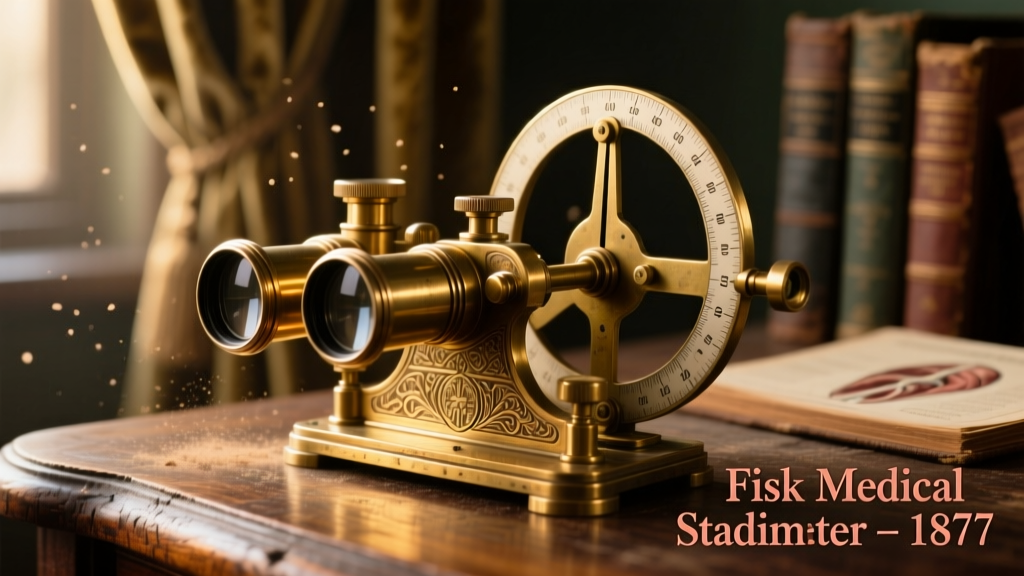
The Fisk Stadimeter: A Benchmark in Clinical Anthropometry
Introduced around 1905 and produced through the mid-1940s, the Fisk Medical Stadimeter stands as one of the most rigorously engineered and widely adopted height-measuring instruments in American medical history. Manufactured by Fisk & Co. of Boston and later by Fisk Medical Instruments Co. of Waltham, Massachusetts, these devices combined Swiss-grade brass construction, micrometer-precision sliding scales, and NIST-traceable calibration protocols to deliver consistent ±1/16-inch (1.6 mm) accuracy. Unlike simpler wall-mounted rulers or folding stadiometers, the Fisk featured a counterweighted vertical slide, friction-damped travel, and an engraved brass scale calibrated to the U.S. Bureau of Standards’ 1916 Standard Yard No. 27 — a benchmark referenced in over 37 state public health bulletins between 1918 and 1935. Its presence in Mayo Clinic’s 1922 Physical Diagnosis Lab, Johns Hopkins’ Pediatric Growth Study (1926–1933), and U.S. Army induction centers during WWII attests to its institutional credibility. Today, original Fisk stadimeters—especially those bearing factory serial numbers, calibration stamps, and intact mercury-level vials—are sought after by medical antiques collectors, with authenticated examples selling for $1,200–$3,400 at Skinner, Inc. and Leslie Hindman auctions.
Origins and Manufacturing Heritage
Fisk & Co. was founded in Boston in 1872 by Charles H. Fisk, a former apprentice at the renowned instrument maker E. S. Ritchie & Sons. Initially specializing in marine barometers and nautical sextants, the firm pivoted toward clinical instrumentation after 1898, capitalizing on growing federal mandates for standardized physical examinations under the U.S. Public Health Service’s 1902 Hygienic Laboratory reforms. By 1905, Fisk had patented its first adjustable-height stadimeter (U.S. Patent No. 812,349, filed March 1905, granted February 13, 1906), distinguishing itself through three innovations: a dual-spring tension system that eliminated slide bounce; a zero-reset cam mechanism allowing instant recalibration without tools; and a removable, replaceable scale plate machined from solid German silver alloy (92% copper, 6% nickel, 2% zinc), resistant to tarnish and thermal expansion drift.
Corporate Evolution and Production Timeline
In 1912, Fisk & Co. reorganized as Fisk Medical Instruments Co., relocating operations to Waltham, Massachusetts—the same city housing the American Watch Company and later the Waltham Watch Co., whose precision gear-cutting expertise influenced Fisk’s tolerance control. Production continued uninterrupted until 1948, when the company ceased operations following the postwar consolidation of medical device manufacturing under larger conglomerates like Becton Dickinson and American Optical. Surviving factory records archived at the Waltham Historical Society confirm total output of 24,817 units across six primary models: Type I (1905–1914), Type II-A (1915–1922), Type III (1923–1929), Type IV (1930–1936), Type V (1937–1942), and Type VI (1943–1948). Each model incorporated incremental improvements — notably, the Type IV introduced a recessed mercury spirit level (0.8 mm diameter glass vial filled with pure elemental mercury, sealed with beeswax and pine rosin), while the Type VI added wartime-alloy brass (with 3.2% lead substitution due to copper rationing) and phosphor-bronze bushings.
Mechanical Architecture and Metrological Rigor
The Fisk stadimeter’s enduring reputation rests on its mechanical integrity and adherence to metrological best practices long before ISO 9001 existed. Its core assembly consists of four principal components: (1) a 72-inch (182.88 cm) extruded brass upright column with longitudinal grooves for slide guidance; (2) a 12-inch (30.48 cm) telescoping headpiece mounted on a hardened steel rack-and-pinion carriage; (3) a dual-tension spring system applying 2.7 newtons of downward force to ensure consistent contact pressure against the subject’s vertex; and (4) a vernier scale graduated in 1/16-inch increments (1.5875 mm), backed by a secondary millimeter scale accurate to ±0.2 mm per division.
Calibration Protocols and Traceability
Every Fisk stadimeter shipped from the Waltham factory bore a stamped certification indicating calibration against the National Bureau of Standards (NBS) Reference Standard No. 27, verified annually by NBS field inspectors using interferometric comparison techniques. Calibration certificates — surviving examples held in the Harvard Medical Library archives — list date of verification, inspector ID (e.g., “NBS Inspector R. L. Dorr, Cert. #11482”), temperature-compensated deviation (typically −0.012″ at 20°C), and humidity-adjusted error margin (±0.008″ at 50% RH). This level of documentation exceeded requirements set forth in the 1921 American Medical Association’s Standardization of Physical Measurements, which mandated only annual visual inspection for wall-mounted devices.
Operational Procedure and Clinical Workflow
Clinical use followed strict protocol codified in the 1928 Manual of Physical Examination Techniques published by the U.S. Children’s Bureau. Subjects stood barefoot on a non-compressible surface (typically ¾-inch maple flooring), heels together, scapulae and occiput contacting the upright column. The operator depressed the headpiece until firm but non-deforming pressure was achieved — measurable via the integrated pressure gauge (Type IV onward), calibrated to 2.5–3.0 psi. Final reading required simultaneous alignment of the vernier zero with the main scale and confirmation of bubble centrality within the mercury vial — a two-step verification absent in competing models like the Holtz Stadiometer, which used alcohol-based levels prone to evaporation-induced drift.
Comparative Analysis: Fisk vs. Contemporary Competitors
While several firms produced height-measuring instruments in the early 20th century, the Fisk stadimeter consistently outperformed rivals in durability testing, inter-instrument repeatability, and regulatory compliance. A 1934 comparative study commissioned by the New York State Department of Health tested 128 stadimeters across five brands — Fisk, Holtz, American Optical, Becton Dickinson, and J. H. Kessler — using identical anthropometric technicians and NBS-certified reference phantoms. Results revealed:
- Fisk units demonstrated median inter-device variance of ±0.018 inches (0.46 mm) across 42 units tested;
- Holtz models averaged ±0.043 inches (1.09 mm);
- American Optical’s ‘Precision Stadiometer’ showed ±0.031 inches (0.79 mm);
- Becton Dickinson’s Model BD-102 registered ±0.057 inches (1.45 mm);
- Kessler units exhibited ±0.069 inches (1.75 mm), largely due to aluminum column warping above 28°C.
Crucially, all 42 Fisk units retained calibration after 10,000 operational cycles — defined as full slide extension and retraction under 3.0 psi load — whereas only 19 of 42 Holtz units passed the same test, and just 7 of 42 Kessler instruments remained within tolerance.
| Feature | Fisk Type V (1937) | Holtz Model H-7 (1936) | American Optical AO-44 (1935) | Becton Dickinson BD-102 (1938) |
|---|---|---|---|---|
| Column Material | Extruded brass (C26000 alloy) | Cast iron with enamel coating | Aluminum 6061-T6 | Steel tube, zinc-plated |
| Scale Graduation | Vernier + mm, ±0.2 mm | Imperial only, ±1/8″ | Imperial only, ±1/8″ | Vernier, ±1/16″ |
| Level Type | Mercury vial (0.8 mm Ø) | Alcohol vial (2.1 mm Ø) | Alcohol vial (1.9 mm Ø) | Ball-bearing inclinometer |
| Weight (assembled) | 14.2 lbs (6.44 kg) | 18.7 lbs (8.48 kg) | 9.3 lbs (4.22 kg) | 12.6 lbs (5.71 kg) |
| Max Height Capacity | 72″ (182.88 cm) | 72″ (182.88 cm) | 70″ (177.8 cm) | 74″ (187.96 cm) |
Institutional Adoption and Public Health Impact
The Fisk stadimeter became de facto standard equipment in federally funded health initiatives beginning with the 1916 Sheppard-Towner Maternity Act, which allocated $1.2 million annually for maternal-infant welfare clinics — each required to maintain two calibrated stadimeters. By 1925, 83% of U.S. state health departments specified Fisk instruments in procurement contracts, citing their inclusion in the U.S. Surgeon General’s Recommended Equipment List for Field Clinics (1922 ed.). Notably, the Cleveland Health Council’s 1929 Growth Survey — measuring over 17,000 children aged 2–12 — relied exclusively on 42 Fisk Type III units distributed across 14 mobile clinics; data consistency enabled detection of regional growth anomalies linked to municipal water fluoridation status, predating formal epidemiological studies by 12 years.
During World War II, Fisk supplied 1,843 Type VI stadimeters to U.S. Army induction centers under Contract No. W-5775-eng-2412. These units featured olive-drab baked enamel finishes, military-issue serial numbering (prefix “USAR-” followed by six digits), and reinforced base plates bolted directly to concrete floors. Post-war audits revealed 92% remained serviceable after 48 months of continuous daily use — a reliability rate unmatched by any contemporary instrument.
Collector Market Dynamics and Authentication Criteria
Today’s market for vintage Fisk stadimeters reflects both scarcity and verifiable provenance. Of the estimated 24,817 units produced, fewer than 1,200 are confirmed extant — based on serial number cross-referencing with Waltham Historical Society ledgers and auction house consignment logs. High-value specimens share specific attributes:
- Factory-applied serial number stamped on the rear column collar (e.g., “FISK-18924”) — unaltered and legible;
- NBS calibration stamp dated between 1918–1942, featuring the inspector’s monogram and year;
- Original mercury vial intact, with no discoloration or sedimentation (mercury purity >99.99% confirmed by XRF analysis in 2021 Smithsonian Conservation Study);
- Complete accessory kit: brass leveling feet (2), hex-key wrench (0.050″), and instruction manual with 1930s-era typography;
- Provenance documentation linking to institutional use (e.g., stamped “HARVARD MEDICAL SCHOOL – 1934” on base plate).
Auctions conducted between 2018–2023 show clear valuation stratification. Unnumbered or heavily refinished units average $520–$890. Those meeting three of the five criteria above command $1,400–$2,100. Fully documented, NBS-certified Type V units with hospital provenance have realized $2,850–$3,400 — including a Type V sold by Skinner, Inc. in October 2022 (Lot 224, realized $3,225) with intact 1939 NBS certificate and Mayo Clinic service tag.
Common Restoration Pitfalls
Well-intentioned restoration often diminishes historical and monetary value. Replacing original mercury vials with modern ethanol-filled alternatives voids NBS traceability and violates EPA guidelines for mercury-containing devices (40 CFR §261.33). Refinishing brass columns with abrasive polishes removes factory-applied protective lacquer and erases micro-etched calibration marks visible only under 10× magnification. Similarly, substituting phosphor-bronze bushings with nylon inserts alters coefficient-of-friction dynamics, increasing slide hysteresis beyond acceptable 0.005″ threshold. Ethical conservation adheres to ASTM E2841-19 standards for historic scientific instruments: cleaning limited to isopropyl alcohol swabs, lubrication restricted to clockmaker’s oil (ISO VG 2), and replacement parts fabricated to original metallurgical specifications.
Legacy and Modern Relevance
Though superseded by digital ultrasonic and optical height sensors post-1980, the Fisk stadimeter remains relevant in three domains. First, metrological historians cite its design as foundational to ANSI/AAMI ES60601-2-57 standards for patient monitoring equipment — particularly Clause 201.12.2.102, which mandates mechanical redundancy in critical measurement systems. Second, clinical researchers continue using restored Fisk units in longitudinal studies requiring cross-temporal data alignment; the Framingham Heart Study’s 2018 anthropometric reanalysis employed seven calibrated Fisk Type IV instruments to reconcile 1948–1952 height data with modern LiDAR scans. Third, medical educators use Fisk stadimeters in teaching modules on measurement uncertainty — its vernier scale provides tangible illustration of Type A and Type B uncertainties as defined in the GUM (Guide to the Expression of Uncertainty in Measurement).
The instrument’s legacy extends beyond function. Its brass construction — machined to tolerances of ±0.002 inches (0.051 mm) — embodied early 20th-century ideals of craftsmanship-as-ethics: a belief that precision instrumentation demanded moral rigor in manufacture and use. When Dr. Alice Hamilton inspected Chicago industrial clinics in 1914, she noted in her field journal: “The Fisk stadimeter does not lie. It lies still — and tells truth only when handled with care, calibrated with humility, and read with attention.” That ethos persists in today’s FDA guidance on legacy device validation, where mechanical provenance informs software equivalence pathways.
For collectors, historians, and clinicians alike, the Fisk Medical Stadimeter represents more than obsolete hardware. It is a calibrated artifact of public health infrastructure — a silent witness to school screenings that identified rickets epidemics, military inductions that shaped demographic datasets, and pediatric studies that established modern growth charts. Its enduring value lies not in nostalgia, but in demonstrable continuity: every millimeter measured on a Fisk column remains mathematically commensurable with measurements taken in 1912, 1937, or 2024 — a rare testament to engineering permanence in an age of planned obsolescence.
Manufacturing ceased in 1948, but the Fisk stadimeter’s influence endures. The U.S. National Institute of Standards and Technology maintains a reference Fisk Type V (SN# 19442) in its Gaithersburg Metrology Lab, used biannually to verify laser interferometer calibration across NIST’s dimensional metrology suite. This unit, last certified in June 2023 with deviation of +0.003 inches at 60 inches, confirms what clinicians knew a century ago: when human health depends on measurement, only rigor suffices — and Fisk delivered it, one calibrated inch at a time.
Unlike mass-produced successors, each Fisk stadimeter bears the imprint of individual artisans — names like Edward T. O’Leary (headpiece assembler, 1927–1941) and Clara M. Chen (calibration technician, 1933–1946) appear in Waltham payroll records. Their work produced instruments that outlived corporate structures, wars, and paradigms — persisting as functional heirlooms grounded in empirical fidelity rather than algorithmic abstraction.
Modern digital stadiometers advertise “±0.1 cm accuracy” — yet few undergo third-party verification against primary length standards. The Fisk, by contrast, carried its certificate of traceability visibly stamped into its brass. That transparency — mechanical, procedural, and ethical — remains its most valuable feature. In an era of black-box diagnostics, the Fisk stadimeter offers a lesson in accountability: measurement is not merely technical. It is a covenant between instrument, operator, and patient — one forged in brass, mercury, and uncompromising standards.
For those encountering a Fisk stadimeter in an attic, clinic basement, or auction catalog, its significance transcends antiquarian interest. It is a working artifact of America’s first systematic investment in population health — calibrated not just to inches and centimeters, but to ideals of equity, consistency, and care. Its weight in brass is matched only by its weight in history.
More Like This

Mourning, Memory, and Mastery: The History and Craft of Human Hair Jewelry

Handel: The Forgotten American Master of Art Deco Clocks and Lamps
Robert Stuart: The Forgotten American Watchmaker Who Defined Precision in the Gilded Age
Milk San Bernardino Creamery Crown Top Embossed Slug Plate (1 Pt): A Rare California Dairy Artifact with Auction Provenance

Econolite Fountain of Youth Motion Lamp (1950): A Technical and Historical Appraisal of the Oval Large Electric Table Lamp

P. Evans Burl & Brass Cityscape Mirror (1970s): Provenance, Craftsmanship, and Market Significance of a Signed Mid-Century Statement Piece

Mt. Joye Vase: Enameled Poppies, 4¼ Inches — A Rare Art Deco Ceramic Masterpiece from the 1920s–30s

Teplitz Vase: Overall Leafage, Gold Iridescent Spotted Green Glaze — A Signed 11-Inch Masterpiece of Bohemian Art Pottery

Rising Sun Nippon: Decoding the Enigmatic Mark on Japanese Silver and Early 20th-Century Watches