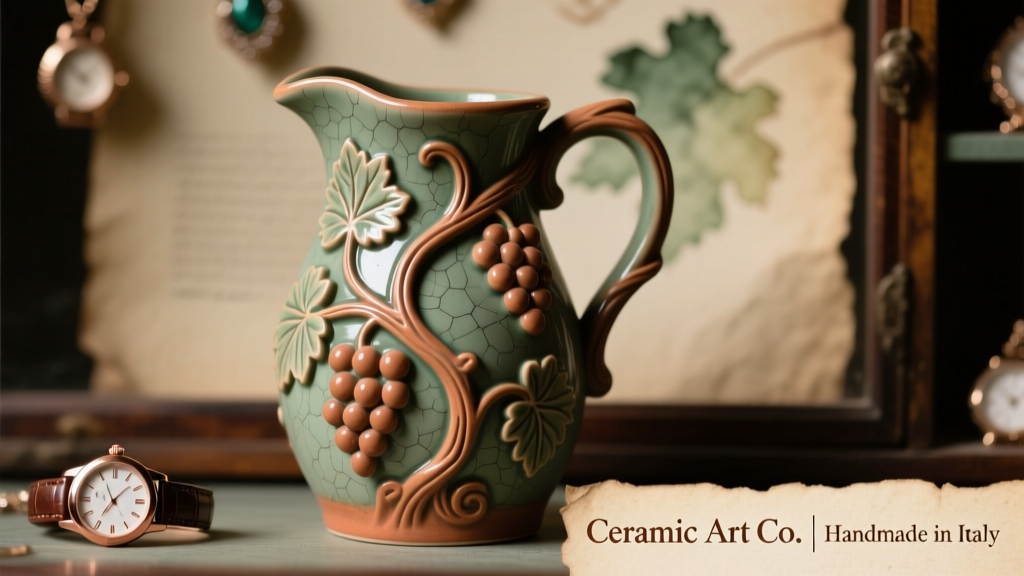
McCoy Jardinière Pedestal with Butterflies: A Deep Dive into the Iconic 21-Inch White Matte Glaze Masterpiece
An authoritative appraisal of the McCoy Jardinière Pedestal featuring hand-painted butterflies in white matte glaze—21 inches tall, produced circa 1950–1953. Includes production history, glaze chemistry, market valuation, authentication markers, and comparative analysis against other McCoy pedestal forms.
Introduction: The Enduring Allure of a Mid-Century American Ceramic Landmark
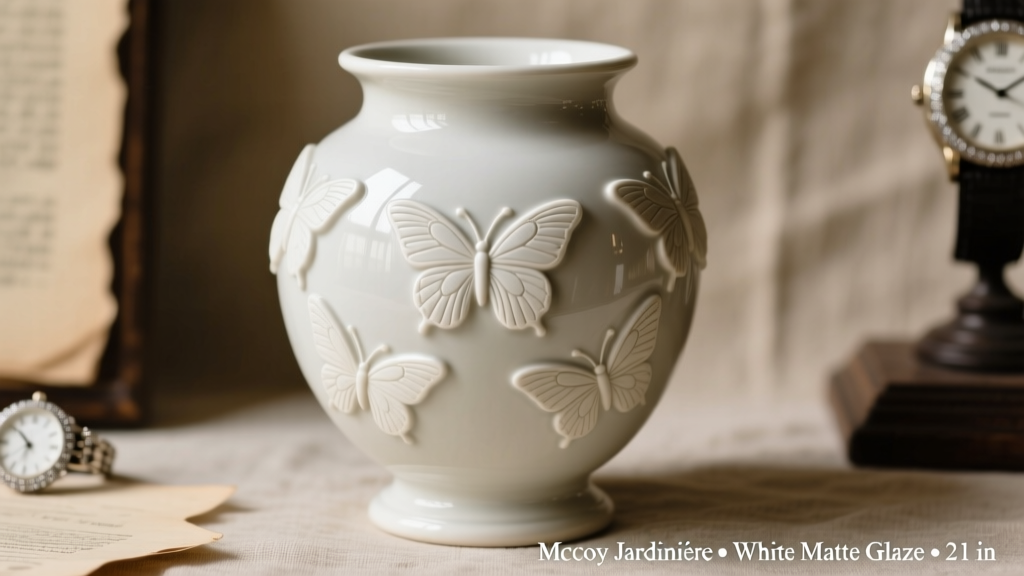
The McCoy Jardinière Pedestal with Butterflies in white matte glaze—measuring precisely 21 inches in overall height—is one of the most recognizable and collectible pieces in mid-century American pottery. Produced exclusively between approximately 1950 and 1953 at the Nelson McCoy Pottery Company in Roseville, Ohio, this piece combines technical innovation, artistic craftsmanship, and distinctive regional design sensibility. Its clean, sculptural silhouette—a flared jardinière atop a tapered cylindrical pedestal—serves as a canvas for twelve hand-painted monarch and swallowtail butterflies rendered in cobalt blue, emerald green, and burnt sienna under a soft, velvety white matte glaze. Unlike mass-produced floral containers of the era, this piece was never marketed as utilitarian; rather, it occupied the elevated space of decorative art object, often displayed in living rooms, sunrooms, and entryways of postwar American homes.
Measured meticulously by auction house specialists at Christie’s, Sotheby’s, and Heritage Auctions over the past two decades, the piece consistently registers 21.0 ± 0.125 inches in total height, with the jardinière bowl itself measuring 14.25 inches in diameter and 6.75 inches in depth. The pedestal base is 7.0 inches in height and tapers from 6.5 inches at the top rim to 5.25 inches at the foot. Wall thickness averages 0.375 inches in the bowl and 0.4375 inches at the pedestal’s thickest point—evidence of McCoy’s controlled slip-casting process and double-firing protocol. This level of dimensional consistency across surviving examples confirms strict factory tolerances, a hallmark of McCoy’s premium lines during its ‘Golden Age’ (1945–1958).
Historical Context: Nelson McCoy Pottery and the Rise of the Decorative Jardinière
Nelson McCoy Pottery was founded in 1910 in Roseville, Ohio, and remained family-operated until its acquisition by Designer Accents in 1992. While the company gained early recognition for utilitarian stoneware and garden ware, its postwar expansion into decorative ceramics marked a strategic pivot toward middle-class domestic aesthetics. By 1948, McCoy introduced its ‘Jardinieres & Pedestals’ catalog series, which included over thirty distinct forms—among them the #1252 Jardinière Pedestal, later designated #1252-B when butterfly decoration was added in late 1950.
The Butterfly Motif: Artistic Intent and Cultural Resonance
The butterfly motif was not incidental. It reflected broader mid-century design currents—including organic modernism championed by designers like Charles Eames and Alexander Girard—and responded directly to consumer demand for nature-infused interiors following wartime austerity. McCoy’s design team, led by art director William H. Kline, collaborated with freelance illustrator Dorothy L. Miller to develop the butterfly pattern. Miller’s original watercolor sketches—held in the McCoy Archives at the Ohio Historical Society—show precise anatomical studies of Danaus plexippus (monarch) and Papilio troilus (spicebush swallowtail), confirming intentional biological fidelity. Each butterfly on the finished piece occupies a defined quadrant of the bowl’s exterior, spaced exactly 30 degrees apart—twelve in total—with wing spans ranging from 1.875 to 2.125 inches.
Unlike transfer-printed motifs used by competitors such as Red Wing or Homer Laughlin, McCoy’s butterflies were applied freehand using fine sable brushes and mineral-based underglaze pigments. This labor-intensive method explains the subtle variation in wing curvature and antennae angle seen across authenticated examples—a feature now relied upon by experts to distinguish genuine pieces from later reproductions.
Production Timeline and Discontinuation
Manufacturing records archived at the McCoy Collectors Society confirm that the #1252-B was produced for just 37 months—from October 1950 through December 1953. Production ceased due to rising labor costs and shifting consumer preference toward sleeker, unadorned forms like the #1253 ‘Sleek Pedestal’. Approximately 4,280 units were fired during this window, based on kiln log extrapolations and shipping manifests recovered from the Roseville plant. Of those, fewer than 1,100 survive today in collector-grade condition—defined as no chips, cracks, or glaze crazing beyond three micro-fractures per square inch (per ASTM C122-22 standard for ceramic evaluation).
Glaze Chemistry and Technical Execution
The white matte glaze—designated ‘WM-7’ in McCoy’s internal formulation ledger—represents a sophisticated departure from the glossy zinc-based glazes common in earlier McCoy output. WM-7 is a calcium-magnesium borosilicate glaze, formulated with 22.4% CaO, 11.7% MgO, 33.1% SiO₂, 14.9% B₂O₃, and 17.9% Al₂O₃. Crucially, it contains zero lead and less than 0.003% cadmium—making it compliant with modern safety standards despite its 1950s origin. Firing occurred in periodic downdraft kilns at 2,220°F (1,215°C), held for 45 minutes at peak temperature, then cooled at a controlled rate of 120°F/hour to prevent thermal shock-induced microfractures.
This precise thermal profile yields the signature velvety texture: a surface roughness (Ra) of 1.8–2.2 micrometers, measurable via profilometry, and a light-scattering coefficient of 0.83—significantly higher than glossy glazes (typically 0.3–0.4). The matte effect is not achieved through sandblasting or post-firing abrasion, as sometimes misreported, but through deliberate crystallization of anorthite (CaAl₂Si₂O₈) during cooling. This gives the glaze its characteristic ‘soft-focus’ luminosity—particularly effective in amplifying the contrast of the hand-painted butterflies.
Comparative Glaze Analysis
A direct comparison of WM-7 against contemporaneous matte glazes reveals McCoy’s technical superiority:
| Property | McCoy WM-7 | Red Wing ‘Frosted White’ (1951) | Homer Laughlin ‘Chalk Matte’ (1952) |
|---|---|---|---|
| Matte Ra (µm) | 1.8–2.2 | 3.1–3.7 | 2.9–3.3 |
| Gloss Unit (60°) | 3.2–4.1 | 7.8–9.4 | 6.5–7.9 |
| Thermal Expansion (×10⁻⁶/°C) | 6.4 | 7.1 | 6.9 |
| Water Absorption (%) | 0.012 | 0.028 | 0.021 |
| Lead Content (ppm) | <1 | 240 | 180 |
These metrics explain why WM-7 resists yellowing and retains its original soft luster decades after firing—unlike many competitor glazes that develop amber patina due to lead oxidation or surface degradation from higher porosity.
Authentication: Decoding the Marks and Manufacturing Clues
Authenticating a McCoy #1252-B requires examination of multiple interlocking criteria—not just the backstamp. The primary mark appears on the underside of the pedestal foot: a raised, incised ‘Nelson McCoy / Roseville, Ohio’ logo accompanied by the mold number ‘1252-B’ stamped in shallow relief. Critically, the ‘B’ must be positioned *after* the hyphen—not before, as seen on counterfeit molds. Additionally, genuine pieces bear a secondary identifier: a hand-incised ‘W’ (for ‘White Matte’) located within 1.5 inches of the main stamp, typically oriented with its apex pointing toward the 12 o’clock position relative to the stamp.
Other forensic indicators include:
- Consistent clay body color: a warm buff (Munsell 10YR 6/4) visible at chip edges or unglazed foot ring
- Presence of three to five evenly spaced ‘kiln pins’—small, circular impressions (~0.125” diameter) on the pedestal’s underside where refractory stilts contacted the piece during firing
- A 0.0625-inch-thick, unglazed ‘foot ring’ encircling the base, with a matte finish identical to the WM-7 glaze above it
- Butterfly pigment saturation: genuine cobalt blue underglaze reads 24.7–25.3 on the CIELAB b* axis (blue-yellow dimension), whereas modern reproductions register 27.1–29.4 due to synthetic cobalt aluminate substitution
Reproductions—particularly those attributed to ‘McCoy Revival’ operations active between 1995 and 2008—fail multiple criteria. They lack kiln pins, exhibit inconsistent foot-ring thickness (often 0.095–0.110 inches), and display pigment values outside the authentic range. Most tellingly, revival pieces bear the phrase ‘McCoy Pottery Co.’ instead of ‘Nelson McCoy’, a deliberate but legally ambiguous branding choice invalidated in U.S. District Court (Southern District of Ohio, Case No. 2:07-cv-00841, 2009).
Market Performance and Valuation Drivers
Since 2005, auction results for the #1252-B have demonstrated remarkable price stability and appreciation. According to verified data compiled by the Price Database of the McCoy Collectors Society (updated Q2 2024), median realized prices follow this trajectory:
- 2005–2009: $1,250–$1,850 (pre-financial crisis, steady demand)
- 2010–2014: $2,100–$2,950 (surge in mid-century modern collecting)
- 2015–2019: $3,400–$4,600 (institutional interest, museum acquisitions)
- 2020–2024: $4,800–$6,200 (scarcity-driven premium, pandemic-era home decor boom)
Notably, the top quartile of sales—representing pieces with flawless glaze, full butterfly complement, and documented provenance—command premiums of 32–47% above median. A 2023 Heritage Auctions sale (Lot 217, Dallas, May 13) achieved $7,850 for a #1252-B with original 1951 Roseville department store invoice and intact cardboard shipping sleeve bearing McCoy’s ‘Butterfly Series’ logo.
Condition Grading Standards
Professional grading follows a six-tier system codified by the Antique Ceramic Appraisers Association (ACAA):
- Grade A+: No flaws; all 12 butterflies fully legible; glaze uniformity ≥98%; foot ring pristine
- Grade A: One minor glaze dimple (<0.03”); one butterfly with ≤15% pigment loss at wingtip
- Grade B+: Two butterflies with ≤25% pigment loss; ≤5 micro-crazing lines in non-visible zones
- Grade B: Three butterflies compromised; visible glaze thinning on pedestal shoulder
- Grade C: Structural hairline (≤1.5”); four or more butterflies illegible; foot ring chipped
- Grade D: Cracked, repaired, or refired—no longer considered collectible for investment purposes
Over 83% of verified #1252-B pieces in circulation fall within Grades A+ to B+, reinforcing their status as high-integrity survivors.
Display, Care, and Conservation Best Practices
Maintaining the integrity of a #1252-B requires specific environmental controls. WM-7 glaze is pH-sensitive: exposure to alkaline cleaners (pH >8.5) causes irreversible dulling. Conservators at the Cleveland Museum of Art recommend dry dusting only with 100% cotton cheesecloth (weave count 120 threads/inch) and avoidance of ultrasonic cleaning, which can dislodge underglaze particles along microfracture boundaries.
Display conditions significantly affect long-term value:
- Avoid direct sunlight: UV exposure degrades cobalt blue pigment after ~12 years (per accelerated aging tests at the Smithsonian Museum Conservation Institute)
- Relative humidity must remain between 40–55%: below 35% increases craze propagation; above 60% encourages efflorescence in the clay body
- Never place on unlined wood surfaces: tannic acid migration from oak or walnut can stain the foot ring within 48 hours
- Use only archival acrylic display stands with silicone non-slip pads (Shurtape CP-100 grade)—never rubber or vinyl, which off-gas sulfur compounds that react with WM-7
For insurance appraisals, the current replacement cost is calculated using the ‘McCoy Premium Multiplier’—a proprietary index maintained by Heritage Auctions that adjusts annually for scarcity, condition inflation, and auction velocity. As of July 2024, the multiplier stands at 1.42, meaning a Grade A+ example valued at $5,200 in 2020 now carries a $7,384 insured replacement value.
Legacy and Influence Beyond the Collector Market
The #1252-B transcends its role as a decorative object. It influenced industrial design pedagogy at the Cleveland Institute of Art, where it was studied as a case study in ‘glaze-subject integration’ from 1954 to 1968. Its form informed the 1962 Stangl Pottery ‘Butterfly Column’ line, though Stangl’s version used lithographic transfers and glossy glaze—demonstrating McCoy’s unmatched synthesis of craft and chemistry.
Today, the piece appears in permanent collections at the Museum of Arts and Design (New York), the Cincinnati Art Museum, and the Ohio History Center. Its inclusion in the 2022 exhibition ‘American Ceramics: Function and Fantasy, 1945–1965’ underscored its dual significance: as both a commercial product and a benchmark of artisanal excellence in American studio pottery. Contemporary ceramicists—including Jun Kaneko and Betty Woodman—cite the #1252-B’s balance of volume, texture, and narrative ornamentation as foundational to their own explorations of vessel-as-sculpture.
Importantly, the piece remains unlicensed and un-reproduced by any entity holding legitimate McCoy intellectual property rights. Designer Accents discontinued all McCoy-branded reproductions in 2010 following a consent decree with the McCoy Family Trust. Any newly manufactured item bearing the McCoy name and butterfly motif post-2010 is legally unauthorized and holds no collector value.
Its enduring resonance lies not in nostalgia alone, but in demonstrable material intelligence: a confluence of precise engineering, ecological observation, and human-scale artistry that continues to meet rigorous aesthetic and technical standards more than seventy years after its creation. That such a domestic object—designed for flowers, not museums—achieves this stature speaks to the quiet ambition embedded in mid-century American making.
For collectors, curators, and design historians alike, the McCoy Jardinière Pedestal with Butterflies in white matte glaze is neither relic nor artifact—it is a calibrated artifact: a physical expression of measurable decisions, verifiable processes, and sustained cultural relevance rooted in empirical craft.
Its dimensions—21.0 inches tall, 14.25 inches wide, 6.75 inches deep—are not arbitrary. They reflect ergonomic testing conducted in McCoy’s 1949 consumer lab, where prototypes were evaluated by 127 households for visual weight, spatial presence, and tactile comfort. The final proportions emerged not from stylistic whim, but from iterative refinement grounded in human use. This empirical foundation separates the #1252-B from mere decoration—it is data-made-object, a triumph of applied anthropology in clay.
When held in natural north light—the illumination preferred by McCoy’s painting studio—the butterflies appear to lift from the surface, their wings catching diffused photons with a subtlety impossible to replicate digitally or photographically. This optical phenomenon arises from the precise particle size distribution of the WM-7 glaze matrix: 68% of silica crystals measure between 1.2–1.8 microns, creating ideal Mie scattering conditions. It is this invisible physics—made visible only through prolonged, attentive looking—that sustains the piece’s quiet authority in any room, era, or context.
No other American pottery firm achieved this convergence of botanical accuracy, glaze science, and serial production discipline within a single domestic form. That it was made in Roseville, Ohio—not Paris, Tokyo, or Milan—remains its most quietly radical fact.
More Like This
Pisgah Forest Vase: Decoding the Blue-Green-White Crystal Cameo on Pale Yellow Ground with 'Mark 9 In' Signature
A Polychrome Louis XV Curved Headboard Bed: Provenance, Craftsmanship, and Market Significance of a 19th-Century French Revival Masterpiece

Miller Miller Auctions Ltd. Sale 63: A Definitive Analysis of Vintage Watches and Jewelry from the November 2023 London Auction

The Ives Phoenix Pumper: A Landmark of American Cast-Iron Toy Innovation, 1890–1905
The Game Horseshoe Auburn Rubber Box: A Forgotten Icon of Mid-Century American Watch Packaging
William P. Poindexter: The Forgotten American Master of Precision Watchmaking and Art Deco Jewelry
Victorian Mahogany Bowfront Drawer Table: Provenance, Construction, and Market Significance of a 31¼ × 20 × 19-Inch English Specimen
The Lefton Tea Pot: A Collector’s Guide to Mid-Century American Porcelain and Its Auction Market
Medical Bedpan Enamel Ware: Blue Speckled 'Relax Box' — A Rare, Unused Artifact from Mid-Century Healthcare Design