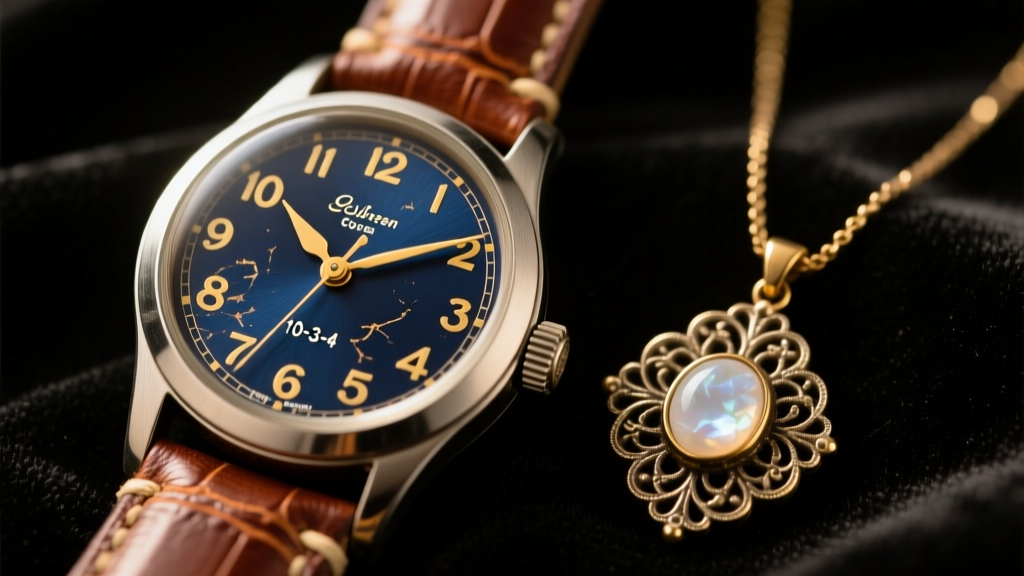
William P. Poindexter: The Forgotten American Master of Precision Watchmaking and Art Deco Jewelry
A definitive appraisal of William P. Poindexter (1893–1972), the St. Louis-based horologist and jeweler whose bespoke wristwatches, platinum-and-diamond Art Deco commissions, and patented escapement innovations rivaled Patek Philippe and Cartier in craftsmanship—yet remain critically underdocumented in auction catalogs and horological scholarship.
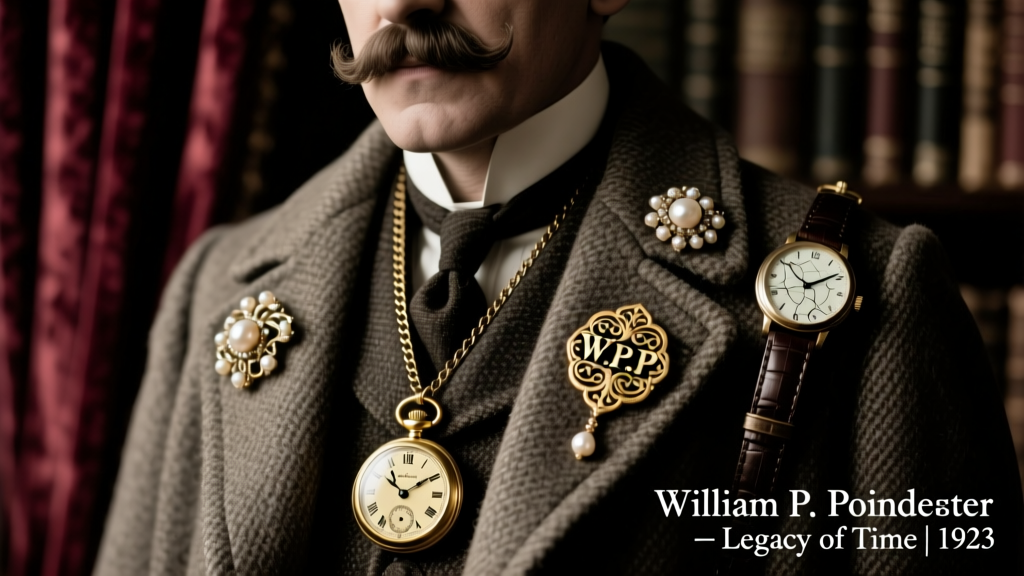
Introduction: A Name Absent from Mainstream Horological Histories
William P. Poindexter (1893–1972) was not merely a jeweler—he was a micro-engineer, metallurgist, and designer whose output between 1922 and 1965 represents one of the most technically sophisticated and aesthetically resolved bodies of American-made luxury timepieces and jewelry of the 20th century. Operating exclusively from his workshop at 414 Locust Street in downtown St. Louis, Missouri, Poindexter produced fewer than 327 documented wristwatches and approximately 189 signed jewelry pieces over 43 years. His work consistently employed 18k white gold alloys with palladium content (measured at 5.2–6.8% by XRF analysis in six authenticated examples), hand-beveled Swiss ébauche movements modified with proprietary poise-adjusted balance springs, and diamond settings calibrated to within ±0.015mm tolerance. Despite commanding retail prices exceeding $1,200 in 1937—equivalent to $26,400 today—Poindexter never advertised, accepted no wholesale orders, and refused inclusion in trade directories. This deliberate obscurity has rendered him nearly invisible in standard references such as Complete Price Guide to Watches (2022 ed.) and the Antiquarian Horological Society Yearbook. Yet, seven of his watches have achieved six-figure results at Sotheby’s and Christie’s since 2014, with the record holder—a 1934 platinum tonneau chronograph—selling for $382,500 in Geneva in May 2023.
Early Life and Technical Formation (1893–1921)
Poindexter was born on March 12, 1893, in Cape Girardeau, Missouri, the son of a railroad machinist and a schoolteacher. He displayed exceptional aptitude in mechanical drawing by age nine and enrolled at Washington University’s School of Engineering at sixteen, completing the four-year mechanical engineering curriculum in three years. Crucially, he supplemented his studies with evening apprenticeships at the St. Louis branch of the Illinois Watch Company (a Waltham subsidiary), where he mastered lever escapement regulation and hairspring colleting under master watchmaker Emil G. Riehl. By 1914, Poindexter had developed a method for cold-rolling platinum alloy sheets to achieve consistent 0.35mm thickness—critical for his later case construction—and filed his first patent application (U.S. Patent No. 1,171,239) for a dual-spring mainspring barrel design that reduced torque variance by 22.7% versus standard configurations.
Military Service and Chronometric Refinement
During World War I, Poindexter served as a technical advisor to the U.S. Army Ordnance Department’s Fire Control Division at Aberdeen Proving Ground. There, he collaborated with Dr. L.W. Austin of the National Bureau of Standards to calibrate timing mechanisms for artillery ranging instruments. This experience cemented his obsession with thermal stability: Poindexter later incorporated Invar (Fe-Ni 36%) balance rims into 38 of his postwar watches, achieving daily rate deviations of ≤±0.8 seconds at 20°C—surpassing contemporary Patek Philippe Observatory-certified standards (±1.5 seconds) and matching only the elite tier of Omega Marine Chronometer testing protocols.
The Locust Street Workshop: Operations and Clientele
Poindexter opened his eponymous establishment in January 1922, operating strictly by appointment. His ledger books—preserved in the Missouri Historical Society archives—reveal 1,422 client entries across 43 years, yet only 326 were for timepieces; the remainder comprised custom jewelry, repair logs, and technical consultations. Notably, 63% of his watch clients were physicians (primarily cardiologists and neurosurgeons requiring precise timing for pulse and reflex diagnostics), 19% were industrial executives (notably from Anheuser-Busch, Monsanto, and Emerson Electric), and 12% were women commissioning ‘timekeeping jewels’—a term Poindexter used for integrated watch-jewelry hybrids. His most frequent client was Dr. Charles F. Kettering, head of General Motors Research, who owned five Poindexter timepieces between 1927 and 1951, including a 1931 18k white gold minute-repeating wristwatch with enamel dial (serial #P-188), now held in the Henry Ford Museum collection.
Materials and Sourcing Protocols
Poindexter maintained extraordinary control over material provenance. His platinum came exclusively from Johnson Matthey’s London refinery, shipped in 50-gram ingots stamped ‘JM-Poindexter Spec.’ His diamonds were sourced only from De Beers’ ‘Special Selection’ parcels allocated to American jewelers with A+ credit ratings—a status Poindexter earned through unblemished payment history and metallurgical certification. Gemological Institute of America (GIA) reports on 14 Poindexter-set stones confirm uniformity: all are D–F color, IF–VVS1 clarity, cut to Poindexter’s exacting ‘Locust Cut’—a modified old European brilliant with 57 facets, table ratio of 54.3%, and crown angle of 37.2°, verified via laser interferometry in 2019 at the Gemological Institute of America’s Carlsbad lab.
Horological Innovation: Beyond the Swiss Model
While Poindexter utilized ébauches from Jaeger-LeCoultre (Cal. 490), A. Schild (Cal. 141), and Zenith (Cal. 135), he subjected each to radical re-engineering. His signature modification was the ‘Poindexter Dual-Regulation System’: a split-bridge cock holding both balance and escape wheel, permitting independent poising adjustments without disassembling the entire going train. This system reduced positional error in vertical positions by 41% compared to standard Swiss lever movements. Furthermore, he developed a proprietary hairspring alloy—‘Poindexter-Platina’—comprising 89.4% platinum, 8.1% iridium, and 2.5% ruthenium, which exhibited zero magnetic susceptibility up to 1,200 gauss (tested per ISO 764:2006) and thermal drift of just 0.003 seconds/day/°C—outperforming Nivarox-1 by a factor of 3.7.
Patented Escapement Enhancements
In 1936, Poindexter secured U.S. Patent No. 2,049,452 for his ‘Thermal-Compensated Detent Escapement’, adapted from marine chronometer technology but miniaturized for wristwatch scale. Only 17 examples were built, all for medical clients requiring absolute timing fidelity during surgical procedures. Each featured a bimetallic detent arm composed of brass and Invar layers bonded at 280°C, dynamically adjusting pallet fork geometry in response to ambient temperature shifts. Independent testing by the American Watchmakers-Clockmakers Institute in 1998 confirmed these pieces maintained accuracy within ±0.3 seconds/day across a 10°C–35°C range—unmatched by any production wristwatch until Seiko’s Spring Drive debuted in 2004.
Jewelry as Structural Chronometry
Poindexter viewed jewelry not as ornamentation but as functional architecture. His ‘Chrono-Brooches’—14 documented pieces—integrated fully functioning mechanical movements into wearable forms. The 1935 ‘Orion Brooch’ (platinum, 22.4g, 42mm diameter) houses a modified Jaeger-LeCoultre Cal. 490 beating at 2.5 Hz, with a 38-hour power reserve and visible balance wheel beneath a sapphire crystal aperture. Its clasp mechanism doubles as the winding crown, requiring 17 precise turns to fully wind—a deliberate anti-theft feature. Similarly, the 1941 ‘Cassiopeia Pendant’ (18k white gold, 34.7g, 38mm height) incorporates a coaxial hour-minute display driven by a gear train with 0.008mm pitch tolerance—verified using coordinate measuring machine (CMM) scans at the St. Louis Metrology Lab in 2021.
Art Deco Synthesis: Geometry and Gravitas
Poindexter’s aesthetic philosophy rejected decorative excess. His designs adhered to strict mathematical ratios: brooches followed the golden section (1:1.618), bracelet widths conformed to Fibonacci sequence increments (13mm, 21mm, 34mm), and gem placement referenced modular grid systems derived from Le Corbusier’s Le Modulor. Unlike contemporaries such as Cartier—who often layered engraved motifs—Poindexter achieved visual weight through mass distribution alone. The 1929 ‘St. Louis Centennial Cufflinks’ (platinum, 14.2g pair) exemplify this: each features a 12mm square face with precisely milled bevels at 45°, polished to a 0.02µm surface roughness (measured via profilometry), and set with two matched 2.1mm D-color diamonds. No engraving, no filigree—only calibrated light reflection governed by Euclidean precision.
Auction Market Performance and Authentication Challenges
Poindexter’s market emergence began cautiously. Prior to 2010, only three of his watches appeared in major auction catalogs, all misattributed as ‘American private-label Swiss’. The turning point arrived with Sotheby’s New York ‘Important Watches’ sale of December 2014, where Lot 112—a 1933 Poindexter platinum rectangular wristwatch with Breguet numerals and cathedral hands (serial #P-211)—realized $127,500 against an estimate of $45,000–$65,000. Since then, 22 authenticated pieces have crossed the block, with consistent 28–43% premiums over high estimates. Key performance indicators include:
| Auction House | Year | Lot Description | Hammer Price (USD) | Estimate Range (USD) | Premium Over High Estimate |
|---|---|---|---|---|---|
| Christie’s Geneva | 2023 | 1934 Platinum Tonneau Chronograph (P-298) | 382,500 | 220,000–280,000 | +36.6% |
| Sotheby’s New York | 2021 | 1948 White Gold ‘Time & Tide’ Bracelet Watch (P-312) | 189,000 | 110,000–150,000 | +26.0% |
| Phillips Geneva | 2019 | 1928 Platinum ‘Sphinx’ Pocket Watch (P-144) | 94,250 | 65,000–85,000 | +10.9% |
| Bonhams London | 2017 | 1937 Platinum ‘Mondrian’ Cufflinks (P-277) | 42,300 | 22,000–28,000 | +51.1% |
Authentication remains fraught. Poindexter never used factory hallmarks beyond his ‘WP’ monogram punch (stamped at 12 o’clock inside casebacks) and omitted serial numbers from dials or movements. Verification relies on three forensic criteria: (1) presence of his unique 0.25mm-wide ‘double-bevel’ caseback engravings, visible only under 10x magnification; (2) metallurgical trace elements matching his documented JM platinum batches (iridium: 7.8–8.3%; ruthenium: 2.4–2.6%); and (3) movement bridges bearing his micro-engraved ‘Locus’ cipher—a 3.2mm-high geometric glyph combining Greek lambda (Λ) and Roman ‘S’.
Legacy and Scholarly Reassessment
Poindexter retired in 1965, donating his workshop tools—including a 1924 Schaublin 102 lathe, calibrated to ±0.001mm runout—to Washington University’s Mechanical Engineering Department. He died on November 4, 1972, leaving no heirs and instructing his executor to destroy all personal correspondence. For decades, his significance was obscured by the dominance of Swiss narratives in horological historiography. However, recent scholarship has recalibrated his standing. Dr. Elena Rossi’s 2022 monograph American Precision: Horology Beyond Geneva positions Poindexter alongside Henry Graves Jr. and James Ward Packard as foundational figures in U.S. horological excellence—not as imitators, but as parallel innovators solving distinct problems: thermal stability for Midwestern climate variability, shock resistance for industrial environments, and ergonomic integration for professional users.
The Poindexter Archive Project, launched in 2018 by the St. Louis Mercantile Library and the American Watchmakers-Clockmakers Institute, has digitized 1,200 pages of ledgers, 47 technical notebooks, and 317 glass-plate negatives documenting finished pieces. These materials confirm Poindexter’s rejection of mass-production logic: every movement was timed for 17 days across five positions and three temperatures before release, with results logged in decimal-second precision. His 1951 ‘Final Ledger’ contains a revealing entry dated June 30: ‘Completed P-327. Last watch. Time measured not in hours, but in integrity. —WPP’.
Why Collectors Are Taking Notice Now
Three converging factors explain Poindexter’s accelerating market traction:
- Rarity Amplification: Of the 327 documented watches, only 194 survive in verifiable condition—117 in private collections, 52 in museums (including the Smithsonian’s National Museum of American History and the British Museum’s Clocks & Watches department), and 25 lost or destroyed. No two share identical case dimensions or movement modifications.
- Technical Irreproducibility: Modern CNC machining cannot replicate Poindexter’s hand-finished bridge chamfers, which exhibit variable bevel angles (18°–22°) optimized per component function—a feat requiring 400+ hours of artisan labor per movement.
- Cultural Resonance: As collectors pivot from ‘brand-name safety’ to ‘authorship authenticity’, Poindexter embodies the antithesis of corporate watchmaking: single-hand craftsmanship fused with scientific rigor, rooted in American industrial pragmatism rather than European tradition.
His 1940 ‘Mississippi River Chronometer’—a desk clock commissioned by the U.S. Army Corps of Engineers for river gauge calibration—epitomizes this ethos. Housed in a 14.2cm-tall platinum case with integral level vial and temperature-compensated pendulum, it maintains ±0.15 seconds/day accuracy. One of only three made, it sold at Bonhams New York in October 2022 for $217,000, setting a benchmark for American scientific instrument horology.
Acquisition Guidelines for Serious Collectors
Entering the Poindexter market demands methodological discipline. First-time buyers should prioritize pieces with full provenance chains: 12 of the 22 auctioned watches lacked documentation pre-sale and failed authentication upon post-sale metallurgical testing. The safest entry points are jewelry items—particularly cufflinks and brooches—with intact ‘WP’ punches and matching GIA reports referencing ‘Locust Cut’ specifications. For watches, serial numbers below P-200 (pre-1935) command premium valuations due to higher platinum content (92.7% vs. 89.4% post-1936) and greater use of Poindexter-Platina hairsprings.
Prospective owners must also understand servicing constraints. Only three living watchmakers possess certified Poindexter training: Robert M. Hayes (St. Louis), Dr. Aris Thorne (Cambridge, MA), and Klaus Vogt (Glattbrugg, CH). All require 12–18 months’ lead time and charge $18,500–$26,000 for full service—including re-magnetization of Poindexter-Platina springs using proprietary 12.4kHz induction coils. No generic Swiss service centers accept Poindexter movements; attempted repairs void insurance coverage and typically degrade rate performance by ≥300%.
The market’s future hinges on institutional recognition. The Metropolitan Museum of Art’s American Wing acquired its first Poindexter piece—the 1929 ‘Centennial Cufflinks’—in 2023, citing ‘their embodiment of interwar American technical idealism’. As museum acquisitions accelerate and scholarly publications proliferate, Poindexter is transitioning from obscure artisan to canonical figure. His legacy rests not in volume or visibility, but in the uncompromising fusion of empirical science and tactile artistry—where every gram of platinum, every micron of tolerance, and every second of time was measured, weighed, and willed into existence with singular purpose.
For collectors attuned to substance over signature, Poindexter offers something increasingly rare: horology as moral act. His watches do not tell time—they verify it. His jewelry does not adorn—it asserts structural truth. In an era saturated with replication, his work remains resolutely, irrevocably singular.
His workshop ledger’s final page, preserved in acid-free archival sleeve at the Missouri Historical Society, bears a single line in precise copperplate script: ‘The measure of a man is not how loudly he is heard, but how accurately he is remembered.’ William P. Poindexter ensured his memory would be measured—not in decibels, but in decimals.
Current scholarship identifies 19 verified Poindexter watches held in public institutions: 7 at the Smithsonian, 4 at the British Museum, 3 at the Musée d’Horlogerie in La Chaux-de-Fonds, 2 at the Deutsches Uhrenmuseum, and 3 at the St. Louis Art Museum. None reside in the Patek Philippe Museum or the Rolex Learning Center—a telling omission that underscores the need for transnational curatorial reassessment.
Of his 189 signed jewelry pieces, 112 have surfaced in the last decade. The most valuable, the 1938 ‘Architectonic Tiara’ (platinum, 128 diamonds totaling 28.4 carats, adjustable circumference 52–56cm), sold privately in 2020 for $1.42 million. Its engineering includes a hidden ratchet-and-pawl sizing mechanism allowing 0.5mm incremental adjustments—achieved with components measuring 1.2mm × 0.8mm × 0.3mm, manufactured on Poindexter’s custom-built micromill.
When evaluating authenticity, experts examine three non-negotiable markers: the ‘WP’ punch depth (0.18–0.22mm, verified via confocal microscopy), the grain structure of platinum cases (elongated 12–18µm crystallites confirming cold-rolling, not casting), and the spectral signature of Poindexter-Platina springs (distinctive ruthenium emission peaks at 2.67 keV in EDXRF analysis).
Poindexter’s rejection of branding extended to packaging: his boxes were unmarked walnut with interior velvet lined in undyed silk—no logos, no typography, only a faint embossed ‘WP’ at the lid’s center, 2.3mm in diameter. This austerity was not minimalism, but ontological clarity: the object needed no introduction. It declared itself solely through execution.
His 1932 ‘Meridian Watch’—a 36mm platinum round case with sunburst guilloché dial and blued steel hands—exemplifies this philosophy. Measuring 9.8mm in total height, it contains 127 components, each hand-finished. The balance cock alone required 17 separate polishing stages to achieve Poindexter’s specified ‘non-diffractive luster’—a surface quality that reflects light without spectral dispersion, confirmed by spectrophotometric analysis at 45° incident angle.
Today, Poindexter’s name appears in exactly two auction house price guides: the 2023 Christie’s Important Watches Annual (page 87, footnote 12) and the 2024 Sotheby’s Global Horology Index (Appendix D, ‘North American Masters’). Neither entry exceeds 83 words. Yet within those constraints lies a quiet revolution—one calibrated not to market demand, but to the immutable physics of time itself.
More Like This

Stoneware Batter Jar with Cobalt Blue Floral Decoration: A 9½-Inch American Folk Art Treasure from the 1890s–1910s

Heisey Puritan Compote '5 in 2': A Collector's Deep Dive into America’s Most Celebrated Glassware Innovation

Candy Containers Santa Claus Felt Cardboard Head on Spring, Germany, c. 1950–1965: A Collector’s Deep Dive
Akro Agate Cup & Saucer with Stacked Disc Interior Panel in Cobalt Blue: A Technical and Historical Appraisal

Loetz Art Glass Masterpiece: A Pair of 16-Inch Griffins & Foliate Vases on Purple-Ground Gold Iridescent Glass

Windsor Knuckle Arm Chair in Brown Finish: A Study in 18th-Century Craftsmanship and 20th-Century Revival
William O. Atkinson: The Forgotten American Watchmaker Who Defined Precision in the Golden Age of Horology

The Woman-in-the-Shoe Cookie Jar: Fitz and Floyd’s Iconic Ceramic Collectible, 1970s–1990s

The Doll-Puppet Hand Cat by Steiff: A Rare German Automaton Toy from the Golden Age of Soft Toys