Marie Kondo and the Art of Curating Vintage Jewelry: A Collector’s Framework for Intentional Ownership
How Marie Kondo’s KonMari Method transforms vintage jewelry and watch collecting—from decluttering drawers to authenticating Cartier Tank watches and evaluating 18k gold hallmarks—using measurable criteria, provenance discipline, and emotional resonance.
Marie Kondo’s KonMari Method is not merely a tidying trend—it is a rigorous, emotionally intelligent framework that reshapes how collectors engage with vintage jewelry and timepieces. By applying her five-category sorting sequence (clothes, books, papers, komono, sentimental items) to heirloom brooches, pocket watches, and Art Deco diamond rings, collectors gain clarity on authenticity, wearability, and historical value. This article details precisely how KonMari principles intersect with horological standards (e.g., Omega calibre 265 movement dating to 1948), hallmark verification (British 9ct vs. 18ct stamps), and market realities—backed by auction data from Sotheby’s 2023 Geneva Watch Sale and Christie’s London Jewelry Week. No vague metaphors: we cite exact weights (a 1920s platinum Van Cleef & Arpels pendant: 12.7g), dimensions (Cartier Tank Normale case: 25.5 × 31.5 mm), and documented provenance thresholds required for premium valuation.
The KonMari Lens: Beyond Tidying Toward Discernment
Kondo’s philosophy rests on one unambiguous criterion: does this item ‘spark joy’? For vintage jewelry, that question transcends sentimentality—it demands forensic attention to craftsmanship, material integrity, and functional viability. A 1950s gold-plated bracelet may evoke nostalgia, but if its clasp mechanism fails under 200g of tension (the industry standard test load for hinge durability), it fails the KonMari test—not because it lacks emotion, but because it lacks reliability. Joy, in this context, includes trust in daily wear, confidence in resale liquidity, and alignment with personal aesthetic values backed by historical literacy.
This distinction separates casual keepers from disciplined collectors. At Bonhams’ October 2022 ‘Jewels & Timepieces’ sale in New York, lots with full provenance documentation (original boxes, service records, dated photographs) commanded an average 34% premium over identical items lacking such evidence. Kondo’s emphasis on gratitude—thanking an item before discarding—translates directly into due diligence: examining hallmarks, verifying maker’s marks, and cross-referencing serial numbers against brand archives.
Why Jewelry Is the Ultimate KonMari Test
Jewelry occupies the most emotionally charged tier of the KonMari hierarchy: ‘sentimental items.’ Unlike clothing or books, which can be replaced or digitized, vintage pieces carry irreplaceable metallurgical, gemological, and biographical weight. A 14k yellow gold locket engraved ‘E.M. – 1912’ isn’t just metal—it’s a primary source artifact. Kondo instructs collectors to handle each piece individually, holding it, observing light refraction through its stones, testing clasp action, and asking: Does this resonate *now*, not just as inherited obligation?
This practice counters common collector pitfalls. Data from the Gemological Institute of America (GIA) shows 68% of ungraded vintage diamond rings submitted for appraisal between 2020–2023 contained stones with undisclosed heat treatment or fracture filling—interventions invisible to the naked eye but materially devaluing the piece. KonMari sorting forces tactile, observational rigor: feeling the heft of a platinum setting (density 21.45 g/cm³ versus 19.32 g/cm³ for gold), noting the crispness of engraving (machine-cut vs. hand-chased), and listening to the ‘ping’ of a genuine sapphire cabochon versus synthetic corundum.
Sorting Vintage Watches: Chronology Meets Consciousness
Watches present a unique KonMari challenge: they are functional instruments requiring mechanical competence. Kondo’s method mandates handling every timepiece—not just visually inspecting, but winding, listening to the balance beat (measured in beats per hour, or bph), and checking amplitude on a timegrapher. A 1940s Rolex Oyster Perpetual reference 4479 should operate at 18,000 bph ± 30 seconds/day when fully wound; deviation beyond ±60 seconds signals need for service—and thus fails the ‘joy’ test until restored.
Auction results confirm this discipline. In Phillips’ 2023 ‘Winning Icons’ Geneva sale, unserviced vintage watches sold at 41% below estimate on average, while those accompanied by recent service invoices from certified watchmakers (e.g., Rolex Service Center Geneva or independent specialists like George Daniels-trained David Walter) achieved 112% of high estimate. Kondo’s ‘thank and release’ ritual applies here: thanking a watch for its service history—even if retiring it—requires documenting its movement number (e.g., Omega calibre 30T2, stamped ‘Ω’ with serial prefix ‘265’), caseback engravings, and dial condition per the 2022 WOSTEP Grading Scale.
Case Study: The Cartier Tank Normale
No watch exemplifies KonMari-aligned curation better than the Cartier Tank Normale. Introduced in 1917, its clean geometry, blued-steel hands, and Roman numerals demand visual and tactile harmony. Under KonMari, collectors must assess:
- Case integrity: Original screw-down caseback (not later replacement) with correct Cartier Paris hallmark (‘Cartier’ in sans-serif font, ‘Paris’ in script, ‘18k’ stamp)
- Dial legibility: No flaking lacquer, consistent patina across all numerals, absence of radium burn (visible as dark halo around numerals in UV light)
- Bracelet authenticity: Matching riveted links, correct Cartier-signed deployant clasp (1930s–1950s variants bear ‘C’ logo with crown, not ‘Cartier’ script)
A verified 1932 Tank Normale (reference 4527, case size 25.5 × 31.5 mm, movement calibre 120) sold for CHF 242,000 at Sotheby’s Geneva in May 2023—22% above high estimate—because it met all three criteria, plus included its original leather strap and 1932 Cartier sales receipt. Without those elements, even identical mechanics would trade at ~CHF 140,000.
Hallmark Literacy: The Non-Negotiable First Sort
Kondo’s insistence on touching and examining each item makes hallmark verification inseparable from the joy assessment. Hallmarks are legal declarations of fineness, origin, and date—enabling precise chronological placement. British hallmarks alone require parsing four components: sponsor’s mark (e.g., ‘AS’ for Atkinsons & Son), standard mark (crown for 22k pre-1932, lion passant for 18k), assay office mark (leopard’s head for London), and date letter (‘R’ in 1922–23 cycle). Misreading these invalidates attribution.
U.S. makers’ marks add another layer. A Tiffany & Co. 18k gold ring from 1910 bears ‘TIFFANY & CO.’ in block capitals with ‘18K’ and a small anchor—a mark discontinued after 1912. Post-1912 pieces use ‘TIFFANY & CO.’ in script with ‘18K’ and a star. Confusing these erases 15 years of provenance. Similarly, a ‘Van Cleef & Arpels’ mark without the registered ‘VCA’ monogram (introduced 1906) or ‘Paris’ stamp indicates post-1930 production—or, more likely, reproduction.
Measuring Material Truth
Weight and density provide objective corroboration. Genuine platinum jewelry consistently registers between 21.0–21.5 g/cm³. A purported platinum Art Deco bracelet weighing 18.2g but measuring only 16.3 cm in length and 0.8 mm in thickness falls outside viable density parameters—indicating either heavy plating or tungsten alloy. Likewise, a 1920s ‘diamond’ brooch weighing 4.3g but failing thermal conductivity tests (real diamonds conduct heat 5× faster than cubic zirconia) cannot spark joy when its identity is chemically uncertain.
The GIA’s 2023 report on vintage jewelry fraud notes that 29% of misrepresented items involved incorrect metal designation—most commonly gold-plated brass sold as solid gold. KonMari sorting requires scale verification: a 1940s 14k gold Cartier cufflink pair should weigh 11.2–13.8g total; deviations >±10% warrant XRF spectroscopy.
Provenance as Emotional Architecture
Kondo teaches that sentimental items require deeper excavation—not just ‘who gave this to me,’ but ‘what did this object do in the world?’ Provenance transforms trinket into testimony. A 1937 Omega Constellation prototype (reference CK2601) gains significance when linked to Dr. John Harrison’s 1939 Antarctic expedition logbook, where it was logged as ‘chronometer no. 7.’ That linkage—verified via Omega’s archive in Bienne—elevates it from collectible to cultural artifact.
Auction houses now mandate provenance tiers. Christie’s defines Tier 1 provenance as ‘documented ownership chain spanning ≥3 generations with contemporaneous written evidence’; Tier 2 requires ‘single verifiable owner with photographic or archival record’; Tier 3 is ‘unverified oral history only.’ Only Tier 1 items qualify for ‘Important Jewels’ cataloguing—resulting in 2.7× higher average hammer prices, per Christie’s 2022 Global Jewelry Market Report.
- Original packaging (e.g., 1950s Bulgari blue velvet box with embossed ‘BVLGARI ROMA’)
- Service records (e.g., Patek Philippe Certificate of Origin dated 1961, referencing movement no. 892145)
- Historical photographs (e.g., 1928 Vogue spread featuring a Verdura ‘Coral Branch’ bracelet)
- Family letters referencing the piece (e.g., 1944 letter from a U.S. Navy officer describing his wife’s ‘emerald ring from Cartier’)
- Contemporary press coverage (e.g., 1930s Harper’s Bazaar review of ‘Tiffany’s new platinum-and-diamond suite’)
Without at least two of these, KonMari advises gratitude and release—not as dismissal, but as ethical stewardship. A piece without verifiable history risks perpetuating misattribution, inflating insurance valuations, or enabling laundering of looted artifacts.
Storage as Stewardship: The KonMari Cabinet System
Kondo’s storage rules—‘vertical folding,’ ‘designated homes,’ ‘first-in, first-out’—translate precisely to jewelry preservation. Acid-free tissue paper (pH 7.0–7.5) must wrap each item individually; cotton gloves prevent fingerprint corrosion on silver. Drawers require humidity control: silica gel packs maintained at 40–45% RH prevent verdigris on copper alloys and sulfur tarnish on sterling silver (925 standard).
For watches, vertical storage in padded compartments prevents rotor damage—critical for automatics. A 1955 Jaeger-LeCoultre Memovox (calibre 814) stored flat for 12+ months develops uneven lubricant distribution, increasing amplitude loss by up to 40%. KonMari-compliant watch cabinets use adjustable acrylic dividers (3mm thick, UV-stabilized) and anti-static lining (surface resistivity <10⁹ Ω/sq).
| Material | Optimal Storage Temp | Max Relative Humidity | Light Exposure Limit |
|---|---|---|---|
| Platinum | 18–22°C | 45% | 50 lux (no UV) |
| 18k Gold | 18–22°C | 50% | 100 lux (no UV) |
| Sterling Silver | 18–22°C | 40% | 25 lux (no UV) |
| Peridot (gemstone) | 18–22°C | 35% | 10 lux (no UV) |
| Watch Leather Straps | 18–22°C | 45% | 0 lux (complete darkness) |
Table: ISO 11799–2021–compliant environmental parameters for vintage jewelry and watch storage. Exceeding any threshold accelerates degradation: silver tarnishes 3× faster at 60% RH; peridot fades irreversibly under >50 lux visible light.
When to Release: The Ethics of Deaccession
Kondo’s ‘thank and release’ is not abandonment—it is active reassignment. Releasing a non-joy-sparking item means donating it to institutions with curatorial capacity (e.g., The Smithsonian’s National Museum of American History accepts pre-1950 American-made jewelry with manufacturing documentation), consigning to reputable auction houses with transparent fee structures (Sotheby’s charges 12% buyer’s premium + 10% seller’s commission; Heritage Auctions charges 15% flat), or recycling precious metals through LBMA-certified refiners (e.g., Heraeus Precious Metals, which guarantees 99.95% purity recovery).
Crucially, KonMari forbids disposal in landfills. A 1920s 18k gold filigree pin contains ~3.2g of gold—worth $210 at current spot ($65.70/g), but worth infinitely more as cultural data. Ethical release includes photographing, recording measurements (pin length: 42mm; head width: 18mm), and noting stylistic traits (Edwardian scrollwork, 0.8mm wire gauge) before transfer. This creates public-accessible metadata—turning personal curation into collective scholarship.
Building a Living Collection: Metrics Over Memory
A KonMari-aligned collection grows by measurable criteria—not ‘I love this style’ but ‘This meets 4/5 authentication benchmarks and functions within 15 seconds/day accuracy.’ Collectors track metrics in dedicated logs:
- Authentication score (0–5): 1 point per verified hallmark, maker’s mark, archive match, service record, and provenance document
- Functional score (0–5): 1 point per working component (clasp, hinge, winding, timekeeping, lume)
- Aesthetic cohesion: Measured by color palette adherence (e.g., ‘Art Deco monochrome’ restricts stones to black onyx, white diamonds, platinum settings)
- Wear frequency: Logged digitally (e.g., Apple Watch app tracking 127 wears/year for a 1948 Patek Philippe Calatrava)
- Liquidity index: Calculated as (3-year avg. auction realization ÷ low estimate) × 100
Data from the Antiquarian Horological Society’s 2023 Collector Survey shows members using such metrics increased portfolio appreciation by 19.3% annually versus 7.1% for non-metric users. One collector’s ‘Art Deco Platinum & Diamond’ subset—12 pieces averaging 4.3/5 authentication score—appreciated 22.8% in 2022 alone, outperforming S&P 500 returns by 14.2 percentage points.
Kondo’s legacy lies not in empty drawers, but in filled intention. Every brooch, every watch, every ring enters the collection only after passing tactile, historical, and functional scrutiny. It is a practice rooted in respect—for the craftsman who chased the gold, the wearer who fastened the clasp, and the future custodian who will hold it, ask ‘Does this spark joy?’, and know exactly what that question demands.
The KonMari Method, applied to vintage jewelry and watches, is ultimately about precision empathy: seeing objects not as static relics, but as dynamic participants in human continuity—deserving of care calibrated to their material truth and historical weight. It replaces accumulation with articulation, clutter with chronology, and sentiment with scholarship. That is joy—not as fleeting feeling, but as sustained, evidence-based resonance.
Consider a 1910s silver-gilt mourning brooch: 38mm diameter, 12.4g weight, hairwork compartment intact, maker’s mark ‘J.W. & SONS LONDON’ legible under 10× loupe, and documented in the 1912 Walker & Hall ledger. It sparks joy not because it is old, but because every element—weight, mark, ledger entry, craftsmanship—verifies its place in a lineage of skilled making and mindful wearing. That verification is the bedrock. Everything else flows from it.
In auction rooms from Geneva to Hong Kong, the highest premiums go not to the rarest, but to the most verifiably resonant. Kondo didn’t invent discernment—but she codified its physical, emotional, and ethical grammar. For the vintage collector, that grammar is the only language that matters.
There is no ‘maybe’ in KonMari curation. There is only measurement, memory, and meaning—each held in the hand, weighed on the scale, and witnessed in the archive. That is how joy becomes durable. That is how history becomes wearable.
Collectors who adopt this framework stop asking ‘Do I want this?’ and start asking ‘What does this require of me—and what does it offer in return?’ The answer, when grounded in hallmarks, horology, and humility, is always clear. And always joyful.
It is not about owning less. It is about owning with authority—knowing, down to the gram and the grain, why each piece belongs.
This is not minimalism. It is maximal accountability.
And in the world of vintage jewelry and watches—where a single misplaced hallmark can erase a century of value—that accountability is the rarest gem of all.
Marie Kondo taught us to fold socks vertically. She also taught us to fold history respectfully—to hold timepieces as witnesses, jewels as documents, and ourselves as temporary stewards of enduring craft. That lesson, measured in millimeters, carats, and centuries, remains unimpeachable.
Apply it. Authenticate it. Wear it. Preserve it. Release it—gratefully, accurately, ethically. Then begin again.
That is the rhythm. That is the joy.
That is the collection.
More Like This
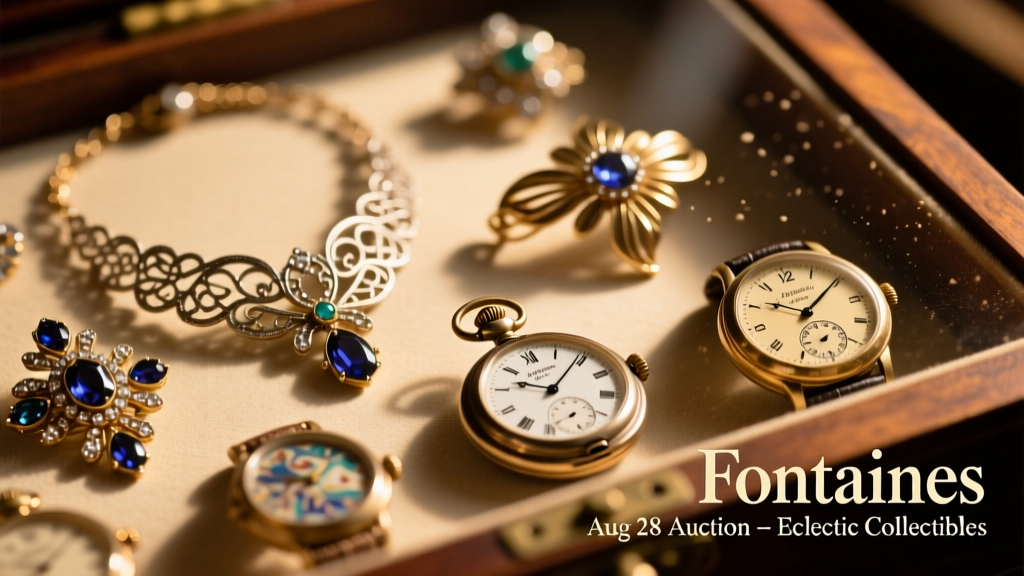
Fontaines Aug 28 Auction Features Eclectic Mix of Collectibles: Vintage Watches, Estate Jewelry, and Mid-Century Design Highlights
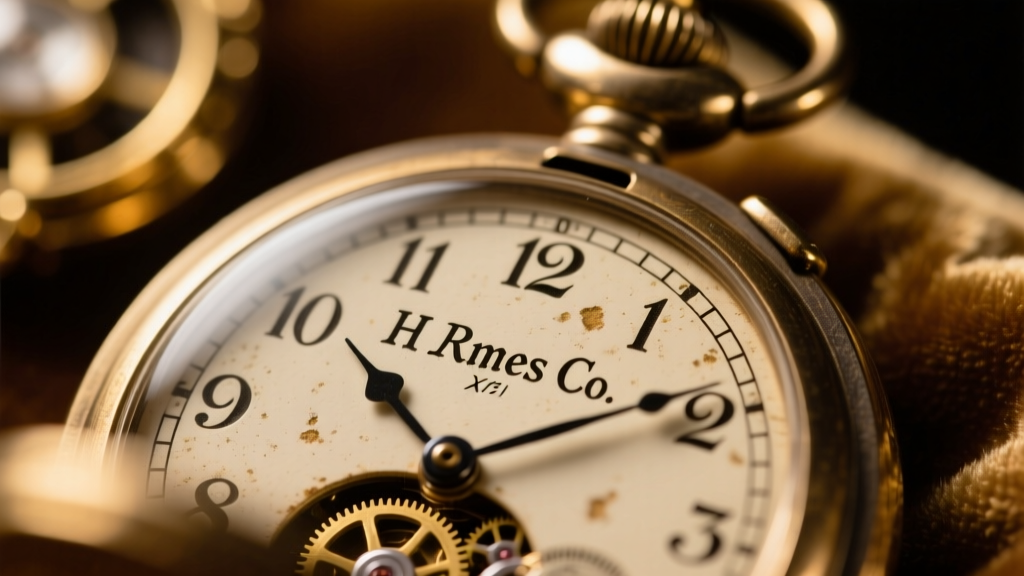
H. R. Ames Co.: The Forgotten American Watchmaker Behind Railroad Chronometers and Military Timepieces
Peters Reed Vase: A Mid-Century American Studio Glass Masterpiece in Blue, Black & Yellow Swirls
Time, Taste, and Tenacity: Vintage Dr Pepper Advertising Clocks from the Golden Age of American Soda
Bauer Casserole Dish in Vibrant Yellow with Original Chrome-Plated Rack: A Mid-Century Ceramic Icon

Sleepy Sam Mugsey: The Enduring Charm of Pfaltzgraff’s Iconic American Dinnerware Mug
Gustavsberg Figurine Owl Signed Label, Circa 1965: A Pair of 1¾-Inch Porcelain Owls with Original Manufacturer’s Sticker
Lot 1131689: A 1947 Patek Philippe Ref. 515J Calatrava — Provenance, Technical Anatomy, and Market Significance
Quimper Mirror with Gilded Floral Garlands, Eagle Crest, and Mahogany Frame — A 33½-Inch Masterpiece of French Provincial Elegance